To save content items to your account,
please confirm that you agree to abide by our usage policies.
If this is the first time you use this feature, you will be asked to authorise Cambridge Core to connect with your account.
Find out more about saving content to .
To save content items to your Kindle, first ensure no-reply@cambridge.org
is added to your Approved Personal Document E-mail List under your Personal Document Settings
on the Manage Your Content and Devices page of your Amazon account. Then enter the ‘name’ part
of your Kindle email address below.
Find out more about saving to your Kindle.
Note you can select to save to either the @free.kindle.com or @kindle.com variations.
‘@free.kindle.com’ emails are free but can only be saved to your device when it is connected to wi-fi.
‘@kindle.com’ emails can be delivered even when you are not connected to wi-fi, but note that service fees apply.
Around 140 million births occur worldwide annually. For some women, childbirth is traumatic and can lead to childbirth-related post-traumatic stress disorder (CB-PTSD), with adverse consequences for both women and their families. However, international evidence remains limited.
Aims
To estimate the international prevalence of traumatic birth and CB-PTSD.
Method
The International Survey of Childbirth-Related Trauma (INTERSECT) is a cross-sectional survey conducted in 31 countries. Women were eligible if they were 6–12 weeks postpartum, legally adults and provided informed consent. Recruitment was through routine maternity services and data were collected from April 2021 to January 2024. Outcomes were assessed using the City Birth Trauma Scale. Traumatic birth was coded using DSM-5 criteria for a traumatic stressor, and CB-PTSD classified when all PTSD criteria were met. Dissociative subtype and differential diagnoses were also assessed.
Results
A total of 11 302 women from 31 countries took part. Most participants were married, aged 30–34 years, with average household income and higher education, and 9.7% identified as being from ethnic or racial minority groups. The prevalence of traumatic birth and CB-PTSD varied across countries: traumatic birth ranged from 7 to 69% (mean 23.3, 95% CI 22.4–24.0), and CB-PTSD ranged from 1 to 36% (mean 6.7, 95% CI 3.7–9.7). CB-PTSD subtypes also varied: the dissociative subtype ranged from 1 to 24% (mean 3.8, 95% CI 2.1–5.4) and acute CB-PTSD from 0 to 7% (mean 1.3, 95% CI 0.7–1.9). Removal of participants with potential differential diagnoses did not affect prevalence rates in most countries. Many participants reported distress and impairment from symptoms, even when they did not meet CB-PTSD diagnostic criteria.
Conclusions
Results show that a notable proportion of women experience traumatic birth and CB-PTSD. The wide variation in prevalence suggests that cultural and healthcare factors unique to each country are important. Results emphasise the importance of routine trauma-informed assessment and culturally informed support in perinatal mental healthcare.
Part of a series of four dialogues with contemporary art and writing practitioners whose work represents a critical intervention in thinking about gesture, politics, and embodiment – across art, writing, and theory – and the various entanglements found therein. This collaborative dialogue on gesture as writing is written by Kathleen Stewart and Lauren Berlant.
Childbirth-related post-traumatic stress disorder (CB-PTSD) is an underrecognized condition with consequences for mothers and infants. This study aimed to determine risk factors for CB-PTSD symptoms across countries within a stress–diathesis framework, focusing on antenatal, birth-related, and postpartum predictors.
Methods
The INTERSECT cross-sectional survey (April 2021–January 2024) included 11,302 women at 6–12 weeks postpartum. The study was carried out across maternity services in 31 countries. Outcomes were CB-PTSD diagnosis, symptom severity, and perceived traumatic birth, assessed with the City Birth Trauma Scale. Multiple risk factors were assessed, including preexisting vulnerability, pregnancy, birth, and infant-related factors. All models were adjusted for country-level variation as a random effect.
Results
Models explained substantial variance across all outcomes (conditional R2 = 0.53–0.58). Negative birth experience was the strongest predictor (e.g. odds ratio [OR] = 0.82, 95% confidence interval [CI] = 0.80–0.84 for diagnosis). Ongoing maternal complications predicted both CB-PTSD diagnosis and symptoms (e.g. OR = 1.61, 95% CI = 1.41–1.84), and major infant complications were associated with CB-PTSD diagnosis (OR = 1.63, 95% CI = 1.29–2.07). Reports of perceived danger to self or infant (criterion A) were linked to higher CB-PTSD symptoms and traumatic birth ratings (e.g., β =0.25, 95% CI = 0.21–0.29). Other predictors reached significance but showed small effects.
Conclusions
Findings support a stress–diathesis framework, showing that while pre-existing vulnerabilities contribute, birth-related stressors exert the strongest influence. Trauma-informed maternity care should prioritize these factors, with attention to women’s appraisals of birth.
Obsessive–compulsive disorder (OCD) is a neuropsychiatric disorder characterized by recurrent intrusive thoughts and ritualized behaviors, often aimed at reducing distress. OCD is heterogeneous in its presentation and many patients with OCD experience a variety of different symptoms throughout their course of illness. Efforts to understand symptom domains in OCD have typically identified three to five symptom domains, such as the domains of doubt/checking, contamination, superstitions/rituals, symmetry/hoarding, and taboo thoughts. Recent studies in the genetics of OCD have suggested a common OCD dimension may provide additional information above and beyond the previously identified symptom domains. Thus, we sought to test a hierarchical model of lifetime OCD symptoms and evaluate the utility of the inclusion of a common OCD dimension.
Methods
Participants included 999 individuals participating in the OCD Collaborative Genetics Study (OCGS) and an additional 2363 individuals participating in the OCD Genetic Association Study (OCGAS). We evaluated unidimensional, 5-factor, and hierarchical models of lifetime OCD symptom presentation using confirmatory factor analysis.
Results
Results suggested that the hierarchical model best fit the data. Further evaluation of these models using a Bayesian testlet response model showed that lifetime presence of specific OCD symptoms was differentially associated with lifetime OCD severity. Moreover, symptoms associated with greater lifetime severity were generally reported less frequently than symptoms present at lower levels of lifetime severity. Implications of these findings and future directions are discussed.
Drug use Disorder (DUD), the risk for which is substantially influenced by both genetic and social factors, is geographically concentrated in high-risk regions. An important step toward understanding this pattern is to examine geographical distributions of the genetic liability to DUD and a key demographic risk factor – social deprivation.
Methods
We calculated the mean family genetic risk score (FGRS) for DUD ((FGRSDUD) and social deprivation for each of the 5983 areas Demographic Statistical Areas (DeSO) for all of Sweden and used geospatial techniques to analyze and map these factors.
Results
Using 2018 data, substantial spatial heterogeneity was seen in the distribution of the genetic risk for DUD in Sweden as a whole and in its three major urban centers which was confirmed by hot-spot analyses. Across DeSOs, FGRSDUD and s.d. levels were substantially but imperfectly correlated (r = + 0.63), with more scattering at higher FGRSDUD and s.d. scores. Joint mapping across DeSOs for FGRSDUD and s.d. revealed a diversity of patterns across Sweden. The stability of the distributions of FGRSDUD and s.d. in DeSOs within Sweden over the years 2012–2018 was quite high.
Conclusions
The geographical distribution of the genetic risk to DUD is quite variable in Sweden. DeSO levels of s.d. and FRGSDUD were substantially correlated but also disassociated in a number of regions. The observed patterns were largely consistent with known trends in the human geography of Sweden. This effort lays the groundwork for further studies of the sources of geographic variation in rates of DUD.
In this survey of 31 hospitals, large metropolitan facilities had a 9.5-fold odds of reporting preparedness for special pathogens; hospitals with special pathogens teams had a 14.3-fold odds of reporting preparedness for special pathogens. In the postpandemic world, healthcare institutions must invest in special pathogen responses to maximize patient safety.
The prevalence of mild to moderate cognitive impairment, including episodic memory deficits, in people living with HIV (PLWH) remains high despite the life-extending success of antiretroviral pharmacotherapy. With PLWH now reaching near-normal life expectancy, questions concerning a potential synergy between age- and HIV disease-related effects, including degradation in fronto-limbic circuits, neural systems also compromised in Parkinson’s disease (PD), have emerged.
Participants and Methods:
This cross-sectional study examined the similarities and differences in component processes of verbal episodic memory and their neural correlates in 42 PLWH, 41 individuals with PD, and 37 controls (CTRL) (all participants aged 45-79 years). Learning over five trials, short-delay (SD) and long-delay, (LD), free-recall (FR) and cued-recall (CR) indices were assessed using the California Verbal Learning Test-2. Retention scores for FR and CR were derived adjusting for Trial 5 performance. All memory scores were age- and education-corrected based on the control group and reported as Z-scores. Regional brain volumes were calculated using 3T MRI data and the SRI24 atlas to delineate frontal (precentral, superior, orbital, middle, inferior, supplemental motor, and medial) and limbic (hippocampus, thalamus) regions. Brain volumes were age- and head-sized corrected based on 238 controls (19-86 years old).
Results:
Compared with the CTRL group, the HIV and PD groups were impaired on learning across trials and on SD and LD free- and cued-recall, with no group difference between the HIV and PD groups on any score. All three groups benefited similarly from cues compared with free-recall. The HIV and PD groups did not differ from CTRL on retention scores. Regarding brain volumes, the HIV group had smaller middle frontal volumes than the PD or CTRL groups and smaller thalamic volumes than the PD group. Correlational analyses (Bonferroni correction for 8 comparisons, p<.01) indicated that fewer total number of words recalled on Trial 5, learning over Trials 1-5, total words recalled on SD-CR, LD-FR, and LD-CR were associated with smaller orbitofrontal volume in the HIV but not the PD group; the correlations between orbitofrontal volume and memory scores were significantly different between the HIV and PD groups. In PD, but not HIV, lower retention scores on SD-FR and LD-CR correlated to smaller hippocampal volume.
Conclusions:
Impairment in learning and cued recall performance indicate that both encoding and retrieval processes are affected in PLWH and PD. Neural correlates of verbal memory differed between groups, with orbitofrontal volume associated with learning and recall in PLWH, whereas hippocampal volume was associated with retention scores in PD. Together, these results suggest that different nodes within the fronto-limbic mnemonic circuitry underlie the mutual verbal episodic memory deficits observed in older PLWH and PD. Support: AA023165, AA005965, AA107347, AA010723, NS07097, MH113406, and the Michael J. Fox Foundation for Parkinson’s Research
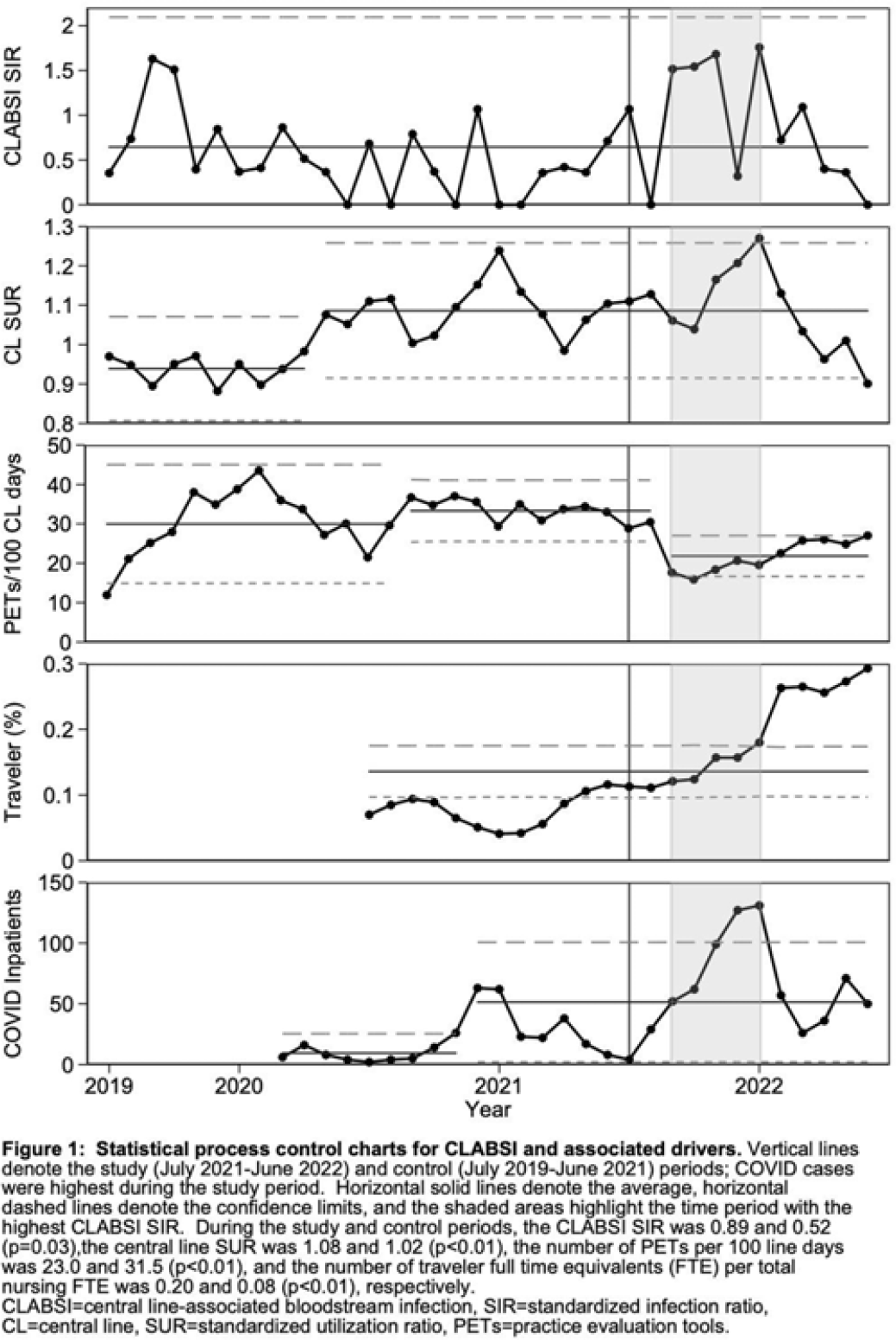
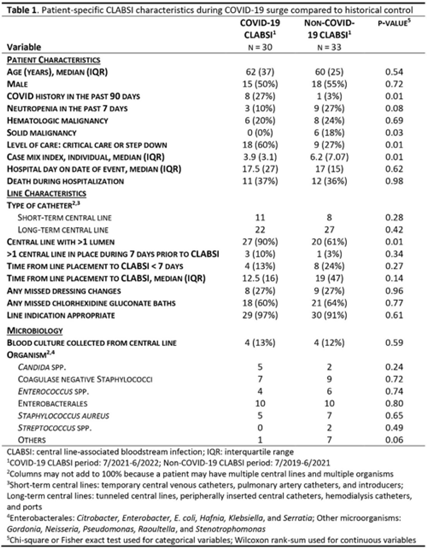
Background: Central-line–associated bloodstream infection (CLABSI) rates increased nationally during COVID-19, the drivers of which are still being characterized in the literature. CLABSI rates doubled during the SARS-CoV-2 omicron-variant surge at our rural academic medical center. We sought to identify potential drivers of CLABSIs by comparing period- and patient-specific characteristics of this COVID-19 surge to a historical control period. Methods: We defined the study period as the time of highest COVID-19 burden at our hospital (July 2021–June 2022) and the control period as the previous 2 years (July 2019–June 2021). We compared NHSN CLABSI standardized infection ratios (SIRs), central-line standardized utilization ratios (SURs), completion of practice evaluation tools (PETs) for monitoring of central-line bundle compliance, and proportions of traveling nurses. We performed chart reviews to determine patient-specific characteristics of NHSN CLABSIs during these periods, including demographics, comorbidities, central-line characteristics and care, and microbiology. Results: The CLABSI SIR was significantly higher during the study period than the control period (0.89 vs 0.52; P = .03); the SUR was significantly higher during the study period (1.08 vs 1.02; P < .01); the PET completion per 100 central-line days was significantly lower during the study period (23.0 vs 31.5; P < .01); and the proportion of traveling nurses was significantly higher during the study period (0.20 vs 0.08; P < .01) (Fig. 1). Patients with NHSN CLABSIs during the study period were more likely to have a history of COVID-19 (27% vs 3%; P = .01) and were more likely to receive a higher level of care (60% vs 27%; P = .02). During the study period, more patients had multilumen catheters (87% vs 61%; P = .04). The type of catheter, catheter care (ie, dressing changes and chlorhexidine bathing), catheter duration before CLABSI, and associated microbiology were similar between the study and control periods (Table 1). Conclusions: During the SARS-CoV-2 omicron-variant surge, the increase in CLABSIs at our hospital was significantly associated with increased central-line utilization, decreased PET completion, and increased proportion of traveling nurses. Critical illness and multilumen catheters were significant patient-specific factors that differed between CLABSIs from the study and control periods. We did not observe differences in catheter type, duration, or catheter care. Our study highlights key modifiable risk factors for CLABSI reduction. These findings may be surrogates for other difficult-to-measure challenges related to the culture of safety during a global pandemic, such as staff education related to infection prevention and daily review of central-line necessity.
For 147 hospital-onset bloodstream infections, we assessed the sensitivity, specificity, positive predictive value, and negative predictive value of the National Healthcare Safety Network surveillance definitions of central-line–associated bloodstream infections against the gold standard of physician review, examining the drivers of discrepancies and related implications for reporting and infection prevention.
To estimate the association between in situ steroids and spine surgical-site infections (SSIs), assessing spinal instrumentation as an effect modifier and adjusting for confounders.
Design:
Case–control study.
Setting:
Rural academic medical center.
Participants:
We identified 1,058 adults undergoing posterior fusion and laminectomy procedures as defined by the National Healthcare Safety Network without a pre-existing SSI between January 2020 and December 2021. We identified 26 SSI as cases and randomly selected 104 controls from the remaining patients without SSI.
Methods:
The primary exposure was the intraoperative administration of methylprednisolone in situ (ie, either in the wound bed or as an epidural injection). The primary outcome was a clinical diagnosis of SSI within 6 months of a patient’s first spine surgery at our facility. We quantified the association between the exposure and outcome using logistic regression, using a product term to assess for effect modification by spinal instrumentation and the change-in-estimate approach to select significant confounders.
Results:
Adjusting for Charlson comorbidity index and malignancy, in situ steroids were significantly associated with spine SSI relative to no in situ steroids for instrumented procedures (adjusted odds ratio [aOR], 9.93; 95% confidence interval [CI], 1.54–64.0), but they were not associated with spine SSIs among noninstrumented procedures (aOR, 0.86; 95% CI, 0.15–4.93).
Conclusions:
In situ steroids were significantly associated with spine SSI among instrumented procedures. The benefits of in situ steroids for pain management following spine surgery should be weighed against the risk of SSI, especially for instrumented procedures.
In this survey of 41 hospitals, 18 (72%) of 25 respondents reporting utilization of National Healthcare Safety Network resources demonstrated accurate central-line–associated bloodstream infection reporting compared to 6 (38%) of 16 without utilization (adjusted odds ratio, 5.37; 95% confidence interval, 1.16–24.8). Adherence to standard definitions is essential for consistent reporting across healthcare facilities.
People working in long-term care homes (LTCH) face ethical dilemmas about how to minimize the risk of spread of COVID-19, while also minimizing psychological hardship and other harms of infection control measures on residents. The Dementia Isolation Toolkit (www.dementiaisolationtoolkit.com; DIT) was developed to address the gap in ethical guidance for LTCH on how to safely and effectively isolate people with dementia while supporting the personhood and well-being of residents. In this presentation, we will present the DIT and report on the results of a survey of LTCH staff in Ontario, Canada on their experiences isolating residents in LTCH and the use of the DIT in supporting person-centred isolation care.
Methods:
A link to an online survey was distributed to LTCH staff through provincial organizations and agencies as well as through social media and the DIT website. Inclusion criteria were LTCH staff working on-site at a LTCH since March 1, 2020, who had direct or indirect experience with the isolation/quarantine of LTCH residents. Results were summarized descriptively.
Results:
A broad sample of LTCH staff (n=207) participated in the survey, most of whom had experienced an outbreak in their LTCH. Dementia (96%) was the most important barrier to implementation of infection control measures in LTCH, followed by staff distress about the effects of isolation on residents (61%). Important facilitators for isolation included delivery of 1:1 activities in the resident’s room (81%) and designating essential caregivers to provide support (67%), while inadequate staffing levels were reported as a barrier (55%). 65% of respondents indicated some familiarity with the DIT, and of those who had used the toolkit, 62% found it helpful in supporting isolation care, particularly in developing care plans and making and communicating decisions. Of those who had used the DIT, 48% found it fairly or very helpful at reducing their level of distress.
Conclusions:
Isolation as an infection control and prevention (ICP) measure in LTCH environments can be harmful to residents and create moral distress in staff. ICP guidance and support of LTCH needs to address how to minimize these harms by providing dementia-specific guidance such as in the DIT.
While chronic worry is typically associated with cautious and harm-avoidant behaviours, there is evidence that people high in chronic worry are characterised by negative urgency (NU), that is, the propensity to act rashly when experiencing negative affect. The present study was a preliminary examination of how rash action and impulsive decision-making manifest for chronic worriers compared to individuals low in worry. In total, 93 participants who endorsed high and low worry and NU responded to open-ended questions about their experience of NU on Amazon Mechanical Turk. Themes were identified using a data-driven approach. Participants high in chronic worry endorsed significantly greater NU compared to those low in worry. However, the types of NU behaviours were similar across participants, with a majority of responses involving initiating interpersonal conflict. Other themes included spending money, excessive eating, alcohol use, and aggressive behaviours. The manifestations of NU were largely consistent with those described in the model of NU. Although individuals higher in chronic worry engaged in NU behaviours to a greater extent, the types of behaviours were similar to those reported by people lower in worry. More research is needed to understand the characteristics of NU-motivated behaviour in individuals high in chronic worry.
OBJECTIVES/SPECIFIC AIMS: “Cure Quest” is an adventure quest game for mobile tablets that aims to teach the player about the complexities of discovery and development of new medicines. The game instills a sense of wonderment into the learning process, taking the player to a world of magic where a mysterious condition has affected the land and they must follow the steps of the discovery and development process to find a treatment. METHODS/STUDY POPULATION: The game is being developed through a collaboration between faculty and students at ISMMS and the Games and Simulation Arts and Science Program at Rensselaer Polytechnic Institute. The first target audience is 2nd–3rd year medical students, with the future goal of adapting the game to a broader population. RESULTS/ANTICIPATED RESULTS: The game is currently in development, but the project has yielded insight into the design process for serious games in medicine. We found that for a game of this type it is essential not just to have both designers and subject matter experts, but to enable cross-pollination of modes of thinking. Through multiple design iterations and focus groups, we found that a game design approach rooted in narrative and allegorical abstraction would have a better ability to engage the target audience than one focused only on realistic simulation. When complete, we anticipate that the game will improve understanding of the core concepts in drug discovery. DISCUSSION/SIGNIFICANCE OF IMPACT: If successful, the game-based learning approach can help fill key gaps in current formal medical and scientific training, as well as gaps in understanding among the general public. The design process serves as an informative model of evolving collaborative team science.
Most previous workers have regarded the insoluble residues of high-purity Quaternary limestones (coral reefs and oolites) as the most important parent material for well-developed, clay-rich soils on Caribbean and western Atlantic islands, but this genetic mechanism requires unreasonable amounts of limestone solution in Quaternary time. Other possible parent materials from external sources are volcanic ash from the Lesser Antilles island arc and Saharan dust carried across the Atlantic Ocean on the northeast trade winds. Soils on Quaternary coral terraces and carbonate eolianites on Barbados, Jamaica, the Florida Keys (United States), and New Providence Island (Bahamas) were studied to determine which, if either, external source was important. Caribbean volcanic ashes and Saharan dust can be clearly distinguished using ratios of relatively immobile elements (Al2O3/TiO2, Ti/Y, Ti/Zr, and Ti/Th). Comparison of these ratios in 25 soils, where estimated ages range from 125,000 to about 870,000 yr, shows that Saharan dust is the most important parent material for soils on all islands. These results indicate that the northeast trade winds have been an important component of the regional climatology for much of the Quaterary. Saharan dust may also be an important parent material for Caribbean island bauxites of much greater age.
The lung is an essential organ for mammalian health throughout life and represents a critical interface with the external environment in the regulation of gas exchange. To achieve these goals the mammalian lung has evolved into a highly complex system of branching epithelial and vascular structures that connects to a vast network of alveolar gas-exchanging units. The generation of this complex organ involves multiple steps and encompasses events that span prenatal and postnatal life. This chapter focuses on the mechanisms that regulate early lung development and branching morphogenesis and the various signaling molecules, extracellular matrix proteins, and genetic changes that influence this process. These research areas are critical for understanding the various causes of respiratory disease, which are a major contributor to morbidity and mortality at all stages of life.