To save content items to your account,
please confirm that you agree to abide by our usage policies.
If this is the first time you use this feature, you will be asked to authorise Cambridge Core to connect with your account.
Find out more about saving content to .
To save content items to your Kindle, first ensure no-reply@cambridge.org
is added to your Approved Personal Document E-mail List under your Personal Document Settings
on the Manage Your Content and Devices page of your Amazon account. Then enter the ‘name’ part
of your Kindle email address below.
Find out more about saving to your Kindle.
Note you can select to save to either the @free.kindle.com or @kindle.com variations.
‘@free.kindle.com’ emails are free but can only be saved to your device when it is connected to wi-fi.
‘@kindle.com’ emails can be delivered even when you are not connected to wi-fi, but note that service fees apply.
This statement draws on over 1,000 person-years’ work by the authors on the conservation of non-human primates and their habitats. It harnesses knowledge of what works for primates in the context of broader issues of global ecological integrity and increasing risk to all primate species, including our own. It indicates how conserving primates can protect and advance the interests of Indigenous Peoples, local communities, developing countries and humankind as a whole. It offers ideas and text for use by those engaged in relevant issues who are unfamiliar with the subject, with the aim of making conservation action easier to understand, to communicate and to do. It highlights four key elements of effective strategy: avoiding damage to native forest ecosystems, restoring native forest ecosystems, building conservation partnerships, and managing and using knowledge. Additionally, it advocates an approach in which all four elements are integrated, as a way to balance human rights and nature rights, to postpone and ultimately to prevent Earth system breakdown, and to promote mutual aid between people and nature.
Laser–target interactions generate intense electromagnetic pulses (EMPs) that can interfere with measurements and damage equipment. In this paper we show that applying a magnetic field to nanosecond pulse laser–target interactions decreases the magnitude of EMPs. We demonstrate this effect in two experiments with different geometries (spherical versus planar), laser intensities ($\sim {10}^{13}$ versus $\sim {10}^{15}$ W/cm${}^2$) and applied field strength (12 versus 0.1 T) that both observed suppression of EMPs in approximately the 1 GHz band (by factors of $0.65\times$ and $0.32\times$, respectively). We then observe the opposite effect at high intensities with a picosecond pulse: for planar experiments with laser intensities of approximately ${10}^{19}$ W/cm${}^2$ and magnetic fields of 6–10 T, the magnitude of EMPs is increased by a factor of $1.75\times$. These results provide a benchmark for models of EMP generation, but suggest that magnetic fields are not a viable solution for mitigating EMPs in the high-intensity laser facilities where they are most damaging.
Bars are ubiquitous morphological features in the observed distribution of galaxies. There are similarly many methods for classifying these features and, without a strict theoretical definition or common standard practice, this is often left to circumstance. So, we were concerned whether astronomers even agree on the bar which they perceive in a given galaxy and whether this could impact perceived scientific results. As an elementary test, we twenty-one astronomers with varied experience in studying resolved galaxies and circumstances, have each assessed 200 galaxy images, spanning the early phase of bar evolution in two different barred galaxy simulations. We find variations exist within the classification of all the standard bar parameters assessed: bar length, axis-ratio, pitch-angle and even whether a bar is present at all. If this is indicative of the wider community, it has implications for interpreting morphological trends, such as bar-end effects. Furthermore, we find that it is surprisingly not expertise but gender, followed by career stage, which gives rise to the largest discrepancies in the reported bar parameters. Currently, automation does not seem to be a viable solution, with bar classifications from two automated bar-finding algorithms tested and failing to find bars in snapshots where most astronomers agree a bar must exist. Increasing dependence on machine learning or crowdsourcing with a training dataset can only serve to obfuscate any existing biases if these originate from the specific astronomer producing the training material. On the strength of this small sample, we encourage an interim best practice to reduce the impact of any possible classification bias and set goals for the community to resolve the issue in the future.
To assess preparedness for Candida auris in Canadian hospitals.
Design:
Cross-sectional survey.
Setting:
Canadian Nosocomial Infection Surveillance Program (CNISP) hospitals.
Methods:
In June 2024, surveys were e-mailed to the infection prevention and control departments of 109 CNISP hospitals and their 33 microbiology laboratories. The surveys assessed policies for patient screening/management and laboratory processes supporting C. auris transmission prevention. Results were compared to a similar 2018 survey.
Results:
All 109 hospitals and 32/33 laboratories responded. Most hospitals had policies for admission screening (80%, 87/109) and policies/defined plans for post-exposure screening (95%, 104/109). Policy presence increased from 18% to 73% in 56 hospitals completing both 2018 and 2024 surveys (P < 0.001). Among hospitals with admission screening policies, 69% (60/87) screened for recent out-of-country hospitalization. All but one hospital implemented transmission-based precautions for cases; 70% (76/109) continued precautions indefinitely. Overall, 94% (99/105; excluding hospitals with exclusively private rooms) and 55% (60/109) of hospitals screened roommates and wardmates, respectively. Frequency and timing of screening and policies regarding precautions for exposed patients varied. All hospitals used axilla and groin swabs, at minimum, for screening. Most (81%, 26/32) laboratories identified all clinically significant Candida isolates to species level, increasing from 48% to 85% (P < 0.001) in the 27 laboratories completing both 2018 and 2024 surveys. Twenty-four laboratories (75%) had standard operating procedures for processing screening specimens; 96% (23/24) used direct plating onto chromogenic agar.
Conclusions:
Despite progress in C. auris preparedness, areas for improvement remain. Variability in practice may be related to evidence gaps and resource constraints.
Human milk and direct breastfeeding provide the optimal, biologically normative nutrition for hospitalised infants, with well-established benefits for immune, gut, cardiac, brain, and maternal health. Despite these benefits, human milk and breastfeeding rates for infants with CHD in high-resource countries are typically low, and there are no formal guidelines to drive CHD breastfeeding practice. Our aim is to (1) summarise the evidence on breastfeeding for infants with CHD, (2) discuss key barriers to and facilitators of breastfeeding in this population, (3) identify critical research and practice gaps to improve breastfeeding care in CHD, and (4) provide recommendations for clinical practice and future research.
Primary breastfeeding barriers for infants with CHD include (1) concern for dysphagia/aspiration, (2) concerns related to weight gain, (3) clinical instability/sickness, (4) developmental considerations, (5) general breastfeeding challenges, and (6) workflow and implementation issues, with racism and health disparities also contributing. The evidence to support these barriers is limited and often conflicting. Breastfeeding facilitators for preterm infants are well described, but facilitators may require modification for infants with CHD. Most lactation interventions have not been tested in CHD populations. Current evidence does not support automatic withholding of breastfeeding from infants with CHD; rather, the benefits of breastfeeding likely outweigh many potential concerns. There is a critical need for research and quality improvement to identify interventions that equitably and effectively support breastfeeding for infants with CHD and to evaluate the effect of breastfeeding on short- and long-term physical, psychological, and developmental outcomes for infants and families.
The dhole Cuon alpinus is a large canid that is categorized as Endangered on the IUCN Red List and at risk of global extinction. Information on the spatial distribution of suitable habitat is important for conservation planning but is largely unavailable. We quantified the spatial distribution of potential range as well as the relative probability of dhole occurrence across large parts of the species’ global range. We used the MaxEnt algorithm to produce a multi-scale environmental niche model based on 24 environmental variables and dhole occurrence data from 12 countries. We identified three regions where dhole conservation should be focused: western India, central India, and across the Himalayan foothills through Southeast Asia. Connectivity between suitable areas was poor, so coordinated action among these regions should be a priority. For instance, transboundary dhole conservation initiatives across the Himalayas from southern China, Myanmar, north-east India, Nepal and Bhutan need to be initiated. We also highlight the value of improving dhole population viability on unprotected land and increasing monitoring in the northern parts of its historic distribution, in particular in areas within mainland China.
It remains unclear which individuals with subthreshold depression benefit most from psychological intervention, and what long-term effects this has on symptom deterioration, response and remission.
Aims
To synthesise psychological intervention benefits in adults with subthreshold depression up to 2 years, and explore participant-level effect-modifiers.
Method
Randomised trials comparing psychological intervention with inactive control were identified via systematic search. Authors were contacted to obtain individual participant data (IPD), analysed using Bayesian one-stage meta-analysis. Treatment–covariate interactions were added to examine moderators. Hierarchical-additive models were used to explore treatment benefits conditional on baseline Patient Health Questionnaire 9 (PHQ-9) values.
Results
IPD of 10 671 individuals (50 studies) could be included. We found significant effects on depressive symptom severity up to 12 months (standardised mean-difference [s.m.d.] = −0.48 to −0.27). Effects could not be ascertained up to 24 months (s.m.d. = −0.18). Similar findings emerged for 50% symptom reduction (relative risk = 1.27–2.79), reliable improvement (relative risk = 1.38–3.17), deterioration (relative risk = 0.67–0.54) and close-to-symptom-free status (relative risk = 1.41–2.80). Among participant-level moderators, only initial depression and anxiety severity were highly credible (P > 0.99). Predicted treatment benefits decreased with lower symptom severity but remained minimally important even for very mild symptoms (s.m.d. = −0.33 for PHQ-9 = 5).
Conclusions
Psychological intervention reduces the symptom burden in individuals with subthreshold depression up to 1 year, and protects against symptom deterioration. Benefits up to 2 years are less certain. We find strong support for intervention in subthreshold depression, particularly with PHQ-9 scores ≥ 10. For very mild symptoms, scalable treatments could be an attractive option.
The treatment recommendation based on a network meta-analysis (NMA) is usually the single treatment with the highest expected value (EV) on an evaluative function. We explore approaches that recommend multiple treatments and that penalise uncertainty, making them suitable for risk-averse decision-makers. We introduce loss-adjusted EV (LaEV) and compare it to GRADE and three probability-based rankings. We define properties of a valid ranking under uncertainty and other desirable properties of ranking systems. A two-stage process is proposed: the first identifies treatments superior to the reference treatment; the second identifies those that are also within a minimal clinically important difference (MCID) of the best treatment. Decision rules and ranking systems are compared on stylised examples and 10 NMAs used in NICE (National Institute of Health and Care Excellence) guidelines. Only LaEV reliably delivers valid rankings under uncertainty and has all the desirable properties. In 10 NMAs comparing between 5 and 41 treatments, an EV decision maker would recommend 4–14 treatments, and LaEV 0–3 (median 2) fewer. GRADE rules give rise to anomalies, and, like the probability-based rankings, the number of treatments recommended depends on arbitrary probability cutoffs. Among treatments that are superior to the reference, GRADE privileges the more uncertain ones, and in 3/10 cases, GRADE failed to recommend the treatment with the highest EV and LaEV. A two-stage approach based on MCID ensures that EV- and LaEV-based rules recommend a clinically appropriate number of treatments. For a risk-averse decision maker, LaEV is conservative, simple to implement, and has an independent theoretical foundation.
Precision or “Personalized Medicine” and “Big Data” are growing trends in the biomedical research community and highlight an increased focus on access to larger datasets to effectively explore disease processes at the molecular level versus the previously common one-size-fits all approach. This focus necessitated a local transition from independent lab and siloed projects to a single software application utilizing a common ontology to create access to data from multiple repositories. Use of a common system has allowed for increased ease of collaboration and access to quality biospecimens that are extensively annotated with clinical, molecular, and patient associated data. The software needed to function at an enterprise level while continuing to allow investigators the autonomy and security access they desire. To identify a solution, a working group comprised of representation from independent repositories and areas of research focus across departments was established and responsible for review and implementation of an enterprise-wide biospecimen management system. Central to this process was the creation of a unified vocabulary across all repositories, including consensus around source of truth, standardized field definitions, and shared terminology.
From early on, infants show a preference for infant-directed speech (IDS) over adult-directed speech (ADS), and exposure to IDS has been correlated with language outcome measures such as vocabulary. The present multi-laboratory study explores this issue by investigating whether there is a link between early preference for IDS and later vocabulary size. Infants’ preference for IDS was tested as part of the ManyBabies 1 project, and follow-up CDI data were collected from a subsample of this dataset at 18 and 24 months. A total of 341 (18 months) and 327 (24 months) infants were tested across 21 laboratories. In neither preregistered analyses with North American and UK English, nor exploratory analyses with a larger sample did we find evidence for a relation between IDS preference and later vocabulary. We discuss implications of this finding in light of recent work suggesting that IDS preference measured in the laboratory has low test-retest reliability.
This article examines the development, early operation and subsequent failure of the Tot-Kolowa Red Cross irrigation scheme in Kenya’s Kerio Valley. Initially conceived as a technical solution to address regional food insecurity, the scheme aimed to scale up food production through the implementation of a fixed pipe irrigation system and the provision of agricultural inputs for cash cropping. A series of unfolding circumstances, however, necessitated numerous modifications to the original design as the project became increasingly entangled with deep and complex histories of land use patterns, resource allocation and conflict. Failure to understand the complexity of these dynamics ultimately led to the project’s collapse as the region spiralled into a period of significant unrest. In tracing these events, we aim to foreground the lived realities of imposed development, including both positive and negative responses to the scheme’s participatory obligations and its wider impact on community resilience.
Different fertilization strategies can be adopted to optimize the productive components of an integrated crop–livestock systems. The current research evaluated how the application of P and K to soybean (Glycine max (L.) Merr.) or Urochloa brizantha (Hochst. ex A. Rich.) R. D. Webster cv. BRS Piatã associated with nitrogen or without nitrogen in the pasture phase affects the accumulation and chemical composition of forage and animal productivity. The treatments were distributed in randomized blocks with three replications. Four fertilization strategies were tested: (1) conventional fertilization with P and K in the crop phase (CF–N); (2) conventional fertilization with nitrogen in the pasture phase (CF + N); (3) system fertilization with P and K in the pasture phase (SF–N); (4) system fertilization with nitrogen in the pasture phase (SF + N). System fertilization increased forage accumulation from 15 710 to 20 920 kg DM ha/year compared to conventional without nitrogen. Stocking rate (3.1 vs. 2.8 AU/ha; SEM = 0.12) and gain per area (458 vs. 413 kg BW/ha; SEM = 27.9) were higher in the SF–N than CF–N, although the average daily gain was lower (0.754 vs. 0.792 kg LW/day; SEM = 0.071). N application in the pasture phase, both, conventional and system fertilization resulted in higher crude protein, stocking rate and gain per area. Applying nitrogen and relocate P and K from crop to pasture phase increase animal productivity and improve forage chemical composition in integrated crop–livestock system.
Delirium is characterised by an acute, fluctuating change in cognition, attention and awareness (Wilson et al. Nature Reviews 2020; 6). This presentation can make the diagnosis of delirium extremely challenging to clinicians (Gofton., Canadian Journal of neurological sciences. 2011; 38 673-680). It is commonly reported in hospitalised patients, particularly in those over the age of sixty five (NICE. Delirium: prevention, diagnosis and management. 2010).
Objectives
Our aim is to identify which investigations and cognitive assessments are completed prior to a referral to the liaison psychiatry services in patients with symptoms of delirium.
Methods
Referrals (N = 6012) to the liaison psychiatry team at Croydon University Hospital made between April and September 2022 were screened. Search parameters used to identify referrals related to a potential diagnosis of delirium were selected by the authors. The terms used were confusion; delirium; agitation; aggression; cognitive decline or impairment; disorientation; challenging behaviour. Data was collected on the completion rates of investigations for delirium as advised by the NICE clinical knowledge summaries. Further data was gathered on neuroimaging (CT or MRI), cognitive assessment tools (MOCA/MMSE) and delirium screening tools (4AT/AMTS).
Results
The study sample identified 114 referrals (61 males and 53 females), with 82% over 65 years at the time of referral. In 96% of referrals, U&E and CRP were performed. Sputum culture (1%), urine toxin screen (4%) and free T3/4 (8%) were the tests utilised the least. Neuroimaging was completed in 41% of referrals (see Graph 1 for a full breakdown of results).
A formal cognitive assessment or delirium screening tool was completed in 32% of referrals. The AMTS and 4AT tools were documented for 65% and 24% respectively. A total of 19 referrals explicitly stated the patient was suspected to have dementia. A delirium screening tool was documented in 47% of these cases however, a formal cognitive assessment was documented in only 5% of these patients.
Following psychiatric assessment 47% of referrals were confirmed as delirium.
Image:
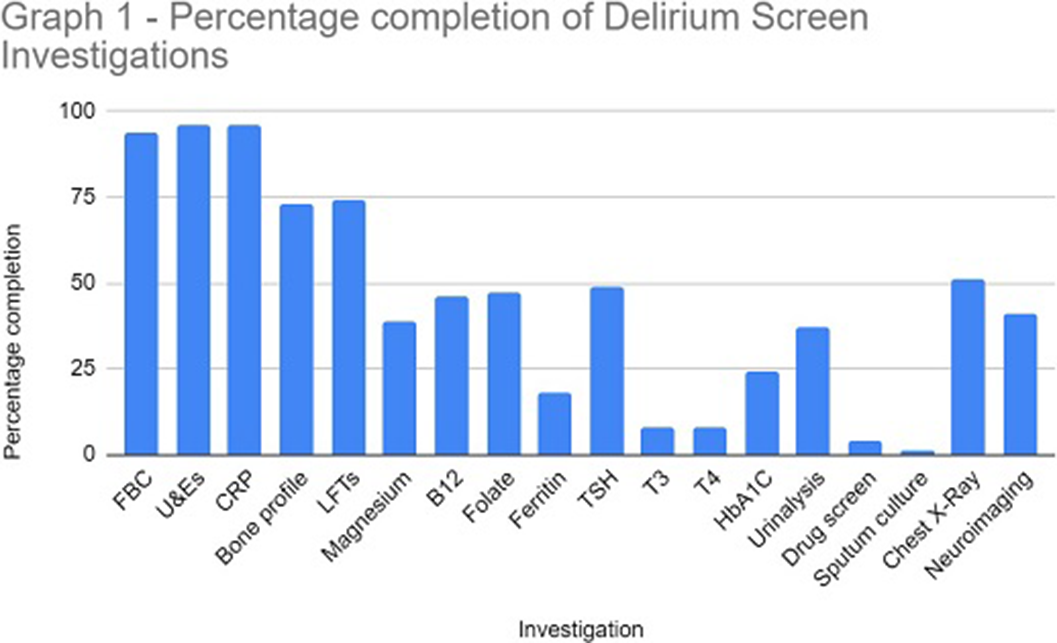
Conclusions
Our data highlights the low level completion of the NICE recommended delirium screen prior to referral to liaison psychiatry. The effective implementation of a delirium screen and cognitive assessment is paramount to reduce the number of inappropriate psychiatric referrals in hospital and helps to identify reversible organic causes of delirium. This in turn will ensure timely treatment of reversible causes of delirium and reduce the length of hospital admission.
Pregnancy is a time of increased vulnerability to psychopathology, yet limited work has investigated the extent to which variation in psychopathology during pregnancy is shared and unshared across syndromes and symptoms. Understanding the structure of psychopathology during pregnancy, including associations with childhood experiences, may elucidate risk and resilience factors that are transdiagnostic and/or specific to particular psychopathology phenotypes. Participants were 292 pregnant individuals assessed using multiple measures of psychopathology. Confirmatory factor analyses found evidence for a structure of psychopathology consistent with the Hierarchical Taxonomy of Psychopathology (HiTOP). A common transdiagnostic factor accounted for most variation in psychopathology, and both adverse and benevolent childhood experiences (ACEs and BCEs) were associated with this transdiagnostic factor. Furthermore, pregnancy-specific anxiety symptoms most closely reflected the dimension of Fear, which may suggest shared variation with manifestations of fear that are not pregnancy-specific. ACEs and BCEs also linked to specific prenatal psychopathology involving thought problems, detachment, and internalizing, externalizing, antagonistic, and antisocial behavior. These findings extend the dimensional and hierarchical HiTOP model to pregnant individuals and show how maternal childhood risk and resilience factors relate to common and specific forms of psychopathology during pregnancy as a period of enhanced vulnerability.
The impact of the coronavirus disease 2019 (COVID-19) pandemic on mental health is still being unravelled. It is important to identify which individuals are at greatest risk of worsening symptoms. This study aimed to examine changes in depression, anxiety and post-traumatic stress disorder (PTSD) symptoms using prospective and retrospective symptom change assessments, and to find and examine the effect of key risk factors.
Method
Online questionnaires were administered to 34 465 individuals (aged 16 years or above) in April/May 2020 in the UK, recruited from existing cohorts or via social media. Around one-third (n = 12 718) of included participants had prior diagnoses of depression or anxiety and had completed pre-pandemic mental health assessments (between September 2018 and February 2020), allowing prospective investigation of symptom change.
Results
Prospective symptom analyses showed small decreases in depression (PHQ-9: −0.43 points) and anxiety [generalised anxiety disorder scale – 7 items (GAD)-7: −0.33 points] and increases in PTSD (PCL-6: 0.22 points). Conversely, retrospective symptom analyses demonstrated significant large increases (PHQ-9: 2.40; GAD-7 = 1.97), with 55% reported worsening mental health since the beginning of the pandemic on a global change rating. Across both prospective and retrospective measures of symptom change, worsening depression, anxiety and PTSD symptoms were associated with prior mental health diagnoses, female gender, young age and unemployed/student status.
Conclusions
We highlight the effect of prior mental health diagnoses on worsening mental health during the pandemic and confirm previously reported sociodemographic risk factors. Discrepancies between prospective and retrospective measures of changes in mental health may be related to recall bias-related underestimation of prior symptom severity.
Contact with livestock and consumption of unpasteurised dairy products are associated with an increased risk of zoonotic and foodborne infection, particularly among populations with close animal contact, including pastoralists and semi-pastoralists. However, there are limited data on disease risk factors among pastoralists and other populations where livestock herding, particularly of dromedary camels, is common. This cross-sectional study used a previously validated survey instrument to identify risk factors for self-reported symptoms. Adults (n = 304) were randomly selected from households (n = 171) in the Somali Region of Ethiopia, a region characterised by chronic food insecurity, population displacement, recurrent droughts and large semi-pastoralist and pastoralist populations. Multivariable logistic regression assessed associations between self-reported symptoms and type of milk consumed, controlling for demographics and human-animal interaction. Consumption of days-old unrefrigerated raw camel milk was significantly associated with symptoms in the 30 days prior to the survey (AOR = 5.07; 95% CI 2.41–10.66), after controlling for age, refugee status, sanitation, camel ownership and source of drinking water and accounting for clustering. Consumption of days-old unrefrigerated raw ruminant milk was significantly associated with symptoms (AOR = 4.00, 95% CI 1.27–12.58). Source of drinking water and camel ownership, a proxy for camel contact, were significantly associated with the outcome in each model. There were no significant associations between self-reported symptoms and fresh or soured animal milk consumption. Research is needed to identify pathogens and major routes of transmission. Tailored communication campaigns to encourage safe food preparation should also be considered.
Seed retention, and ultimately seed shatter, are extremely important for the efficacy of harvest weed seed control (HWSC) and are likely influenced by various agroecological and environmental factors. Field studies investigated seed-shattering phenology of 22 weed species across three soybean [Glycine max (L.) Merr.]-producing regions in the United States. We further evaluated the potential drivers of seed shatter in terms of weather conditions, growing degree days, and plant biomass. Based on the results, weather conditions had no consistent impact on weed seed shatter. However, there was a positive correlation between individual weed plant biomass and delayed weed seed–shattering rates during harvest. This work demonstrates that HWSC can potentially reduce weed seedbank inputs of plants that have escaped early-season management practices and retained seed through harvest. However, smaller individuals of plants within the same population that shatter seed before harvest pose a risk of escaping early-season management and HWSC.
To determine the impact of clinical decision support on guideline-concordant Clostridioides difficile infection (CDI) treatment.
Design:
Quasi-experimental study in >50 ambulatory clinics.
Setting:
Primary, specialty, and urgent-care clinics.
Patients:
Adult patients were eligible for inclusion if they were diagnosed with and treated for a first episode of symptomatic CDI at an ambulatory clinic between November 1, 2019, and November 30, 2020.
Interventions:
An outpatient best practice advisory (BPA) was implemented to notify prescribers that “vancomycin or fidaxomicin are preferred over metronidazole for C.difficile infection” when metronidazole was prescribed to a patient with CDI.
Results:
In total, 189 patients were included in the study: 92 before the BPA and 97 after the BPA. Their median age was 59 years; 31% were male; 75% were white; 30% had CDI-related comorbidities; 35% had healthcare exposure; 65% had antibiotic exposure; 44% had gastric acid suppression therapy within 90 days of CDI diagnosis. The BPA was accepted 23 of 26 times and was used to optimize the therapy of 16 patients in 6 months. Guideline-concordant therapy increased after implementation of the BPA (72% vs 91%; P = .001). Vancomycin prescribing increased and metronidazole prescribing decreased after the BPA. There was no difference in clinical response or unplanned encounter within 14 days after treatment initiation. Fewer patients after the BPA had CDI recurrence within 14–56 days of the initial episode (27% vs 7%; P < .001).
Conclusions:
Clinical decision support increased prescribing of guideline-concordant CDI therapy in the outpatient setting. A targeted BPA is an effective stewardship intervention and may be especially useful in settings with limited antimicrobial stewardship resources.
We present an overview of the Middle Ages Galaxy Properties with Integral Field Spectroscopy (MAGPI) survey, a Large Program on the European Southern Observatory Very Large Telescope. MAGPI is designed to study the physical drivers of galaxy transformation at a lookback time of 3–4 Gyr, during which the dynamical, morphological, and chemical properties of galaxies are predicted to evolve significantly. The survey uses new medium-deep adaptive optics aided Multi-Unit Spectroscopic Explorer (MUSE) observations of fields selected from the Galaxy and Mass Assembly (GAMA) survey, providing a wealth of publicly available ancillary multi-wavelength data. With these data, MAGPI will map the kinematic and chemical properties of stars and ionised gas for a sample of 60 massive (${>}7 \times 10^{10} {\mathrm{M}}_\odot$) central galaxies at $0.25 < z <0.35$ in a representative range of environments (isolated, groups and clusters). The spatial resolution delivered by MUSE with Ground Layer Adaptive Optics ($0.6-0.8$ arcsec FWHM) will facilitate a direct comparison with Integral Field Spectroscopy surveys of the nearby Universe, such as SAMI and MaNGA, and at higher redshifts using adaptive optics, for example, SINS. In addition to the primary (central) galaxy sample, MAGPI will deliver resolved and unresolved spectra for as many as 150 satellite galaxies at $0.25 < z <0.35$, as well as hundreds of emission-line sources at $z < 6$. This paper outlines the science goals, survey design, and observing strategy of MAGPI. We also present a first look at the MAGPI data, and the theoretical framework to which MAGPI data will be compared using the current generation of cosmological hydrodynamical simulations including EAGLE, Magneticum, HORIZON-AGN, and Illustris-TNG. Our results show that cosmological hydrodynamical simulations make discrepant predictions in the spatially resolved properties of galaxies at $z\approx 0.3$. MAGPI observations will place new constraints and allow for tangible improvements in galaxy formation theory.
