To save content items to your account,
please confirm that you agree to abide by our usage policies.
If this is the first time you use this feature, you will be asked to authorise Cambridge Core to connect with your account.
Find out more about saving content to .
To save content items to your Kindle, first ensure no-reply@cambridge.org
is added to your Approved Personal Document E-mail List under your Personal Document Settings
on the Manage Your Content and Devices page of your Amazon account. Then enter the ‘name’ part
of your Kindle email address below.
Find out more about saving to your Kindle.
Note you can select to save to either the @free.kindle.com or @kindle.com variations.
‘@free.kindle.com’ emails are free but can only be saved to your device when it is connected to wi-fi.
‘@kindle.com’ emails can be delivered even when you are not connected to wi-fi, but note that service fees apply.
How can one know if a woman is honourable? In medieval culture, female honour rested most heavily on one thing: sexual continence, or chastity. But how could one be absolutely sure if a given woman was chaste? Practising Shame demonstrates how, in the literature of later medieval England, female honour is a matter of emotional practice and performance – it requires learning how to ‘feel’ in a specific way. In order to safeguard their chastity, women were encouraged to cultivate hypervigilance against the possibility of sexual shame through a combination of inward reflection and outward comportment. Often termed ‘shamefastness’, this practice was believed to reinforce women’s chastity of mind and body, and to communicate that chastity to others through a combination of conventional gestures. At the same time, however, medieval anxiety concerning the potentially misleading nature of appearances rendered these gestures suspect – after all, if good conduct could be learned, then it could also be counterfeited. Practising Shame uncovers the paradoxes and complications that emerged out of the emotional practices linked to female honour, as well as some of the unexpected ways in which those practices might be reappropriated by male authors. Written at the intersection of literary studies, gender studies, and the history of emotions, this book transforms our understanding of the ethical construction of femininity in the past and provides a new framework for thinking about honourable womanhood now and in the years to come.
This chapter begins by using the subject of women’s preuytees (or shamefuls, as genitalia might also be termed in Middle English) as a gateway to examining the relationship between shame and the embodied nature of female honour in medieval English culture, focusing on the links between postlapsarian shame and the body in the medieval imagination. It then considers how postlapsarian shame contributed to medieval understandings of pain and shame as universal features of women’s experience of childbirth. Finally, it explores how the prologue of one version of the mid fifteenth-century gynaecological treatise now known as The Sickness of Women, as well as the prologue of The Knowing of Woman’s Kind in Childing, employ strategies to mitigate the social and emotional risks women faced in exposing their bodies even for the ostensibly innocent purposes of medical diagnosis and treatment. While they perhaps inevitably replicate the gestures of concealing and revealing that characterize the practice of female honour, these prologues also present women’s shamefastness as something deserving of sympathy, respect, and protection.
This chapter shows that medieval English conduct texts exhort women to be invested in being hypervigilant against the possibility of shame, and that they function as guides for practising that shamefastness, advocating and describing ‘manipulations of body and mind’ that are intended to intensify and communicate a woman’s sense of shame. The chapter begins by situating conduct literature in relation to the education of girls and young women in medieval England, and in relation to the chaste ideals to which medieval women were expected to adhere. It then turns to the conduct texts themselves, focusing primarily on four examples of conduct literature in Middle English and Middle Scots: the Middle English translation of Le livre du Chevalier de la Tour Landry pour l’enseignement de ses filles, and the poems How the Good Wife Taught Her Daughter, The Good Wife Would a Pilgrimage, and the Middle Scots Thewis of Good Women. The final section of the chapter demonstrates how the Book of the Knight of La Tour Landry situates its advice regarding how to secure womanly ‘honoure and goodnesse’ within a recognizably literary frame, one that recasts the pursuit of female honour in heroic terms.
This final chapter examines Hoccleve’s engagement with both female shamefastness and masculinity in two of his early works, the Letter of Cupid (his translation of Christine de Pizan’s anti-misogynist Epistre au dieu d’Amours) and La Male Regle, through the lens of what has been characterized as Hoccleve’s distinctive pattern of self-effacement. It argues that, in presenting himself as a ‘poore shamefast man’, Hoccleve plays on two of the key beliefs underpinning the medieval practice of honourable female shamefastness: the belief that such emotional practices can be learned, and the belief that they can also be counterfeited. The chapter begins by taking a closer look at the Middle English language of ‘manhood’ and ‘manliness’ in relation to shamefastness. It then turns to Hoccleve’s treatment of misleading appearances in his Letter of Cupid, in which Hoccleve claims to have proto-feminist intentions but ultimately suggests that the behaviour of neither men nor women can be taken at face value. Finally, it considers La Male Regle in order to show how Hoccleve exploits the idea of shamefastness as a replicable practice, transforming what medieval women were encouraged to make an apparently artless performance of virtue into a performance of conspicuous artifice.
This chapter explores how anxieties regarding women’s ability to feign virtue contribute to the idea of female shamefastness as an enemy to be besieged and conquered by desiring men. This adversarial dynamic emerges clearly in personification allegories of varying scale and complexity, which present Shame as a stubborn adversary who must be defeated by Love by any means necessary, including by force. The chapter begins by considering the origins of the enmity between desire and shamefastness in the nature of personification allegory, focusing in particular on Prudentius’s treatment of lust (Sodomita Libido) and modesty (Pudicitia) in his Psychomachia. It then examines how personification allegories such as the medieval French Roman de la rose and its Middle English translation draw on anti-feminist tradition in order to explicitly establish female shamefastness as an obstacle or opponent to be overcome by male desire. The chapter’s final section turns to Lydgate’s discussion of female shamefastness in the Troy Book, and demonstrates how his depiction of Medea’s ‘staged’ shamefastness and his allegorization of her subsequent emotional turmoil articulate the anti-feminist logic that puts female honour at risk.
This chapter takes up the problematic relationship between female shamefastness and the model of hardy masculinity and considers its disturbing implications for female exemplarity founded on shamefastness. As Chaucer’s adaptations of the narratives of Virginia and Lucretia demonstrate, women’s shamefast chastity is not only under threat from masculine hardiness, but can even provoke that threat, either by stimulating masculine desire or by inviting men to prove their manhood. The chapter begins by exploring how Chaucer represents the irreconcilability of shamefast femininity and forceful masculinity elsewhere in his work. It then continues to the stories of Virginia and Lucretia, and shows that Chaucer and his contemporary, John Gower (c. 1330–1408), approach the theme of ‘manly force’ from very different angles. Whereas Gower invites readers to consider what might have happened in a Rome that was justly governed by chaste rulers, Chaucer engages readers in a deeply uncomfortable experiment in counterfactual thinking about female honour, an experiment that threatens to reopen the question of whether the binary of death or dishonour need exist in the first place.
The introductory chapter of Practising Shame lays out the problem of female honour in later medieval England: namely, its problematic reliance on a characteristic (sexual continence) that was revered in women, but also subject to suspicion. This chapter introduces the practices that underpin medieval understandings of female honour, and literature’s role in shaping and articulating those practices in later medieval England. In placing such emphasis on emotion as a practice, and in writing of shamefastness as a practice, Practising Shame contributes to a body of scholarship that is attempting to effect a theoretical shift away from the notion that emotions are something that we ‘have’ (or do not have) and towards the idea that emotions are something that we do. The book’s introduction outlines how shamefastness might be said to constitute an emotional practice and concludes with chapter synopses.
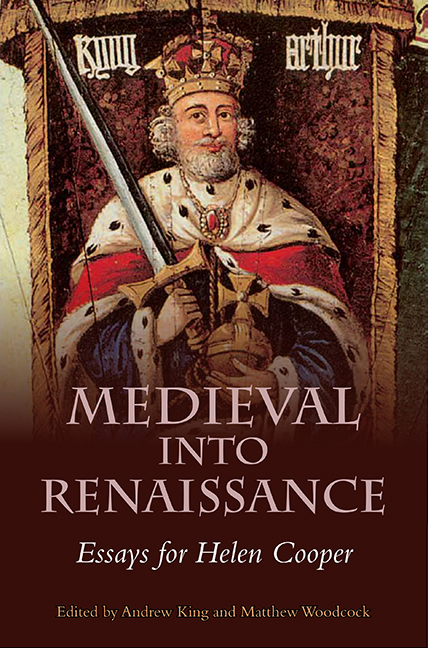
The borderline between the periods commonly termed "medieval" and "Renaissance", or "medieval" and "early modern", is one of the most hotly, energetically and productively contested faultlines in literary history studies. The essays presented in this volume both build upon and respond to the work of Professor Helen Cooper, a scholar who has long been committed to exploring the complex connectionsand interactions between medieval and Renaissance literature. The contributors re-examine a range of ideas, authors and genres addressed in her work, including pastoral, chivalric romance, early English drama, and the writings of Chaucer, Langland, Spenser and Shakespeare. As a whole, the volume aims to stimulate active debates on the ways in which Renaissance writers used, adapted, and remembered aspects of the medieval.
Andrew King is Lecturer in Medieval and Renaissance Literature at University College, Cork; Matthew Woodcock is Senior Lecturer in Medieval and Renaissance Literature at the University of East Anglia.
Contributors: Joyce Boro, Aisling Byrne, Nandini Das, Mary C. Flannery, Alexandra Gillespie, Andrew King, Megan G. Leitch, R.W. Maslen, Jason Powell,Helen Vincent, James Wade, Matthew Woodcock