To save content items to your account,
please confirm that you agree to abide by our usage policies.
If this is the first time you use this feature, you will be asked to authorise Cambridge Core to connect with your account.
Find out more about saving content to .
To save content items to your Kindle, first ensure no-reply@cambridge.org
is added to your Approved Personal Document E-mail List under your Personal Document Settings
on the Manage Your Content and Devices page of your Amazon account. Then enter the ‘name’ part
of your Kindle email address below.
Find out more about saving to your Kindle.
Note you can select to save to either the @free.kindle.com or @kindle.com variations.
‘@free.kindle.com’ emails are free but can only be saved to your device when it is connected to wi-fi.
‘@kindle.com’ emails can be delivered even when you are not connected to wi-fi, but note that service fees apply.
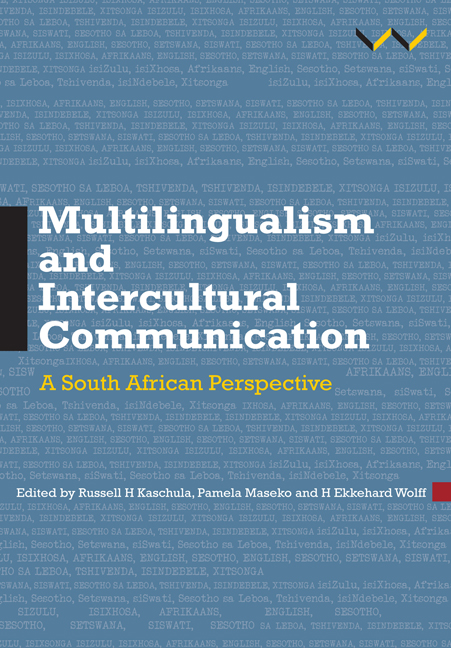
To date, there has been no published textbook which takes into account changing sociolinguistic dynamics that have influenced South African society. Multilingualism and Intercultural Communication breaks new ground in this arena. The scope of this book ranges from macro-sociolinguistic questions pertaining to language policies and their implementation (or non-implementation) to micro-sociolinguistic observations of actual language-use in verbal interaction, mainly in multilingual contexts of Higher Education (HE). There is a gradual move for the study of language and culture to be taught in the context of (professional) disciplines in which they would be used, for example, Journalism and African languages, Education and African languages, etc. The book caters for this growing market. Because of its multilingual nature, it caters to English and Afrikaans language speakers, as well as the Sotho and Nguni language groups – the largest languages in South Africa [and also increasingly used in the context of South African Higher Education]. It brings together various inter-linked disciplines such as Sociolinguistics and Applied Language Studies, Media Studies and Journalism, History and Education, Social and Natural Sciences, Law, Human Language Technology, Music, Intercultural Communication and Literary Studies. The unique cross-cutting disciplinary features of the book will make it a must-have for twenty-first century South African students and scholars and those interested in applied language issues.
By
Michael Joseph, currently an honorary senior researcher under the SARChI Multilingualism Chair in the School of Languages and Literatures at Rhodes University.,
Nompumelelo Frans, currently a foundation phase teacher at CM Vellem School in Joza, Grahamstown.,
Esther Ramani, coordinated the first dual-medium undergraduate degree (in English and Sesotho sa Leboa) at the University of Limpopo from 2003 to 2012.
Numerous studies have shown that South African children in rural and township schools are failing to reach grade-appropriate benchmarks in literacy and numeracy. Several educationists and researchers, including Ntuli and Pretorius (2005), Fleisch (2008) and Ramphele (Mail & Guardian 23 March 2012) have reiterated that South African schooling is in crisis. Evidence also suggests that training initiatives by government continue to have little impact on classroom practice (Metcalfe 2008; Taylor, Van der Berg and Mabogoane 2013). While thousands of preservice and in-service teachers upgrade their qualifications year after year, in many schools, little changes. Efforts made by the Department of Higher Education and Training to increase the number of qualified teachers have had little or no impact on rural and township schools. One-off training workshops, though well intentioned, still leave these learners at low levels of cognition and literacy, and locked into their everyday knowledges. University academics are often cut off from classrooms and are hardly ever able to follow up on their certificated teachers.
The failure of top-down training provokes us to point to the distinction between teacher training and teacher development models of professionalisation (Barnes 1975; Allwright 1983; Stern 1983; Ramani 1987; Gains 2010). Teacher training tends to be top-down and is often a lock-step transmission of policy statements and pedagogic procedures (as in the current highly scripted Curriculum Assessment Policy Statements [CAPS] directives, which offer minute- by-minute guidelines). Models of teacher development, on the other hand, perceive teachers as being autonomous professionals capable of integrating their own beliefs about teaching and learning with pedagogic practices and of engaging with policy in empowering ways.
However, the history of apartheid and post-apartheid South Africa shows the continuation of policies driven from above, such as fundamental pedagogics, Outcomes-Based Education (OBE), the Revised National Curriculum Statement (RNCS) and the current CAPS. While policies and textbooks are necessary, they are ineffective if not coupled with effective teacher development initiatives, sensitive to teachers’ contexts and constraints.