To save content items to your account,
please confirm that you agree to abide by our usage policies.
If this is the first time you use this feature, you will be asked to authorise Cambridge Core to connect with your account.
Find out more about saving content to .
To save content items to your Kindle, first ensure no-reply@cambridge.org
is added to your Approved Personal Document E-mail List under your Personal Document Settings
on the Manage Your Content and Devices page of your Amazon account. Then enter the ‘name’ part
of your Kindle email address below.
Find out more about saving to your Kindle.
Note you can select to save to either the @free.kindle.com or @kindle.com variations.
‘@free.kindle.com’ emails are free but can only be saved to your device when it is connected to wi-fi.
‘@kindle.com’ emails can be delivered even when you are not connected to wi-fi, but note that service fees apply.
Evidence links early adolescent cannabis use (CU) to long-term health risks, but most studies lack comprehensive early-life confounder data and rely on subjective health measures.
Objectives
To assess the association between adolescent CU trajectories and healthcare use for physical and mental health problems (P&MHP) in young adulthood.
Methods
Data from the Québec Longitudinal Study of Child Development, a 23-year population-based birth cohort (N = 1,591), were linked to healthcare administrative records (hospitalizations, outpatient, and ER visits). CU trajectories (exposure) were derived from age of onset and frequency data (ages 12-17) using group-based trajectory modeling. Missing data on pre-exposure confounders were multiply imputed. Overlap-weighted logistic regression was used to assess the adjusted associations between these trajectories and healthcare use for P&MHP between ages 18-23.
Results
Three CU trajectories were identified: non-users, late users, and early users (Figure 1). Early users had a higher risk of healthcare use for any mental disorder (OR 1.55, 95% CI 1.17-2.06), common mental disorders (OR 1.69, 95% CI 1.19-2.39), substance-related disorders (OR 2.25, 95% 1.24-4.10), and hospitalizations for physical diseases (OR 1.57, 95% CI 1.03-2.38) compared to non-users. No significant differences were found between late and non-users.
Image 1:
Conclusions
These findings highlight the need for targeted interventions during adolescence to mitigate long-term health risks. Prevention efforts should prioritize early users, and be focused on integrated social, mental, and physical care.
Background: Attitudes toward aging influence many health outcomes, yet their relationship with cognition and Alzheimer’s disease (AD) remains unknown. To better understand their impact on cognition and AD risk, we examined whether positive attitudes predict better cognition and diminished risk on AD biomarkers. Methods: A subsample of older adults with a family history of AD (n=54; women=39) from the McGill PREVENT-AD cohort participated in this study. Participants completed the Attitudes to Ageing Questionnaire (AAQ-24), providing three scores: psychosocial loss, psychological growth and physical change. Participants underwent cognitive testing (Rey Auditory Verbal Learning Test, RAVLT; Delis-Kaplan Executive Function System-Color Word Interference Test, D-KEFS-CWIT), and AD blood-based biomarker assessments (p-tau217, Aβ42/40). Regression models tested associations, adjusting for covariates (age, sex, education, depression, APOE4), and were Bonferroni corrected. Results: Positive attitudes were associated with better recall and recognition (RAVLT) and improved word reading, colour naming, switching, and inhibition (D-KEFS-CWIT) (p<0.00077), while negative attitudes showed the opposite pattern. Negative attitudes were correlated with lower Aβ42/40 ratios, while positive attitudes were linked to lower p-tau217 (p<0.0167). Conclusions: These findings demonstrate that positive attitudes predict better cognition and a lower risk profile for AD biomarkers, suggesting that life outlook may be an early disease feature or a risk factor.
In Colombia the traditional treatment model implies the needing of a total cessation of consume to be able to acces an impatientand long stance rehabilitation program. However, literature in other countries expériences had sugested and used a harm reduction program with an otpatien rehabilitation program.
As this programs are more cost-effective and enables the patient to continue his daily life, perpetuate his life style, keep and enhance the psychosocial network, an outpatient comprehensive multimodular program was designed to adapt to a health promotion company (EPS for its spanish acronym) and has been used since 2017.
Objectives
- share the expérience aquired in an undeveloped country of latin America
- The tipification in the main substance consumption in the development group as well as it’s differentiation in gender and age group
Methods
Expérience and results
Results
- The majority of patients are men over women
- the predominant age group is between 29-59 years old
- there is a difference between the age group depending on the substance of impact
Conclusions
The experience have shown that up to 30% of the population treated have gotten to a controlled consumption or the total suspension without the needing of an impatient program In général thé patient have shown motivation and adherence to an outpatient program
Background: Colloid cysts are rare benign lesions of the third ventricle that can cause hydrocephalus and intracranial hypertension. Their primary treatment is surgical removal. Although open surgery presents the best opportunity for total resection of the cyst, there is no consensus regarding the optimal choice between the interhemispheric and the transcortical approaches. We aim to compare these two approaches in regard of the radicality of excision, the recurrence rate, and the surgical imprint. Methods: Retrospective cohort study on all patients who underwent surgical resection of colloid cyst between 2003 and 2023 at CHU de Québec. Data on demographics, symptoms, complications, and imaging was gathered. Results: In a cohort of 28 patients (17 interhemispheric, 11 transcortical), the preliminary results demonstrate prolonging operative time (270min. vs. 187min.) and increasing blood loss (193cc vs 100cc) associated with the interhemispheric approach. Despite these results, the hospitalization duration remains similar (p=0.734). However, the interhemispheric approach results in significantly lower surgery-induced encephalomalacia (1.1cc vs. 4.4cc, p=0.006). Conclusions: The interhemispheric approach could lead to potentially lesser consequences due to the reduced volume of encephalomalacia left by the surgical intervention, at the cost of prolonged operating time and higher blood loss.
OBJECTIVES/GOALS: The goals of the present study were to examine levels and potential changes in oxytocin and HPL over the course of pregnancy. We assessed the potential predictive value of oxytocin and HPL on maternal-fetal attachment, anxiety and depression at three timepoints during pregnancy. METHODS/STUDY POPULATION: Pregnant women (n=70) enrolled in a longitudinal, rolling protocol study. Eligibility criteria included 1) singleton pregnancy confirmed at early pregnancy screen (EPS) ultrasonography, 2) mother aged 19 or greater, and 3) fluent in English. Predictors (oxytocin and HPL levels) were measured via blood draws at the same three times (early-stage, mid-stage, and late-stage) that MFA, anxiety and depression questionnaires were completed. RESULTS/ANTICIPATED RESULTS: An increased OT level compared to a mother’s average OT level did not have a statistically significant effect on MFA (within-person estimate = 0.02, 95% CI: -0.03 to 0.05, p = 0.427. An increased HPL level compared to a patient’s average HPL level did not have a statistically significant effect on MFA (within-person estimate = -0.10, 95% CI: -0.67 to 0.47, p = 0.730). The main effect of between-person HPL was significant; such that a one-unit increase in average HPL level was associated with a 0.52 higher anxiety score (between-person 95% CI: 0.08 to 0.96, p = 0.022). The main effect of between-person HPL was significant, such that an increased average HPL level was associated with a 0.45 higher depression score (between-person estimate = 0.45, 95% CI: 0.04 to 0.86, p=0.031). DISCUSSION/SIGNIFICANCE: To our knowledge, our study is the first to measure HPL and MFA over the course of a pregnancy. At this point, perhaps the best we can say is that HPL is a promising new target hormone that may be related to psychological symptoms surrounding pregnancy.
Adverse environments are linked to elevated youth antisocial behavior. However, this relation is thought to depend, in part, on genetic susceptibility. The present study investigated whether polygenic risk for antisociality moderates relations between hostile environments and stable as well as dynamic antisocial behaviors across adolescence. We derived two antisocial-linked polygenic risk scores (PRS) (N = 721) based on previous genome-wide association studies. Forms of antisocial behavior (nonaggressive conduct problems, physical aggression, social aggression) and environmental hostility (harsh parenting and school violence) were assessed at age 13, 15, and 17 years. Relations to individual differences stable across adolescence (latent stability) vs. time-specific states (timepoint residual variance) of antisocial behavior were assessed via structural equation models. Higher antisocial PRS, harsh parenting, and school violence were linked to stable elevations in antisocial behaviors across adolescence. We identified a consistent polygenic-environment interaction suggestive of differential susceptibility in late adolescence. At age 17, harsher parenting was linked to higher social aggression in those with higher antisocial PRS, and lower social aggression in those with lower antisocial PRS. This suggests that genetics and environmental hostility relate to stable youth antisocial behaviors, and that genetic susceptibility moderates home environment-antisocial associations specifically in late adolescence.
In individuals with first episode psychosis (FEP) and cannabis use disorder (CUD), reducing cannabis use is associated with improved clinical outcomes. Access to evidence-based psychological interventions to decrease cannabis use in FEP clinics is highly variable; E-mental health interventions may help to address this gap. Development of E-interventions for CUD in individuals with FEP is in its incipient phases.
Objectives
To assess preferences for online psychological interventions aiming at decreasing or stopping cannabis use in young adults with psychosis and CUD.
Methods
Individuals aged 18 to 35 years old with psychosis and CUD were recruited from seven FEP intervention programs in Canada and responded to an electronic survey between January 2020-July 2022. We used the Case 2 Best Worst Scaling methodology that is grounded in the trade-off utility concept to collect and analyse data. Participants selected the best or worst option for each of the nine questions corresponding to three distinct domains. For each domain we used conditional logistic regression and marginal models (i.e., three models in total) to estimate preferences for attributes (e.g., duration, frequency of online intervention sessions) and attribute levels (e.g., 15 minutes, every day).
Results
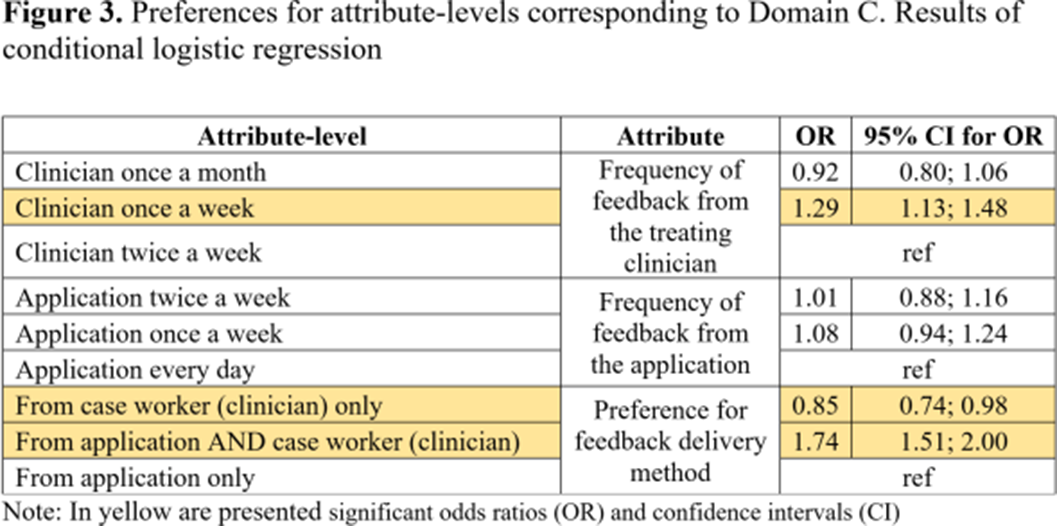
Participants (N=104) showed higher preferences for the following attributes: duration of online sessions; mode of receiving the intervention; method of feedback delivery and the frequency of feedback from clinicians (Table 1). Attribute-level analyses showed higher preferences for participating once a week in short (15 minutes) online interventions (Figure 1). Participants valued the autonomy offered by online interventions which aligns with their preference for completing the intervention outside the clinic and only require assistance once a week (Figure 2). Participants’ preferences were higher for receiving feedback related to cannabis consumption both from the application and clinicians at a frequency of once a week from clinicians (Figure 3).Table 1.
Preferences for Attributes. Results of conditional logistic regression
Attributes
Domains
OR
95% CI for OR
Duration session
A
1.62
1.45; 1.82
Frequency sessions
0.98
0.87; 1.09
Duration intervention
ref
Preferred mode of receiving the intervention
B
1.63
1.46; 1.83
Preferred location for participating
1.07
0.96; 1.20
Frequency of assistance from the clinician
ref
Preference for the feedback delivery method
C
1.21
1.08; 1.36
Frequency of feedback from the treating clinician
1.14
1.02; 1.28
Frequency of feedback from the application
ref
Note: In boldface significant odds ratios (OR) and confidence intervals (CI)
Image:
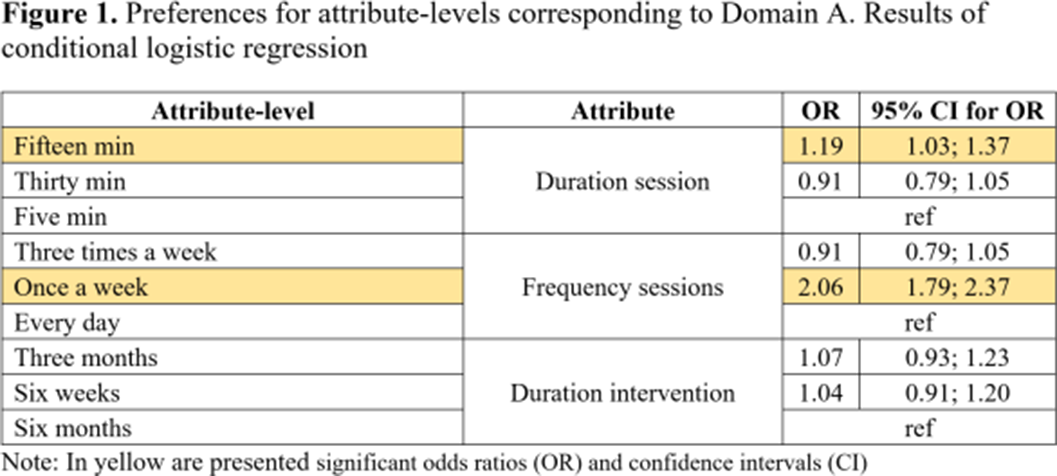
Image 2:
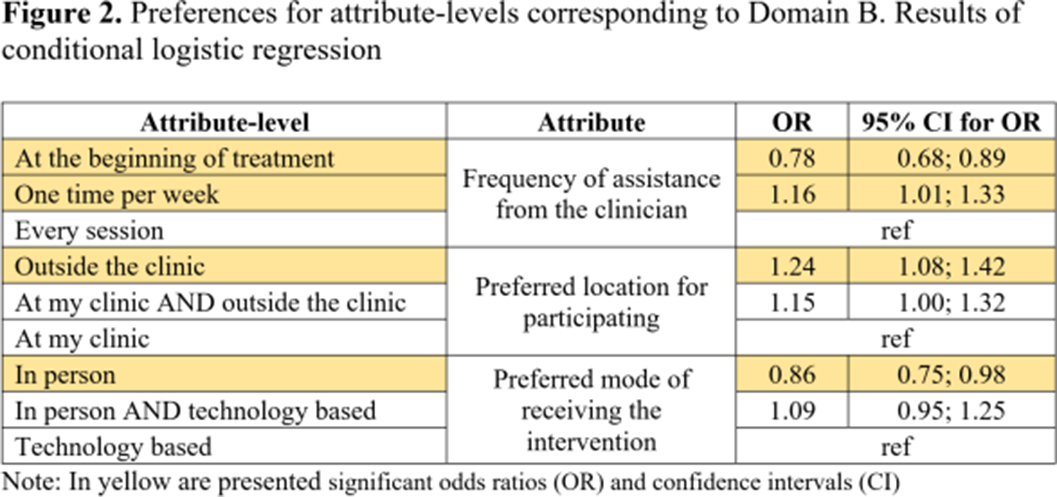
Image 3:
Conclusions
Using advanced methodologies to assess preferences, our results can inform the development of highly acceptable E-Mental health interventions for decreasing cannabis use in individuals with CUD and FEP.
Young people are worried about climate change but the association between climate worry and current and past mental health has not been examined in population-based samples.
Objectives
To examine 1) the prevalence of worry about climate change at age 23-years and its association with contemporaneous mental health symptoms, and 2) and adolescent mental health symptoms.
Methods
We used a Canadian population-based birth cohort (n=1325) to examine associations between 1) climate change at age 23-years and concurrent anxiety, depression, and suicidal behaviors, and 2) mental health at age 15 and 17 years defined as anxiety, depression, aggression-opposition, inattention-hyperactivity. We adjusted for participants’ socioeconomic status, childhood IQ, sex, and parental history of psychopathology.
Results
Most participants were worried about climate change: 190 (14.3%) were extremely worried, 553 (41.7%) were somewhat worried, 383 (28.9%) were very worried, and 199 (15.0%) were not at all worried. Worry about climate change was associated with significantly elevated contemporaneous anxiety, depression, and suicidal thoughts. In longitudinal analysis, adolescent anxiety was associated with higher climate change worry at age 23-years while adolescent aggression-opposition was associated with lower climate change worry.
Conclusions
Worry about climate change is associated with contemporaneous mental health symptoms. However, longitudinal analysis suggests that this is largely explained by prior mental health, with adolescent anxiety symptoms linked with higher worry and aggression-opposition with lower worry. Future studies should aim to better define the dimensions of climate anxiety and track it alongside symptoms using prospective follow-up studies.
Mental health regional differences during pregnancy through the COVID-19 pandemic is understudied.
Objectives
We aimed to quantify the impact of the COVID-19 pandemic on maternal mental health during pregnancy.
Methods
A cohort study with a web-based recruitment strategy and electronic data collection was initiated in 06/2020. Although Canadian women, >18 years were primarily targeted, pregnant women worldwide were eligible. The current analysis includes data on women enrolled 06/2020-11/2020. Self-reported data included mental health measures (Edinburgh Perinatal Depression Scale (EPDS), Generalized Anxiety Disorders (GAD-7)), stress. We compared maternal mental health stratifying on country/continents of residence, and identified determinants of mental health using multivariable regression models.
Results
Of 2,109 pregnant women recruited, 1,932 were from Canada, 48 the United States (US), 73 Europe, 35 Africa, and 21 Asia/Oceania. Mean depressive symptom scores were lower in Canada (EPDS 8.2, SD 5.2) compared to the US (EPDS 10.5, SD 4.8) and Europe (EPDS 10.4, SD 6.5) (p<0.05), regardless of being infected or not. Maternal anxiety, stress, decreased income and access to health care due to the pandemic were increasing maternal depression. The prevalence of severe anxiety was similar across country/continents. Maternal depression, stress, and earlier recruitment during the pandemic (June/July) were associated with increased maternal anxiety.
Conclusions
In this first international study on the impact of the COVID-19 pandemic, CONCEPTION has shown significant country/continent-specific variations in depressive symptoms during pregnancy, whereas severe anxiety was similar regardless of place of residence. Strategies are needed to reduce COVID-19’s mental health burden in pregnancy.
Externalising and internalising problems are common in school-aged children. Few studies have examined the association between comorbid externalising and internalising symptoms and adult-life economic participation.
Objectives
To investigate associations of childhood externalising, internalising, and comorbid internalising-externalising symptoms with earnings and welfare receipt in adulthood.
Methods
We used group-based trajectory modeling to identify profiles of children with externalising, internalising, and comorbid symptoms from age 6-12 years. We estimated associations of the identified profiles with participants’ employment earnings at age 33-37 years and welfare receipt from age 18-35 years obtained from tax return records. The child’s IQ and family socioeconomic background were adjusted for.
Results
Four profiles were identified: no symptoms (45%), externalizing (29%), internalizing (11%) and comorbid symptoms (13%). Relative to the no-symptom profile, participants in the comorbid profile earned US$-18,323 less annually (95%CI=-20,925 to -15700) at age 33-37 years and were significantly more likely to receive welfare across follow-up (RR=6.30, 95%CI=5.4 to 7.2). Similarly, compared to the no-symptom profile, participants in the externalising profile earned US$-7,256 less per year (95%CI=-9,205 to -5,307), while participants in the internalising profile earned US$-9,716 less (95%CI=-12,358 to -7,074). Significant interactions by sex were observed. For participants in the comorbid profile, males were more likely to have lower earnings while females were more likely to receive welfare, relative to the no-symptom profile.
Conclusions
Children exhibiting comorbid externalising and internalising symptoms are at high risk of poor economic outcomes in adulthood. Early detection, prevention and management is crucial to improve the life chances of this vulnerable population.
Anorexia nervosa (AN) is a psychiatric disorder with complex etiology, with a significant portion of disease risk imparted by genetics. Traditional genome-wide association studies (GWAS) produce principal evidence for the association of genetic variants with disease. Transcriptomic imputation (TI) allows for the translation of those variants into regulatory mechanisms, which can then be used to assess the functional outcome of genetically regulated gene expression (GReX) in a broader setting through the use of phenome-wide association studies (pheWASs) in large and diverse clinical biobank populations with electronic health record phenotypes.
Methods
Here, we applied TI using S-PrediXcan to translate the most recent PGC-ED AN GWAS findings into AN-GReX. For significant genes, we imputed AN-GReX in the Mount Sinai BioMe™ Biobank and performed pheWASs on over 2000 outcomes to test the clinical consequences of aberrant expression of these genes. We performed a secondary analysis to assess the impact of body mass index (BMI) and sex on AN-GReX clinical associations.
Results
Our S-PrediXcan analysis identified 53 genes associated with AN, including what is, to our knowledge, the first-genetic association of AN with the major histocompatibility complex. AN-GReX was associated with autoimmune, metabolic, and gastrointestinal diagnoses in our biobank cohort, as well as measures of cholesterol, medications, substance use, and pain. Additionally, our analyses showed moderation of AN-GReX associations with measures of cholesterol and substance use by BMI, and moderation of AN-GReX associations with celiac disease by sex.
Conclusions
Our BMI-stratified results provide potential avenues of functional mechanism for AN-genes to investigate further.
Childhood behavioral problems are highly prevalent in school-aged children and are associated with poor long-term outcomes. Yet little is known about their association with patterns of partnering in adulthood.
Objectives
To (1) describe patterns of partnering from age 18-35 years in a large population-based sample, and (2) examine the association between childhood behavioural problems and adult partnering patterns.
Methods
Behavioural ratings were prospectively obtained from teachers when children (n=2960) were aged 10-12 years – for inattention, hyperactivity, aggression-opposition, anxiety and prosociality – and linked to their tax return records from age 18-35 years. We used group-based trajectory modelling to identify distinct trajectories of partnering (married or cohabitating) and multinomial regression models to examine the association between childhood behaviour and trajectory group membership.
Results
Five distinct trajectories of partnering were identified: early-partnered (n=420, 14.4%), mid-partnered (n=620, 21.3%), late-partnered (n=570, 19.2%), early-separated (n=460, 15.5%), and delayed-or-unpartnered (n=890, 30.0%). After adjustment for sex and family background, children rated as being anxious or inattentive were more likely to remain unpartnered from age 18 to 35 years, while those rated as aggressive-oppositional or inattentive were more likely to separate and return to unpartnered status. Prosocial behaviours were consistently associated with earlier and more sustained partnership. Participants in the early-separated and delayed-or-unpartnered trajectories were also more likely to have left high school without a diploma and to have lower earnings.
Conclusions
Childhood behavioural problems were associated with increased likelihood of being unpartnered and of partnership dissolution, which has implications for the psychological health and wellbeing of individuals and their families.
Disruptive behaviours underpin the most prevalent and costly psychiatric disorders in youth including ADHD and conduct disorder. Yet the association between childhood behavioural problems and economic and social outcomes in adulthood are rarely examined in a population-based samples where early detection and prevention may be possible.
Objectives
To examine the association childhood behavioural problems and economic and social outcomes from age 18-35 years across three studies.
Methods
This study daws on 30-year Canadian birth cohort (n=3017) linked to government tax return records. Behavioural assessments – for inattention, hyperactivity, opposition, aggression, anxiety and prosociality – were prospectively obtained from teachers when children were aged 6-12 years. Regression models were used to link behavioural assessments in kindergarten (age 5/6 years) to earnings at age 33-35 years (Study 1) and to trajectories of welfare receipt (Study 2), while behaviour at age 10-12 years was linked to trajectories of partnering. Children’s IQ and family background were adjusted for.
Results
Inattention, aggression-opposition (males only) and low low-prosociality in kindergarten were associated with lower earnings at age 33-35 years (Study 1), inattention, aggression-opposition and low prosociality in kindergarten predicted following a chronic welfare receipt trajectory from age 18-35 (Study 2), and inattention, aggression-opposition, anxiety and low-prosociality at age 10-12 years were associated with increased likelihood of being unpartnered and with partnership dissolution from age 18-35 years (Study3).
Conclusions
Behavioural assessments made by schoolteachers can identify children at risk of adverse economic and social outcomes in adulthood. The implications of for early screening and prevention will be discussed.
Six younger investigators of violent behavior comment on the autobiographies of their senior colleagues. They were chosen to represent investigators at different points in their careers, as well as different countries and different topics. Their comments highlight the family, economic, cultural, and professional contexts that influenced the lives and careers of their senior colleagues. They also highlight the general lessons to be learned from their research. They then describe how the last five decades of work has set the agenda for the next generations of scholars. Suggested future research topics include: 1) testing the extent to which reducing identified risk factors has preventive impacts; 2) studying genetics and epigenetics; 3) using machine learning; 4) using electronic tools to substantially increase data collection in longitudinal studies; 5) expanding the education and training of aggression researchers by integrating biological sciences, data sciences such as bioinformatics and machine learning, social sciences, moral sciences, and the art of policymaking; 6) creating international research teams to do cross-cultural studies and also address global violence research; and 7) scaling up evidence-based programs for wider dissemination and to achieve population-level impacts.
Introduction: Venipuncture is a frequent cause of pain and distress in the pediatric emergency department (ED). Distraction, which can improve patient experience, remains the most studied psychological intervention. Virtual reality (VR) is a method of immersive distraction that can contribute to the multi-modal management of procedural pain and distress. Methods: The main objectives of this study were to determine the feasibility and acceptability of Virtual Reality (VR) distraction for pain management associated with venipunctures and to examine its preliminary effects on pain and distress in the pediatric ED. Children 7-17 years requiring a venipuncture in the pediatric ED were recruited. Participants were randomized to either a control group (standard care) or intervention group (standard of care + VR). Principal clinical outcome was the mean level of procedural pain, measured by the verbal numerical rating scale (VNRS). Distress was also measured using the Child Fear Scale (CFS) and the Procedure Behavior Check List (PBCL) and memory of pain using the VNRS. Side effects were documented. Results: A total of 63 patients were recruited. Results showed feasibility and acceptability of VR in the PED and overall high satisfaction levels (79% recruitment rate of eligible families, 90% rate of VR game completion, and overall high mean satisfaction levels). There was a significantly higher level of satisfaction among healthcare providers in the intervention group, and 93% of those were willing to use this technology again for the same procedure. Regarding clinical outcomes, no significant difference was observed between groups on procedural pain. Distress evaluated by proxy (10/40 vs 13.2/40, p = 0.007) and memory of pain at 24 hours (2.4 vs 4.2, p = 0.027) were significantly lower in the VR group. Venipuncture was successful on first attempt in 23/31 patients (74%) in the VR group and 15/30 (50%) patients in the control group (p = 0.039). Five of the 31 patients (16%) in the VR group reported side effects Conclusion: The addition of VR to standard care is feasible and acceptable for pain and distress management during venipunctures in the pediatric ED. There was no difference in self-reported procedural pain between groups. Levels of procedural distress and memory of pain at 24 hours were lower in the VR group.
Food insecurity (that is inadequate access to sufficient, safe, and nutritious food that meets individuals’ dietary needs) is concurrently associated with children's psychological difficulties. However, the predictive role of food insecurity with regard to specific types of children's mental health symptoms has not previously been studied. We used data from the Longitudinal Study of Child Development in Québec, LSCDQ, a representative birth cohort study of children born in the Québec region in Canada in 1997-1998 (n=2120). Family food insecurity was ascertained when children were 1½ and 4½ years old. Children's mental health symptoms were assessed longitudinally using validated measures of behaviour at ages 4½, 5, 6 and 8 years. Symptom trajectory groups were estimated to identify children with persistently high levels of depression/anxiety (21.0%), aggression (26.2%), and hyperactivity/inattention (6.0%). The prevalence of food insecurity in the study was 5.9%. In sex-adjusted analyses, children from food-insecure families were disproportionately likely to experience persistent symptoms of depression/anxiety (OR: 1.79, 95% CI 1.15–2.79) and hyperactivity/inattention (OR: 3.06, 95% CI 1.68–5.55). After controlling for immigrant status, family structure, maternal age at child's birth, family income, maternal and paternal education, prenatal tobacco exposure, maternal and paternal depression and negative parenting, only persistent hyperactivity/inattention remained associated with food insecurity (fully adjusted OR: 2.65, 95% CI 1.16–6.06). Family food insecurity predicts high levels of children's mental health symptoms, particularly hyperactivity/inattention. Addressing food insecurity and associated problems in families could help reduce the burden of mental health problems in children and reduce social inequalities in development.
Elevated levels of organochlorines (OC) have been reported in Inuit populations in the Arctic. We hypothesized that prenatal exposure to a Canadian Arctic OC mixture adversely affects male reproductive function and health with age. Sprague–Dawley female rats (F0) were gavaged with an environmentally relevant concentration of an Arctic OC mixture or corn oil (Control) during mating with untreated males until parturition (F1 litters). After postnatal day (PND) 90, the weights of the OC F1 males differed dramatically relative to Controls (P<0.05; n=10) and they exhibited respiratory distress. Except for possible thinning of the alveolar barrier, histological observation of the lungs revealed no apparent pathology to explain the respiratory distress. At PND 365, OC F1 males had reduced relative reproductive organ weights and lower sperm quality than Controls (P<0.05). At PND 90, OC F1 males were subfertile (P<0.05), but were infertile at PND 365. In conclusion, environmentally relevant prenatal OC exposure reduced reproductive function and health in aging male rats, providing new insight into the effects of early-life exposures to these contaminants.
Atherosclerosis is a significant risk factor for ischemic stroke, and is a frequent cause for extra- and intra-cranial vessels stenosis. Here, we present an unusual case of ischemic stroke associated with intra-cranial vessel stenosis and subarachnoid hemorrhage (SAH) secondary to carotid artery atheroma. A 64-year old female known for hypertension and dyslipidemia presented with a three-day history of three transient episodes (< 30 minutes) of dysarthria and right hand weakness. An initial brain CT scan revealed left frontal SAH. She was admitted to our Stroke Unit for observation and management. CT-angiogram revealed 90% ICAs stenosis bilaterally with several short focal stenotic lesions, involving several left MCA branches. Brain MRI revealed acute infarcts in the left insula, external capsule and inferior frontal gyrus. The clinical picture was attributed to a thromboembolic left MCA ischemic stroke. She was managed with maximum medical therapy, and later underwent successful left carotid endarterectomy. The presence of SAH on our patient’s presenting CT scan lead to an initial radiological diagnosis of RCVS. However, subsequent imaging studies indicated that SAH had occurred in association with a thromboembolic ischemic stroke. Despite its rarity, this clinical association is important to recognize to avoid diagnostic confusion and guide appropriate management.
Introduction: An evidence-based care protocol to treat migraine with low-dose Propofol was implemented in May 2014 at the emergency department (ED) of the CHUL (Québec city). Given potential side effects of Propofol, we aimed to evaluate the safety and effectiveness of this protocol. Methods: We reviewed charts of all patients aged 16 years and older who received Propofol between May 2014 and August 2017 for a migraine headache with or without aura, as defined in the International Headache Society Classification. The care protocol consisted of: 1) administration of intra-venous Propofol 20 mg each 5 to 10 minutes as needed (maximum of 6 doses); 2) sets of vital signs before and after each dose; and 3) continuous cardiac and saturation monitoring. Our primary outcome measures were the incidence (95%CI) of the following side effects: low arterial pressure (< 90 systolic or < 65 mean), desaturation (SaO2<92%), excessive sedation (scores 3 or 4 on the Pasero scale), and any arrhythmia. We also compared the mean reduction (95%CI) of pain pre- and post-treatment (visual analogous scale VAS 0-10) and the proportion (95%CI) of rescue medication among patients who received Propofol as first-line medication to a matched cohort of patients who had Metoclopramide first. The two cohorts were paired for gender, age, triage priority, and month/year of ED visit. Results: Over the 3-year study period, 45 patients with migraine received Propofol through the care protocol, either as a first-line or a rescue therapy. In this cohort, hypotension, bradycardia (<60/min) and desaturation occurred in 17.8% (8.0-32.1), 13.3% (5.1-26.8) and 6.7% (1.4-18.3) of cases respectively; no excessive sedation was reported. An intervention was undertaken in 4 cases [8.9% (2.5-21.2) 3 iv fluid bolus, 1 supplemental oxygen] to palliate the side effects of Propofol. A statistically significant mean reduction of 3.6 points (2.8-4.4) on the VAS scale was observed in patients treated with Propofol as first-line therapy (n=35). However, patients managed with first-line Metoclopramide (n=100) experienced a significantly higher mean reduction of their VAS score [5.3 (4.6-6.0)] than the Propofol group (p=0.003). The proportion of patients requiring the use of rescue medication was higher among patients first treated with Propofol [77.1% (63.2-91.1) vs. 29.0% (20.1-37.9); p<0.001]. Conclusion: Our care protocol to treat migraine with low doses of Propofol appears to be safe and to cause very few side effects prompting corrective interventions. Continuous (as opposed to intermittent) heart and saturation monitoring is probably not indicated. Given the effectiveness of Propofol compared to Metoclopramide, our care protocol will be used as a second-line therapy.
Introduction: Poor physicians’ knowledge of health care costs has been identified as an important barrier to improving efficiency and reducing overuse in care delivery. Moreover, costs of tests and treatments estimated with traditional costing methods have been shown to be imprecise and unreliable. We estimated the cost of frequent care activities in the emergency department (ED) using the time-driven activity-based costing (TDABC) method. Methods: We conducted a TDABC study in the ED of the CHUL, Québec city (77000 visits/year). We estimated the cost of all potential care activities (e.g. triage) provided to adult patients with selected urgent (e.g. pulmonary sepsis) and non urgent (e.g. urinary tract infection) conditions frequently encountered in the ED. Following Lean management principles, process maps were developed by a group of ED care providers for each care activity to identify human resources, supplies and equipment involved, and to estimate the time required to complete each process. Resource unit cost (e.g. cost per minute of a nurse) and overhead rate were calculated using financial information from fiscal year 2015-16. Estimated cost of each care activity (e.g. chest X-ray) including physicians’ charges was calculated by summing overhead allocation and the cost of each process (e.g. disinfection of the X-ray machine) as obtained by multiplying the resource unit cost by the time for process completion. Results: Process maps were developed for 14 conditions and 68 ED care activities. We estimated the costs of activities (CAN$) related to nursing (e.g. urinalysis and culture triage ordering $14.70), clerk tasks (e.g. patient registration $3.40), physicians (e.g. FAST scan $20.90), laboratory testing (e.g. CBC $6.30), diagnostic imaging (e.g. abdominal CT scan $146.50), therapy (e.g. 5 mg of iv morphine $20.40), and resuscitation (rapid sequence intubation with ketamine and succinylcholine $146.40). Overall, emergency physicians’ charges, personnel salaries and overheads accounted for 38%, 22% and 16% of all ED care costs, respectively. Conclusion: Our results represent an important step toward increasing emergency physicians’ awareness on the real cost of their interventions and empowering them to adopt more cost-effective practice patterns.
