To save content items to your account,
please confirm that you agree to abide by our usage policies.
If this is the first time you use this feature, you will be asked to authorise Cambridge Core to connect with your account.
Find out more about saving content to .
To save content items to your Kindle, first ensure no-reply@cambridge.org
is added to your Approved Personal Document E-mail List under your Personal Document Settings
on the Manage Your Content and Devices page of your Amazon account. Then enter the ‘name’ part
of your Kindle email address below.
Find out more about saving to your Kindle.
Note you can select to save to either the @free.kindle.com or @kindle.com variations.
‘@free.kindle.com’ emails are free but can only be saved to your device when it is connected to wi-fi.
‘@kindle.com’ emails can be delivered even when you are not connected to wi-fi, but note that service fees apply.
Understanding the interactions of stars in multiple systems is critical if we wish to understand the fates of massive stars. Here, we present the case of the binary system HD 148937. This O-star binary system is a rarity amongst its class, displaying magnetism and harbouring a extended, complex bipolar nebula enriched with CNO process elements. Using a combination of spectrointerferometric and spectroscopic data, we find that one star in the system appears significantly different to its companion despite their almost identical brightnesses - the primary star alone is magnetic and when placed on a Hertzsprung-Russell diagram appears ∼1.5 Myr younger than its companion. Comparing our results with stellar coalescence models, we determine that this star and the surrounding nebula were likely formed through a stellar merger, and that the system was likely originally a triple system.
Past research has only studied genetic panel scores and feedlot performance. This research combines impacts of genetic panel scores on a cow-calf operation with previously estimated feedlot impacts to evaluate the potential for misaligned economic incentives in the beef industry. Calves that were higher genetic scores for two carcass traits, marbling and tenderness, had lower weaning weights and lower net returns. Correlations between genetic traits and cow size were small and mostly insignificant. The sum of the effects on feedlot and cow-calf sectors of a one-unit higher panel score totaled $-2.83 per cow year for marbling and $-4.93 per cow year for tenderness.
Mate poaching is engaging in premeditated behaviors to attract either short-term or long-term mates by luring them away from their already established relationship. It is unique as compared to other ways to initiate a relationship because it involves specific behaviours and consequences, given that the target is already mated. Despite the potential for negative outcomes related to the discovery of the poacher’s attempt, including homicide and intimate partner violence, it is a common occurrence. Depending on the context, cultural group, and sex, rates vary from slightly under 30 percent to over 60 percent for how many people report having attempted mate poaching. During the past two decades, there has been a noteworthy growth in our understanding of mate poaching, and this chapter will present a comprehensive review of those developments. We focus specifically on men’s use of mate poaching, with the goal of explaining how it has led to advantages over evolutionary time. There are many reasons to examine men separately from women. For example, data reveal that men, more than women, report attempting to poach short-term mates, and that they have succumbed to poaching attempts in short-term contexts. These differences imply that men receive different benefits from poaching, and being poached, than women. We start with an overview to show how frequently it occurs and some of the general traits of those who poach. Then, we use a functional approach to investigate the problems that mate poaching solves for men, as well as the associated costs. This approach allows us to document which strategies are the most effective for poaching, as well as the identity of potential targets. We conclude with suggestions for future research, including the need to be inclusive in studying mate poaching so as to more fully encompass a variety of sexual orientations, and how mate poaching leads to direct reproductive success via increased numbers of children.
Researchers have spent decades investigating factors in attraction; biological variables, cultural norms, and social pressures have all had their time in the spotlight. Humans are complicated animals and each of these realms have shown measurable effects. However, evolutionary approaches provide a unifying theory that subsumes and explains each of these factors and how they interact to create intricate yet predictable patterns in human mating behavior. In this chapter, we give a brief summary of major factors influencing attractiveness as perceived by men, including biological factors such as age and ovulatory status but also social factors such as exposure to highly attractive, or simply novel, women. Understanding how attractiveness can vary over time and within relationships can be useful, not only to research but also in applied clinical fields such as couples’ and marital therapy.
Ketamine is a rapidly-acting antidepressant treatment with robust response rates. Previous studies have reported that serial ketamine therapy modulates resting state functional connectivity in several large-scale networks, though it remains unknown whether variations in brain structure, function, and connectivity impact subsequent treatment success. We used a data-driven approach to determine whether pretreatment multimodal neuroimaging measures predict changes along symptom dimensions of depression following serial ketamine infusion.
Methods
Patients with depression (n = 60) received structural, resting state functional, and diffusion MRI scans before treatment. Depressive symptoms were assessed using the 17-item Hamilton Depression Rating Scale (HDRS-17), the Inventory of Depressive Symptomatology (IDS-C), and the Rumination Response Scale (RRS) before and 24 h after patients received four (0.5 mg/kg) infusions of racemic ketamine over 2 weeks. Nineteen unaffected controls were assessed at similar timepoints. Random forest regression models predicted symptom changes using pretreatment multimodal neuroimaging and demographic measures.
Results
Two HDRS-17 subscales, the HDRS-6 and core mood and anhedonia (CMA) symptoms, and the RRS: reflection (RRSR) scale were predicted significantly with 19, 27, and 1% variance explained, respectively. Increased right medial prefrontal cortex/anterior cingulate and posterior insula (PoI) and lower kurtosis of the superior longitudinal fasciculus predicted reduced HDRS-6 and CMA symptoms following treatment. RRSR change was predicted by global connectivity of the left posterior cingulate, left insula, and right superior parietal lobule.
Conclusions
Our findings support that connectivity of the anterior default mode network and PoI may serve as potential biomarkers of antidepressant outcomes for core depressive symptoms.
Localized contamination from research-related activities and its effects on macrofauna communities in the marine environment were investigated at Palmer Station, a medium-sized Antarctic research station. Relatively low concentrations of polycyclic aromatic hydrocarbons (PAHs; 32–302 ng g-1) and total petroleum hydrocarbons (TPHs; 0.9–8.9 μg g-1) were detected in sediments adjacent to the sewage outfall and pier, where most human activities were expected to have occurred, and at even lower concentrations at two seemingly reference areas (PAHs 6–30 ng g-1, TPHs 0.03–5.1 μg g-1). Elevated concentrations of PAHs in one sample taken in one reference area (816 ng g-1) and polychlorinated biphenyls (353 ng g-1) and dichloro-diphenyl-trichloroethane (3.2 and 25.3 ng g-1) in two samples taken adjacent to the sewage outfall indicate spatial heterogeneity of localized sediment contamination. Limpet (Nacella concinna) tissues collected adjacent to Palmer Station had high concentrations of PAHs, copper, lead, zinc and several other metals relative to outlying islands. Sediment and limpet tissue contaminant concentrations have decreased since the early 1990s following the Bahía Paraíso spill. Natural sediment characteristics affected macrofaunal community composition more than contamination adjacent to Palmer Station, presumably because of the low overall contamination levels.
Studying phenotypic and genetic characteristics of age at onset (AAO) and polarity at onset (PAO) in bipolar disorder can provide new insights into disease pathology and facilitate the development of screening tools.
Aims
To examine the genetic architecture of AAO and PAO and their association with bipolar disorder disease characteristics.
Method
Genome-wide association studies (GWASs) and polygenic score (PGS) analyses of AAO (n = 12 977) and PAO (n = 6773) were conducted in patients with bipolar disorder from 34 cohorts and a replication sample (n = 2237). The association of onset with disease characteristics was investigated in two of these cohorts.
Results
Earlier AAO was associated with a higher probability of psychotic symptoms, suicidality, lower educational attainment, not living together and fewer episodes. Depressive onset correlated with suicidality and manic onset correlated with delusions and manic episodes. Systematic differences in AAO between cohorts and continents of origin were observed. This was also reflected in single-nucleotide variant-based heritability estimates, with higher heritabilities for stricter onset definitions. Increased PGS for autism spectrum disorder (β = −0.34 years, s.e. = 0.08), major depression (β = −0.34 years, s.e. = 0.08), schizophrenia (β = −0.39 years, s.e. = 0.08), and educational attainment (β = −0.31 years, s.e. = 0.08) were associated with an earlier AAO. The AAO GWAS identified one significant locus, but this finding did not replicate. Neither GWAS nor PGS analyses yielded significant associations with PAO.
Conclusions
AAO and PAO are associated with indicators of bipolar disorder severity. Individuals with an earlier onset show an increased polygenic liability for a broad spectrum of psychiatric traits. Systematic differences in AAO across cohorts, continents and phenotype definitions introduce significant heterogeneity, affecting analyses.
Gravitational waves from coalescing neutron stars encode information about nuclear matter at extreme densities, inaccessible by laboratory experiments. The late inspiral is influenced by the presence of tides, which depend on the neutron star equation of state. Neutron star mergers are expected to often produce rapidly rotating remnant neutron stars that emit gravitational waves. These will provide clues to the extremely hot post-merger environment. This signature of nuclear matter in gravitational waves contains most information in the 2–4 kHz frequency band, which is outside of the most sensitive band of current detectors. We present the design concept and science case for a Neutron Star Extreme Matter Observatory (NEMO): a gravitational-wave interferometer optimised to study nuclear physics with merging neutron stars. The concept uses high-circulating laser power, quantum squeezing, and a detector topology specifically designed to achieve the high-frequency sensitivity necessary to probe nuclear matter using gravitational waves. Above 1 kHz, the proposed strain sensitivity is comparable to full third-generation detectors at a fraction of the cost. Such sensitivity changes expected event rates for detection of post-merger remnants from approximately one per few decades with two A+ detectors to a few per year and potentially allow for the first gravitational-wave observations of supernovae, isolated neutron stars, and other exotica.
Improvement in symptoms of depression is typically delayed with antidepressant treatment. Pipamperone (PIP) at low doses acts as a highly selective 5HT2A/D4 receptor antagonist. The purpose of this study was to investigate whether the addition of PIP to the SSRI citalopram (CIT) would increase the rate of resolution of depressive symptoms.
Methods
This was an 8-week, double-blind, parallel-group, single-dummy study in patients with MDD who received either CIT 40 mg daily or PIP 5 mg bid plus CIT 40 mg daily (PIPCIT).
Results
The mean total MADRS score (±SD) of the 165 patients (81% women; mean age, 40 y) was 32.6±5.5. More CIT than PIPCIT patients discontinued treatment in the first 4 weeks [15 (18%) vs 3 (4%); P=0.003]. Reductions in mean total MADRS scores were significantly (ITT LOCF) larger in patients receiving PIPCIT after 1 week [-6.42±6.18 vs -3.99±5.15; P=0.007] and 4 weeks [-15.06±8.48 vs - 12.11±8.30; P=0.025] compared with those receiving CIT alone. Significant differences in favor of PIPCIT were observed in MADRS items “reduced sleep,” “reduced appetite,” “concentration difficulties,” and “pessimistic thoughts.” Mean CGI-I scores were also improved after 1 week of PIPCIT [3.09±0.85 vs. 3.47±0.72; P=0.002]. There were no significant differences observed at 8 weeks. No additional, clinically significant adverse events were noted in the PIPCIT group.
Conclusions
A low dose of PIP added to CIT provided superior antidepressant effects and less discontinuations compared with CIT alone during the first 4 weeks of treatment, and especially in the first week, at apparently no tolerability/safety cost.
Prior studies have demonstrated an inter-relationship between the diagnosis of diabetes, obesity and depression. Our data has demonstrated that baseline body mass index (BMI) was not predictive for clinical outcomes (remission at six months).
Objectives/Aims:
Our hypothesis was that obesity (BMI ≥30) and the diagnosis of diabetes in depressed primary patients would have no effect on depression remission rates six months after diagnosis.
Methods:
This study was retrospective analysis of 1, 894 primary care patients diagnosed with Major Depressive Disorder or Dysthymia with a PHQ-9 score of 10 or greater.
▪ Outcome variable was clinical remission (PHQ-9 < 5) at six months.
▪ Logistic regression modeling included the demographic variables of age, gender, marital status, the clinical variables of BMI, baseline PHQ-9 score, diagnosis of diabetes (yes/no) and clinical diagnosis (recurrent or first episode of depression, or dysthymia).
Results:
Figure 1
Odds ratio for clinical remission (PHQ-9<5) at six months in depressed primary care patients, by variable (N=1,894).
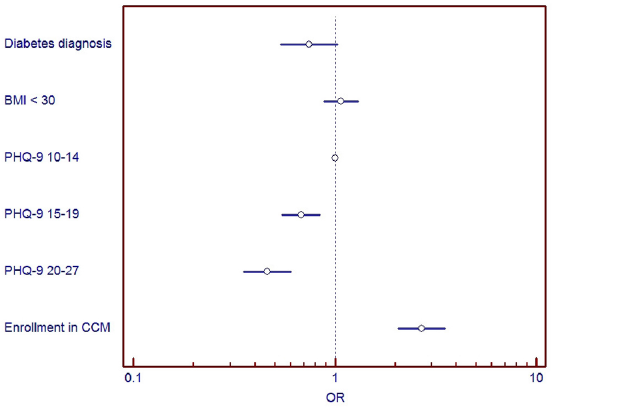
Controlling for age, gender, marital status, race, clinical diagnosis and clinical site with logistic regression modeling.
Conclusions:
▪ Baseline obesity was not an independent predictor for depression outcome at six months.
▪ Diagnosis of diabetes was not an independent predictor for depression outcome at six months.
This data suggests that obesity and diabetes were not associated with worsening clinical outcomes in depression management.
With one in ten young people being affected by ill mental health and stigma regularly cited as a factor affecting access to early intervention services, focussing resources on school based stigma reduction strategies seems prudent. ‘Headucate’, a student society, designed a 50 minute workshop which aims to increase mental health literacy and decrease stigma.
Methodology
Repeated, cross sectional surveys were carried out at three time points; 1) immediately before (n=77), 2) Immediately after (n=81) and 3) three months post workshop (n=73). The surveys were paper based versions of the Reported Intended Behaviours Score (RIBS) and Mental Health Knowledge Scale (MAKS) utilising a social distance scale.
Results
Four year 10 classed (pupils aged 14-15) were recruited. Post hoc t-tests were carried out when one-way ANOVAS were significant.
Disorder knowledge (from MAKS) and intended contact (from RIBS) significantly increased between time points one and two (p<0.01 and <0.004 respectively) but then decreased.
Analysis of the question pertaining to knowing where to access help showed a statistically significant increase (p<0.001) between time points one and two and then a decrease at time three, albeit to a higher value than at time point one (3.45 compared to 3.13, P=0.088).
Discussion
Headucate workshops offer a low resource option which is well accepted by students. Like other school based stigma reduction strategies, a dramatic increase was seen between immediately before and after indicating that the workshop resonates with the pupils, but there was little sustained change in attitudes.
Against a backdrop of poor mental health education in UK schools a group of students from Norwich Medical School have formed a student society called ‘Headucate’ in order to create, deliver and evaluate an educational intervention for adolescents, initially to be delivered in Norfolk schools.
Objectives:
To create an educational intervention that:
Is the length of a standard lesson
Is age appropriate and acceptable
Contains appropriate signposting
Contains content that challenges common myths and replaces them with knowledge
Contains content that encourages empathy and understanding towards those with mental illnesses
Is easily delivered in the same way each time so that its effectiveness can be evaluated
Aim:
To create an intervention effective at tackling stigma and empowering adolescents to recognise signs of poor mental health and access services appropriately.
Methods:
Lesson plan created after consultation with psychiatrists, a psychologist, a GP, a university outreach professional, a teacher and secondary school age children, then trialled and revised.
Results:
Interactive workshop produced with 5 sections.
1) Myth vs Fact activity that dispels prevalent myths
2) Scenario based activity to demonstrate that mental health is a spectrum
3) An interactive presentation covering the most common mental illnesses and their symptoms
4) An activity focusing on talking to those with mental illnesses, furthering the scenario from the previous activity
5) A question and answer session. Every student leaves with a leaflet containing appropriate signposting.
Conclusion:
We have created an educational intervention ready to be delivered and evaluated.
Prior studies have demonstrated an inter-relationship between the diagnosis of diabetes, obesity and depression. Our prior studies have shown that the diagnosis of diabetes or baseline body mass index (BMI) did not impact six month depression remission rates.
Objectives/Aims:
Our hypothesis was that level of control of diabetes (hemoglobulin A1c < 8.0%) in depressed diabetic patients would have no effect on depression remission rates six months after diagnosis.
Methods:
This study was retrospective analysis of 451 diabetic primary care patients diagnosed with Major Depressive Disorder or Dysthymia with a PHQ-9 score of 10 or greater.
▪ Outcome variable was clinical remission (PHQ-9 < 5) at six months.
▪ Logistic regression modeling included the demographic variables of age, gender, marital status, the clinical variables of BMI, baseline PHQ-9 score, hemoglobin A1c level (at date of diagnosis of depression) and clinical diagnosis (recurrent or first episode of depression, or dysthymia).
Results:
78.5% (354) of depressed diabetics were in good control of diabetes (hemoglobin A1c< 8%) at enrollment. Obesity (BMI≥ 30) at baseline was not different between the controlled and uncontrolled diabetic patients at baseline (approximately 70%), p=0.36.
Figure 1
Odds ratio for clinical remission (PHQ-9<5) at six months in diabetic primary care patients, by variable (N=451).
Controlling for age, gender, marital status, race, clinical diagnosis and clinical site.
Conclusion:
▪ Baseline control of diabetes was not an independent predictor for depression outcome at six months.
This data suggests that poor diabetic control was not associated worsening clinical outcomes in depression management.

Mental health education is not compulsory in the UK therefore adolescents have very varied experiences despite half of people with mental health illnesses reporting having experienced symptoms by 14 years old. University students are ideal for delivering a relaxed, educational intervention aimed at this age group, providing an opportunity to for them to learn necessary tools for recognising signs of poor mental health and tackle associated stigma.
Aim:
To expand Headucate's membership, including other disciplines within the University of East Anglia (UEA) and provide core training enabling members to deliver a school-based educational intervention
Methods:
Recruitment of members has been a multifaceted approach utilising social media sites such as Facebook and the Headucate website, and oncampus events and ‘awareness campaigns’ including several successful evening talks and lectures.
Three training sessions, which include ‘Introduction to Mental Health’, ‘Workshop run-through’ and ‘Child Protection’, have been developed for all members wishing to partake in the delivery of workshops.
Results:
We have recruited approximately 300 members since summer 2012; 70 fully paid members in 2012/13 academic year and currently 45 paid members for 2013/14.
A total of 18 members are fully trained and ready to deliver workshops within schools and 17 other members have just one training session remaining.
Conclusions:
We are looking forward to delivering our first workshops in October and building on a successful first year. We are confident we can provide workshops for approximately 600 children per year.
The symptoms of many mental illnesses often begin during high school. Interventions to improve mental health awareness amongst adolescents may lead to improved outcomes. in the UK unfortunately many schools do not fulfil this need and mental health education is not a compulsory part of the curriculum.
Aim:
To develop and measure the effectiveness of and educational intervention designed to raise awareness and empower adolescents to recognise signs of poor mental health and access services appropriately.
Objectives:
Evaluate the effectiveness of the intervention through baseline and follow up surveys.
Methods:
Students at Norwich Medical School collaborated with teachers, psychiatrists and general practitioners to design an educational intervention that aims to tackle stigma and raise awareness of mental health conditions among 13-14 year olds in the hope that they can access services when needed, support those around them and look after their mental health. To evaluate effectiveness of the intervention, a knowledge, attitudes and practices survey that utilises a social distance scale that has been adapted for this age group and will be used to gather baseline and follow up data after six months.
Results:
We have developed a one-hour educational intervention delivered by medical students, that uses a variety of teaching techniques to raise awareness of mental health issues. We will start implementation in January 2013 so will have baseline effectiveness results shortly after.
Conclusions:
Headucate has the potential to fill an important gap in effectively raising awareness of mental health issues in schools.
Perfectionism is a transdiagnostic risk factor across psychopathology. The Clinical Perfectionism Questionnaire (CPQ) was developed to assess change in order to provide clinical utility, but currently the psychometric properties of the CPQ with adolescents is unknown.
Aims:
To assess the factor structure and construct validity of the CPQ in female adolescents.
Method:
The CPQ was administered to 267 females aged 14–19 years of age. Confirmatory factor analysis (CFA) was used to examine the validity of the two-factor model and a second-order factor model. Pearson correlations were used to evaluate the relationships between the CPQ and a wide range of measures of perfectionism, psychopathology and personality traits.
Results:
The study demonstrated internal consistency, construct validity and incremental validity of the CPQ in a sample of female adolescents. The CFA in the present study confirmed the two-factor model of the CPQ with Factor 1 relating to perfectionistic strivings and Factor 2 representing perfectionistic concerns. The second-order two factor model indicated no deterioration in fit.
Conclusions:
The two-factor model of the CPQ fits with the theoretical definition of clinical perfectionism where the over-dependence of self-worth on achievement and concern over mistakes are key elements. The CPQ is suitable for use with female adolescents in future research that seeks to better understand the role of perfectionism in the range of mental illnesses that impact youth.