Temporary Disruption
We have implemented additional assurance measures to protect our systems.
As a result, we have suspended some of our systems and services. We apologise for any temporary disruption some customers may experience.
The T-shaped mixer is widely used in fundamental studies of chemical engineering. Its transitional regime is well understood, whereas the turbulent dynamics has received scarce attention so far. Here, we perform direct numerical simulations of the turbulent regime for Reynolds numbers up to  $\textit{Re}=2000$ at Schmidt number $\textit{Sc}=1$. Our analysis reveals two distinct stages along the mixing channel prior to relaxation toward duct flow. Near the junction, a jet-like flow forms and exhibits the approximately self-similar behaviour of transitional planar jets. Subsequently, a decay region characterised by power-law decay of turbulent kinetic energy, dissipation and scalar variance emerges. For the velocity field, the observed exponents are consistent with those of decaying turbulence in bounded domains, whereas the scalar-variance exponent is consistent with that of unbounded turbulence. We argue that this apparent discrepancy is a consequence of the mixing process progressing from the centre of the channel toward the sidewalls in the decay region, while turbulence already fills the channel cross-section entirely at the end of the jet region.The time-averaged mixing state presents error-function profiles of the scalar in the transverse direction, similar to the laminar cases, and is quantified here through a streamwise evolving effective diffusion coefficient.
In high-Reynolds-number wall-bounded flows, the inner-scaled wall-pressure variance is often represented as a logarithmic increase with frictional Reynolds number. We consider the two sources of the incompressible pressure–Poisson equation: a linear (rapid) term linked to mean shear and a nonlinear (slow) term composed of quadratic velocity fluctuations. This paper establishes a link between the sources and the coefficients in a logarithmic inner-scaled variance representation. To leading order we posit that the linear source provides a Reynolds-number-independent offset, while the nonlinear source contributes the logarithmic coefficient. The illustrative dataset is direct numerical simulation (DNS) at frictional Reynolds number  $\delta ^+\approx 550$, although the principal contribution is the establishment of a mechanistic link to well-known high- $\delta ^+$ scalings of wall-bounded turbulence. Through consideration of the sources and the integral solution method of the Poisson equation, we find that the linear source contribution sits predominantly in the buffer layer and maps to the near-wall cycle. To leading order, this contribution becomes $\delta ^+$ invariant under inner scaling, thus contributing an offset in the logarithmic representation. The interfacial regions between uniform momentum zones characteristic of the inertial layer (vortical fissures) spatially localise strain and vorticity contributions and contain an increasingly large proportion of the strain and vorticity. We show that fissures act as a compact carrier for the source terms, with the nonlinear term especially prominent in these regions. By considering the inertial layer statistics, we link the changing nonlinear contribution to the $\ln \delta ^+$ growth, in agreement with previous empirical observations.
We investigate the exponential growth of uncertainty energy in three-dimensional (3-D) Navier–Stokes turbulence, emphasising the intermittent and highly localised amplification/production of uncertainty, a critical factor in understanding the predictability of turbulent systems. From the Navier–Stokes equations, one can identify some key fields contributing to the growth/decay of uncertainty-production term  $P_{\varDelta }$: strain rate, vorticity and vortex deformation. The dynamics of these fields is examined in the $Q{-}R$ plane, where $Q$ and $R$ are the second and third invariants of the velocity gradient tensor, to understand their role in the evolution of uncertainty-production term $P_{\varDelta }$. We proceed by estimating committor functions across the entire spatiotemporal domain of the direct numerical simulation (DNS) of turbulence in a periodic domain at different Reynolds numbers. Our estimates of the probability of rare extreme events of the local uncertainty-production term as a function of uncertainty energy, strain rate, vorticity and vortex deformation confirm the role of strain rate in driving uncertainty. Where strain rate and vorticity are too close to their space-average values, stable probabilistic forecasts appear impossible solely based on the fields considered here.
To investigate the spanwise length scales of turbulent motions essential for sustaining near-wall turbulence, we perform numerical experiments in direct numerical simulations of full-scale turbulent channel flows by filtering out motions wider than a prescribed cutoff wavelength  $\lambda _{zf}$. As $\lambda _{zf}$ decreases, near-wall short vortical structures are suppressed, while long streaks are amplified. When $\lambda _{zf}$ is reduced to approximately 200 wall units, the flow relaminarises, indicating that at least turbulent motions twice those of near-wall coherent structures are necessary. To elucidate the underlying mechanism, we derive transport equations for Reynolds shear stresses associated separately with long streaks and short vortical structures, and decompose nonlinear transport terms into contributions from spanwise-wide motions, long streaks, short vortical structures and their interactions. Spanwise-wide motions enhance the energy production of short vortical structures by supplying energy, via nonlinear interactions, to vertical velocity fluctuations; thus, their removal suppresses these structures. Conversely, nonlinear interactions involving spanwise-wide motions act as a major energy sink for long streamwise fluctuations, so their absence amplifies streaks. However, long streaks ultimately depend on short vortical structures, as their energy is extracted from the mean shear by vertical velocity fluctuations, which draw energy from spanwise velocity fluctuations sustained by nonlinear interactions involving both short structures and spanwise-wide motions. Therefore, when short structures are strongly suppressed at sufficiently small $\lambda _{zf}$, the flow relaminarises. These findings highlight the central role of short vortical structures and their dependence on ‘inactive’ spanwise-wide turbulent motions, and reveal multiple interconnected energy cycles governing near-wall coherent structures.
This study extends the data-driven quasilinear approximation (DQLA) (Holford, Lee & Hwang 2024 J. Fluid Mech., vol. 980, A12) to compressible turbulent channel flow. The DQLA employs the eddy viscosity enhanced linearised compressible Navier–Stokes operator (Chen et al. 2023 J. Fluid Mech., vol. 962, A7), driven by stochastic forcing whose streamwise weights are determined through self-similarity assimilated from an incompressible direct numerical simulation (DNS) database, and spanwise weights are obtained by minimising discrepancies in the Reynolds stresses between the mean and the fluctuation equations. Without any compressible DNS input, the extended DQLA reproduces turbulence intensities and energy spectra in close quantitative agreement with DNS up to bulk Mach number  $\textit{Ma}_b=1.5$, and exhibits a consistent collapse of turbulence statistics across Mach numbers when expressed in semilocal units at the same centreline semilocal friction Reynolds number $\textit{Re}_{\tau c}^*$. This collapse is largely inherited from the scaling properties of the mean flow and is preserved through DQLA, consistent with Morkovin’s hypothesis. At higher Mach number ( $\textit{Ma}_b=3.0$), systematic deviations emerge, reflecting the limitations of the present modelling assumptions, particularly the neglect of nonlinear terms associated with density fluctuations. The results demonstrate the predictive capability of DQLA up to moderate Mach numbers, and establish its potential as a physically interpretable and computationally efficient framework for exploring compressible wall-bounded turbulence at high Reynolds numbers.
We investigate the equal-height, two-dimensional second-order structure function of the streamwise velocity fluctuation  $u$ in turbulent channel flow. Specifically, at a given wall-normal location $z$ we consider $S_2(r_x,r_y;z)=\langle [u(x+r_x,y+r_y,z)-u(x,y,z)]^2\rangle$, where $(r_x,r_y)$ are the streamwise and spanwise separations in a wall-parallel plane and $\langle \boldsymbol{\cdot }\rangle$ denotes wall-parallel spatial averaging. Focusing on separations within the logarithmic region, we build on Townsend’s attached-eddy hypothesis and its hierarchical random additive-process formulation to introduce an attached-eddy elliptic approximation, in which the two-point geometry is represented by an elliptic in-plane footprint. The model yields a compact prediction for $S_2(r_x,r_y;z)$: its one-dimensional projections recover the canonical logarithmic forms with an asymptotically common slope, and its iso- $S_2$ contours at fixed $z$ are predicted to be self-similar ellipses whose semi-axes scale linearly with $z$ while maintaining an approximately constant aspect ratio (with mild finite-Reynolds-number effects). These predictions are assessed using direct numerical simulations at friction Reynolds numbers $Re_\tau =1000$ and $5200$, where $Re_\tau =u_\tau \delta /\nu$, and $u_\tau$ is the friction velocity, $\nu$ is the kinematic viscosity and $\delta$ is the channel half-height. When expressed in terms of $r_i/z$ ( $i=x,y$), the projected structure functions collapse across wall-normal locations and vary linearly with $\ln (r_i/z)$. At fixed $z$, the iso- $S_2$ contours in the $(r_x,r_y)$ plane are well described by ellipses characterised by a single anisotropy parameter $R=b/a$, where $a$ and $b$ are the ellipse semi-axes in the $r_x$ and $r_y$ directions, respectively. A simple level-dependent parameterisation of $a$ and $b$ provides an accurate and parsimonious reconstruction of the two-dimensional fields. Collectively, these results establish a geometrically transparent and quantitatively predictive framework for the two-dimensional organisation of wall-attached motions in the logarithmic region, extending attached-eddy concepts beyond traditional one-dimensional formulations.
Estimation of instantaneous and statistical properties of wall-bounded turbulence across different Reynolds numbers has significant applications in scientific research and engineering, where the key challenge is to identify the Reynolds number invariance underlying the varying flow properties as Reynolds number changes. In this study, we develop a refined inner–outer interaction model (IOIM) that isolates the footprints of large-scale structures populating within a prescribed wall-normal range 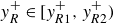 $y_{R}^+ \in [ y_{R1}^+ , y_{R2}^+ )$. When the reference layers are located within $ 80 \leqslant y_{R1}^+ \lt y_{R2}^+ \leqslant 0.3\textit{Re}_\tau$, the energy spectral densities of the isolated large-scale structures, including the wall-attached and wall-detached eddies, are found to be independent of Reynolds numbers with direct numerical simulations spanning $ \textit{Re}_\tau \sim O(10^2)$– $O(10^3)$. The spectral energy densities of the near-wall small-scale motions also show little Reynolds number dependence. The increase in near-wall turbulent kinetic energy with Reynolds number is explained from the identified Reynolds number invariance of coherent structures. Meanwhile, certain amplitude and scale modulation effects caused by large-scale structures are found to make the distribution patterns of fluctuation amplitudes and scales of near-wall structures more susceptible to Reynolds number influence. The findings of this study provide insights for the developments of predictive models for wall-bounded turbulence across different Reynolds numbers.
A new model of the mean temperature profiles within incompressible wall-bounded turbulence is developed based on a relationship between the momentum and thermal eddy diffusivities for a wide range of Prandtl numbers ( $ \textit{Pr}$). Flow media with $ \textit{Pr}$ and Schmidt numbers ( $ \textit{Sc}$) other than unity are of great engineering importance, and the proposed model for passive scalar mean profiles is able to suitably account for $ \textit{Pr}$ and $ \textit{Sc}$ variations and their effects. Existing models have a higher degree of error at the lower $ \textit{Pr}$ ranges due to significant inaccuracies of the modelled thermal eddy diffusivity in this region. Considering incompressible wall-bounded turbulence at $0.007 \leqslant \textit{Pr} \leqslant 10$, the proposed methodology reduces the average error to just around $4\,\%$ across all cases considered, lower than previously proposed models due to its ability to capture low $ \textit{Pr}$ behaviour, showcasing a new temperature–velocity relationship that can account for variations in $ \textit{Pr}$ for all the cases considered.
Turbulent pipe flow is of substantial importance in practical applications, and it remains challenging to depict the characteristic complex multiscale dynamics by a unified theoretical framework, hindered by its inherent intermittency. Inspired by a recent study of velocity circulation in turbulent channel flows from Duan, Chen & Sreenivasan (2025 J. Fluid Mech., vol. 1009, p. R4), in this study, we investigate the statistical characteristics of velocity circulation (or equally the area integral of wall-normal vorticity) over rectangular loops in concentric cylindrical shells, parallel to the pipe wall. The statistics are implemented using direct numerical simulation data at friction Reynolds numbers of  $ \textit{Re}_\tau =1057$ and $2000$. Close to the pipe wall, the circulation in the inertial range resides on space-filling unifractal sets, with the Hölder exponent smaller than Kolmogorov’s $4/3$. Away from the pipe wall, the circulation displays bifractal characteristics and the Hölder exponents for high moment orders are very close to those reported in channel flows and homogeneous isotropic turbulence. The circulation statistics are only dependent on the area enclosed by the loops, and are invariant to the loop aspect ratio, once both edge lengths of the loops are in the inertial range.
In this work, the classical Prandtl relation for the skin-friction law of incompressible turbulent channel and pipe flows is generalised to compressible cases. Specifically, based on the law of the wall and asymptotic analysis, a skin-friction transformation is proposed to map the skin-friction law of compressible turbulent channel and pipe flows to the classical Prandtl relation. It has been theoretically proven that the skin-friction coefficient  $C_{\!f,i}$ and the bulk Reynolds number $\textit{Re}_{b,i}$ for compressible turbulent channel and pipe flows, where the subscript $i$ denotes the transformed quantity obtained from the proposed skin-friction transformation, adhere to the Prandtl relation, expressed as $\sqrt {2/C_{\!f,i}}\propto \ln (\textit{Re}_{b,i}\sqrt {C_{\!f,i}/2})$. Moreover, it is quantitatively verified that the transformed $C_{\!f,i}$ and $\textit{Re}_{b,i}$, obtained from direct numerical simulations (DNS) of compressible turbulent channel flows with bulk Mach numbers ranging from $0.2$ to $4$, and friction Reynolds numbers from $200$ to $2000$, elegantly collapse into the Prandtl relation for the incompressible skin-friction law. Additionally, the transformed $C_{\!f,i}$ and $\textit{Re}_{b,i}$ from DNS of compressible turbulent pipe flows, with bulk Mach numbers ranging from $1.5$ to $3$, and friction Reynolds numbers from $200$ to $1000$, are also unified with the Prandtl relation for the incompressible skin-friction law. $\boldsymbol{Pr}\boldsymbol{\leqslant} \boldsymbol{1}$
Similarities and differences between Kolmogorov scale-by-scale equilibria/non-equilibria for velocity and scalar fields are investigated in the intermediate layer of a fully developed turbulent channel flow with a passive scalar/temperature field driven by a uniform heat source. The analysis is based on intermediate asymptotics and direct numerical simulations at different Prandtl numbers lower than unity. Similarly to what happens to the velocity fluctuations, for the fluctuating scalar field Kolmogorov scale-by-scale equilibrium is achieved asymptotically around a length scale  $r_{\textit{min}}$, which is located below the inertial range. The length scale $r_{\textit{min}}$ and the ratio between the inter-scale transfer and dissipation rates at $r_{\textit{min}}$ vary following power laws of the Prandtl number, with exponents determined by matched asymptotics based on the hypothesis of homogeneous two-point physics in non-homogeneous turbulence. The inter-scale transfer rates of turbulent kinetic energy and passive scalar variance are globally similar but show evident differences when their aligned/anti-aligned contributions are considered.
