Refine search
Actions for selected content:
28 results
Action-Driven flows for causal variational principles
- Part of
-
- Journal:
- Forum of Mathematics, Sigma / Volume 14 / 2026
- Published online by Cambridge University Press:
- 26 May 2026, e83
-
- Article
-
- You have access
- Open access
- HTML
- Export citation
ANALYSIS OF THE LAPLACIAN ON A CLASS OF NONDOUBLING CONNECTED SUMS AND MANIFOLDS WITH QUADRATICALLY DECAYING RICCI CURVATURE
- Part of
-
- Journal:
- Bulletin of the Australian Mathematical Society / Volume 113 / Issue 1 / February 2026
- Published online by Cambridge University Press:
- 17 October 2025, pp. 173-174
- Print publication:
- February 2026
-
- Article
-
- You have access
- HTML
- Export citation
Adversarial flows: A gradient flow characterization of adversarial attacks
- Part of
-
- Journal:
- European Journal of Applied Mathematics / Volume 37 / Issue 1 / February 2026
- Published online by Cambridge University Press:
- 12 September 2025, pp. 123-179
-
- Article
-
- You have access
- Open access
- HTML
- Export citation
-
A popular method to perform adversarial attacks on neural networks is the so-called fast gradient sign method and its iterative variant. In this paper, we interpret this method as an explicit Euler discretization of a differential inclusion, where we also show convergence of the discretization to the associated gradient flow. To do so, we consider the concept of $p$-curves of maximal slope in the case $p=\infty$. We prove existence of $\infty$-curves of maximum slope and derive an alternative characterization via differential inclusions. Furthermore, we also consider Wasserstein gradient flows for potential energies, where we show that curves in the Wasserstein space can be characterized by a representing measure on the space of curves in the underlying Banach space, which fulfil the differential inclusion. The application of our theory to the finite-dimensional setting is twofold: On the one hand, we show that a whole class of normalized gradient descent methods (in particular, signed gradient descent) converge, up to subsequences, to the flow when sending the step size to zero. On the other hand, in the distributional setting, we show that the inner optimization task of adversarial training objective can be characterized via $\infty$-curves of maximum slope on an appropriate optimal transport space.


Alexandrov sphere theorems for $ W^{2,n} $-hypersurfaces
- Part of
-
- Journal:
- Proceedings of the Royal Society of Edinburgh. Section A: Mathematics , First View
- Published online by Cambridge University Press:
- 26 August 2025, pp. 1-49
-
- Article
-
- You have access
- Open access
- HTML
- Export citation
-
We prove that the proximal unit normal bundle of the subgraph of a $W^{2,n} $-function carries a natural structure of Legendrian cycle. This result is used to obtain an Alexandrov-type sphere theorem for hypersurfaces in $ \mathbf{R}^{n+1} $, which are locally graphs of arbitrary $W^{2,n} $-functions. We also extend the classical umbilicality theorem to $ W^{2,1} $-graphs, under the Lusin (N) condition for the graph map.


Homogenization of vectorial free-discontinuity functionals with cohesive type surface terms
- Part of
-
- Journal:
- Proceedings of the Royal Society of Edinburgh. Section A: Mathematics , First View
- Published online by Cambridge University Press:
- 08 August 2025, pp. 1-71
-
- Article
- Export citation
Minimal Lagrangian submanifolds of weighted Kim–McCann metrics
- Part of
-
- Journal:
- Canadian Mathematical Bulletin / Volume 68 / Issue 4 / December 2025
- Published online by Cambridge University Press:
- 21 April 2025, pp. 1223-1238
- Print publication:
- December 2025
-
- Article
- Export citation
On a general matrix-valued unbalanced optimal transport problem
- Part of
-
- Journal:
- European Journal of Applied Mathematics / Volume 36 / Issue 6 / December 2025
- Published online by Cambridge University Press:
- 24 February 2025, pp. 1063-1095
-
- Article
-
- You have access
- Open access
- HTML
- Export citation
-
We introduce a general class of transport distances $\mathrm {WB}_{\Lambda }$ over the space of positive semi-definite matrix-valued Radon measures $\mathcal {M}(\Omega, \mathbb {S}_+^n)$, called the weighted Wasserstein–Bures distance. Such a distance is defined via a generalised Benamou–Brenier formulation with a weighted action functional and an abstract matricial continuity equation, which leads to a convex optimisation problem. Some recently proposed models, including the Kantorovich–Bures distance and the Wasserstein–Fisher–Rao distance, can naturally fit into ours. We give a complete characterisation of the minimiser and explore the topological and geometrical properties of the space $(\mathcal {M}(\Omega, \mathbb {S}_+^n),\mathrm {WB}_{\Lambda })$. In particular, we show that $(\mathcal {M}(\Omega, \mathbb {S}_+^n),\mathrm {WB}_{\Lambda })$ is a complete geodesic space and exhibits a conic structure.


A stability inequality for planar lens partition
- Part of
-
- Journal:
- Proceedings of the Royal Society of Edinburgh. Section A: Mathematics , First View
- Published online by Cambridge University Press:
- 27 January 2025, pp. 1-34
-
- Article
-
- You have access
- Open access
- HTML
- Export citation
A note on the Winterbottom shape
- Part of
-
- Journal:
- Proceedings of the Royal Society of Edinburgh. Section A: Mathematics / Volume 156 / Issue 5 / October 2026
- Published online by Cambridge University Press:
- 02 December 2024, pp. 2035-2048
- Print publication:
- October 2026
-
- Article
-
- You have access
- Open access
- HTML
- Export citation
Rigidity for the perimeter inequality under Schwarz symmetrization
- Part of
-
- Journal:
- Proceedings of the Royal Society of Edinburgh. Section A: Mathematics / Volume 156 / Issue 2 / April 2026
- Published online by Cambridge University Press:
- 03 June 2024, pp. 566-592
- Print publication:
- April 2026
-
- Article
-
- You have access
- Open access
- HTML
- Export citation
On the support of measures with fixed marginals with applications in optimal mass transportation
- Part of
-
- Journal:
- Canadian Mathematical Bulletin / Volume 67 / Issue 4 / December 2024
- Published online by Cambridge University Press:
- 29 May 2024, pp. 1059-1068
- Print publication:
- December 2024
-
- Article
- Export citation
-
Let $\mu $ and $\nu $ be Borel probability measures on complete separable metric spaces X and Y, respectively. Each Borel probability measure $\gamma $ on $X\times Y$ with marginals $\mu $ and $\nu $ can be described through its disintegration $\big ( \gamma _{x}\big )_{x \in X}$ with respect to the initial distribution $\mu .$ Assume that $\mu $ is continuous, i.e., $\mu \big (\{x\}\big )=0$ for all $x \in X.$ We shall analyze the structure of the support of the measure $\gamma $ provided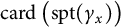 $\text {card } \big (\mathrm{spt} (\gamma _{x}) \big )$ is finitely countable for $\mu $-a.e. $x\in X.$ We shall also provide an application to optimal mass transportation.


A remark on a conjecture on the symmetric Gaussian problem
- Part of
-
- Journal:
- Proceedings of the Edinburgh Mathematical Society / Volume 67 / Issue 2 / May 2024
- Published online by Cambridge University Press:
- 15 April 2024, pp. 643-661
-
- Article
- Export citation
A Lebesgue–Lusin property for linear operators of first and second order
- Part of
-
- Journal:
- Proceedings of the Royal Society of Edinburgh. Section A: Mathematics / Volume 155 / Issue 3 / June 2025
- Published online by Cambridge University Press:
- 06 November 2023, pp. 858-868
- Print publication:
- June 2025
-
- Article
- Export citation
-
We prove that for a homogeneous linear partial differential operator $\mathcal {A}$
 of order $k \le 2$
 and an integrable map $f$
 taking values in the essential range of that operator, there exists a function $u$
 of special bounded variation satisfying\[ \mathcal{A} u(x)= f(x) \qquad \text{almost everywhere}. \]This extends a result of G. Alberti for gradients on $\mathbf {R}^N$

 . In particular, for $0 \le m < N$
 , it is shown that every integrable $m$
 -vector field is the absolutely continuous part of the boundary of a normal $(m+1)$
 -current.


Topological regularity of isoperimetric sets in PI spaces having a deformation property
- Part of
-
- Journal:
- Proceedings of the Royal Society of Edinburgh. Section A: Mathematics / Volume 155 / Issue 2 / April 2025
- Published online by Cambridge University Press:
- 09 October 2023, pp. 611-633
- Print publication:
- April 2025
-
- Article
- Export citation
-
We prove topological regularity results for isoperimetric sets in PI spaces having a suitable deformation property, which prescribes a control on the increment of the perimeter of sets under perturbations with balls. More precisely, we prove that isoperimetric sets are open, satisfy boundary density estimates and, under a uniform lower bound on the volumes of unit balls, are bounded. Our results apply, in particular, to the class of possibly collapsed $\mathrm {RCD}(K,N)$
 spaces. As a consequence, the rigidity in the isoperimetric inequality on possibly collapsed $\mathrm {RCD}(0,N)$
 spaces with Euclidean volume growth holds without the additional assumption on the boundedness of isoperimetric sets. Our strategy is of interest even in the Euclidean setting, as it simplifies some classical arguments.


Non-local approximation of free-discontinuity problems in linear elasticity and application to stochastic homogenisation
- Part of
-
- Journal:
- Proceedings of the Royal Society of Edinburgh. Section A: Mathematics / Volume 154 / Issue 4 / August 2024
- Published online by Cambridge University Press:
- 08 June 2023, pp. 1060-1094
- Print publication:
- August 2024
-
- Article
-
- You have access
- Open access
- HTML
- Export citation
-
We analyse the $\Gamma$
 -convergence of general non-local convolution type functionals with varying densities depending on the space variable and on the symmetrized gradient. The limit is a local free-discontinuity functional, where the bulk term can be completely characterized in terms of an asymptotic cell formula. From that, we can deduce an homogenisation result in the stochastic setting.

COMPACTNESS AND STRUCTURE OF ZERO-STATES FOR UNORIENTED AVILES–GIGA FUNCTIONALS
- Part of
-
- Journal:
- Journal of the Institute of Mathematics of Jussieu / Volume 23 / Issue 2 / March 2024
- Published online by Cambridge University Press:
- 10 March 2023, pp. 941-982
- Print publication:
- March 2024
-
- Article
- Export citation
-
Motivated by some models of pattern formation involving an unoriented director field in the plane, we study a family of unoriented counterparts to the Aviles–Giga functional. We introduce a nonlinear $\operatorname {\mathrm {curl}}$ operator for such unoriented vector fields as well as a family of even entropies which we call ‘trigonometric entropies’. Using these tools, we show two main theorems which parallel some results in the literature on the classical Aviles–Giga energy. The first is a compactness result for sequences of configurations with uniformly bounded energies. The second is a complete characterization of zero-states, that is, the limit configurations when the energies go to 0. These are Lipschitz continuous away from a locally finite set of points, near which they form either a vortex pattern or a disclination with degree 1/2. The proof is based on a combination of regularity theory together with techniques coming from the study of the Ginzburg–Landau energy. Our methods provide alternative proofs in the classical Aviles–Giga context.

Tight frames and related geometric problems
- Part of
-
- Journal:
- Canadian Mathematical Bulletin / Volume 64 / Issue 4 / December 2021
- Published online by Cambridge University Press:
- 18 December 2020, pp. 942-963
- Print publication:
- December 2021
-
- Article
- Export citation
-
A tight frame is the orthogonal projection of some orthonormal basis of $\mathbb {R}^n$ onto $\mathbb {R}^k.$ We show that a set of vectors is a tight frame if and only if the set of all cross products of these vectors is a tight frame. We reformulate a range of problems on the volume of projections (or sections) of regular polytopes in terms of tight frames and write a first-order necessary condition for local extrema of these problems. As applications, we prove new results for the problem of maximization of the volume of zonotopes.


Optimal free export/import regions
- Part of
-
- Journal:
- Canadian Mathematical Bulletin / Volume 64 / Issue 4 / December 2021
- Published online by Cambridge University Press:
- 17 September 2020, pp. 737-751
- Print publication:
- December 2021
-
- Article
- Export citation
-
We consider the problem of finding two free export/import sets $E^+$ and $E^-$ that minimize the total cost of some export/import transportation problem (with export/import taxes $g^\pm $), between two densities $f^+$ and $f^-$, plus penalization terms on $E^+$ and $E^-$. First, we prove the existence of such optimal sets under some assumptions on $f^\pm $ and $g^\pm $. Then we study some properties of these sets such as convexity and regularity. In particular, we show that the optimal free export (resp. import) region $E^+$ (resp. $E^-$) has a boundary of class $C^2$ as soon as $f^+$ (resp. $f^-$) is continuous and $\partial E^+$ (resp. $\partial E^-$) is $C^{2,1}$ provided that $f^+$ (resp. $f^-$) is Lipschitz.


An Endpoint Alexandrov Bakelman Pucci Estimate in the Plane
- Part of
-
- Journal:
- Canadian Mathematical Bulletin / Volume 62 / Issue 3 / September 2019
- Published online by Cambridge University Press:
- 11 January 2019, pp. 643-651
- Print publication:
- September 2019
-
- Article
-
- You have access
- Export citation
-
The classical Alexandrov–Bakelman–Pucci estimate for the Laplacian states
where $$\begin{eqnarray}\max _{x\in \unicode[STIX]{x03A9}}|u(x)|\leqslant \max _{x\in \unicode[STIX]{x2202}\unicode[STIX]{x03A9}}|u(x)|+c_{s,n}\text{diam}(\unicode[STIX]{x03A9})^{2-\frac{n}{s}}\Vert \unicode[STIX]{x0394}u\Vert _{L^{s}(\unicode[STIX]{x03A9})},\end{eqnarray}$$ $\unicode[STIX]{x03A9}\subset \mathbb{R}^{n}$, $u\in C^{2}(\unicode[STIX]{x03A9})\cap C(\overline{\unicode[STIX]{x03A9}})$ and $s>n/2$. The inequality fails for $s=n/2$. A Sobolev embedding result of Milman and Pustylnik, originally phrased in a slightly different context, implies an endpoint inequality: if $n\geqslant 3$ and $\unicode[STIX]{x03A9}\subset \mathbb{R}^{n}$ is bounded, then where
 $$\begin{eqnarray}\max _{x\in \unicode[STIX]{x03A9}}|u(x)|\leqslant \max _{x\in \unicode[STIX]{x2202}\unicode[STIX]{x03A9}}|u(x)|+c_{n}\Vert \unicode[STIX]{x0394}u\Vert _{L^{\frac{n}{2},1}(\unicode[STIX]{x03A9})},\end{eqnarray}$$ $L^{p,q}$ is the Lorentz space refinement of $L^{p}$. This inequality fails for $n=2$, and we prove a sharp substitute result: there exists $c>0$ such that for all $\unicode[STIX]{x03A9}\subset \mathbb{R}^{2}$ with finite measure, This is somewhat dual to the classical Trudinger–Moser inequality; we also note that it is sharper than the usual estimates given in Orlicz spaces; the proof is rearrangement-free. The Laplacian can be replaced by any uniformly elliptic operator in divergence form.
 $$\begin{eqnarray}\max _{x\in \unicode[STIX]{x03A9}}|u(x)|\leqslant \max _{x\in \unicode[STIX]{x2202}\unicode[STIX]{x03A9}}|u(x)|+c\max _{x\in \unicode[STIX]{x03A9}}\int _{y\in \unicode[STIX]{x03A9}}\max \left\{1,\log \left(\frac{|\unicode[STIX]{x03A9}|}{\Vert x-y\Vert ^{2}}\right)\right\}|\unicode[STIX]{x0394}u(y)|dy.\end{eqnarray}$$


On the boundary regularity of phase-fields for Willmore's energy
- Part of
-
- Journal:
- Proceedings of the Royal Society of Edinburgh. Section A: Mathematics / Volume 149 / Issue 4 / August 2019
- Published online by Cambridge University Press:
- 27 December 2018, pp. 1017-1035
- Print publication:
- August 2019
-
- Article
- Export citation