To save content items to your account,
please confirm that you agree to abide by our usage policies.
If this is the first time you use this feature, you will be asked to authorise Cambridge Core to connect with your account.
Find out more about saving content to .
To save content items to your Kindle, first ensure no-reply@cambridge.org
is added to your Approved Personal Document E-mail List under your Personal Document Settings
on the Manage Your Content and Devices page of your Amazon account. Then enter the ‘name’ part
of your Kindle email address below.
Find out more about saving to your Kindle.
Note you can select to save to either the @free.kindle.com or @kindle.com variations.
‘@free.kindle.com’ emails are free but can only be saved to your device when it is connected to wi-fi.
‘@kindle.com’ emails can be delivered even when you are not connected to wi-fi, but note that service fees apply.
This chapter examines the planning of the German invasion of the Soviet Union. It sketches Hitler’s long-term economic and ideological motives for seeking to conquer the country, before examining the strategic considerations that determined the invasion’s particular timing in June 1941. Wehrmacht planners’ confidence was boosted by intelligence assessments that overlooked the less-than-overwhelming superiority of the German armed forces and underestimated Soviet military and economic potential. It was also boosted by their identification with the invasion’s ideological goals. Thus were the Panzer divisions and their air support, on which success depended more than anything else, committed to too many targets simultaneously, and the risk grew of a lengthy war in which superior Soviet resources would be increasingly likely to prevail. The chapter also sketches the peripheral roles played by Germany’s Axis allies in the invasion and the under-strength forces that the planners of Barbarossa would commit to rear area security. This underpowered occupation force would be compelled to cooperate closely with the SS and police in its efforts to control the occupied territories. This relationship, together with the Wehrmacht’s own ideological proclivities and harsh perception of military necessity, would help precipitate its deep involvement in Nazi crimes in the East.
The German army invaded the Soviet Union in hopes of destroying it in a blitz campaign in 1941. Its professional and experienced officer corps utilized Auftragstaktik to achieve early victories on the battlefield. The men they led were well-motivated, generally well-trained, loyal to the Nazi regime, and confident in victory. The emphasis on tactical flexibility and independence helped balance out the army’s numerical inferiority in weapons and equipment. The enormous casualties suffered in 1941 and early 1942, however, ensured that the army’s qualitative edge soon dulled, leading to complete defeat.
Collective memory of a historical event does not depend on its contemporary and historiographical significance alone. Germany’s selective memory of the Eastern Front is a case in point. It has been influenced by four developments. The problem of the prisoners of war that had remained in the Soviet Union, the ‘returnees’, and the veterans underlined the importance of the Eastern Front among the West German public. The Stalingrad myth, in particular, had a decisive influence on an image of war (in the East), according to which the Germans considered themselves first and foremost victims of that war. The critical discussion of the war and its nexus with the Holocaust after 1970 led to a turning point wherein the victims of the Germans became the focus of remembrance in West Germany. In the socialist satellite state of East Germany, the heroization of the Red Army was a characteristic feature of public war memories. Commemorations of the Eastern Front changed again in unified Germany after the Cold War – from the early years of Russia’s rapprochement to the dramatic deterioration of the German-Russian relationship.
The chapter focuses on Germany’s international relations, the development of the German army and military policy, the domestic consequences of military policy, and the origins of war in 1914.
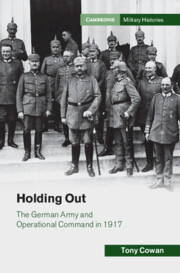
This is a ground-breaking study of German operational command during a critical phase of the First World War from November 1916 to the eve of the third battle of Ypres. The situation faced by the German army on the Western Front in 1917 was very different from the one anticipated in pre-war doctrine and Holding Out examines how German commanders and staff officers adapted. Tony Cowan analyses key command tasks to get under the skin of the army's command culture, internal politics and battle management systems from co-ordinating the troops, matériel and different levels of command needed to fight a modern battle to continuously learning and applying lessons from the ever-changing Western Front. His detailed analysis of the German defeat of the 1917 Entente spring offensive sheds new light on how the army and Germany were able to hold out so long during the war against increasing odds.
The American Civil War presented an exceptional state of affairs in modern warfare, because strong personalities could embed their own command philosophies into field armies, due to the miniscule size of the prior US military establishment. The effectiveness of the Union Army of the Tennessee stemmed in large part from the strong influence of Ulysses S. Grant, who as early as the fall of 1861 imbued in the organization an aggressive mind-set. However, Grant’s command culture went beyond simple aggressiveness – it included an emphasis on suppressing internal rivalries among sometimes prideful officers for the sake of winning victories. In the winter of 1861 and the spring of 1862, the Army of the Tennessee was organized and consolidated into a single force, and, despite deficits in trained personnel as compared to other Union field armies, Grant established important precedents for both his soldiers and officers that would resonate even after his departure to the east. The capture of Vicksburg the following summer represented the culminating triumph of that army, cementing the self-confident force that would later capture Atlanta and win the war in the western theater.
German military history of 1871 to 1945 is often seen as a direct continuation of Prussian military history. Taking a closer look at the organizational and cultural background of German military forces produces a slightly more nuanced picture and makes it possible to divide the history of the German Army into five phases. Initially, the German Empire effectively had four different forces – the Prussian, Bavarian, Saxon, and Württemberg armies – united only in times of war. During the First World War, these German "armies" increasingly lost their prewar independence, while the war itself had a unifying effect on German society and on its armed forces. Following the defeat of 1918, the army of the newly founded Weimar Republic was developed as a small, elite force exclusively based on Prussian traditions. The 1936 rearmament then turned this force into a mass army, the Wehrmacht, which, while still sticking to Prussian traditions, struggled with various issues caused by rapid expansion. Finally, during the Second World War, the Wehrmacht evolved from a purely German force into one in which significant numbers of foreigners from all over Europe served as volunteers, resulting in an army transcending the boundaries of the nation-state.
Recommend this
Email your librarian or administrator to recommend adding this to your organisation's collection.