Purchasing features are currently disabled. We are working to restore these as soon as possible. For purchasing or other enquiries during these times, please contact your local Customer Services team. UK/ROW directcs@cambridge.org +44 (0) 1223 326050 | US customer_service@cambridge.org 1 800 872 7423 or 1 212 337 5000 | Australia/New Zealand enquiries@cambridge.edu.au
Published in association with the British Society for Eighteenth-Century Studies, this series presents the best current multidisciplinary research on the global eighteenth century.<br><br>The eighteenth century was an age of instability, conflict, revolution and war, which saw profound political, economic, social and cultural change. It was an era that sparked a variety of 'isms': liberalism, capitalism, socialism, feminism, cosmopolitanism, conservatism, romanticism, colonialism and racism. Furthermore, it was an age in which today’s disciplinary and topographical borders were emerging but not yet fixed. With these ideas of flux at the forefront of its rationale, this series promotes fruitful dialogue between the different disciplines involved in all aspects of the study of the long eighteenth century (c.1660-1820).
To save content items to your account,
please confirm that you agree to abide by our usage policies.
If this is the first time you use this feature, you will be asked to authorise Cambridge Core to connect with your account.
Find out more about saving content to .
To save content items to your Kindle, first ensure no-reply@cambridge.org
is added to your Approved Personal Document E-mail List under your Personal Document Settings
on the Manage Your Content and Devices page of your Amazon account. Then enter the ‘name’ part
of your Kindle email address below.
Find out more about saving to your Kindle.
Note you can select to save to either the @free.kindle.com or @kindle.com variations.
‘@free.kindle.com’ emails are free but can only be saved to your device when it is connected to wi-fi.
‘@kindle.com’ emails can be delivered even when you are not connected to wi-fi, but note that service fees apply.
Captures in unprecedented depth the cultural significance of the designed landscape and its relationship with Bluestocking philosophy.
Situated within the broader context of eighteenth-century intellectual and cultural history, this collection redefines the role of the Bluestocking circle in shaping Britain's landscapes and social ideals. Against the backdrop of Whiggish notions of "improvement"-encompassing agricultural innovation, aesthetic refinement, and moral progress-it explores how women such as Elizabeth Montagu, Mary Delany, and Elizabeth Carter navigated the intersections of polite sociability, intellectual production, and estate management. Their contributions reveal a dynamic interplay between cultural critique and practical reform, positioning them as active participants in the period's debates on land, labour, and national identity.
Drawing on insights from the Elizabeth Montagu's Correspondence Online (EMCO) project, these essays uncover the creative and social tensions embedded in iconic estates such as Montagu's Sandleford and Lord Lyttelton's Hagley Hall. They delve into the poetic and philosophical musings of James Woodhouse, the sociable artistry of Mary Delany, and the symbolic landscapes of Wrest Park. By examining correspondence, poetry, visual arts, and cartography, this volume offers an unprecedented exploration of the ways Bluestocking women engaged with and redefined the designed landscape as a site of intellectual and environmental innovation.
This interdisciplinary collection reshapes the historiography of gender, environment, and cultural progress, offering fresh insights into the enduring significance of eighteenth-century landscapes and the intellectual communities that shaped them.
Reframes the study of Welsh cultural revivalism, highlighting transnational and imperial contexts.
In the long eighteenth century, as Britain grappled with the aftermath of the 1707 Acts of Union and consolidated a global empire, Welsh 'Cambro-Britons' developed a movement of cultural awakening, reinventing their traditions for a new age. Amid profound local, national and imperial transformations, Welsh authors and activists sought to reimagine their history, language and literature, claiming a place for Wales and the Welsh diaspora in the British imperial order. Far from being an insular phenomenon, this revival intersected with key debates of the era, from enlightenment science and radical politics to colonial expansion, transatlantic abolitionism and metropolitan sociability.
This study reframes Welsh cultural revivalism, revealing its fundamentally international and archipelagic dimensions. Nationally significant Welsh authors like Lewis Morris, David Samwell, Thomas Pennant, and Iolo Morganwg are placed in their transnational, imperial, and global contexts. Examined alongside Thomas Gray's British bardism, William Jones's Orientalism, and the imperialism of Cook's voyages, their writings demonstrate how Welsh thinkers engaged with - and shaped - shifting ideas of Britishness, empire, race, and identity. Drawing on new archival research, and giving equal attention to Welsh and English language texts, Rhys Kaminski-Jones challenges traditional narratives of Welsh cultural nationalism as a simple precursor to modern Welsh nationhood, instead positioning the revival as central to transatlantic intellectual currents. With its pathbreaking bilingual and interdisciplinary approach, this book offers fresh insights into the complexities of nationhood, empire, and cultural memory.
The first comprehensive study of Britain's coastal policing and administration across the long eighteenth century.
Throughout Britain's past its coast has presented security concerns. Despite this long history of raids, smugglers and warfare, consistent, designated and permanent coastal enforcement bodies were only established in England in the 1690s. Initially a reaction to the threats of the Nine Years' Wars, their creation spoke to a new understanding of "The Coast" as a politically distinct and liminal space - a region neither land nor sea - with its own issues and social dynamics that had to be controlled through new, more sophisticated, methods.
This study explores the circumstances that both necessitated a formalised policing of coastal areas and influenced the subsequent development of these enforcement bodies, showing how their missions and practices fluctuated in relation to key political events and economic policies across the century. In doing so, the book encompasses a long eighteenth century, starting with political developments in the run-up to the Glorious Revolution and ending with the overhaul of coastal bureaucracies in the wake of the Napoleonic Wars.
In conjunction with this larger historical sweep, through extensive archival research, the book reveals the failures in coastal policing, arguing that these shortcomings stemmed not from the cunning of smugglers or bureaucratic inefficiency but from inherent contradictions in Britain's imperial ambitions. In highlighting the complexities of this watery borderland, Hannes Ziegler sheds new light on the inner workings of Britain's fiscal-military enterprises and state-building challenges of its evolving imperial identity.
A gateway to the complex world of eighteenth-century sociability of elite women and of their lasting impact on modern concepts of national identity and community.
In the dynamic intellectual and social landscape of eighteenth-century Northern Europe, the interplay between patriotism, nationalism, and cosmopolitanism was pivotal in shaping the era's cultural and political discourse. This study delves into the intricate networks of elite women who navigated and influenced these concepts through their participation in salons and literary circles. By examining figures such as Anna Amalia of Weimar, Dorothea von Kurland, members of the Bluestockings, Friederike Brun and the grande Dame of eighteenth-century salon world, Mme de Staël, the narrative uncovers how these women fostered transnational dialogues and cultural exchanges that were crucial in redefining public spirit and national identity.
Grounded in extensive archival research and touching on the lives of over twenty-five individuals, the work highlights the nuanced roles these women played as cultural mediators and agents of change across national borders, challenging the traditional male-dominated historiography. The exploration of their contributions offers fresh insights into the interconnectedness of European intellectual life and the critical role of gender in shaping historical discourses. This book not only broadens our understanding of the Enlightenment but also provides a rich, interdisciplinary perspective on the socio-political transformations of the era.
Indispensable for understanding the historical forces that shaped modern governance.
How did Enlightenment philosophy shape the modern bureaucratic state? While thinkers like Adam Smith and David Hume are celebrated for their contributions to political economy, the crucial work of administrative reformers has largely been forgotten-until now. Here, this question is explored through the untold story of the specialists of public administration, such as the Commissioners for Examining the Public Accounts, whose pioneering efforts to translate political economy into practice laid the foundation for contemporary public administration.
This methodologically refined study re-evaluates Britain's administrative reforms of the late eighteenth century. It traces how systematic, resource-oriented administrative rationality replaced patrimonial notions of office, which treated public offices as royal privileges similar to titles of nobility. Sebastian Meurer relates the British reforms to contemporary administrative reform processes in British India and Ireland and reveals their manifold interconnections. Furthermore, the book offers an analysis of the very process, in which new notions pervaded public administration and traces the interrelations of different perspectives and their gradual shift of credibility.
By connecting the rise of public administration with the early social sciences, this monograph illuminates how ideas once confined to philosophical discourse were adapted into the practical realities of governance, reform, and statecraft across the British Empire.
Using pedagogy as a lens through which to explore issues of gender, social class, power and hegemony, Cohen's study makes a major new contribution to the study of education in eighteenth-century England.
'Cheap' genres of print such as ballads, almanacs and playing cards were part of everyday life in seventeenth-century society - ubiquitous and disposable. Toward the end of the century, however, individuals began to preserve, arrange and display articles of cheap print within carefully curated collections. What motivated this sudden urge to preserve the ephemeral? This book answers that question by analysing the social, political and intellectual factors behind the formation of cheap print collections, how these collections were used by their owners, and what this activity can tell us about 'print culture' in the early modern period.
The book's central collector is John Bagford (1650-1715), a shoemaker who became a dealer of prints and other 'curiosities' to important collectors of the time such as Samuel Pepys, Hans Sloane and Robert Harley. Bagford's own rich and largely unstudied collection is a fascinating study in its own right and his position at the centre of commercial and intellectual networks opens up a whole world of collecting. This world encompasses later Stuart partisan political culture, when modern parties and the 'public sphere' first emerged; the 'New Science' and 'virtuoso culture' with its milieu of natural philosophers, antiquaries and artisans; the aural and visual landscape of marketplaces, streets and alehouses; and developing practices of record-keeping, life-writing and historical writing during the long eighteenth century.
This book explores the processes by which the people of Edinburgh came to understand and order their world and establish those scales of judgement through the acquisition of geographic knowledge.
An intriguing case study on how popular images of Oceania, mediated through a developing culture of celebrity, contributed to the formation of British identity both domestically and as a nascent imperial power in the eighteenth century.
A study of the literature of the 'art of travel' in eighteenth-century France, showing how consideration of who should travel and for what purpose provided an occasion for wider debate about the social status quo.
A methodologically innovative account of the role of women writers in the development of early psychological theory and practice in the long eighteenth century.
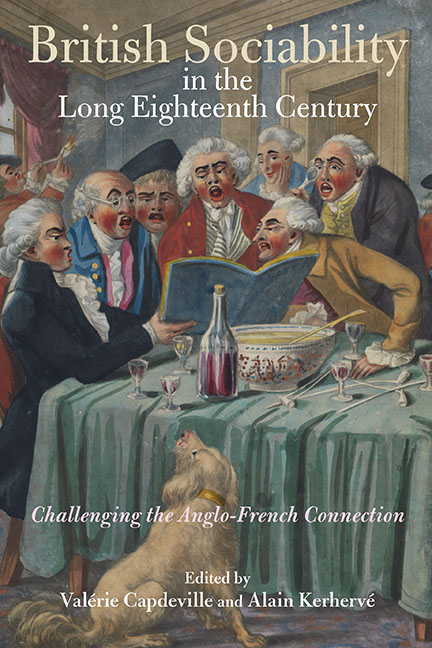
This innovative collection explores how a distinctively British model of sociability developed in the period from the Restoration of Charles II to the early nineteenth century through a complex process of appropriation, emulation and resistance to what was happening in France and other parts of Europe.
Recommend this
Email your librarian or administrator to recommend adding this to your organisation's collection.