

Modern Compiler Implementation in Java
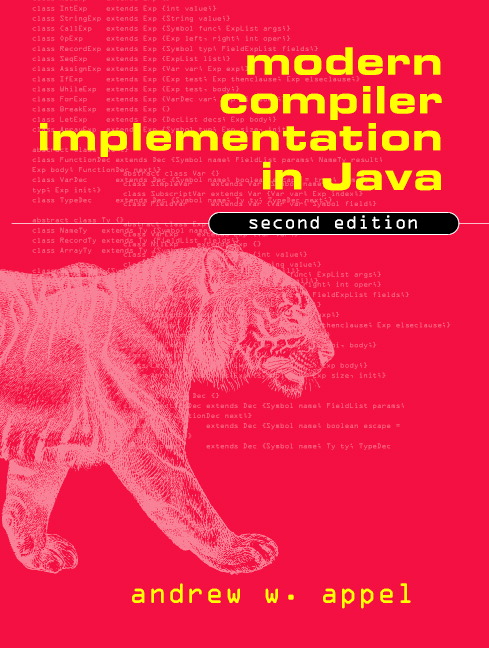
Modern Compiler Implementation in Java
This textbook describes all phases of a compiler: lexical analysis, parsing, abstract syntax, semantic actions, intermediate representations, instruction selection via tree matching, dataflow analysis, graph-coloring register allocation, and runtime systems. It includes thorough coverage of current techniques in code generation and register allocation, and the compilation of functional and object-oriented languages. The most accepted and successful techniques are described and illustrated with actual Java^TM® classes. The first part is suitable for a one-semester first course in compiler design. The second part; which includes the compilation of object-oriented and functional languages, garbage collection, loop optimization, SSA form, instruction scheduling, and optimization for cache-memory hierarchies; can be used for a second-semester or graduate course. This new edition includes more discussion of Java and object-oriented programming concepts such as visitor patterns plus a new Mini-Java programming project. A unique feature is the newly redesigned compiler project in Java for a subset of Java itself. The project includes both front-end and back-end phases.
- The new edition features a newly designed, easy-to-use software project in Java for a subset of Java itself
- Expanded coverage of object-oriented concepts; also includes coverage of imperative and functional languages
- Keeps up with the revolution in computer architecture since 1985, including practical back-end issues not available in most texts, with current techniques in instruction selection, code generation and register allocation
Reviews & endorsements
"...fit[s] comfortably and usefully between cookbooks and encyclopedias on compilation...suitable for self-study." Computing Reviews
"A well-written book, which strictly adheres to a no-nonsense style." Computing Reviews
Product details
- Published: October 2002
- Format: Hardback
- ISBN: 9780521820608
- Length: 512 pages
- Dimensions: 257 × 208 × 33 mm
- Weight: 1.051kg
- Contains: 80 b/w illus. 35 tables 135 exercises
- Availability: Available
Related links





Table of Contents
- Part I. Fundamentals of Compilation:
- 1. Introduction
- 2. Lexical analysis
- 3. Parsing
- 4. Abstract syntax
- 5. Semantic analysis
- 6. Activation records
- 7. Translation to intermediate code
- 8. Basic blocks and traces
- 9. Instruction selection
- 10. Liveness analysis
- 11. Register allocation
- 12. Putting it all together
- Part II. Advanced Topics:
- 13. Garbage collection
- 14. Object-oriented languages
- 15. Functional programming languages
- 16. Polymorphic types
- 17. Dataflow analysis
- 18. Loop optimizations
- 19. Static single-assignment form
- 20. Pipelining and scheduling
- 21. The memory hierarchy
- Appendix: Mini-Java reference manual.
- Show more



