
 |


|
|
|
 Home
> ELT > The New Cambridge English
Course > NCEC Forum > Sentence
Halves Home
> ELT > The New Cambridge English
Course > NCEC Forum > Sentence
Halves |
|
 |
Sentence HalvesCatherine Higham |
|
|
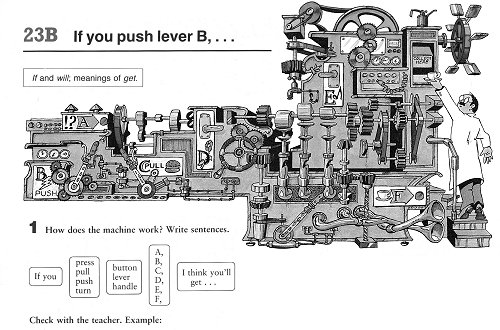
This activity is designed to be used with The New Cambridge English Course 1 Unit 23, lesson B.
|
|
If you lie to me, He'll call me |
|
you'll be sorry. if he discovers anything. |
Collect the papers from students when they have finished, and mix them up well. Divide the class into two or three teams as explained above and ask each team to choose a representative, preferably one who won't mind getting down on all fours to pick up the pieces of paper from the floor! Throw the papers up in the air; team representatives must pick up as many pieces of paper as possible and take them back to the rest of their team. Teams now make as many logical sentences as possible and place the two halves together on their desks so that counting may be easier. An example of a correctly matched sentence would be:
|
if he discovers anything |
|
you'll be sorry. |
The following sentence would not be an accepted logical sentence:
|
if you lie to me, |
|
He'll call me |
Obviously, punctuation cannot be taken into account for the activity, as it would limit possibilities. Teams will be left with odd pieces of paper which cannot be used. At this point, correct finished sentences may be counted, but if time permits, the left-overs can then be thrown up again for new opportunities to match. When time is up, or possibilities exhausted, count each team's complete sentences; the team with most correct answers wins.

The advantage of this activity is that students themselves prepare the material; it is therefore learner-centred. It is also very active and motivating due to the competitive element.
Catherine Higham is Academic Consultant, CUP Mexico
|
|
 Aim:
Aim: