 |


|
|
|
 Home
> ELT > The New Cambridge English
Course > NCEC Forum > Task-Based
Learning Home
> ELT > The New Cambridge English
Course > NCEC Forum > Task-Based
Learning |
|
 |
The New Cambridge English Course and Task-Based LearningAlejandro G. Martinez |
|
|
English language teaching is a dynamic profession so new ideas, methods and a wider range of options are being constantly incorporated into the language classroom. One of these is Task-based learning (TBL), a way of teaching that sprang from the dissatisfaction with the outcomes produced by the Communicative Language Teaching Approach. Rather than contradicting CLT, TBL draws on it and tries to avoid its pitfalls. One of the main aspects of CLT that has been criticised is the fact that even though meaning and communication are its main tenets, a structural syllabus is still the actual centre. In other words, it really consists of a list of structures and functions taught in a communicative disguise. On the other hand, the central part of TBL is meaning too, but language is taught through a series of tasks. These are activities whose aim is not necessarily for students to practise a specific linguistic point but to use language to work towards a goal (Skehan, 1998). Tasks are outcome evaluated and have a relationship with the real world (Foster and Skehan, 1996). Often problem solving is an element present in tasks: in order to solve a certain problem students need to use the target language. Students accomplish this by using whatever language resources they possess, and as they move along they notice the gap between what they already know and what they need to learn or improve so that they can carry out a specific task in English. Willis (1998) has explained that there are three stages in TBL: pre-task, task cycle and post-task or language focus. In the pre-task part, students might see other students carrying out the same task or planning what they need to say in order to do the task. The task is done generally in pairs or groups and the outcome is evaluated, that is to say, students report whether they were able to reach the aim of the task, and how they did it. In the post-task stage teachers can give learners a chance to focus on form. Most textbooks can be adapted to conform to TBL. This is easier than it sounds and the following examples taken from The New Cambridge English Course should clarify it.
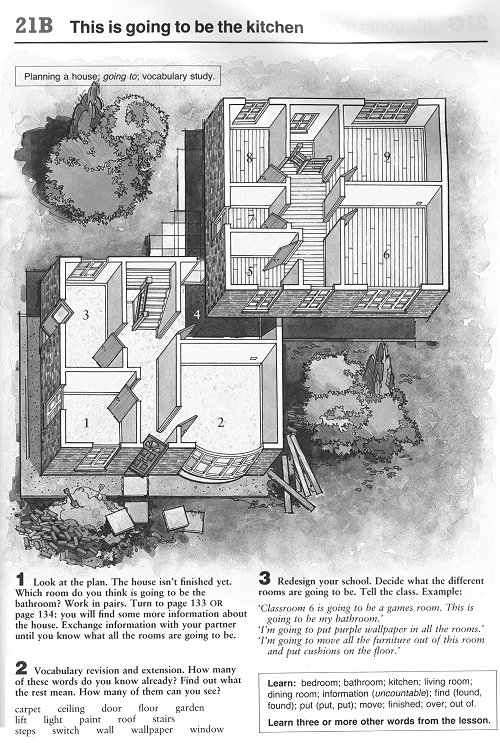
The first activity of Lesson B Unit 21 of Level 1 includes several features of TBL. First, it has a connection with the real world, since it is something students might do in their real lives. Second, the task is done in pairs and there is a problem-solving element and students need to use English so that they find a solution. The post-task element can include asking two pairs to report to the rest of the class how they worked out whose room is which.
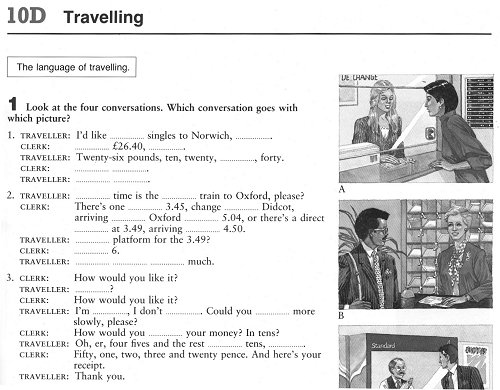
Lesson D of Unit 10 of Level 1 is an example of an activity that can easily become a task. Before they go over the conversations, they just look at the pictures on the right hand side of the page. It is obvious where the people are and what they are trying to do, so in pairs they decide what each customer is saying/asking. At this level it is enough if they focus on the customers'side only. They write down two or three questions in each case. This should be done in English. However, it cannot be expected that at this point students will produce sentences in perfect English. For instance, in the case of the first conversation students may write something like: 'Can change this?' or 'I change money.' Once they have done this, they listen to the tape and try to match the conversations with the pictures. The next step is then to compare the conversations with the questions they have written down. This means that they get a chance to see the gap between their interlanguage and the target structures which is an important stage in language acquisition (Skehan, 1998). So with a little preparation, textbooks such as The New Cambridge English Course can be easily adapted to TBL, a meaning-based way of teaching that is becoming popular in language classrooms. REFERENCES: Skehan, P. 1998 Task-based instruction. Annual Review of
Applied Linguistics 18. 268-286 Foster, P. and Skehan, P. 1996 The Influence
of Planning and Task Type on Second Language Performance. Studies in Second
Language Acquisition 18. 299-323 Willis, J. 1998 Task-based learning.
English Teaching Professional 9. 3-6. Alejandro G. Martinez is Academic
Consultant, CUP Mexico and Central America |
|
|
|