
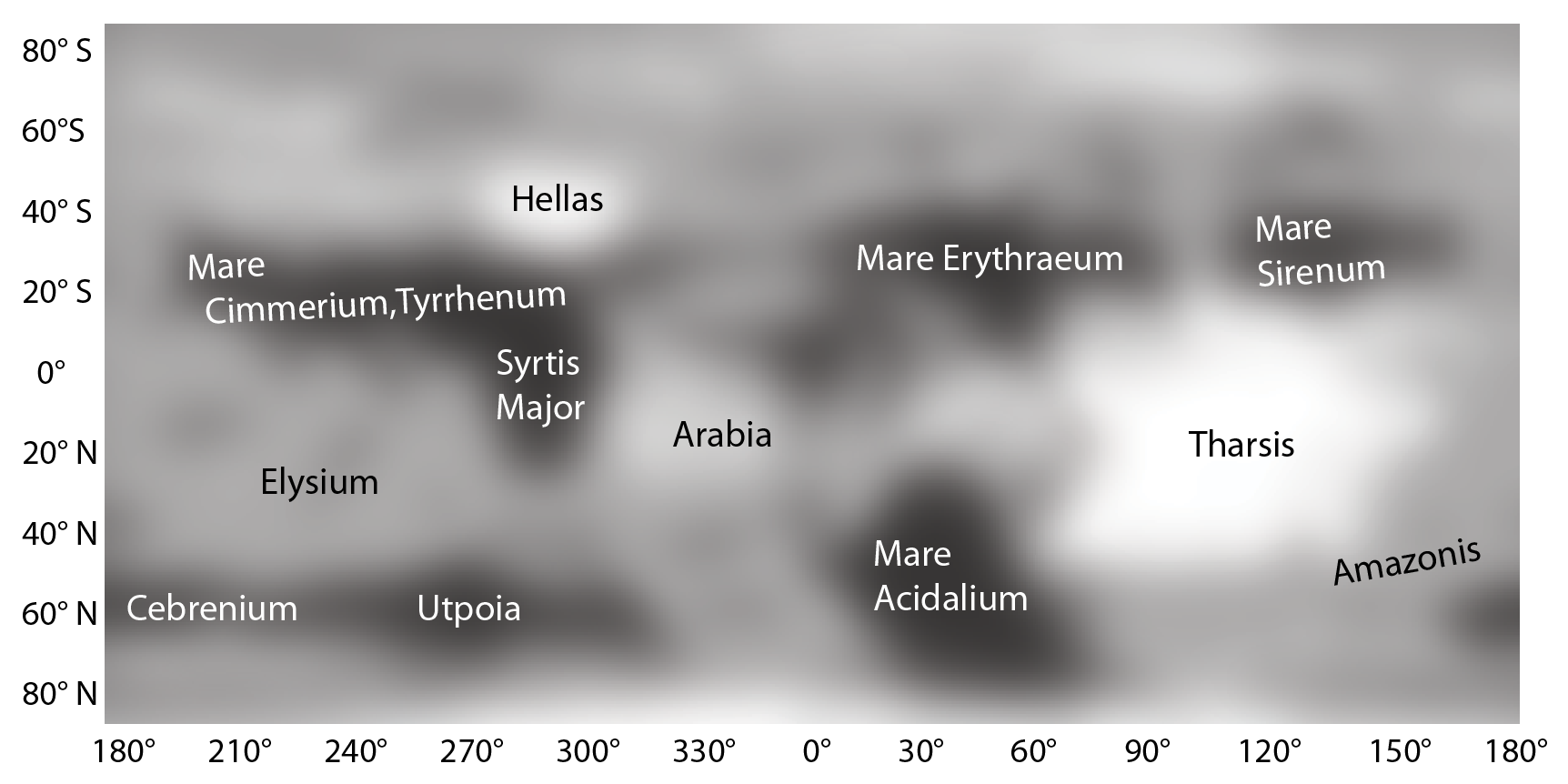
The most prominent feature you’ll likely see is a white polar cap, especially the southern one, which is generally larger and oriented towards us during the best oppositions. In addition, look for a large dark triangle, pointing to the north, called Syrtis Major; or a dark region toward the north, Mare Acidalium. Which one is visible depends on which side of Mars is facing Earth. One Martian day (or sol) lasts 24 hours and 37 minutes, so from one night to the next you’ll see almost the same side of the planet.
Mars has a thin atmosphere, with clouds and dust storms sometimes visible in a small telescope. Thin white clouds are most often seen in an area just north of the equator, a region of volcanoes known as Tharsis. Observing Mars with a blue filter helps make these clouds stand out.
Along with clouds, the Martian winds stir up planet-wide dust storms. Sometimes, as in 2018, they can make Mars look pretty much featureless. Lesser dust storms can also occur, covering smaller areas of the planet. A red filter can help you spot these storms.
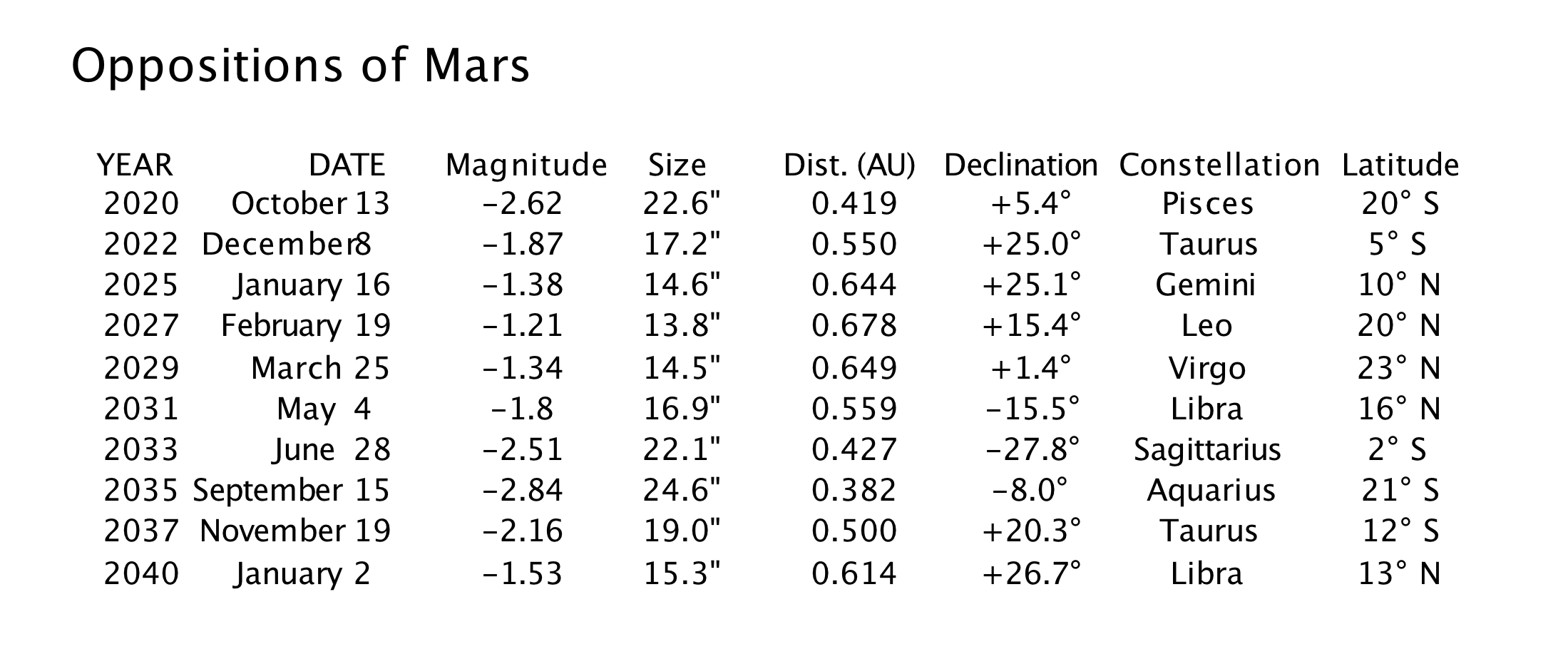
The best oppositions (when Mars is closest so it looks biggest and brightest), between 2020 and 2040 are in 2020, 2033, and 2035. Unfortunately for northern observers, when Mars is at a northern declination from 2022 through 2027, it appears quite small. In the periods 2020-2022 and 2033-2037 we are looking down onto the southern hemisphere of Mars, making its prominent southern polar quite prominent. The rest of the time (2025-2031, and again in 2040) our view is centered on a northern latitude of Mars.