
Uranus and Neptune are faint and small compared to the other planets – but each is fun to find and interesting to observe. Their tiny green and blue disks stand out is surprisingly well. They’re easiest to see near midnight around opposition (or a month or so after, if you prefer the early evening).
Uranus
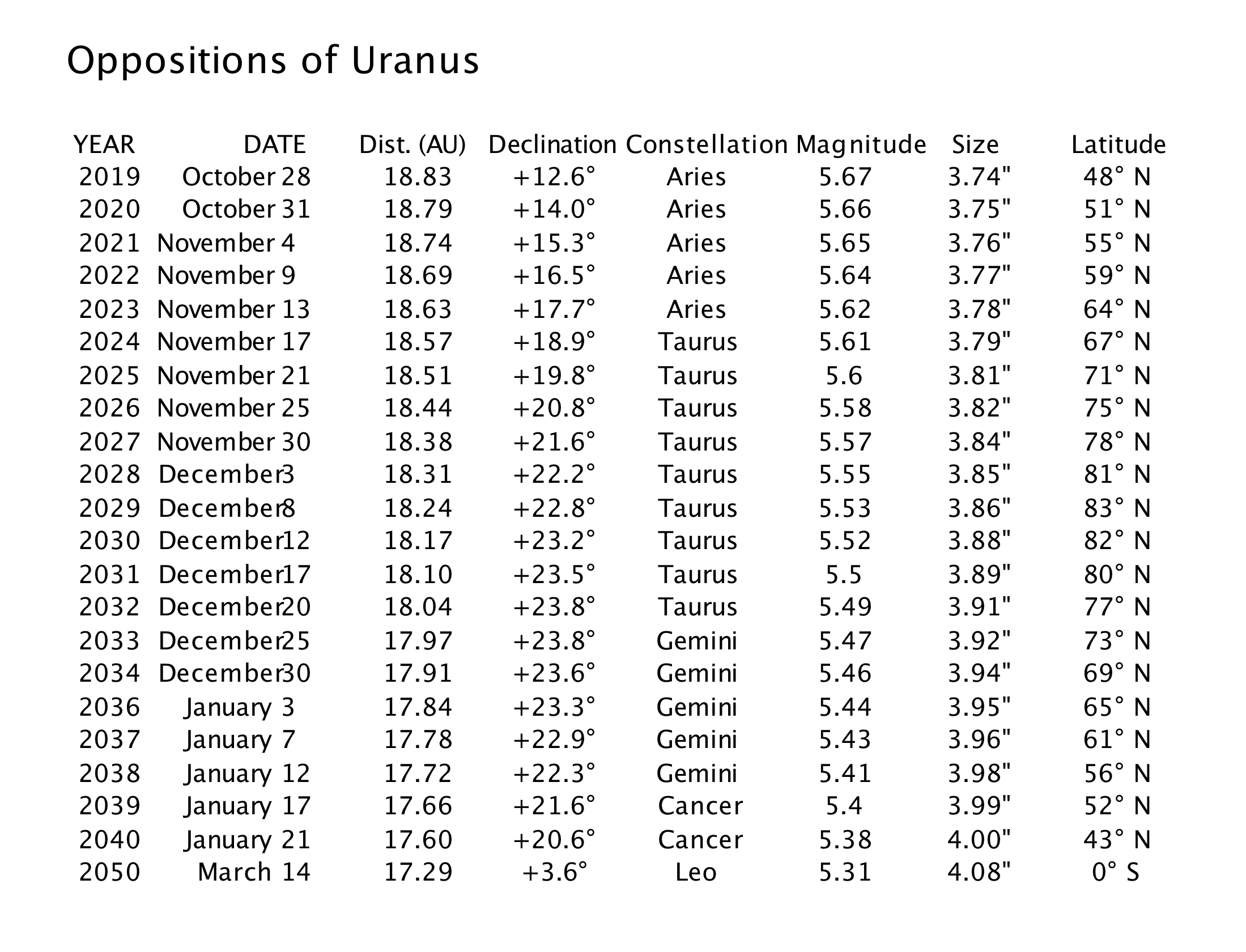
Uranus moves slowly through the constellations; with a period of 84 years, it spends on average seven years in each. Until 2023 it’s in Aries – well placed in a November evening. From 2024 until 2032 it moves through Taurus – easy viewing in January.
Uranus is slowly moving northward in declination, increasingly favorable for northern observers. You won’t see any surface features, but if you did you’d notice something odd: we’re peering down on very high northern latitudes on Uranus, with its pole pointed almost directly at us around 2029. Something more significant is also happening: Uranus is approaching its perihelion in 2050. This means that every year it is getting brighter- bright enough to be see with the naked eye around opposition and in a really dark place!

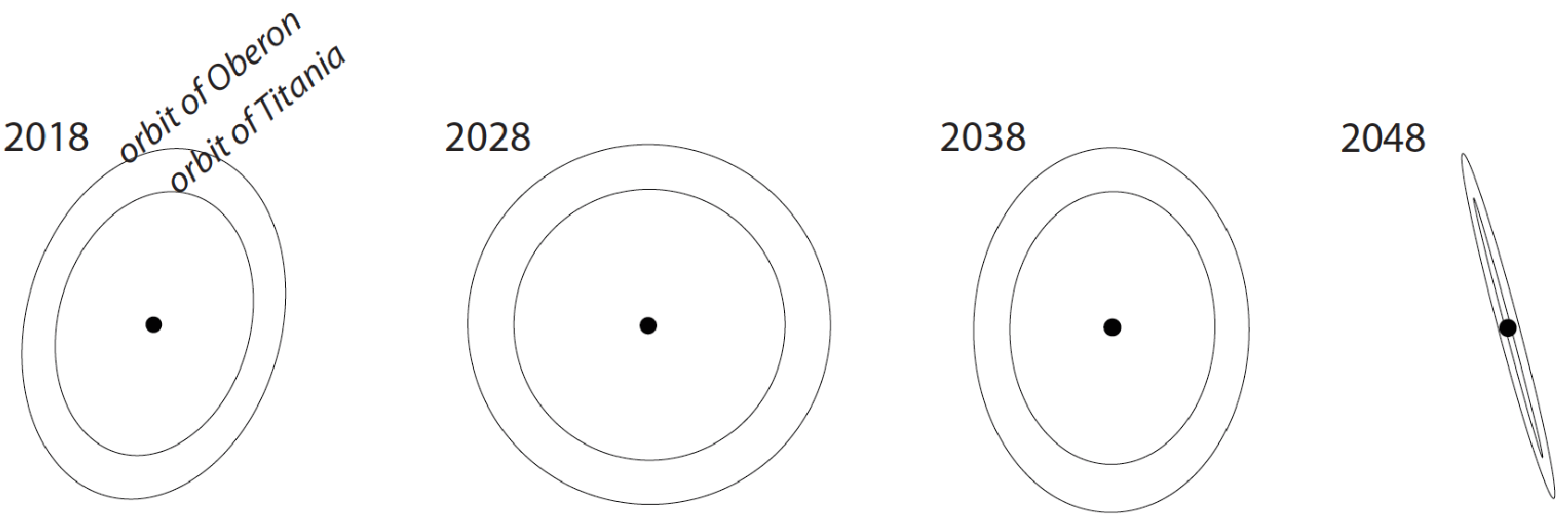
Of course, moons are most easily seen when they are placed as far as possible from the planet. But unlike the other giant planets, Uranus’ spin axis is tilted nearly “on its side” (about 98° from the plane of its orbit) as seen from Earth. In 2028–29 we’ll be looking down the north pole of Uranus, with its moons’ orbits lying nearly face-on, so the moons might be anywhere, at any angle, around the planet – more opportunities to see them – each at its own distance. But in 2049–50 we’ll be passing through the plane of its moons’ orbits (as we did last in 2007); then, the moons’ orbits will lie along a roughly north–south axis, and easier to see when at their furthest along one of those directions.
Neptune
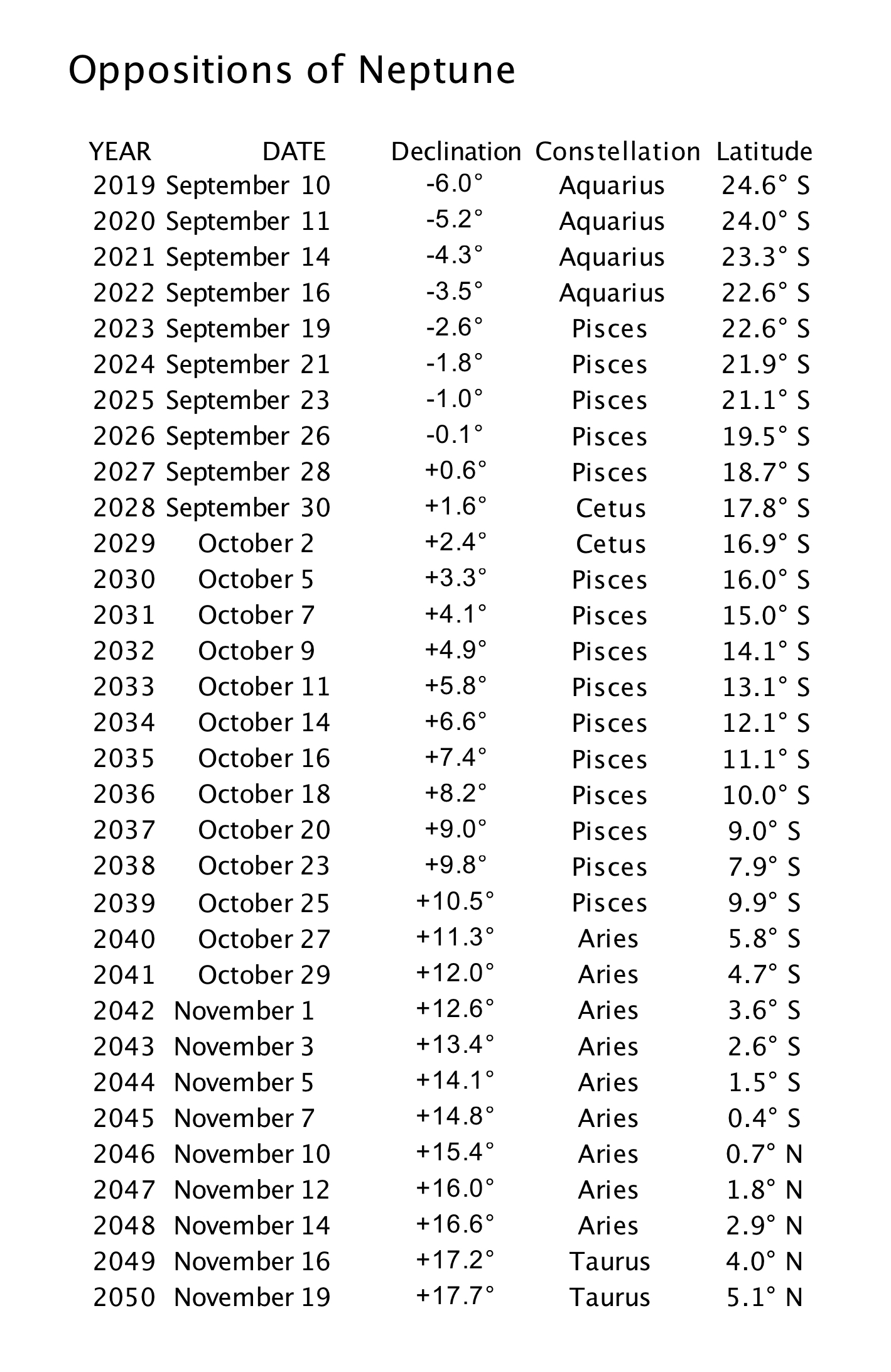
Neptune takes 165 years to orbit the Sun, thus spending on average fourteen years in each zodiac constellation. In 2022 it passes from Aquarius into Pisces, reaching Aries in 2039; by 2050 it will have just entered Taurus. Thus for the next few decades, the best evenings to look for it are in September.
Triton (magnitude 13.7) is about the same brightness as Uranus’ brightest moons (and Pluto); but Neptune is dimmer than Uranus so in a large (more than 10 inch aperture) telescope in dark skies it’s realistic to look for it. How do you know for sure if you’ve spotted Triton? At high power count how many planet diameters (about 2.4") from the center of Neptune your candidate lies. Is it preceding (ahead, or west) of Neptune as they move across your field of view or is it trailing (to the east)? Nudge the ’scope north and south, and see in which direction it is from the planet. Once you can say that your candidate is, say, north and east of Neptune, then go to your favorite planetarium software (or one of the websites we link to) and see if what you saw is where Triton actually is.