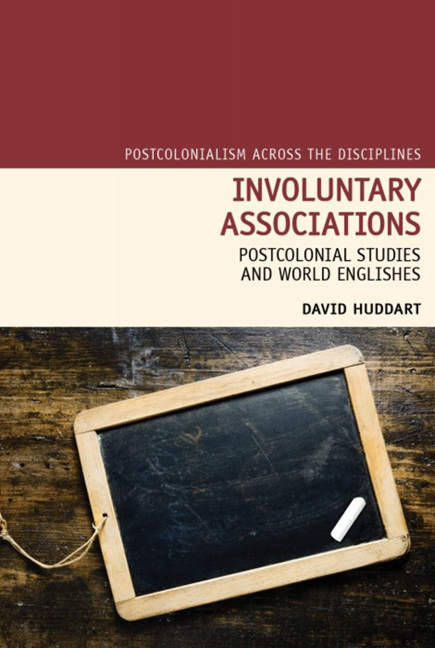
Involuntary Associations

-
The digital format of this book is no longer available to purchase from Cambridge Core. Other formats may be available.
-
Select format
-
- Publisher:
- Liverpool University Press
- Publication date:
- 27 May 2017
- 28 May 2014
- ISBN:
- 9781781385982
- 9781781380253
- Dimensions:
- Weight & Pages:
- Dimensions:
- Weight & Pages:
You may already have access via personal or institutional login
Show more authors 
You may already have access via personal or institutional login
Book description
The consequences of English’s spread have become increasingly clear to its diverse speakers. Sometimes associated with a standardization leading to homogenization, often also with imperialism, English is increasingly understood to have no necessary connection with any country or group of countries. The willingness to accept that English has become Englishes might be less evident among so-called native speakers, but their authority is weaker than it seemed. The idea of World Englishes encourages us to re-imagine our understanding of the language. The difference between error and innovation can no longer be decided through assumptions about the language 'ownership'. In fact, the language is beginning to be a medium of the expression of identity for more and more people in very different contexts. This book puts examples from World Englishes into dialogue with postcolonial studies, in the belief that while postcolonial studies has obviously had much to say about English, it has either directly concerned or been influenced by English literary studies. The dialogue will correct misconceptions and misapprehensions in postcolonial studies, with World Englishes offering renewal for postcolonial studies. At the same time, the dialogue will also apply postcolonial studies' political and philosophical ideas to World Englishes, resulting in a postcolonial perspective on English today.
Reviews
David Huddart covers an impressive range of topics, and his discussion of major contributions in the fields of postcolonial studies, critical linguistics, cultural studies and globalisation studies is intriguing. He has set the stage for many productive discussions and further research.
Ana Sobral Source: English World Wide
Contents
Contents
Metrics
Altmetric attention score
Full text views
Full text views helpTotal number of HTML views: 0
Total number of PDF views: 0 *
 Loading metrics...
* Views captured on Cambridge Core between #date#. This data will be updated every 24 hours.
Usage data cannot currently be displayed.
Accessibility standard: Unknown
Why this information is here
This section outlines the accessibility features of this content - including support for screen readers, full keyboard navigation and high-contrast display options. This may not be relevant for you.
Accessibility Information
Accessibility compliance for the PDF of this book is currently unknown and may be updated in the future.