




In the 2008 Democratic presidential primary Barack Obama defeated Hillary Clinton by a very narrow margin – a margin that was largely due to his success in caucus states. Clinton won only 174 pledged delegates in caucuses to Obama's 312 pledged delegates in the caucus format – almost two-thirds of the total going to Obama. The result in primaries was quite different: Clinton won 1,379.5 delegatesFootnote 1 to Obama's 1,371.5 – essentially a tie, though one that Clinton actually won narrowly. In the eyes of a die-hard Clinton supporter this result is, no doubt, striking – and possibly a bit infuriating. After all, it holds out the tantalizing possibility that, had all states used primary elections, Hillary Clinton could well have become the nominee.
Of course, because different states held primaries and caucuses that margin might really have nothing to do with process; it could be due to differences between the states. Such an explanation could not, however, account for the results in Texas, where the Democratic party awarded 126 pledged delegates based on the results of the primary held during the day on March 4, 2008, and sixty-seven delegates based on the results of caucuses held in the evening on the same day. Texas serves as a useful natural experiment because the two procedures came from potentially the exact same electorate,Footnote 2 but the different processes produced different results.Footnote 3 While Clinton won a three-point victory in the primary election, she lost by nearly thirteen points in the caucuses. This meant that Obama received four more delegates than Clinton in the state total,Footnote 4 a difference that must be attributed to the process used.Footnote 5 Inevitably, it raises questions about the quality and fairness of the entire nominating process.
Political scientists generally explain voter participation with reference to personal characteristics of the citizenry,Footnote 6 competitiveness of the election,Footnote 7 campaign mobilization efforts,Footnote 8 or (in the US context) registration laws.Footnote 9 All of these factors contribute to an electorate that is not necessarily representative. The wealthy, educated, white, and interested will all be more likely to participate than their opposites (at least this is historically true – the 2008 election is a clear exception with respect to race).Footnote 10 Without taking exception to any of this, we believe that the study of mass participation sometimes overlooks crucial elements illustrated by the 2008 election nomination process: the structure of citizen belief systems and the design of the institutions within which citizens make their preferences known.
The literature connecting elite behavior to institutional design is well known and voluminous,Footnote 11 but much remains to be learned about the ways institutions affect the participatory choices of ordinary citizens, in large part because it is difficult to find quasi-experiments like the one in Texas. And where such natural experiments do exist their scope is obviously limited. We bring to bear a survey experiment that can be combined with the observational data from a large survey. The experiment allows us to explore directly the causal effect of the two institutional procedures typically used in the presidential nominating process – caucuses and primaries – on citizens’ probability of participation. The results clearly show that the electorate for caucuses is likely to be more ideologically consistent with the policy views of elites. Thus, it is not merely that the set of caucus participants is smaller than the set of primary voters; caucus participants are also different from primary participants in important ways. And this result is not merely visible in the experiment; it is clear and present in the observational data on nomination participation. The choice of caucus or primary is, therefore, a choice about who participates – and not just how many participate – in the nominating process. Representation through caucuses means something very different than representation via a primary.
Representation in Primaries and Caucuses
The concern over representation in different types of elections is an old one, but often this concern focused on the difference between the general election and the primary election.Footnote 12 Kaufmann, Gimpel, and Hoffman find, for example, that primary participants tend to be older and (at least in some places) wealthier than the general electorate, though the specific institutional structures of primaries also matter.Footnote 13 Many others also assert that the primary electorate is older, whiter, more affluent, and better educated than the general public.Footnote 14 Ranney concludes that the primary electorate is not at all representative of fellow partisans with respect to both demographic characteristics and issue positions.Footnote 15 Lengle, Polsby, Keeter and Zukin, Crotty and Jackson, and Kaufmann, Gimpel, and Hoffman all find that the primary electorate tends to be more ideologically extreme with respect to both issue positions and ideological self-placement than those who take part in the general election.Footnote 16
The question remains far from settled, however, as Norrander reports that primary voters are not more likely to be ideological or issue extremists.Footnote 17 In many respects, she concludes, they are similar to general election voters who happened not to participate in the nomination process. And using exit polls of voters in presidential primaries and general elections in 1976 and 1980, Geer similarly finds that the primary electorate tends to be more moderate, not more ideologically extreme, than the ‘party following’ – those who do not participate in the primary but are likely to support a given party and vote in the general election.Footnote 18 Obviously, the comparison group matters: judgments about the relative extremism of participants in the nomination process may vary depending on whether they are being compared to non-voters, general election voters, the party following, or party activists, for example.
The literature comparing primaries and the general election suggests that reducing the level of participation may change the electorate and, therefore, the quality of representation, but it less clear that there are differences between primaries and caucuses, because previous studies of primaries and caucuses have generally avoided direct comparisons between the two collective action procedures. Instead, scholars explore the characteristics of primary and caucus participants separately. These studies typically find meaningful demographic differences between caucus attenders and those who do not show up, but the evidence with respect to ideology or attitudes is far more equivocal.
For example, Stone and Stone and Abramowitz find that caucus attenders care a great deal about the electability of candidates, perhaps even more than ideology.Footnote 19 Abramowitz and Stone argue that in the 1980 nomination process, caucus attenders were more ideologically extreme, with Republicans being especially constrained ideologically.Footnote 20 Stone, Abramowitz, and Rapoport find that Iowa caucus-goers of both parties are more liberal than the general Iowa electorate, and in a study of the 1988 Iowa caucuses, those same authors claim that caucus participants were more ideologically polarized than the national electorate, but that such polarization was primarily about ideological self-identification, not about consistency of issue positions.Footnote 21 Overall, they conclude, there is little evidence that the caucus system is ‘overwhelmed by ideologues’, though they do not offer a direct comparison between primary and caucus participants.Footnote 22
Marshall does offer such a comparison and finds that Minnesota caucuses perform ‘as well as equivalent primaries in representing policy, candidate or party-related attitudes’.Footnote 23 Nearly twenty years later, Mayer asserts the opposite: that caucus attenders are not only better educated, wealthier, and older than primary voters, but also more ideologically extreme.Footnote 24 More recent comparisons are similarly contradictory. Eitan Hersh's comparison of primary and caucus participants uncovers little evidence of ideological bias but shows important differences between caucus-goers and primary voters in their commitment to community engagement.Footnote 25 Conversely, Panagopoulos finds significant differences between caucus and primary voters with respect to both ideological self-placement and issue preferences.Footnote 26 On issues such as the Iraq War, Social Security, health care, and affirmative action, he concludes caucus-goers held more extreme views than those who participated in primaries.
The hypothesis that caucuses might produce a more extreme electorate is implied by the literature. Both the work on the differences between primary electorates and general electorates and the more relevant work on primaries and caucuses suggest the possibility – though the case is far from proved because so few scholars have directly compared participants in one institution for nominating candidates to its other major institutional alternative and those who have done so see contradictory results.Footnote 27 A better understanding of the difference between participants in primaries and in caucuses is crucial because these are the two options in widest use for nominations. What is lacking is a theory of why the two election types might differ and a research design that directly tests how the choice of a primary or a caucus affects the tendency to participate. To this point, no previous scholars have directly compared attitudes about primaries and caucuses in an experimental setting in which participants are randomly assigned to one of the two major nominating procedures.
Theory And Hypotheses About Procedural Differences
Given the work already done a null hypothesis of no difference between primaries and caucuses seems like a good place to begin. This null would be consistent with both Marshall and the work of Abramowitz, Rapoport, and Stone, and it could be tested against the claim that there are differences.Footnote 28 It is more useful, however, to go beyond simply looking for differences to offering a theory about how and why the two electorates might be different. After all, in many respects they should be similar. In the case of presidential primaries, both procedures serve the same end: selecting a party's nominee. So why would one procedure generate a systematically different group from the other procedure?
We contend that different electoral institutions attract different kinds of participants, and the bias produced by such institutions is not only about socio-economic disparities and civic skills,Footnote 29 but also about the way participants think about the political world. We believe there is an interaction between the institutional context, people's judgments about the fairness of institutions, and levels of participation. Thus, the difference between a primary and a caucus is not just about the overall rates of participation, but more precisely about how a particular institution encourages (or discourages) participation from certain groups.
By fairness of electoral institutions, we have in mind citizens’ beliefs about the extent to which the process is open to a diversity of voices and treats each voice equally. Tyler's account of procedural justice – or the extent to which authoritative processes are seen by the participants as fair and equal – is relevant to this concept.Footnote 30 Lind and Tyler show, for example, that citizen judgments about politics are not solely the result of political outcomes, but are also influenced by beliefs about the fairness and openness of the process.Footnote 31 Similarly, Hibbing and Theiss-Morse argue that that in addition to caring about policy, Americans have strong preferences about the processes through which decisions are made.Footnote 32 Like Hibbing and Theiss-Morse, we make a connection between processes and patterns of political participation. If individuals believe institutions are unbiased and open to all, then we expect that they will be more likely to participate in such institutions.
Primaries and caucuses, though similar in some ways, differ significantly as institutional processes. Primaries adhere rigorously to the idea of equality of influence, with each vote counting exactly the same in the privacy of the voting booth. In a primary there is little or no political debate, discussion, or exchange of arguments at the moment of electoral choice. In contrast, while the exact rules for caucuses differ from state to state, the procedure emphasizes expressive voices, rather than votes alone. Caucuses tend to offer a greater opportunity for collective citizen discussion or debate about the merits of each candidate, though the amount of discussion and debate at any given caucus can vary a great deal. The presence of some level of public discussion may allow for a more informed and thoughtful (or at least public) consideration of the candidates, but it may also allow some voices to be more prominent in guiding the discussion and more influential in determining the outcome. True, some caucuses probably engage in minimal discussion and debate. Participants merely show up and gather with likeminded voters to be publicly counted. Still, the public and collective nature of the process is quite different. More importantly, voters have a different impression of caucuses relative to primaries, a fact we demonstrate in the survey below.
These rough differences between the institutional processes of primaries and caucuses lead us to a set of expectations about the relationship between institutions and participation. We begin with a procedural fairness hypothesis:
hypothesis 1: individuals’ willingness to participate in primaries or caucuses will be closely connected to their judgments about the fairness of the collective action mechanism; they will perceive significant differences between the fairness of primaries and caucuses and will be more likely to participate in the institutions they judge to be fairer.
Second, our idea of citizen expression also encompasses the structure of citizen opinions. That is, having something to say involves not just a willingness to share opinions openly, but also the ways in which citizens’ belief systems are organized. Some electoral institutions may be more amenable to certain belief structures than to others. And if one procedure is seen as more fair (regardless of whether or not it actually is fairer) that could affect what type of people will participate.
In his well-known work on the nature of belief systems in mass publics, Converse finds that the issue opinions of ordinary citizens are far less consistent and far less structured by elite understandings of ideology than are the opinions of more involved political actors like members of Congress.Footnote 33 He describes citizens as lacking ‘constraint’: they are not ideological in the way elites are. Scholars use different terms for this idea and ones similar to it, including extremism or polarization, among others. It is not our purpose to replicate Converse's work on ideology or review all of the vast literature here. For more on constraint and ideological sorting, interested readers should consult Baldassari and Gelman, and Levendusky.Footnote 34
Our question is, however, directly related to Converse's constraint concept: are citizens who look the most like elite actors more or less likely to participate in primaries or caucuses? Because the term constraint invokes a wider set of concerns and issues, we employ the narrower term ‘ideological consistency’, though our concept is similar to our view of Converse's core notion: the ideologically consistent are those citizens who agree with partisan elites on most questions. It is, of course, possible to be consistently moderate, always splitting the difference to find the golden mean. However, our use of the term focuses not on this (relatively small) group but on the participants who are consistently like the party elites.
Because caucuses are locations where political argument may proceed with strong reference to ideology or where the connection between various issue positions might be the subject of open debate, we expect that individuals whose opinions are relatively more consistent with those of partisan elites may feel more at home in caucuses than those less likely to think about politics in clearly ideological terms. Those whose issue positions are less ideologically consistent may fear coming across as uninformed or out of step with the campaigns. This implies our second hypothesis:
hypothesis 2: Those who are more ideologically consistent will be more likely to participate in caucuses, while the relationship between consistency and participation will be weaker in primaries.
Though we are not insensitive to the importance of class, racial, or gender inequalities that have been the focus of much of the classic work on voice and equality and that are important for citizens’ ability to bear the costs of participationFootnote 35 – and in our subsequent analyses we will control for civic resources, race, income, and other important factors – our primary focus is on the ways in which differing electoral institutions attract citizens with differing belief systems and differing attitudes about political debate. The central concern running through our approach is that caucuses will produce an electorate with issue positions that are more similar to partisan elites than to the general electorate (see, especially, Hypothesis 2). We now turn to the experimental design.
Data And Experimental Protocol
Data for this experiment were collected as part of the 2008 Cooperative Congressional Election Survey. The CCES is a collaborative research effort involving teams at thirty different institutions, each of which developed a survey questionnaire for a national sample of approximately 1,000 respondents. In addition, all respondents answered Common Content questions, which consisted of a series of questions common to all team modules. Thus, half of the questions any individual respondent answered were from a research team and half from the Common Content. This means that the Common Content sample size is equal to the total sample size of all team modules combined. In 2008, the Common Content sample was approximately 32,800 cases.Footnote 36 Data analyzed here are drawn from the pre-election module developed by the authors and from the pre-election Common Content questions.
A survey experimental approach to participation in primaries and caucuses offers some unique advantages relative to purely observational studies. Because of the lack of random assignment to primary or caucus institutions in actual elections, it is impossible to make causal inferences about the effects of institutions on participation. In the real world of politics, choices about electoral institutions could easily be endogenous to the nature of voters in the district. An experimental approach avoids this quandary, allowing us to assign voters randomly to institutional conditions. We are thus able to make causal inferences about the relationship between the features of electoral institutions and citizens’ participatory preferences.
A potential drawback to an experimental survey approach is that we measure simulated participation – more specifically, self-reported likelihood of participation – not actual political behavior. As with any survey report of participation, our self-reports are likely to be inflated. However, we would note that our experiment took place in the midst of an actual election, one that generated a great deal of interest and attention. Additionally, the survey setting also means that we have reduced the costs of participation to essentially zero: from the perspective of the respondent, the threshold for reporting participation is extremely low. If we still find significant differences between primaries and caucuses, even when it is extremely easy to report participation, then we expect such differences will be even more profound when participation takes actual time and effort. In this respect, the survey experiment methodology actually works to help us avoid finding spurious results. And because we can assert that it is the treatment that is at issue in our results, we can be much more confident about the general issue of endogeneity in responses.
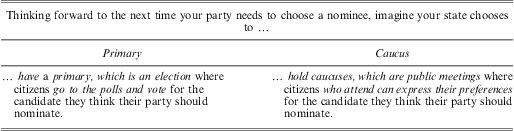
Our primary focus in this article is the Candidate Selection Process Experiment. Respondents were randomly assigned to either the primary or caucus condition.Footnote 37 The experiment was introduced with the following statement: ‘There has been a lot of talk lately about how the political parties should choose their nominees for president. Different states use different processes for assigning delegates to the party's national convention.’ Respondents were next asked to think forward to the next opportunity to nominate a candidate for president and were given a basic description of either primaries or caucus procedures nominating presidential candidates. The experimental language is reported in Table 1. Because the specifics of the caucus procedure vary by party, by state, and sometimes even by precinct, our description of the caucus emphasizes only that it is a ‘public meeting’ where those who attend can express preferences.Footnote 38 Nonetheless, our descriptions capture both the common understandings of each procedure and essential differences between them.
Table 1 Candidate Selection Process Experiment Treatments
Source: 2008 CCES.
After the treatment, respondents were asked four different questions: how likely would they be to attend the primary or caucus, how likely would the process ‘allow all different points of view to be considered,’ how likely would the process ‘result in your party choosing the best possible candidate for president,’ and how likely would it be that the process would ‘give an advantage to special interests.’ Respondents could choose from four different options: very likely, somewhat likely, somewhat unlikely, and very unlikely.Footnote 39
Key Variables
Before exploring the likelihood of participation in primaries or caucuses, we pause briefly to explain the key measures we employ. First, our measure of procedural fairness is an index comprised of three evaluative questions about the political process of caucuses or primaries: how fair was the process; will the process result in the best possible decision; and will the process allow all voices to be heard?Footnote 40 In a factor analysis, these three questions all load highly on the same factor, and alpha reliability coefficients indicate that they hang together as a single scale (alpha = 0.84 for the caucus condition and 0.82 for the primary condition). For purposes of analysis, the index is recoded to run from 0 to 1, with higher scores indicating higher procedural fairness.
Second, the measure of ideological consistency relies on the policy questions at the heart of the CCES survey. The questionnaire is designed to measure the relationship between the issue opinions of our survey sample and those of members of Congress by comparing opinions on issues that were actually considered by Congress. The survey asked whether respondents supported ‘in principle’ eight different bills that had recently been the subject of roll call votes in the House of Representatives: withdrawing troops from Iraq, an increase in the minimum wage, federal funding for stem cell research, allowing spy agencies to eavesdrop on overseas terrorists without a court order, funding to provide health insurance for children in low-income families, a constitutional amendment banning gay marriage, federal assistance for homeowners facing foreclosure, and the extension of NAFTA to include Peru and Columbia. We assigned support for the more conservative position on each bill to a score of 1 and the more liberal position to a score of −1. We then computed a simple measure of ideological consistency for both our survey sample and members of Congress by adding their scores on the eight different bills to create a 17-point scale that ranged between −8 and 8.Footnote 41 In other words, a person who supported the liberal position on every bill would receive a score of −8, while those who took the conservative position every time would have a score of +8. Those who were liberal half the time and conservative half the time would receive a score of 0.
As a point of comparison, we use the actual roll call votes to assign an ideological consistency score to members of Congress. We find that the average score among congressional Democrats was −4.56 (with a 95 percent confidence interval ranging between −4.94 and −4.19), and more than half of Democratic members of Congress had scores of −6, −7, or −8. The mean among Republican legislators was 5.28 (with the 95 percent confidence interval ranging from 4.90 to 5.67), and more than 60 percent of Republican representatives had scores of 6, 7, or 8. In our CCES sample, the mean score for all respondents was −1.24, with the mean among self-identified Democrats being −3.94 and the mean among self-identified Republicans measuring 2.51. Only 27 percent of Democrats in our sample had scores ranging between −6 and −8 (less than half the percentage among Democratic members of Congress), and only 11 percent of self-identified Republicans had scores between 6 and 8 (as compared to 60 percent of Republican members of Congress). The ordinary citizens in our sample are generally far less ideologically consistent in their issue attitudes than elites, but because the measure captures citizen opinion on current issues of the day – issues clearly supported by the parties – we are able to see just how similar respondents are to partisan elites.
Our measure of consistency is most often the absolute value of the 17-point scale, which folds the scale to measure overall ideological consistency. In subsequent analyses, this measure is recoded from 0 to 1 for ease of interpretation. Occasionally, we will mark a rougher distinction between ‘consistent’ and ‘inconsistent’ or ‘moderate’. We used a simple rule of thumb to assign respondents to one of those two categories. Those with scores between −4 and −8 (approximately 37 percent of the sample) were designated as consistent in a liberal direction; those with scores between +4 and +8 (approximately 13 percent of the sample) were labeled as consistent conservatives, and those with scores between −3 and +3 (the remaining 50 percent of the sample) were categorized as ideologically inconsistent or moderate. In other words, the moderate comprise the half of the sample that is relatively centrist, taking a mix of both liberal and conservative positions on our selection of issues.Footnote 42
Results
We begin by reviewing the basic experimental results and summary data on the questions about caucus and primary fairness. Figure 1 summarizes the essential findings for participation. Not surprisingly, participants in our experiment reported a significantly greater likelihood of attending a primary, as opposed to a caucus. In the primary condition, respondents’ mean likelihood of attendance on our four-point attendance scale was approximately 20–30 percent higher than average scores for respondents in the caucus condition. These results are notable because within the experiment, it is easy for respondents to label themselves as likely participants. Though the experimental context means that the costs of self-reported likely participation are low, something about the caucus condition still deters respondents.

Fig. 1 Dotplot displays mean likelihood with a 95 percent confidence interval; based on the 2008 CCES
It is worth noting, in passing, that the experimental conditions actually included a second experiment between winner-takes-all and proportional methods of aggregating votes.Footnote 43 Though it was true that respondents reacted strongly to the difference between a primary and a caucus, we never found any evidence that voters distinguished between winner-takes-all methods and proportional methods. Some procedural differences matter to voters – others, apparently, do not.
The significant differences between primaries and caucuses in Figure 1 are not unexpected, in part because actual turnout at caucuses is almost always considerably lower than turnout at primaries. As we detailed above, caucuses are more involved, time-intensive events, meaning that the costs of attending such events are undoubtedly higher. Our theory holds, though, that attendance at both primaries and caucuses is related, in part, to citizen judgments about the nature of these political processes.
Figure 2 represents the mean and 95 percent confidence interval for the evaluations of primaries and caucuses with respect to our measures of procedural justice (described above). In each case, respondents judge primaries to be a better procedure. The primary condition yielded higher scores on the general measure of fairness. Survey participants in the primary condition were also more likely to feel that primaries allowed all different points of view to be considered and that the procedure would result in the best possible presidential candidate.

Fig. 2 Dotplot displays mean likelihood of the occurrence with a 95 percent confidence interval; based on the 2008 CCES
The final two points in the figure reverse the pattern where primaries score higher than caucuses, but the prompt has changed to ‘more likely to give an advantage to special interests’. Without exception, then, primaries are rated more positively than caucuses on every evaluative measure we examined.
It is important to note that these evaluative judgments are not shared by those who reported attending caucuses in 2008. Unlike non-attenders, those who took part in the caucus process rated it either equal to or even slightly better than primaries. We have only a small number of such respondents (n = 46), but it appears those who ventured out to a caucus came to very different conclusions than the rest of the sample, though we are reluctant to draw strong conclusions with a sample of that size.
In other words, most respondents expressed negative impressions about several different dimensions of caucuses: they judged caucuses to be less fair, less open to diverse viewpoints, more likely to benefit special interests, and less likely to result in the highest quality collective choice. However, compared to those who did not take part, respondents who reported attending the caucuses judged them to be significantly more fair, more open to different points of view, more likely to result in the best choice, and less prone to bias toward special interests.Footnote 44 This pattern is not simply the result of embracing the procedures of one's own state. If we restrict our findings to those who live in caucus states, regardless of whether the respondent had actually attended, the results are similar to those reported in Figure 2: primaries are preferred. Only among those committed enough to have attended a caucus in 2008 is the caucus seen in a more favorable light.
As has been well documented, in recent years citizens have sorted themselves out by party.Footnote 45 This means that the above relationships could simply be about strength of partisanship, rather than being related to issue consistency. Figure 3 explores this possibility by breaking down the respondent's reported likelihood of participation by partisanship (strong partisans on the left and weak partisans and independent leaners on the right), ideology, and experimental condition. When we compare the groups across conditions, we find that the respondents assigned to the primary condition are always more likely to want to participate. This pattern is emphatically not simply a feature of partisanship or ideology, but a feature of the experimental conditions.Footnote 46

Fig. 3 Dotplots display the mean likelihood of participation with a 95 percent confidence interval
Notes: The left panel is for strong partisans and the right panel is for weak partisans and independent leaners. Data come from the 2008 CCES experimental module.
Focusing on the left-hand panel of strong partisans, when we look within the primary condition there is no statistically significant difference in the reported likelihood of participation between the ideologically consistent and the inconsistent. All groups are likely to participate at about equal rates, with the confidence intervals overlapping substantially. This is mostly true when we look within the caucus condition as well; however, the inconsistent score about four-tenths of a point lower on the likelihood of participation scale than those who are consistently liberal, and approximately one-third of a point lower than those who are consistently conservative. The 95 percent confidence intervals overlap slightly (not unexpectedly given the relatively low sample size in each cell), but these differences are nonetheless statistically significant at the 0.05 level. In other words, among strong partisans, the inconsistent are significantly less likely to report that they would participate in a caucus.
This basic finding is repeated among weak partisans and independent leaners, as seen in the right panel of Figure 3. Among this group, expected participation is slightly lower for all levels of consistency, reflecting the fact that presidential nominating procedures are friendlier to those with the strongest partisan attachments. Once again, however, participation at caucuses is especially low among the ideologically inconsistent, suggesting that partisan fervor is not driving the results. Moderates with lower levels of attachment to their party are far less likely than any other group to attend caucuses. Caucuses are less attractive than primaries to all those who feel less tied to their party, but they are especially likely to drive away those whose issue positions are not always consistent with the party's ideology.
With these results in hand we can confidently reject the null hypothesis of no difference between primaries and caucuses. Indisputably, the primary condition elicits a greater reported likelihood across many sets of voters. This is not simply due to partisanship and appears to be linked to ideological consistency (see Hypothesis 2). To go further with the experiment and look at the relationships between fairness judgments, ideological consistency, and participation we employ an ordinary least squares (OLS) regression, with the dependent variable being our measure of likely participation.Footnote 47 Table 2 presents the results.
Table 2 Determinants of Likely Participation in Primary or Caucus

Note: Cell entries are OLS regression coefficients, with standard errors in parentheses. ***p < 0.01, **p < 0.05, *p < 0.1.
Source: 2008 CCES.
Our key concern is how the effects of our key independent variables differ between caucuses and primaries, and Model 1 presents the interactions between our independent variables and the caucus condition. These interaction terms represent the difference-in-differences between caucuses and primaries. In other words, they show the extent to which our key variables exert a different effect on likely participation in caucuses, as compared to primaries. Model 2 includes controls for political sophistication, self-reported partisanship, previous attendance at primaries or caucuses, and other aspects of the experimental design.Footnote 48 Model 3 adds controls for demographic characteristics. The presence of these controls does not change our substantive results in any meaningful way.
We begin with Hypothesis 1 and note that judgments about procedural fairness play an increased role in caucuses as opposed to primaries. In Model 1, the interaction term between the caucus condition and procedural fairness is positive and statistically significant (t = 2.07, p = 0.04). Predicted values from the model show that as fairness judgments move from their minimum to the maximum, self-reported likely participation increases by 60 percentage points in the caucus condition, rising from 0.27 to 0.87 on the one-point scale of likely participation. Greater confidence in the fairness of the procedure also matters in the primary condition, but less dramatically (an increase of 46 percentage points as compared to 60 percentage points). In other words, judgments about fairness appear to take on an even greater emphasis in the caucus condition, and those who feel positively about the caucus process are much more likely to say they will participate in it. This result remains significant when controls are added to the model, including controls for previous attendance at caucuses.Footnote 49 Hypothesis 1 suggested that judgments about institutional fairness matter for likelihood of participation. Based on these models this is true of both primaries and caucuses, but the interaction term also shows that citizen judgments about procedural fairness take on increased importance in the case of caucuses.
Turning to Hypothesis 2, we find a substantial relationship between the structure of citizen belief systems and participation in caucuses. Consistency is here operationalized as the absolute value of the roll call measure (scaled from 0 to 1), with those who have more ideologically consistent issue positions (whether conservative or liberal) scoring high on the scale. In Model 1, we find a strong interaction between ideological consistency and caucus attendance. The main effect of ideological consistency cannot be distinguished from zero, which means that this variable has no significant effect in the primary condition. In the caucus condition, however, ideological consistency is strongly related to participation, increasing the likelihood of showing up by 13 percentage points. Consistent with the pattern in Figure 3, these results are not driven by the respondent's strength of partisanship. When additional controls for political sophistication, partisanship, and previous attendance at a caucus or primary are included (Model 2) or when other demographic controls are added (Model 3), these findings continue to hold. We find no significant relationship between ideological consistency and primary attendance, but a sizeable and significant relationship between consistency and participation in caucuses.Footnote 50
We interpret these findings as meaningful support for Hypothesis 2: those whose belief systems are a better ideological match to the issue positions of party elites are more likely to attend caucuses, while attendance at primaries is not significantly driven by the structure of citizen belief systems. Put differently, caucuses drive down participation among policy centrists – those whose issue positions are less ideologically consistent – while no such relationship exists among those in the primary condition.
An Alternative Explanation?
A plausible alternative hypothesis might be that participation in caucuses is not about the organization of citizen beliefs or any question of fairness. Perhaps it is about the expressive nature of caucus meetings as a form of political participation. While primaries require only private disclosure of one's opinions and preferences in the privacy of the ballot box, caucuses are more likely to involve some sort of public revelation of preferences as well as the possibility of being confronted with the preferences and arguments of those who disagree. Hibbing and Theiss-Morse show that many citizens express discomfort with the idea of openly confronting differences of opinion in deliberative settings.Footnote 51 Mutz has chronicled a strong, negative relationship between participation and exposure to cross-cutting opinion networks, especially among those who are conflict avoidant.Footnote 52 This could simply mean that citizens who avoid conflict may find participation in a caucus very daunting. If this trait is correlated with citizen attitudes or with judgments of fairness it complicates the analysis. An alternative hypothesis, our third, holds:
hypothesis 3: Those who are more comfortable with political conflict and disagreement will be more likely to attend caucuses, while the relationship between conflict avoidance and participation will be weaker with respect to primaries.
Our data allow us to explore this alternative explanation using measures drawn from the literature on conflict avoidance. Respondents were asked to ‘think of recent situations where you have experienced a conflict, disagreement, or argument.’ They were then asked to choose a location between a pair of statements that would best describe them when confronted with such conflict. The two pairs of statements were: ‘I say what I think no matter what the consequences’ vs. ‘I avoid expressing beliefs that would create controversy’, and ‘I am proud to share my political opinions with other people’ vs. ‘I worry about what other people would think if they knew my political opinions’. Responses to these questions were combined to form a scale ranging from 0–1 (alpha reliability coefficient = 0.75).
Contrary to the alternative hypothesis, we find no evidence that comfort with disagreement is more important for attendance at caucuses than at primaries. Though the main effect of the variable is significant in the primary condition, the interaction term is small and does not come close to statistical significance. Those who are less comfortable with disagreement are less likely to participate in both institutions; there is no special effect of comfort with disagreement on caucus attendance. We conclude that the experiment shows that the key differences between being willing to participate in a caucus over a primary are related to judgments about the fairness of the procedure and a voter's ideological profile.
Primaries and Caucuses in The 2008 Election
To this point, we have used a simple experiment to show that survey respondents are less likely to say they will attend caucuses as opposed to primaries and that, with the exception of those who report having actually attended a caucus, they also cast more negative evaluative judgments of caucuses as compared to primaries. These evaluations of the process affect their likelihood of participation, clearly coupled with the respondent's ideological consistency: more (less) constrained citizens are more (less) likely to participate in a caucus (primary); caucuses do not suppress participation evenly.
Readers may rightly worry that these effects, while suggestive, may not generalize outside of the experimental setting. To bolster the case that our findings are externally valid and that caucuses attract certain kinds of participants while repelling others, we turn to observational data from the 2008 CCES Common Content and its 32,800 cases. This large dataset includes enough respondents (more than 9,000) to say something about the levels of ideological consistency among those who actually attended caucuses and primaries. Figure 4 reports mean levels of consistency on our 17-point scale among those who took part in Democratic primaries and caucuses in 2008. The left panel of the figure shows the results for self-reports of participation, while the right panel highlights the pattern for the smaller group of respondents for whom we have validated measures of participation.Footnote 53 In general, Clinton voters were somewhat more centrist than Obama voters, regardless of participatory venue (and both primary-attenders and caucus-attenders were more consistent than the general electorate). But among both Clinton and Obama voters, caucus-goers were more ideologically consistent than primary voters, scoring higher on our measure of consistency in eight issue attitudes. In the panel with self-reports, these differences are all significant at the conventional levels. In the validated vote panel, the difference between primaries and caucuses is very large and strongly significant for Clinton supporters (p < 0.001). For Obama supporters, the differences are in the expected direction but somewhat smaller and do not achieve conventional levels of significance (p < 0.13). Still, the basic finding of the experiment is borne out in the observational data: caucuses attracted participants who were, on average, more liberal (and sometimes much more liberal) than those who attended primaries. Among Republicans, a similar basic finding emerges, though the number of respondents who participated in the comparatively less frequent Republican caucuses was considerably smaller, which means that confidence intervals are much wider.

Fig. 4 Dotplots display the mean level of ideological consistency, with a 95 percent confidence interval; based on the 2008 CCE
Notes: The scale reports the mean number of roll calls in which the respondents are in support of the Democratic party. Lower values indicate more support; higher values indicate less support for the Democratic party. The left panel is based on all self-reports of participation; none of the 95 percent confidence intervals for estimates overlap. The right panel is based on the validated vote of voters from states that held only a caucus or a primary (not both); though the overall pattern is the same, the results are not always statistically significant, though the general pattern of caucus voters being more ideologically consistent than primary voters does appear.
Based on these data, the choice of procedure is clearly related to the mix of citizens who chose to participate. Perhaps, though, the differences we see in the observational data are simply the result of differences between the states.Footnote 54 In other words, it is possible that caucus attenders are more ideologically consistent because states that hold caucuses have more ideologically consistent voters and the electorate in those states would be more ideologically consistent no matter which nomination procedure was chosen. A simple t-test shows that there is a small difference between Democrats in caucus states and Democrats in primary states on our 17-point measure of ideological consistency. Democrats in caucus states average a consistency score of −4.24, while those in primary states average −4.10. With our large sample size, this difference of 0.13 points is significant at p < 0.01.Footnote 55 Despite its statistical significance, a difference of this size cannot account for the much larger differences between caucus and primary participants we see in Figure 4. It is slightly more than half of the difference between Obama primary and caucus voters and barely over 10 percent of the difference between Clinton's caucus and primary voters. Thus, while Democrats in caucus states are slightly more consistent than those in primary states, these differences do not come close to explaining fully the much larger disparities between actual participants in caucuses or primaries during the nomination process. These findings parallel those of Panagopoulos, who shows important differences between caucus and primary participants in ideological self-placement and issue positions even when the analyses explicitly account for state-level effects.Footnote 56
The conventional wisdom in the 2008 Democratic primary held that Hillary Clinton tended to do better in primaries and that Barack Obama was more successful in understanding and using the caucus system, and – as we showed above – one can reasonably argue that Obama's margin of victory was tied to his victory in the caucuses. So this difference between processes influenced more than the total number of participants who expressed a preference about the Democratic nominees: it affected the ideological beliefs of each constituency. For instance, those who backed Barack Obama in the caucuses proved to be a much more consistently liberal group, scoring, on average, about the same as the mean Democratic member of Congress on our measure of ideological consistency. Using the measures of self-reported attendance, Obama's caucus supporters turned out to be nearly nine-tenths of a point more liberal than Clinton's caucus supporters and more than 1.5 points more liberal than Clinton's primary voters. Using validated vote does not substantially change the story as the direction of the effect remains clear within each candidate and the overall importance of caucuses relative to primaries is still substantial. The choice of process thus helped to shape the relationship between the candidates and their constituencies. When the state or party chose a caucus over a primary, they were also choosing to nominate candidates from a significantly more extreme electorate.Footnote 57
Conclusion
Institutional design obviously matters a great deal, and here we have shown it may alter not only how many people participate, but also who participates. Here, we have tried to demonstrate this fact using both a survey experiment and observational data. Both respondents and citizens clearly prefer primaries in general. This preference may be associated with the simple fact that primaries are more familiar than caucuses for many respondents, but the preference is associated with two other factors as well. First, citizens believe that caucuses are less fair, less likely to consider all different points of view, provide advantages to special interests and are less likely to choose the best possible candidate (though this is understandably less true of the people who actually attend caucuses).
If this preference for primaries were constant across all groups, any bias in the procedure would be irrelevant. But the preference for caucuses is associated with a second factor. Those voters who are most ideologically consistent – and therefore the most extreme – are least likely to be deterred by a caucus. Most voters – even strong partisans – are willing to participate in primaries. But those whose policy attitudes most closely match those of partisan elites are the ones most likely to show up to a caucus. This has important implications for any democratic theory that connects the views of the governed with the governing elites.
The Texas primary and caucus highlighted potential differences between primaries and caucuses. Our experimental results reveal that the differences are tied not to partisan affect or any similar concept, and are not obviously a feature of demographics (see Table 2). The results of the experiment point to the ideological consistency of the voters. This relationship clearly affected Barack Obama's margin of victory in the 2008 Democratic primaries. Obama supporters who attended caucuses were the most ideologically constrained, followed by Obama supporters who attended a primary, Clinton supporters who attended a caucus, and last of all by Clinton supporters who attended the primary. If the 2008 nomination was completely primary-based, the election results could well have been different – perhaps ending in a Clinton nomination (though we obviously cannot know this for sure).Footnote 58 At the least, a nomination that relied exclusively on primaries would have produced a different constituency, different campaign and, therefore, different results. Caucuses may have some expressive benefits for attenders who think alike, but they simultaneously drive away those who organize the political world in slightly different ways (even the strong partisans). This means that the voices of policy centrists are less likely to be heard on caucus night, thus altering the political discourse at the one place where the give-and-take of face-to-face interaction is possible as we choose our presidential nominees.
These results have implications for both theories of deliberative democracy and electoral strategy. While caucuses are unlikely to meet all of the standards normative theorists lay out for healthy deliberation,Footnote 59 they are locations where citizens have an opportunity to make public arguments for and against candidates running for office. In this sense they are much more deliberative than primaries. Our findings show that caucuses impose a high bar on citizens: caucuses are more welcoming for those who organize the political world in familiar ways, and less welcoming for those who do not. Creating a more representative democratic discourse at caucuses will mean helping more Americans learn to deal productively with their political disagreements in public forums,Footnote 60 but that is true of primaries, too. For caucuses to inch closer to full and healthy deliberation, they will need to include the full mix of voices present within the political party. At present, caucuses repel those whose views do not fit the patterns of elites.
This last point relates our two hypotheses. At a minimum, fairness in representation requires that all points of view be given the same chance to influence the outcome; a stronger version might also require that all points of view be equally represented or be represented in proportion to the population. Our argument is not that political decision making must always come from bodies that mirror the population,Footnote 61 but meetings convened to choose presidential candidates are settings where a wide mix of voices within a political party could be especially valuable for holding representatives accountable to a diversity of perspectives. Our analysis thus raises the concern that caucuses do not meet even the minimal standard of fairness in representation: they systematically deter the moderate, less consistent voters, and people appear to have misgivings about the procedure. We cannot say with any certainty that these two patterns are related and that the misgivings of non-participants are caused by the nature of caucus participants, but this is a fertile question for further study. Perhaps we should all take voter concerns about fairness and process a bit more seriously.
The consequences of these patterns for electoral strategy are obvious: relatively more extreme political actors should probably prefer caucuses (or similar procedures) for candidate selection (ceteris paribus). We are not going so far as to argue that Obama was crowned because of this procedural choice. With different procedures the candidates would, no doubt, have selected different campaign strategies. However, we are noting that political institutions and processes are matters of public choice, and these choices affect not only overall levels of participation,Footnote 62 but also the relationship between elected officials and their constituents. In the case of presidential nominating process, the choice of caucuses over primaries shapes both the number of citizens in the electorate and, importantly, the characteristics of the citizens who will choose the nominees. Candidates will see a substantially different electorate – and not just in terms of the size of the electorate – across the different political procedures. Whether we care about total number of citizens taking part or the attributes of the citizens who select the nominees, the choice of institutions is not neutral.
Supplementary Material
For Supplementary Materials for this article, please visit http://dx.doi.org/10.1017/S0007123413000288.



