We have implemented additional assurance measures for our systems. As a result, we have suspended some systems and services. Customers may experience temporary disruption.
We are making every effort to minimise any disruption as far as possible and working to get all services back online as quickly as possible.
To save content items to your account,
please confirm that you agree to abide by our usage policies.
If this is the first time you use this feature, you will be asked to authorise Cambridge Core to connect with your account.
Find out more about saving content to .
To save content items to your Kindle, first ensure no-reply@cambridge.org
is added to your Approved Personal Document E-mail List under your Personal Document Settings
on the Manage Your Content and Devices page of your Amazon account. Then enter the ‘name’ part
of your Kindle email address below.
Find out more about saving to your Kindle.
Note you can select to save to either the @free.kindle.com or @kindle.com variations.
‘@free.kindle.com’ emails are free but can only be saved to your device when it is connected to wi-fi.
‘@kindle.com’ emails can be delivered even when you are not connected to wi-fi, but note that service fees apply.
St Edmund, king and martyr, supposedly killed by Danes (or "Vikings") in 869, was one of the pre-eminent saints of the middle ages; his cult was favoured and patronised by several English kings and spawned a rich array of visual, literary, musical and political artefacts. Celebrated throughout England, especially at the abbey of Bury St Edmunds, it also inspired separate cults in France, Iceland and Italy. The essays in this collection offer a range of readings from a variety of disciplines - literature, history, music, art history - and of sources - chronicles, poems, theological material - providing an overview of the multi-faceted nature of St Edmund's cult, from the ninth century to the early modern period. They demonstrate the openness and dynamism of a medieval saint's cult, showing how the saint's image could be used in many and changing contexts: Edmund's image was bent to various political and propagandistic ends, often articulating conflicting messages and ideals, negotiating identity, politics and belief.
CONTRIBUTORS: ANTHONY BALE, CARL PHELPSTEAD, ALISON FINLAY, PAUL ANTONY HAYWARD, LISA COLTON, REBECCA PINNER, A.S.G. EDWARDS, ALEXANDRA GILLESPIE
Founded in 1415, the double monastery of Syon Abbey was the only English example of the order established by the fourteenth-century mystic St Bridget of Sweden. After its dispersal at the Dissolution, the community survived in exile and was briefly restored during the reign of Mary I; but with the accession of Elizabeth I, some of the nuns and brothers once again sought refuge on the Continent, first in the Netherlands and later in Lisbon.
This volume of essays traces the fortunes of Syon Abbey and the Bridgettine order between 1400 and 1700, examining the various ways in which reading and writing shaped its identity and defined its experience, and exploring the interconnections between late medieval and post-Reformation monastic history and the rapidly evolving world of communication, learning, and books. They extend our understanding of religious culture and institutions on the eve of the Reformation and the impulses that inspired initiatives for early modern Catholic renewal, and also illuminate the spread of literacy and the gradual and uneven transition from manuscript to print between the fourteenth and the seventeenth centuries. In the process, the volume engages with larger questions about the origins and consequences of religious, intellectual and cultural change in late medieval and early modern England.
E. A. Jones is Senior Lecturer in English, University of Exeter; Alexandra Walsham is Professor of Reformation History, University of Exeter
Contributors: E. A. Jones, Alexandra Walsham, Peter Cunich, Virginia Bainbridge, Vincent Gillespie, C. Annette Grise, Claire Walker, Caroline Bowden, Claes Gejrot, Ann Hutchison
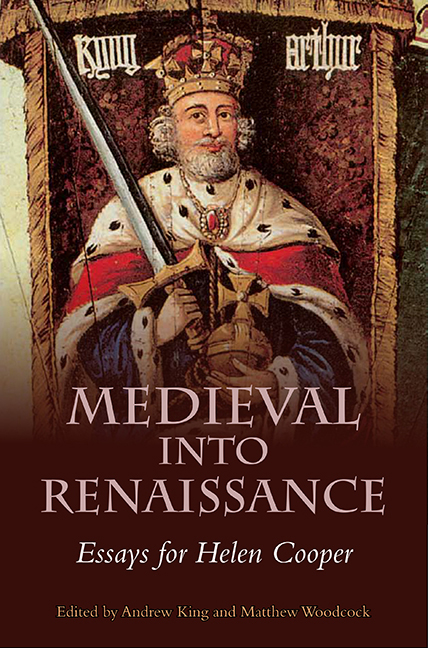
The borderline between the periods commonly termed "medieval" and "Renaissance", or "medieval" and "early modern", is one of the most hotly, energetically and productively contested faultlines in literary history studies. The essays presented in this volume both build upon and respond to the work of Professor Helen Cooper, a scholar who has long been committed to exploring the complex connectionsand interactions between medieval and Renaissance literature. The contributors re-examine a range of ideas, authors and genres addressed in her work, including pastoral, chivalric romance, early English drama, and the writings of Chaucer, Langland, Spenser and Shakespeare. As a whole, the volume aims to stimulate active debates on the ways in which Renaissance writers used, adapted, and remembered aspects of the medieval.
Andrew King is Lecturer in Medieval and Renaissance Literature at University College, Cork; Matthew Woodcock is Senior Lecturer in Medieval and Renaissance Literature at the University of East Anglia.
Contributors: Joyce Boro, Aisling Byrne, Nandini Das, Mary C. Flannery, Alexandra Gillespie, Andrew King, Megan G. Leitch, R.W. Maslen, Jason Powell,Helen Vincent, James Wade, Matthew Woodcock
My discussion, which owes a great deal to the work of Helen Cooper, begins with E.K.'s remarks on the 1579 edition of The Shepheardes Calender. Edmund Spenser is not named in this book, but he is in subsequent early editions and in modern editions. The first substantive point that E.K. makes in his Epistle, which is directed to Gabriel Harvey, is that once the anonymous, ‘vncovthe’ author of the poem to follow is ‘covthe’ he will be irresistibly attractive to readers. The passage in question is well known, but because my analysis of it will be detailed, I reproduce it at length:
To the most excellent and learned both Orator and Poete, Mayster Gabriell Haruey, his verie special and singular good frend E.K. commendeth the good lyking of this his labour, and the patronage of the new Poete.
VNCOVTHE VNKISTE, Sayde the olde famous Poete Chaucer: whom for his excellencie and wonderfull skil in making, his scholler Lidgate, a worthy scholler of so excellent a maister, calleth the Loadestarre of our Language: and whom our Colin clout in his glogue calleth Tityrus the God of shepheards, comparing hym to the worthines of the Roman Tityrus Virgile. Which prouerbe, myne owne good friend Ma. Haruey, as in that good old Poete it serued well Pandares purpose, for the bolstering of his baudy brocage, so very well taketh place in this our new Poete, who for that he is vncouthe (as said Chaucer) is vnkist, and vnknown to most men, is regarded but of few. But I dout not, so soone as his name shall come into the knowledg of men, and his worthines be sounded in the tromp of fame, but that he shall be not onely kiste, but also beloued of all, embraced of the most, and wondred at of the best.
The word ‘covth’, shunted aside here by the prefix ‘vn-’, is an archaism, one of the ‘olde and obsolete words […] most vsed of country folke’ that Spenser draws upon for the poetry of the Calender, in order, E.K. says, to bring ‘auctoritie to the verse’.
Between roughly 1350 and 1500, the English vernacular became established as a language of literary, bureaucratic, devotional and controversial writing; metropolitan artisans formed guilds for the production and sale of books for the first time; and Gutenberg's and eventually Caxton's printed books reached their first English consumers. This book gathers the best work on manuscript books in England made during this crucial but neglected period. Its authors survey existing research, gather intensive new evidence and develop new approaches to key topics. The chapters cover the material conditions and economy of the book trade; amateur production both lay and religious; the effects of censorship; and the impact on English book production of manuscripts and artisans from elsewhere in the British Isles and Europe. A wide-ranging and innovative series of essays, this volume is a major contribution to the history of the book in medieval England.
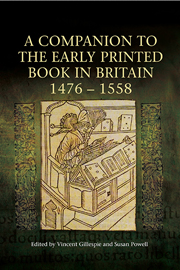
The history of the book is now recognized as a field of central importance for understanding the cultural changes that swept through Tudor England. This companion aims to provide a comprehensive guide to the issues relevant to theearly printed book, covering the significant cultural, social and technological developments from 1476 (the introduction of printing to England) to 1558 (the death of Mary Tudor). Divided into thematic sections (the printed booktrade; the book as artefact; patrons, purchasers and producers; and the cultural capital of print), it considers the social, historical, and cultural context of the rise of print, with the problems as well as advantages of the transmission from manuscript to print. the printers of the period; the significant Latin trade and its effect on the English market; paper, types, bindings, and woodcuts and other decorative features which create the packaged book; and the main sponsors and consumers of the printed book: merchants, the lay clientele, secular and religious clergy, and the two Universities, as well as secular colleges and chantries. Further topics addressed include humanism, women translators, and the role of censorship and the continuity of Catholic publishing from that time. The book is completed with a chronology and detailed indices. Vincent Gillespie is J.R.R. Tolkien Professor of English Literature and Language at the University of Oxford; Susan Powell held a Chair in Medieval Texts and Culture at the University of Salford, and is currently affiliated to the Universities of London and York. Contributors: Tamara Atkin, Alan Coates, Thomas Betteridge, Julia Boffey, James Clark, A.S.G. Edwards, Martha W. Driver, Mary Erler, Alexandra Gilespie, Vincent Gillespie, Andrew Hope, Brenda Hosington, Susan Powerll, Pamela Robinson, AnneF. Sutton, Daniel Wakelin, James Willoughby, Lucy Wooding
Edited by
Vincent Gillespie, J.R.R. Tolkien Professor of English Literature and Language at the University of Oxford,Susan Powell, Held a Chair in Medieval Texts and Culture at the University of Salford, and is currently affiliated to the Universities of London and York
Edited by
Vincent Gillespie, J.R.R. Tolkien Professor of English Literature and Language at the University of Oxford,Susan Powell, Held a Chair in Medieval Texts and Culture at the University of Salford, and is currently affiliated to the Universities of London and York
Edited by
Vincent Gillespie, J.R.R. Tolkien Professor of English Literature and Language at the University of Oxford,Susan Powell, Held a Chair in Medieval Texts and Culture at the University of Salford, and is currently affiliated to the Universities of London and York
Edited by
Vincent Gillespie, J.R.R. Tolkien Professor of English Literature and Language at the University of Oxford,Susan Powell, Held a Chair in Medieval Texts and Culture at the University of Salford, and is currently affiliated to the Universities of London and York