To save content items to your account,
please confirm that you agree to abide by our usage policies.
If this is the first time you use this feature, you will be asked to authorise Cambridge Core to connect with your account.
Find out more about saving content to .
To save content items to your Kindle, first ensure no-reply@cambridge.org
is added to your Approved Personal Document E-mail List under your Personal Document Settings
on the Manage Your Content and Devices page of your Amazon account. Then enter the ‘name’ part
of your Kindle email address below.
Find out more about saving to your Kindle.
Note you can select to save to either the @free.kindle.com or @kindle.com variations.
‘@free.kindle.com’ emails are free but can only be saved to your device when it is connected to wi-fi.
‘@kindle.com’ emails can be delivered even when you are not connected to wi-fi, but note that service fees apply.
To provide the proper background to understand jazz in the GDR (founded in 1949), the book opens with a brief historical account of jazz in Germany prior to the creation of the East German state.examines the arrival of jazz in Germany after World War I, offering a brief synopsis of the cultural politics of the Weimar (1919-1933) and the National Socialist (1933-1945) eras. These years witness the influx of jazz music and dance culture into the defeated German empire, its ambivalent reception by the bourgeoisie, and the emergence of deep questions about national cultural identity against newfound American trends and influences. Under the twelve years of National Socialism, these questions took on new dimensions: Nazi propaganda unequivocally ostracized jazz as an emblem of racial transgression, categorizing it alongside other degenerate works, yet also recruited the popularity of the music for propagandist purposes throughout the regime, even until its collapse.
examines the decade following the building of the Berlin Wall, from 1961-1971. After partition, which resulted both in increased jazz activities in the East and the clandestine transfer of jazz materials across the border, party leadership authored a pivotal “jazz resolution” that sought to steer the course of jazz in the socialist state. Examining this landmark policy in detail, this chapter shows how socialist leaders claimed jazz as a genuine folk tradition once more and called for its recognition as an art form that protested racial oppression. The chapter also details the pivotal 1965 tour by Louis Armstrong of the eastern bloc, which the GDR used to demonstrate its solidarity with the civil rights movement in America, and which permanently changed the trajectory of jazz in the GDR. In this light, the East German cultural establishment aimed to recruit one of the world’s most famous jazz musicians not just as a critic of American racial policies but furthermore as an ideal socialist-realist artist. Armstrong’s tour had many impacts, including the founding of the Dixieland Festival in Dresden, which continues to the present day.
By the last decade of the GDR, jazz had become a cherished national art form, a process of legitimization thatexplores in detail even as it chronicles the collapse of the East German state as a whole. In the 1980s, prominent GDR jazz musicians toured both the Eastern and Western blocs, turning free jazz that was “made in the GDR” into a desirable export from a progressive socialist country. Socialist leaders sought to showcase that prestige: in 1985 the GDR held its first “national” jazz festival in Weimar, a city that symbolized German humanist and democratic heritage. Despite the popularity of jazz as a “national” art form by this time, including the formation of the first national jazz orchestra, larger political currents would catalyze the collapse of the GDR within a few short years. To conclude this account, this chapter details the fall of the Berlin Wall through the eyes of key members of the jazz scene interviewed for this book. A brief epilogue explores the last chapter in the history of East German jazz, examining the months after the fall of the wall and the dismantling of the social and political apparatus that had nurtured jazz for so many years.
examines the period from 1949-1961, the first decade of the GDR. The chapter explores Marxist perceptions of jazz from both sides of the Atlantic that informed socialist-realist doctrine, contextualizing these views in the years before and after Joseph Stalin’s death. During this a newly-formed State Commission for the Arts (STAKOKU) sought to shield German cultural values against supposed American cultural decadence, restrictions that contributed to widespread dissent that peaked in a broader uprising in 1953. Analyzing the East German musical discourse of the 1950s that sought to rehabilitate jazz, this chapter explores its links to the 19th-century tradition of Hausmusik, including the prolific West Berlin jazz scene that sought to attract fans from East Berlin and beyond. Critically, at this time the STASI initiated its surveillance of the jazz scene, recruiting secret informants that proved pivotal in shaping East German jazz life. Ultimately, galvanized by political pressures and rising defections to the West throughout the 1950s, East German leadership responded by building the Berlin Wall. Dividing the city and country sorely impacted the spread of jazz activities, and resulted in the formation of a jazz scene specific to the GDR.
With the course of jazz profoundly influenced by the events of the previous decade,examines the 1970s, a time of new growth and innovation in jazz in the GDR. During these years East German cultural critics viewed American free jazz (as exemplified by Ornette Coleman) as an expression of social revolution in the United States, reading it as music protesting grievances and echoing class warfare. By contrast, however, jazz “made in the GDR” became emblematic of an art form in harmony with socialist society. Yet this harmonization was not perfect. This chapter explores how jazz retained its countercultural aspect, despite its incorporation into state culture and its subsequent flourishing, as well as how STASI surveillance of jazz increased given growing traffic between East and West. At various live jazz events in the 1970s, fans described an oppositional atmosphere, revealing a more ambiguous dynamic between individual and state than official proclamations might indicate. In the era of Ostpolitik, performers and audiences found subtle ways to critique the socialist state, even as East German diplomats recruited jazz to showcase socialist Germany on the global stage.
Having laid the groundwork for debates about jazz reception in Germany in ,explores jazz in the years of immediate postwar occupation in Germany: from the fall of the regime in 1945 to the founding of the GDR in 1949. During these years, Berlin, the former Nazi capital, served as the epicenter for the formerly Allied occupying powers to engage in ideological battle. During this time, both Soviet and Western allies employed culture, music, and jazz as key tools of the postwar rebuilding effort, with each side using jazz as a political tool to sway audiences toward democratic or socialist ideals. This chapter details the prominence Soviet policymakers assigned to music of African-American descent, recruiting it for propagandistic purposes, and shows how jazz served as entertainment for troops in the Western sectors. Charting the political developments that led to the creation of the GDR in 1949, this chapter further explores the personal experiences of German jazz fans in the late 1940s, whose experiences offer key accounts of racial segregation in the American sectors alongside the impact of Soviet propaganda of the time.
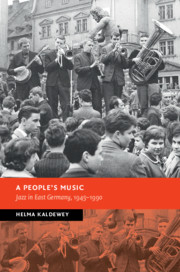
A People's Music presents the first full history of jazz in East Germany, drawing on new and previously unexamined sources and vivid eyewitness accounts. Helma Kaldewey chronicles the experiences of jazz musicians, fans, and advocates, and charts the numerous policies state socialism issued to manage this dynamic art form. Offering a radical revision of scholarly views of jazz as a musical genre of dissent, this vivid and authoritative study marks developments in the production, performance, and reception of jazz decade by decade, from the GDR's beginning in the 1940s to its end in 1990, examining how members of the jazz scene were engaged with (and were sometimes complicit with) state officials and agencies throughout the Cold War. From postwar rebuilding, to Stalinism and partition, to détente, Ostpolitik, and glasnost, and finally to its acceptance as a national art form, Kaldewey reveals just how many lives jazz has lived.
Recommend this
Email your librarian or administrator to recommend adding this to your organisation's collection.