To save content items to your account,
please confirm that you agree to abide by our usage policies.
If this is the first time you use this feature, you will be asked to authorise Cambridge Core to connect with your account.
Find out more about saving content to .
To save content items to your Kindle, first ensure no-reply@cambridge.org
is added to your Approved Personal Document E-mail List under your Personal Document Settings
on the Manage Your Content and Devices page of your Amazon account. Then enter the ‘name’ part
of your Kindle email address below.
Find out more about saving to your Kindle.
Note you can select to save to either the @free.kindle.com or @kindle.com variations.
‘@free.kindle.com’ emails are free but can only be saved to your device when it is connected to wi-fi.
‘@kindle.com’ emails can be delivered even when you are not connected to wi-fi, but note that service fees apply.
In African Literature in the World, Simon Gikandi asks: Why do debates on language continue to inform and haunt African writing? What happened when writing replaced orality as the primary form of creative expression? When, how, and why did the novel come to occupy such a dominant role in African literary history?
This is a comprehensive study of the histories and theories of African literature in the twentieth century and shows how African writers adopted and transformed the English language and its traditions to account for African identities and experiences. Concerned with writing and reading as forms of mediation, Gikandi provides examples of how imaginative works shaped the public sphere in Africa in relation to decolonization and the politics of language. He explores how the emergence of a modern tradition of African writing has generated new forms of criticism in relation to the form of the novel, modernity, and modernism.
Poststructuralist theory and postcolonial criticism represented the first major challenge to the institution of literary criticism as it had taken root in Britain and had been transported to Africa through the colonial university. This chapter discusses how the theories of literature, writing, and identity were geared toward a critique of the assumed relationship between language and identity and unsettled older forms of criticism and how this unsettling depended on the adoption of Africa as the quintessential zone of difference. A key question here is whether the notions of difference espoused by the new, poststructuralist criticism could rescue Africa from the old colonial accounts of the continent in which positioned Africa and Africanness as unmodern. Overall, the poststructuralist deconstruction of European systems of thought compelled intellectuals to rethink the location of Africa in global conceptual systems, leading to the rise of postcolonial criticism, a mode of thinking and reading whose goal was to question both the authority of English and American literary criticism and the nationalist foundations of earlier accounts of African literary criticism.
This chapter continues the discussion of how English came to function as the language of African self-expression in the twentieth century and was ultimately liberated from its colonial legacies. The chapter starts by exploring the so-called language question, a long-running debate on the status and function of the English language in the making of African letters, which has perhaps been the most divisive issue among African writers in the second half of the twentieth century. The debate was not simply a feud on language use but the expression of a deep anxiety about what it has meant to produce a literature of decolonization in the language of the former colonizer. The second part of the chapter provides an account of the evolution and transformation of English in Africa among different social groups including the slave traders of Calabar, Creole elites in West Africa, and the elites produced by the colonial schools and university colleges that produced the first generation of African writers.
This chapter is on the triangular relation between romance, tragedy, and decolonization as both themes and tropes in African fiction. The primary concern in the chapter is the work of the novel in the late colonial period and first decade of independence in Africa when the genre was tied closely to the politics of cultural nationalism. A key premise in the chapter is that the turn to the novel among African elites was bifurcated. On one hand, the genre attracted African elites in the late colonial period because they assumed that the genre would best register the tragedy of colonization, notably its cultural deracination, its destruction of subjects, and its denial of African agency. On the other hand, the novel was often asked to help African subjects imagine a future beyond colonialism. The novel in Africa came to be structured by the need to develop a language in which the tragedy that was seen as a defining characteristic of colonial history and the lived experience of colonized subjects, would be countered by the romance of a future that the novel as a genre was imagining and willing into being.
This chapter is a close examination of the politics of English in African literature, one that considers the language as an essential, but problematic part of the genealogy of imaginative writing in Africa. The chapter starts with a critical examination of the globalization of English and its expansive power in the postcolonial world. Why is it that of all the major languages of the world English has come to be celebrated as a tool of globalization, the conduit to modernity, modernization, and global citizenship? The chapter complicates the narrative of English as a hegemonic and compulsory system in modern culture by focusing on how, in the hands of formally colonized writers, it has been provincialized, relocated from its metropolitan centers, and turned into a force of imaginative works at odds with the dominant narrative of globalization. Using African examples, the chapter reflects on how a provincialized English has generated new modes of writing that challenge the traditional conception of English literary studies.
Even when they were produced within colonial systems or in the crucible of cultural nationalism, African literature and art in the twentieth century were inseparable from global cultural movements most notably modernism. Nevertheless, for reasons discussed in this chapter, the idea of a modern or contemporary art in Africa has often been resisted by Euro-American (and even African) critics and the institutions of art and literary criticism, which have historically located African creativity in a premodern realm. This chapter is a critique of this location of African art outside the epistemologies and forms of modernism. Originating as a comprehensive review of “The Short Century: Independence and Liberation Movements in Africa, 1945–1994,” a landmark exhibition of African art curated by Okui Enwezor in 2002, this chapter seeks to go beyond the denial of the modernism of African art and, through a close examination of Enwezor’s project, identifies the modernist aesthetic as a dynamic form that was indispensable to the African imagination in the twentieth century.
This chapter returns to a problem that continues to haunt and inform the study of Africa in modernity and modernism: What is the role of the aesthetic in the constitution of African imaginaries? While the starting point for this chapter is the problematic relationship between the African subject and dominant European ideas about race and blackness in the modern period, the chapter provides a critical account of how literature and art were deployed not so much as a play of forms, styles, and affects embedded in the African imagination, but as a mode of thought, one that challenged dominant Eurocentric ideas about Africans as a people without the capacity for reason and aesthetic judgment. This chapter returns to controversial debates about Négritude in African art and thought, arguing that this much-maligned movement was an important aesthetic ideology, a powerful counterpoint to the image of Africa as an unmodern subject. In the end, debates surrounding Négritude call attention to how African writers and critics embraced literature as a venue and method for simultaneously challenging particular European ideas about Africa while questioning nationalist desires for a unanimous African identity.
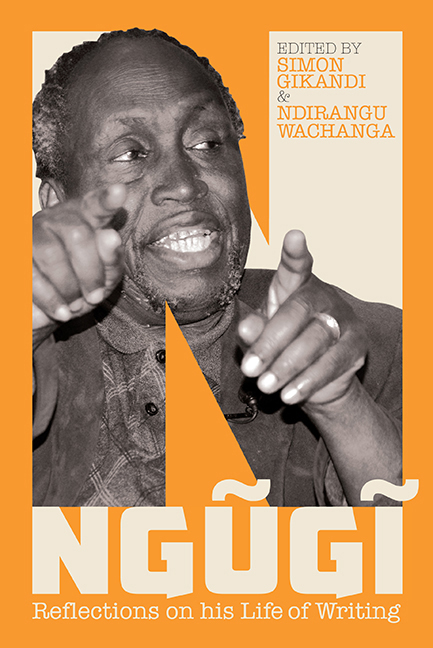
The tribute attempts to locate Ngugi as a major player within the African literary revolution. It draws attention to how writers like Ngugi used literary imagination to challenge colonial systems of thought, while offering decolonial alternatives and a powerful sense of newness, including the need to privilege writing in African languages. In a sense Ngugi was at the forefront of challenging the mythology of Englishness. For him, literature offered a platform for the critique of dominant ideologies. The tribute argues that Ngugi’s late career was, however, defined by exile and with it the challenge of writing about Africa away from Africa. In his last days, his writing wrestles with the idea of home – its politics and poetics.
The fact that the novel was an imported genre meant that African writers who sought to use it needed to signal its function in contexts that were far removed from the European experiences and ideas that had generated the emergence of the genre in the first place. This chapter takes up a simple but transformative question: How did novelistic genres travel from their assumed European centers to the outposts of empire and why and how did fictional forms acquire high cultural authority outside metropolitan settings? To answer this question, the chapter compares African novels to those produced in other colonial landscapes such as India not so much to identify a common purpose, but to show the deliberate process by which local writers brought local cultural elements, histories, and forms to domesticate the novel, to make them appear to be products of local communities and ideas even when they deployed familiar tropes. Popular novels could remind readers both of their colonial education in English literature and their connection or disconnection to the local customs rehearsed in fiction.
For most of its history in the twentieth century African literature has been haunted by the question of modernity. This chapter presents modernity as the overdetermining condition of literature in both colonialism and postcolonial society, examines how modernity came to exert its influence in the institution of African literature by hiding behind the mask of tradition, and treats modernity as both the cause and a symptom of the crisis associated with decolonial projects. This chapter is on the strategies developed by African writers to narrate this crisis: What does it mean to consider modernity as the overdetermining condition of African literature when the original impetus for this tradition of writing was the recuperation of precolonial histories and experiences? The chapter pays particular attention to the variety of forms in which the figure of the modern was represented in works that were not explicitly about modernity, most prominently Chinua Achebes Things Fall Apart and Arrow of God, Flora Nwapa’s Efuru, and Elechi Amadi’s The Concubine. These are novels where the referents are obviously precolonial while the ideas and the forms are about the nature and meaning of the modern.
This chapter takes up the idea of African literature, history, and criticism as part of a larger project of cultural transformation and examines the role of literary criticism and a literary education in the shaping of postcolonial identities. Starting with a personal reflection on the role of English colonial Englishness in the making of an African literature, and originally published as an “Editor’s Column” when the author assumed the editorship of the PMLA, the chapter functions as an overture to the whole book. It opens up the multiple worlds and texts that came to define African literature against the background of decolonization and calls attention to the intimate relationship between reading, writing, and thinking in the making of colonial and postcolonial subjects.
The introduction focuses on how modern African writing has challenged the central categories that have shaped intellectual debates on the nature of literature and criticism in the twentieth century with particular attention to the problem of modernity and the narrative of decolonization. The chapter identifies the key moments and contours of African literature from the early twentieth century to the great period of decolonization in the second half of the century and identifies the critical traditions that have determined the nature of this literature and its relation to global cultural movements. Rejecting the idea of an African literary tradition that is either a prisoner of Euro-American critical traditions or one isolated from global treads, the introduction summarizes the key arguments in the book to show how, at a distinct moment in the twentieth century, African imaginaries were codified into a set of practices that changed theories and histories of modern literature.
This chapter provides an account of how literary criticism, especially the one associated with F. R. Leavis and the Cambridge school worked, or failed to work, in an African context and the role this critical tradition played in the mapping of African writing in the postcolonial period. Focusing on the critical work of Abiola Irele, perhaps the most dominant figure in African literary critical studies in the second half of the twentieth century, the chapter looks at how the use of African literature as a primary body of reference led to the questioning of the key concepts defining literary criticism including the notion of tradition, literary genealogies, and the relation between language and identity. The chapter explores how Irele, working within three distinct cultural formations, namely the English, the French, and the Yoruba, positioned literary criticism as both an affirmation of tradition and a critique of traditionalism. Tracing the evolution of Irele’s critical thinking as he moved from universities in West Africa to the United States, the chapter provides an account of the relation between criticism, institutions, and audiences.
This chapter is on novelistic discourses and the project of cultural translation in African literature from the perspective of Comparative Literature. The chapter begins with an analysis of debates on translation from both a linguistic and cultural perspective focusing on how, in comparative literature, debates about translation are caught in a conceptual impasse between critics who insist on the impossibility of translation and those who claim that nothing is untranslatable. The key argument in this chapter is that African literature in European languages complicates this division by calling into question the notion of an original or source language. In African fiction produced in the twentieth century, what appeared to be the source language was already a translation. More significantly, linguistic translation could not be separated from the project of cultural translation; in order for novels to perform significant cultural work, writers had to make African idioms and speech forms intelligible to outsiders without reaffirming the forms of colonial knowledge.