


20 results
Abbreviations
-
- Book:
- The Haskins Society Journal 23
- Published by:
- Boydell & Brewer
- Published online:
- 05 November 2014
- Print publication:
- 17 April 2014, pp x-xiv
-
- Chapter
- Export citation
6 - Men and Masculinities at the Courts of the Anglo-Norman Kings in the Ecclesiastical History of Orderic Vitalis
-
-
- Book:
- The Haskins Society Journal 23
- Published by:
- Boydell & Brewer
- Published online:
- 05 November 2014
- Print publication:
- 17 April 2014, pp 105-114
-
- Chapter
- Export citation
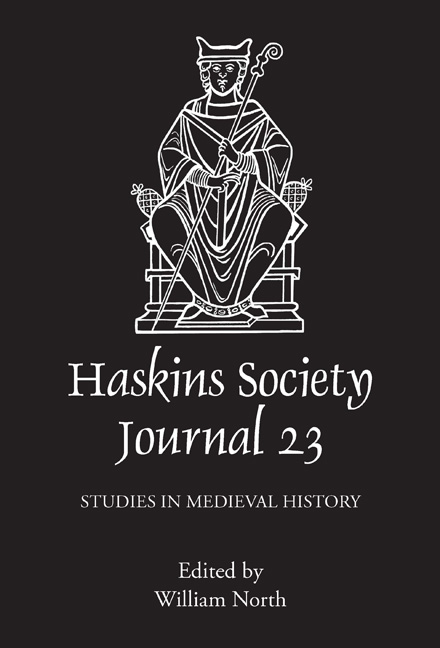
The Haskins Society Journal 23
- 2011. Studies in Medieval History
-
- Published by:
- Boydell & Brewer
- Published online:
- 05 November 2014
- Print publication:
- 17 April 2014
Authors' Preface to Chapters 6 and 7
-
-
- Book:
- The Haskins Society Journal 23
- Published by:
- Boydell & Brewer
- Published online:
- 05 November 2014
- Print publication:
- 17 April 2014, pp 103-104
-
- Chapter
- Export citation
Frontmatter
-
- Book:
- The Haskins Society Journal 23
- Published by:
- Boydell & Brewer
- Published online:
- 05 November 2014
- Print publication:
- 17 April 2014, pp i-iv
-
- Chapter
- Export citation
Contents
-
- Book:
- The Haskins Society Journal 23
- Published by:
- Boydell & Brewer
- Published online:
- 05 November 2014
- Print publication:
- 17 April 2014, pp v-vi
-
- Chapter
- Export citation
List of Figures
-
- Book:
- The Haskins Society Journal 23
- Published by:
- Boydell & Brewer
- Published online:
- 05 November 2014
- Print publication:
- 17 April 2014, pp vii-viii
-
- Chapter
- Export citation
Editor's Note
-
- Book:
- The Haskins Society Journal 23
- Published by:
- Boydell & Brewer
- Published online:
- 05 November 2014
- Print publication:
- 17 April 2014, pp ix-ix
-
- Chapter
- Export citation
English medieval shrines. By John Crook. (Boydell Studies in Medieval Art and Architecture.) Pp. xxiv+342 incl. frontispiece, 4 figs and 53 plates. Woodbridge: Boydell Press, 2011. £39.95. 978 1 84383 682 7
-
- Journal:
- The Journal of Ecclesiastical History / Volume 65 / Issue 1 / January 2014
- Published online by Cambridge University Press:
- 13 December 2013, p. 167
- Print publication:
- January 2014
-
- Article
- Export citation
Contributors
-
-
- Book:
- The Hellenistic West
- Published online:
- 05 December 2013
- Print publication:
- 24 October 2013, pp xvii-xviii
-
- Chapter
- Export citation
Saints and sanctity. Edited by Peter Clarke and Tony Claydon. (Studies in Church History, 47.) Pp. xxii+437 incl. 4 figs and 8 tables + double-sided pull-out colour plates. Woodbridge: Boydell Press (for the Ecclesiastical History Society), 2011. £45. 978 0 95468 098 5; 0424 2084
-
- Journal:
- The Journal of Ecclesiastical History / Volume 64 / Issue 2 / April 2013
- Published online by Cambridge University Press:
- 12 April 2013, p. 365
- Print publication:
- April 2013
-
- Article
- Export citation
European religious cultures. Essays offered to Christopher Brooke on the occasion of his eightieth birthday. Edited by Miri Rubin. Pp. ix+156. London: Institute of Historical Research, 2008. £20. 978 1 905165 40 7
-
- Journal:
- The Journal of Ecclesiastical History / Volume 62 / Issue 2 / April 2011
- Published online by Cambridge University Press:
- 04 March 2011, pp. 368-369
- Print publication:
- April 2011
-
- Article
- Export citation
Religious life in Normandy, 1050–1300. Space, gender and social pressure. By Leonie V. Hicks. (Studies in the History of Medieval Religion, 33.) Pp. x+243. Woodbridge: Boydell Press, 2007. £45. 978 1 84383 329 1; 0955 2480
-
- Journal:
- The Journal of Ecclesiastical History / Volume 60 / Issue 4 / October 2009
- Published online by Cambridge University Press:
- 16 October 2009, pp. 783-784
- Print publication:
- October 2009
-
- Article
- Export citation
Imagining the sacred past. Hagiography and power in early Normandy. By Samantha Kahn Herrick. Pp. xiii+256 incl. 1 map and 1 genealogical chart. Cambridge, MA–London: Harvard University Press, 2007. £32.95 ($49.95). 13 978 0 674 02443 4; 10 0 674 02443 5
-
- Journal:
- The Journal of Ecclesiastical History / Volume 60 / Issue 1 / January 2009
- Published online by Cambridge University Press:
- 08 January 2009, pp. 149-150
- Print publication:
- January 2009
-
- Article
- Export citation
Miracles and the miraculous in medieval Germanic and Latin literature. Edited by K. E. Olsen, A. Harbus and T. Hofstra. (Mediaevalia Groningana. New Ser., 6.) Pp. ix+211. Louvain–Paris–Dudley, MA: Peeters, 2004. €50 (paper). 90 429 1532 4
-
- Journal:
- The Journal of Ecclesiastical History / Volume 58 / Issue 2 / April 2007
- Published online by Cambridge University Press:
- 28 March 2007, pp. 308-309
- Print publication:
- April 2007
-
- Article
- Export citation
Narrative, Audience and the Negotiation of Community in Twelfth-Century English Miracle Collections
-
- Journal:
- Studies in Church History / Volume 42 / 2006
- Published online by Cambridge University Press:
- 21 March 2016, pp. 65-77
- Print publication:
- 2006
-
- Article
- Export citation
Local saints and local churches in the early medieval west. Edited by Alan Thacker and Richard Sharpe. Pp. xiii+581 incl. 39 ills. Oxford: Oxford University Press, 2002. £85. 0 19 820394 2
-
- Journal:
- The Journal of Ecclesiastical History / Volume 57 / Issue 1 / January 2006
- Published online by Cambridge University Press:
- 17 January 2006, pp. 111-112
- Print publication:
- January 2006
-
- Article
- Export citation
The English and the Normans. Ethnic hostility, assimilation, and identity, 1066–c. 1220. By Hugh M. Thomas. Pp. xii + 462. Oxford: Oxford University Press, 2003. £65. 0 19 925123 1
-
- Journal:
- The Journal of Ecclesiastical History / Volume 56 / Issue 4 / October 2005
- Published online by Cambridge University Press:
- 05 December 2005, pp. 767-769
- Print publication:
- October 2005
-
- Article
- Export citation
Pilgrimage in medieval England. By Diana Webb. Pp. xvii+317 incl. frontispiece and 5 ills+13 plates. London–New York: Hambledon–London, 2000. £25. 1 85285 250 X
-
- Journal:
- The Journal of Ecclesiastical History / Volume 54 / Issue 1 / January 2003
- Published online by Cambridge University Press:
- 13 May 2003, pp. 97-194
- Print publication:
- January 2003
-
- Article
- Export citation
Richard I. By John Gillingham. (Yale English Monarchs.) Pp. xi+378 incl. 5 maps+18 ills. New Haven–London: Yale University Press, 1999. £20. 0 300 07912 5
-
- Journal:
- The Journal of Ecclesiastical History / Volume 52 / Issue 2 / April 2001
- Published online by Cambridge University Press:
- 15 June 2001, pp. 338-396
- Print publication:
- April 2001
-
- Article
- Export citation
