


Work-life balance
First published in English Teaching Professional magazine, www.etprofessional.com © 2005, 2007 Keyways Publishing Ltd.

Simon Sweeney's career reflects changes in perception in adult English teaching.
My involvement with English language teaching began in Alba in northwestern Italy a very long time ago. These were the anni di piombo, and Italy was still going through convulsions after the killing of Aldo Moro in 1978. I taught general English in a private language school. Despite the precarious nature of confronting frequent roadblocks manned by nervous carabinieri in the middle of the night, those were great times. They included discovering the delights of Barbaresco,
Nebbiolo, Barolo and even occasional tastes of the famous white truffles, tartufi bianchi. I also recall that prospective students (or their parents) would often ask if the English we taught was l'inglese della regina, or l'inglese di Oxford. I used to say, 'If you learn English from me, it'll be the English I speak.' That was the wrong answer: they didn't want that.
Language ownership
Fortunately things have moved on, even if teachers in Italy still tell me that the question hasn't died away altogether. The point is that English isn't the Queen's, or that of a particular city (or publisher), or even the property of the BBC. English belongs to everyone who uses it, around 1.5 billion speakers worldwide. There are countless varieties and many interlanguages serving the needs of its speakers, regardless of where they originate from. Most people who use English, including most of those who teach it, are not native speakers.
In a tripartite business meeting between a Russian, a Japanese and a Finn, their common use of English serves as a communication tool, just as the internet does for most of us. Furthermore, if this trio were joined by someone from Scunthorpe, the Brit might be more difficult for the others to understand than each other — so who is at a disadvantage? English is outside anyone's control, as is the internet. Certain governments, anxious about their citizens' increasing access to websites that might stimulate demands for freedom of belief and expression, may try to close particular servers. But others crop up continually, making censorship no more effective than putting sticking plaster on a burst pipe.
From general to specific
After three years in Alba, I spent another three in San Sebastian, Spain. Where Italy had the Brigate Rosse, Spain had ETA militar. In place of Barbaresco, I discovered Rioja. Instead of endless antipasti, I had pintxos (better known as tapas in the rest of Spain) and superb fish. This, then, was my foundation in teaching general English (EFL), though I also learnt to cook (a bit).
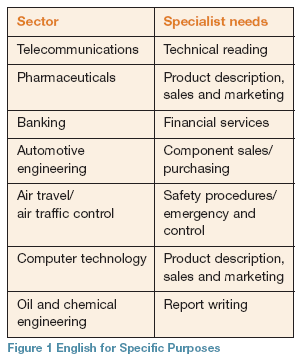
Back in the UK, after a spell in a factory, I eventually found myself in the mid to late 1980s in what appeared to be the exalted world of English for Specific Purposes (ESP), working for York Associates, teaching engineers, technicians and managers, mainly in the fields of telecommunications, petroleum engineering and computer technology. The students all had specialist needs, as shown in Figure 1.
Business Skills
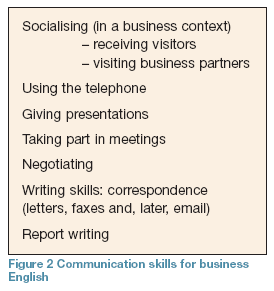
Much of the language was somewhat specialist, and the fashion for ESP didn't last very long, or it was more or less entirely internalised in company training departments. In fact, this wasn't surprising, as both training managers and course providers recognised that the learners didn't lack technical language or specialist terminology: what they lacked was the confidence and competence to achieve given communication needs effectively. In other words, their skills needed improving. Publishers, textbook writers and course providers responded by focusing their offerings not on ESP but on business English, and on developing communication skills as outlined in Figure 2.
Here the focus was on the characteristics of effective acts of communication, with provision of examples of the kind of phrases useful in realising certain objectives. For example, in using the telephone, students might need to have at their disposal phrases that would enable them to take control of the conversation:
- Can you speak more slowly, please?
- Please can you repeat that?
- Did you say...?
- I didn't understand what you said.
However, just as important, if not more so, was the need to develop learners' conscious understanding of what constitutes a good communication technique. This begins with a clear recognition of the inherent structure of communication events in areas such as telephoning, presenting, describing visual aids, meetings and negotiations, as well as written acts of communication such as reports or faxes (and now emails).
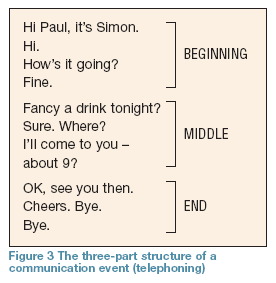
So, for example, there is the fundamental observation that such communication events have a clear threepart structure, as shown in Figure 3. Almost all communication events typical of the skills listed in Figure 2 can be mapped onto this three-part structure. A presentation starts with an introduction, has a (longer) main bit in the middle, full of information, and an end which consists of a summary, questions and maybe discussion. Learners need to apply this structure consciously to what they create in the target language, and in so doing they will enhance the clarity of what they produce. A conscious reflection on — and application of — technique will prevent difficulties with language submerging the communication event and rendering the whole thing broadly incomprehensible.
Transfer and reconstruction
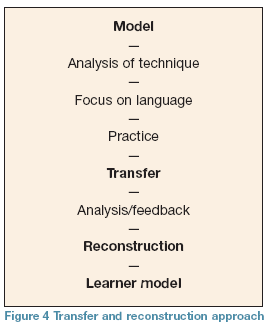
This process can be consolidated through the application of a 'Transfer and reconstruction' approach. This is summarised in Figure 4.
Model
The model may be an audio or video recording, or a transcript of a genuine communication event, or one specially produced for training purposes, or something published. The idea is that students are encouraged to comment on what they see and hear: what is good, what is not good (the model may sometimes be an example of how not to communicate). Above all, students are encouraged to reflect on what makes communication effective. What are the characteristics of a good presentation? (For example, it has a clear three-part structure, it uses visual aids effectively, and it respects audience expectations, needs and time constraints.)
Once these are fully understood and internalised, we can then separately begin to consider what language is needed to facilitate the communication aims.
This is followed by practice, making sure that key phrases are broadly internalised.
Transfer
Next the transfer is introduced. This is the vital step of shifting from roleplay to the learners' perceived needs: the transfer allows the learner to create the email, the visual aid description, the phone call, the presentation or the part of a meeting, or even the part of a negotiation, that is based on a likely scenario in their workplace, or at least on a context which relates to the learner's interests and needs. This is transfer. It is much more than a roleplay.
Reconstruction/learner model
Following the transfer, the trainer and the learner(s) together engage in critical reflection, highlighting what is good, what worked, and what needs improvement. After this, the event (the transfer) is reconstructed with the benefit of the feedback. It is important that as much of the feedback as possible is elicited from the learners, rather than simply supplied by the teacher, the trainer or the facilitator. This helps to establish the habit of reflective learning and enables learners to take responsibility for their own learning. The next step is for the learners to re-do the act of communication — the reconstruction. This is recorded and retained as the learner's own model. This is vital, and should be kept for future reference, preferably in a recorded or written format. It should be included as part of the student's file of stored materials, useful for future reference and thus much more likely to benefit from commitment to long-term memory.
Business turns professional
This strategy, it seems to me, is broadly applicable in a range of contexts. But at this point, I would like to return to the personal journey that I was describing above. So far, I have spoken about moving from teaching general English, to the concern for ESP which later became a concentration on business English. But this, too, underwent a significant mutation. Towards the late 1990s, it became increasingly apparent that significant numbers of adult learners of English hardly wanted business English at all, for the simple reason that they weren't business people. The market contained, instead, an emerging group of professional learners of English, encompassing a few members of the old-style professions, but also the selfemployed and the consultant, as well as public sector government employees, and workers and officials in nongovernmental organisations such as charities, or other professionals working in governmental bodies such as the UN or any of its 200-plus agencies, the European Union and its various institutions, journalists and others in the media, and even footballers, employed in a game that, like everything else, was undergoing profound changes relating to the much discussed but little understood phenomenon of globalisation.
In summary, business English became professional English, not wishing to exclude anyone.
The re-emergence of general English
However, the journey did not end there. There is another new and important reality concerning adult learners of English: they use English not only for work, but also for other things in their lives, encompassing leisure, holidays and family life. We call this work-life balance. I am now a writer of teaching materials that seek to reflect this evolution, and as any authors reading this who also have full-time jobs will attest, though we may talk about work-life balance, we hardly practise it, although we do dream about one day recovering a sense of how to lead more balanced lives!
Why has this need for the incorporation of a balance between general and professional English emerged? Essentially it has done so because in the post-world-wide-web context of globalisation, with increased travel and trade, many more people perceive English as a desirable commodity which reflects a lifestyle choice. Aspiring individuals across the world want to know English because it contributes to their overall sense of identity as modern, cosmopolitan individuals. Thus, knowing English becomes part of individuals' aspirations. This is unsurprising: English is the dominant language in fashion, computer technology, travel, media and advertising, as well as sport and leisure. It is the language people use on holiday when abroad. It is the language of university exchanges, and above all, of the internet, where 80 per cent of websites and 90 per cent of emails are in English. Thus, as well as the myriad of work sectors where English prevails, it has become a common communication tool in the non-work contexts in which individuals and their families conduct their lives. Michael Schumacher is German and drives for Ferrari. He speaks English, though not Italian. That's a choice he is, of course, entitled to make.
In my writing of textbooks for adult learners, I want to reflect this work- and life-based need for English, choosing to present real people talking about their real daily concerns. I believe this adds to the credibility of the material, and makes it more interesting and more motivating. Variety and a sense of authenticity are key elements in any successful course planning. Syllabus design too needs to be wide ranging and comprehensive, with several tracks running through the material, including survival English based on common situations (not untypical of what one might wish to find in a holiday or business trip phrase book), grammar consolidation, pronunciation, communicating at work (skills-based) and vocabulary (following a thematic and lexical set type approach). Courses also need to include tips for effective learner-training, encouraging learners to adopt measures to consolidate their learning, to convert new language from short-term to long-term memory, and to accept responsibility for achieving progress with the language.
As well as this breadth of syllabus content, I think a good and wideranging adult course should reflect a work-life balance, focusing on both professional and personal interests.
The author would like to thank Sally Searby, Chris Capper, Sandy Collett, Bob Dignen and Steve Flinders.