
Humans at the heart of education: A new framework to unlock human potential

As we approach 2030, we find ourselves in a profoundly different world to the one the UN Sustainable Development Goals imagined in 2015. Where should we focus in the increasingly urgent discussions on what’s next?
Last year, we shared a report on the possibilities if we put humans at the heart of education. That report was the beginning of a conversation – and we’ve been speaking to government leaders, educators, learners, partners and those who support them to dig deeper.
Watch some of our recent conversations, where leaders graffitied their top education priority on a school desk:
Advances in AI
AI has huge potential to amplify human capability, creativity and productivity… if we can guide the world to embrace it effectively. For us, that means incorporating AI into education systems while always keeping humans at the heart of teaching and learning.
Advances in neuroscience
We now have an increasingly rich picture of people’s remarkable capacity to learn, adapt, grow and contribute throughout their lives. We can and should use this to nurture resilient lifelong learners, who can thrive in unpredictable futures.
Advances in sustainability
The challenging impact of the climate crisis on education is undeniable. But education is where we’ll find the solutions. Stressing how we are connected with each other and the natural world in classrooms will help learners become the scientists, stewards and sustainability-conscious citizens the world urgently needs.
As these advances transform our world, it can feel as though education systems need to do more and more. Research highlights hundreds of skills young people are likely to require for the future. More information is available than ever before.
A growing list of priorities, from climate education to digital fluency, is rightly gaining attention. At the same time, too many children are still out of school, and too many others leave with a sense of failure and without basic literacy skills. Surrounded by possibilities, and urgency, how do we connect the dots to create a clearer map for developing education systems?
Drawing on conversations across the globe and existing approaches, we believe that the starting point has to be how to unlock human potential. We've developed this Future of Education Framework to set out four connected dimensions to help focus that work:
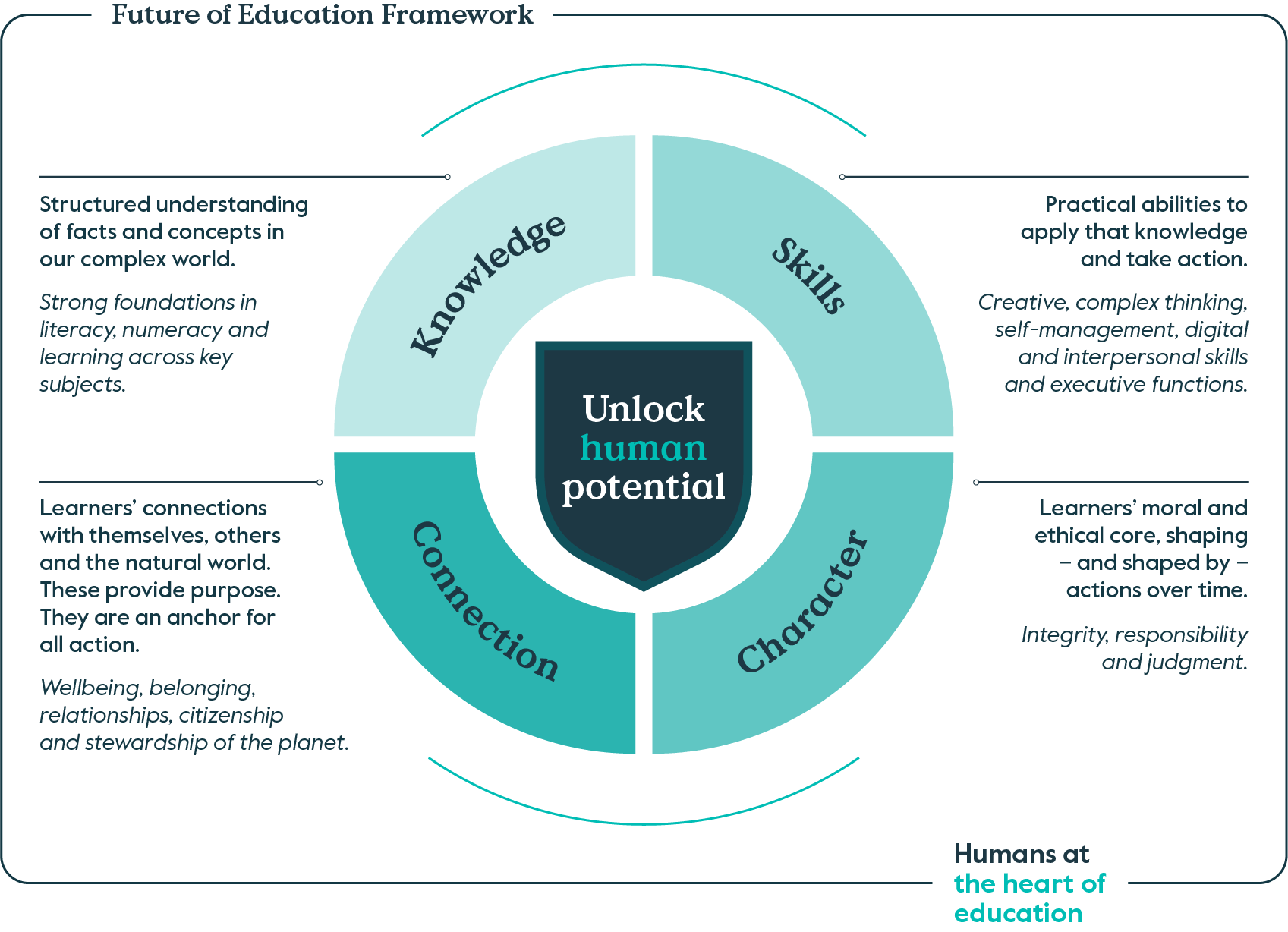
The specifics of these dimensions will look different for every individual and community across the world, and they should – this is part of our collective humanity.
While AI may be capable of parts of these dimensions, we still need learning to balance all four to realise human potential. Each one builds on the others and is essential to equip learners and societies to thrive.
For example, if you develop your interpersonal skills, this will positively influence the connections you’re able to build with others.
These dimensions can weave throughout education in a holistic way. They develop progressively across subjects and stages of learning, strengthening one another over time.
This framework is not final. It reflects our evolving approach, and over the coming months we will be putting it to the test with government leaders, employers, educators, teachers, learners and communities.
Want to join us? Register your interest below for our upcoming webinars on each of the three advances.
