

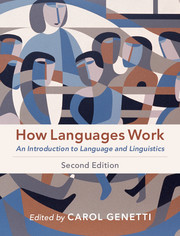
How Languages Work
An Introduction to Language and Linguistics
- Editor: Carol Genetti, University of California, Santa Barbara
- Date Published: March 2014
- availability: Replaced by 9781108454513
- format: Paperback
- isbn: 9780521174688
Paperback
Looking for an examination copy?
This title is not currently available for examination. However, if you are interested in the title for your course we can consider offering an examination copy. To register your interest please contact collegesales@cambridge.org providing details of the course you are teaching.
-
A new and exciting introduction to linguistics, this textbook presents language in all its amazing complexity, while guiding students gently through the basics. Students emerge with an appreciation of the diversity of the world's languages, as well as a deeper understanding of the structure of human language, the ways it is used, and its broader social and cultural context. Chapters introducing the nuts and bolts of language study (phonology, syntax, meaning) are combined with those on the 'functions' of language (discourse, prosody, pragmatics, and language contact), helping students gain a better grasp of how language works in the real world. A rich set of language 'profiles' help students explore the world's linguistic diversity, identify similarities and differences between languages, and encourages them to apply concepts from earlier chapter material. A range of carefully designed pedagogical features encourage student engagement, adopting a step-by-step approach and using study questions and case studies.
Read more- Takes a functional approach, providing a modern, global and integrated perspective on language
- Student-engaging features include a step-by-step structure, reflection questions and in-depth case studies
- Student online resources include sound and video files, study guides, tutorials, interactive problem sets, electronic flash cards, and documents on argumentation, problem solving and writing in linguistics
- Instructor online resources include modifiable PowerPoint slides, answer keys, quiz questions and problem sets
Reviews & endorsements
Advance Praise: ‘truly a textbook of the 21st century’ --Keren Rice,Department of Linguistics, University of Toronto
See more reviews‘How Languages Work is the perfect introductory textbook on language and linguistics … an invigorating combination of a straightforward, introductory tone and high-level scholarship. The chapter authors effectively communicate their own enthusiasm for language and linguistics in a way that promises to engender similar enthusiasm in undergraduate readers.’ --Thomas Payne, University of Oregon and SIL International
“Here at last is a textbook that isn't locked into theoretical dogmas but that instead introduces students to the analytical methods and skills needed for successful research! Each method and concept is carefully explained, hands-on and step-by-step.’’ --Balthasar Bickel, University of Zurich
Customer reviews
31st Aug 2014 by Emilson
I appreciate the selection of topics covered in this text, and the way they are arranged. I also like the fact that it introduces the student to a functional perspective on grammar. The book and the accompanying on-line resources offer a wealth of material that make teaching an Intro to linguistics course very enjoyable. Thank you. Perhaps the only thing I miss is that sign languages do not get a lot of coverage in this book, but at our institution we cover sign languages only marginally in the Intro course anyway.
Review was not posted due to profanity
×Product details
- Date Published: March 2014
- format: Paperback
- isbn: 9780521174688
- length: 674 pages
- dimensions: 245 x 188 x 31 mm
- weight: 1.41kg
- contains: 96 b/w illus. 19 maps 57 tables 150 exercises
- availability: Replaced by 9781108454513
Table of Contents
1. Introduction: language, languages, and linguistics Carol Genetti
2. Phonetics: physical dimensions of speech sounds Matthew Gordon
3. Phonology: organization of speech sounds Matthew Gordon
4. Morphology: what's in a word? Marianne Mithun
5. Word classes: evidence from grammatical behavior Carol Genetti
6. Syntax: words in combination Carol Genetti
7. Semantics: how language makes sense Michael Israel
8. Pragmatics: inference for language Mira Ariel
9. Discourse: language beyond the sentence Wallace Chafe
10. Prosody: the music of language Wallace Chafe
11. Language and the social world Mary Bucholtz
12. Language change: the dynamicity of linguistic systems Marianne Mithun
13. Language contact and areal linguistics Alexandra Y. Aikhenvald
14. First language acquisition Patricia Clancy
15. Second language acquisition Dorothy Chun and Jan Frodesen
Language Profiles:
1. Kabardian Matthew Gordon and Ayla Applebaum
2. Goemai Birgit Hellwig
3. Manange Kristine Hildebrandt
4. Finnish Ritva Laury
5. Nuuchahnulth (Nootka) Toshihide Nakayama
6. South Conchucos Quechua Daniel Hintz
7. Tsez Bernard Comrie
8. Bardi Claire Bowern
9. Lowland Chontal Loretta O'Connor
10. Manambu Alexandra Y. Aikhenvald and Carol Genetti
11. Indonesian Robert Englebretson
12. Seneca Wallace Chafe
13. Akkadian Guy Deutscher.-

Resources for
How Languages Work
General Resources
Instructor Resources
- Resources
- Chapter 01
- Chapter 02
- Chapter 03
- Chapter 04
- Chapter 05
- Chapter 06
- Chapter 07
- Chapter 08
- Chapter 09
- Chapter 10
- Chapter 11
- Chapter 12
- Chapter 13
- Chapter 14
- Chapter 15
- Language profile materials
Student Resources
Find resources associated with this title
Type Name Unlocked * Format Size Showing of
This title is supported by one or more locked resources. Access to locked resources is granted exclusively by Cambridge University Press to instructors whose faculty status has been verified. To gain access to locked resources, instructors should sign in to or register for a Cambridge user account.
Please use locked resources responsibly and exercise your professional discretion when choosing how you share these materials with your students. Other instructors may wish to use locked resources for assessment purposes and their usefulness is undermined when the source files (for example, solution manuals or test banks) are shared online or via social networks.
Supplementary resources are subject to copyright. Instructors are permitted to view, print or download these resources for use in their teaching, but may not change them or use them for commercial gain.
If you are having problems accessing these resources please contact lecturers@cambridge.org.
Related Books
related journals
Sorry, this resource is locked
Please register or sign in to request access. If you are having problems accessing these resources please email lecturers@cambridge.org
Register Sign in» Proceed
You are now leaving the Cambridge University Press website. Your eBook purchase and download will be completed by our partner www.ebooks.com. Please see the permission section of the www.ebooks.com catalogue page for details of the print & copy limits on our eBooks.
Continue ×Are you sure you want to delete your account?
This cannot be undone.
Thank you for your feedback which will help us improve our service.
If you requested a response, we will make sure to get back to you shortly.
×