

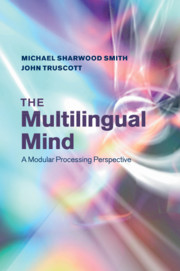
The Multilingual Mind
A Modular Processing Perspective
AUD$75.95 inc GST
- Authors:
- Michael Sharwood Smith, Heriot-Watt University, Edinburgh
- John Truscott, National Tsing Hua University, Taiwan
- Date Published: August 2019
- availability: Available
- format: Paperback
- isbn: 9781107612457
AUD$
75.95
inc GST
Paperback
Other available formats:
Hardback, eBook
Looking for an inspection copy?
Please email academicmarketing@cambridge.edu.au to enquire about an inspection copy of this book
-
Language lies at the heart of the way we think, communicate and view the world. Most people on this planet are in some sense multilingual. The Multilingual Mind explores, within a processing perspective, how languages share space and interact in our minds. The mental architecture proposed in this volume permits research across many domains in cognitive science to be integrated and explored within one explanatory framework, recasting compatible insights and findings in terms of a common set of terms and concepts. The MOGUL framework has already proven effective for shedding light on the relationship between processing and learning, metalinguistic knowledge, consciousness, optionality, crosslinguistic influence, the initial state, 'UG access', ultimate attainment, input enhancement, and even language instruction. This groundbreaking work will be essential reading for linguists working in language acquisition, multilingualism, and language processing, as well as for those working in related areas of psychology, neurology and cognitive science.
Read more- Discusses language within a broader framework of cognition and integrates compatible perspectives from specialist fields
- Integrates current trends in cognitive science, allowing readers to gain easy access to relevant research from different disciplines
- Treats multilingualism and second language acquisition as particular instances of language acquisition, enabling readers to learn about broader based approaches to language learning
Reviews & endorsements
'An immensely interesting treatment of the bilingual mind, full of important ideas about the cognitive systems that support the acquisition and use of language.' William O'Grady, University of Hawaii, Manoa
See more reviews'Sharwood Smith and Truscott present their long-awaited book-length treatment of the MOGUL framework, an approach to linguistic - and in particular bilingual and multilingual - development which reconciles approaches from various contemporary linguistic, psycholinguistic and cognitive domains. The result is thorough, convincing and highly readable and will, no doubt, leave its mark on research into language development for many years to come.' Monika S. Schmid, University of Essex and University of Groningen
'The book offers an extensive description of the MOGUL (Modular On-line Growth and Use of Language) framework. The proposal is interesting, parsimonious, and elegant. The book is easy to follow, clearly written, and well organised (notably, each chapter opens with a chapter outline and concludes with a useful chapter summary), and the exposition is coherent.' Marta De Pedis, LINGUIST List
Customer reviews
Not yet reviewed
Be the first to review
Review was not posted due to profanity
×Product details
- Date Published: August 2019
- format: Paperback
- isbn: 9781107612457
- length: 430 pages
- dimensions: 150 x 230 x 20 mm
- weight: 0.45kg
- contains: 23 b/w illus. 1 table
- availability: Available
Table of Contents
1. Introduction
Part I. The Framework:
2. The language module: architecture and representations
3. Processing in the language module
4. Growth of the language module: acquisition by processing
5. Beyond the language module
Part II. Applying the Framework:
6. The bilingual mind introduced
7. The growth of a second language
8. Consciousness and attention
9. The role of consciousness in language growth
10. Issues in SLA revisited
11. Conclusion
References.-
Resources for
The Multilingual Mind
Michael Sharwood Smith, John Truscott
General Resources
Find resources associated with this title
Type Name Unlocked * Format Size Showing of
This title is supported by one or more locked resources. Access to locked resources is granted exclusively by Cambridge University Press to lecturers whose faculty status has been verified. To gain access to locked resources, lecturers should sign in to or register for a Cambridge user account.
Please use locked resources responsibly and exercise your professional discretion when choosing how you share these materials with your students. Other lecturers may wish to use locked resources for assessment purposes and their usefulness is undermined when the source files (for example, solution manuals or test banks) are shared online or via social networks.
Supplementary resources are subject to copyright. Lecturers are permitted to view, print or download these resources for use in their teaching, but may not change them or use them for commercial gain.
If you are having problems accessing these resources please contact lecturers@cambridge.org.
Related Books

related journals

also by this author

Sorry, this resource is locked
Please register or sign in to request access. If you are having problems accessing these resources please email lecturers@cambridge.org
Register Sign in» Proceed
You are now leaving the Cambridge University Press website. Your eBook purchase and download will be completed by our partner www.ebooks.com. Please see the permission section of the www.ebooks.com catalogue page for details of the print & copy limits on our eBooks.
Continue ×Are you sure you want to delete your account?
This cannot be undone.
Thank you for your feedback which will help us improve our service.
If you requested a response, we will make sure to get back to you shortly.
×