


Not since the early 1980s has interest in local, regional, national, and global food systems been as strong as it is today. This renewed interest confirms that good ideas come around every 30 years, but the analytical tools and concepts now used have improved, the scale of the analyses has expanded, and the research questions have changed. That agricultural economists have a role to play in food system research is not news to readers of this journal. Agricultural economists also hardly have a monopoly on the subject, as Reardon and Timmer (Reference Reardon and Timmer2012, p. 227) pointed out: “the system nature of the food system means it is conditioned by many factors and thus studied by many disciplines (anthropology, sociology, geography, and so on).” Nevertheless, agricultural economists can be uniquely positioned, if not uniquely qualified, to lead multidisciplinary food system studies.
By “food system” I mean the networked set of input suppliers, farmers, processors, distributors, and consumers and the rules, incentives, and behaviors that make the system work. Viewing production, distribution, and consumption of food as integrated activities along the supply chain provides a useful framework for thinking about food system issues. In addition, because system components influence one another in the process of interacting, we can use emerging tools from network science to study food system issues. I highlight the roles of agricultural economists by first reviewing earlier research on food systems and describing a large-scale ongoing research project led by the Northeast Regional Center for Rural Development (NERCRD). Then I examine how economic development concepts are used to study the impacts of food systems and explore the use of emerging concepts from network science. In addition to providing essential language needed to frame food-system-related hypotheses, agricultural economists are trained to think in terms of system perspectives.Footnote 1 In this context, I examine how insights gained by economists while working with individuals involved in other areas of food and system research can have more-general impacts by guiding policies and public and private investment decisions.
A Brief History
The roots of modern food system research can be traced, in part, to subsector studies sponsored by the North Central Regional Research Project (NC- 117) in the 1970s and 1980s that culminated in The Organization and Performance of the U.S. Food System, which was edited by Bruce W. Marion (Reference Marion1985). In these studies, which were conducted at the commodity level, flows of agricultural and other inputs were traced from on-farm transformation to first assemblers, wholesalers, and retailers and ultimately to consumers. The chart presented in Figure 1 is a useful tool for visually organizing the flow of inputs in a food marketing channel.

The structure-conduct-performance (SCP) framework used by economists in the 1980s emphasized how an industry's structure or organization (number and size of firms, etc.) allowed different types of behavior (e.g., competitive, predatory, collusive) to emerge among participants in a food system. Superimposed on the physical flow of products that was fruitfully studied by engineers were rules and institutions that influence prices at different levels and nodes in a supply chain, in turn providing market signals and incentives. This arena naturally was where economists could add the greatest value and provide key analytical insights. Different incentives and initial structures lead to behaviors that in turn generate different kinds of performance in the overall industry. Furthermore, performance outcomes in any one year change the industry's structure in subsequent years, leading to new behaviors and performance. Many opportunities remain to introduce game theory into the study of food systems.
A key contribution of this early work was recognition that competitive conditions in the food system were often less than perfect. Researchers identified natural monopoly power, information asymmetries, high transaction costs, and other barriers to entry (e.g., Williamson Reference Williamson2010). Applied studies of the food system in the United States, such as those in Marion (Reference Marion1985), were soon extended to countries in South America and Africa. That research showed, for example, that raising the price of food crops in a country such as Senegal would not uniformly make Senegalese farmers better off. Some farmers were net sellers of food crops while others were net buyers, and many were autarkic (Goetz Reference Goetz1992a). Furthermore, because of economies of scope in producing food and cash crops, a Senegalese policy that encouraged production of food crops exclusively was suboptimal for most households (Goetz Reference Goetz1992b). Other examples of well-intended agricultural development projects that ignored system-wide effects abound, such as cases in which oversupplies of perishable products (e.g., tomatoes) led markets to collapse, causing more short-term harm than benefit.
Unless production, distribution, market access, and consumption decisions are jointly considered, it is easy to miss important interactions and key behavioral causes and consequences. Policies must account not only for the flow of physical products and monetary returns but also for consumers' endogenous preferences, which are articulated back to farmers through price signals. Agricultural economists have made seminal contributions in this area. One such contribution is identifying how inefficient distribution systems contribute to both poor production signals and reduced consumption. Another critical interaction established by agricultural economists relates to food security—households' food self-reliance or self-sufficiency. The degree of food security is represented by the ratio of the types of foods consumed by a particular group or nation to the food available from domestic production. To illustrate how the production, distribution, and consumption of food inter-relate, I next describe a specific project.
Example of a Regional Food System Project: EFSNE
A current example of a project that uses a food system approach is Enhancing Food Security in the Northeast (EFSNE) through Regional Food Systems Development, which is funded by the U.S. Department of Agriculture's (USDA's) National Institute of Food and Agriculture (NIFA) at $5 million over five years.Footnote 2 The project is flexible in that it accommodates analyses at different units of observation ranging from individual stores and consumers to county-level and state-level aggregations. In addition to economic analyses, the project relies on methods and concepts from sixteen disciplines—from engineering and crop science in which models of crop processes or growth simulate the effects of climate change to sociologic studies involving focus groups and issues associated with nutrition and urban architecture.Footnote 3
The EFSNE project's primary goal is to assess whether greater reliance on regionally produced foods can improve access to food for low-income communities while also benefiting farmers, firms in the food supply chain, and other participants in the food system. Reflecting the interdisciplinary nature of the research team, the project uses a variety of surveys and data collection methods. Given the limited resources available, a total diet market basket of staple foods from each major food group was chosen for intensive study. The selection process carefully considered diets and crop production possibilities in the region, ultimately selecting eight foods for the market basket: milk, bread, ground beef, potatoes, apples, cabbage, canned peaches, and frozen broccoli. The project is fully integrated in terms of research, extension, and teaching and relies on separate teams that address production, distribution, and consumption issues.
Production Issues
For many public decision-makers, global food security is primarily a production problem addressed by investing in developing new production technologies. Indeed, land-grant-university colleges of agriculture and many of USDA's research investments continue to focus largely on production problems, but food consumption is a function of both food availability and access and purchasing power. While technology-based solutions are clearly important and continued investments are needed to ensure future human survival (e.g., Amundson et al. Reference Amundson, Berhe, Hopmans, Olson, Sztein and Sparks2015), they are only part of the puzzle.
A related expectation is that U.S. regions can be more self-reliant in terms of meeting the food needs of their populations. Raising prices would bring more land into production and increase the intensity of current land uses but ignores the problem of processing and distribution capacity (product transformation in form, space, and time) and the more critical fact that consumers would likely have to pay higher prices. More fundamentally, important questions of natural comparative advantage arise.
A central EFSNE objective is to quantify current and potential capacity of the Northeast to produce enough food to meet consumer demand (Griffin et al. Reference Griffin, Conrad, Peters, Ridberg and Tyler2015). This effort involves developing baseline production estimates for all Northeast states (from West Virginia to Maine) and then estimating the region's potential capacity for producing more food (including where it would be produced) using geographic information system (GIS) data and related modeling and predicting the effects of changes in climate, land use, diet, and demographics. The resulting data sets can then be scaled to the county level and used in the distribution and consumption components of the project.
The next step in the project's analysis of production capacity involves economists introducing supply-response functions that depend on changes in prices and other factors, building on studies that simulate the effects of physical production possibilities developed by crop scientists (e.g., DeFauw et al. Reference DeFauw, Hoshide, English, Plant, Goetz, Halloran and Larkin2013, Resop et al. Reference Resop, Fleisher, Wang, Timlin and Reddy2012). Once demand and transportation functions are specified, spatial equilibrium models can be developed. Several recent studies estimate how much of an area's food needs could be met by local or regional sources under current and alternative scenarios but do not consider general equilibrium conditions (Grewal and Grewal Reference Grewal and Grewal2012, Zumkehr and Campbell Reference Zumkehr and Campbell2015). However, once food has been produced, it still must be marketed and distributed. The question is at what price and how the economics of regional and long-distance distributions of various foods compare.
Distribution Issues
The cost of food distribution and associated marketing margins are not new concepts, but they are not thoroughly understood, even by educators in the land grant system, and economists and food system experts have an opportunity to fill this gap. Gomez et al. (Reference Gomez, Barrett, Buck, Groote, Ferris, Gao, McCullough, Miller, Outhred, Pell, Reardon, Retnanestri, Ruben, Struebi, Swinnen, Touesnard, Weinberger, Keatinge, Milstein and Yang2011) noted that there is much still to learn about “multidimensional demands” emerging in food value chains in developing nations, and the same can be said of local and regional supply chains in the United States (King et al. Reference King, Hand, DiGiacomo, Clancy, Gómez, Hardesty, Lev and McLaughlin2010, Reardon and Timmer Reference Reardon and Timmer2012, Low et al. Reference Low, Adalja, Beaulieu, Key, Martinez, Melton, Perez, Ralston, Stewart, Suttles, Vogel and Jablonski2015). Related to this is popular concern that U.S. farmers are receiving too small a share of the consumer's dollar and that the share has been declining over time. This concern fails to recognize that high marketing margins result from the considerable, and sometimes invisible, value added to food beyond the farm gate. Canning (Reference Canning2011) developed detailed food-dollar series over time showing that consumers' dollars are split among farmers; marketers; industry groups associated with agribusiness, processing, packaging, advertising, and transportation; and primary economic factors associated with imports, property incomes, output taxes, and salaries and benefits.
Much remains unknown about evolving components of the food distribution system in general and product-specific supply chains in particular. The EFSNE project proposes to examine the nested supply chains of key retailers, comparing regional and more-global chains and identifying incentives and potential policy interventions across those chains that could bring about desired changes such as increasing regionally sourced foods. The study involves eight locations in the Northeast where the project team works with stores in one or two low-income neighborhoods (see Figure 2). The primary data set is collected through interviews with store owners to trace the supply chains for two market-basket items and prices paid and received at each level (i.e., the margins). This work is painstaking and labor-intensive for both store owners and the data collectors, but it is the only way to understand how those individual supply chains operate (Park et al. Reference Park, Smith, Gomez and Hill2015).
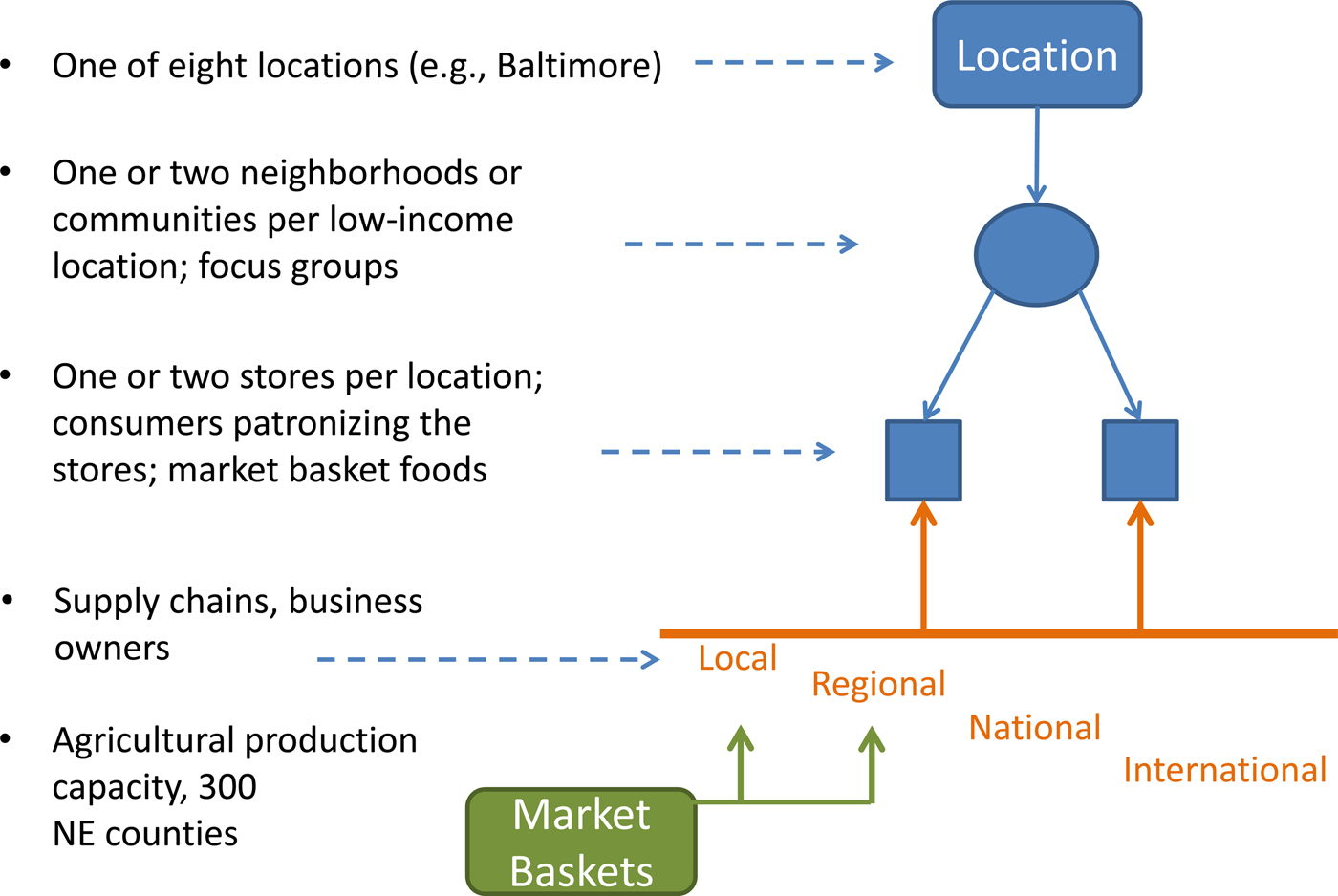
Figure 2. EFSNE Study Design
As food is increasingly distributed through consolidated private channels, less public information is available about prices, marketing margins, and quantities transacted. This problem is compounded by reductions in recent years in the amount of data collected by the USDA's Agricultural Marketing Service. Under the EFSNE project, we are studying the national, global, regional, and local origins of the market-basket foods. Here it is important to remember that regional food products may earn higher prices elsewhere, giving producers an incentive to sell their products in nonlocal markets. Thus, it is essential to examine the opportunity costs of regional food sales (see also Hughes and Boys (Reference Hughes and Boys2015)).
Complementary modeling work currently supported by NERCRD in collaboration with the Economic Research Service (ERS) is examining where best to locate fruit and vegetable assembly hubs to minimize distribution costs subject to production, transportation, and consumption constraints. Again, this is not a new problem, but recently developed network analyses provide useful frameworks for thinking about how to cost-effectively connect suppliers and consumers in supply chains connected by hubs (i.e., hub and spoke systems) and about the vulnerability of such systems to external shocks. Recent project studies examined how congestion (impedance) costs and fuel prices influence the optimal number and location of such hubs and distribution centers (Etemadnia et al. Reference Etemadnia, Hassan, Goetz and Abdelghany2013, Reference Etemadnia, Goetz, Canning and Tavallalid2015). This work is expanding to include seasonality in fruit and vegetable production and distribution and scale economies in hub operations (Ge et al. Reference Ge, Canning, Goetz and Perez2015). Physical distribution is an engineering problem that could be solved without considering economic factors, but introduction of four production seasons along with economies of scale for the hubs makes the resulting estimates more realistic. In future extensions, the studies will introduce consumer demand at various locations and consider monthly product flows.
By laying the aspatial input-output relationships in the food system over the actual locations of different types of entities in the supply chain, we can assess the extent to which the locations of the distribution firms operating at different stages in the supply chain are optimal. A related question is how the optimal spatial distribution changes as the production belts for individual crops shift northward in response to climate change. Attavanich et al. (Reference Attavanich, McCarl, Fuller, Vedenov and Ahmedov2011) examined this question in terms of the impact of climate change on the physical distribution system but did not address the optimal location of the distribution system's infrastructure. The study combined models of the agricultural sector and transportation to estimate social welfare effects for corn and soybeans.
Consumption Issues
Consumers' access to food in low-income areas is a topic of continuing research. Economic questions include the role of factors such as prices, quality, and availability in influencing food purchases and barriers to accessing healthier foods in communities. The EFSNE project is using various surveys, including consumer intercepts and store and market-basket inventories, as well as structural models of consumer behavior coupled with county-level statistical modeling to understand how consumers make purchasing decisions and barriers they perceive. Recent research (e.g., Bonanno and Goetz Reference Bonanno and Goetz2012, Handbury, Rahkovsky, and Schnell Reference Handbury, Rahkovsky and Schnell2015) suggests that affordable prices and availability are necessary but not sufficient to encourage healthy eating. Level of formal education appears to be the most important factor influencing consumers' demand for more-healthful foods.
For faculties of land grant universities, where work on agricultural, food, and rural issues traditionally has been carried out, the fact that urban universities are examining questions associated with food and urban agriculture should be of interest. Because these researchers are located where consumers increasingly agglomerate, they are focusing on both the supply of and demand for food. The EFSNE project includes collaborators from Tufts, Columbia, and Johns Hopkins, some of whom received degrees from land grant universities. Clearly, agricultural economists can make important contributions to studies of food systems conducted at urban universities just as they can learn about urban food systems from their urban-based colleagues.
Issues of Consumption, Production, and Self-Reliance
An important consideration in establishing the EFSNE project was framing of food security in terms of (i) the ability of a country or region to continually produce a significant portion of staple foods in the context of declining quantities and quality of farm land and number of farms coupled with a growing reliance on food imported from outside the region; (ii) household food security; and (iii) adequate access to an affordable supply of food in low-income communities (community food security) in the context of increases in the number of people who lack food security, difficulty accessing healthy foods in low-income areas, and increases in diet-related diseases.Footnote 4
Obtaining an adequate supply of food is as much a question of purchasing power as of food availability, a fact that has long been recognized by agricultural economists (see, for example, the watershed work by Rukuni and Eicher (Reference Rukuni and Eicher1987)). Significant quantities of food are wasted annually (Buzby and Hyman Reference Buzby and Hyman2012), a problem that requires both behavioral and technical solutions. In addition, so-called “food deserts” cannot be understood without jointly considering consumption (including its determinants), distribution, and production. Bonanno (Reference Bonanno2012) presented an economic framework to explain the existence of such areas and argued that they do not necessarily result from market failures.
Studies of the Impact of Local Foods
Consumer demand for local food varies across states (Palma et al. Reference Palma, Morgan, Woods and McCoy2013) and generally remains poorly understood (Low et al. Reference Low, Adalja, Beaulieu, Key, Martinez, Melton, Perez, Ralston, Stewart, Suttles, Vogel and Jablonski2015, Woods et al. Reference Woods, Velandia, Holcomb, Dunning and Bendfeldt2013). In addition to the expectation, or hope, that local food production can allow a region or state to better meet its food needs, there is the idea that local and regional food production can serve as an engine of economic growth. A number of recent studies have analyzed the economic impact of development of local food sources to determine whether it has been positive and, if so, under what conditions with an eye toward public-sector intervention.
Brown et al. (Reference Brown, Goetz, Ahearn and Liang2014) examined whether local food in the United States has an indirect economic-development impact through its effect on overall local agricultural production. After controlling carefully for possible reverse causation, they found a statistically significant effect only in the Northeast. Before dismissing investments in local and regional food distribution infrastructures outside the Northeast, however, it is important to determine why there is a lack of comparable effect elsewhere and whether one is dealing with a chicken-and-egg problem.Footnote 5 Lack of scale, capital, and/or information may currently prevent supply chains outside the Northeast from expanding and thus from providing positive economic development. Location quotients, which identify the relative importance of an agricultural sector in a state or region, and other tools used by regional economists can provide useful insights.
As shown in Figure 3, location quotients can identify changes in a supply chain over time, in this case employment by meat, fruit, and vegetable suppliers and distributors in Maine in 1998 and 2012, and whether strategic investments are likely to lead to greater local economic impacts. The quotients identify a substantial decline in employment by meat processors and wholesalers while employment remained relatively stable or increased for fruit and vegetable processors. While there may be good economic reasons for these changes, they need to be quantified if they are to be fully understood. More-elaborate tools for investigating these issues include analysis of gaps and disconnects when a food is imported and exported from a county (Deller Reference Deller, Goetz, Deller and Harris2009). Many of the questions and related hypotheses about developing capacity in a supply chain are currently being tested in the Agricultural Marketing Service Technical Assistance (AMSTA) Project.Footnote 6

Figure 3. Maine Employment Location Quotients for 1998 and 2012 for Post-farm-gate Meats and Fruits and Vegetables
Low et al. (Reference Low, Adalja, Beaulieu, Key, Martinez, Melton, Perez, Ralston, Stewart, Suttles, Vogel and Jablonski2015) summarized studies of the economic impacts of local food systems and challenges associated with that kind of work. A project funded by the Agricultural Marketing Service (AMS) reviewed existing studies and then developed IMPLAN software modules that can be custom-tailored to better inform analyses of local food systems and identify opportunities for investment.Footnote 7 Hughes and Boys (Reference Hughes and Boys2015) and others have pointed out that there is an opportunity cost associated with local food purchases and that policies designed to attract consumers from neighboring communities have beggar-thy-neighbor characteristics. Not surprisingly, researchers have found that most direct-to-consumer sales occur in relatively populated counties, underscoring the importance of transaction costs involved in connecting producers and consumers.
Emerging Opportunities: Network Analysis
One of the most exciting new developments in terms of analytical tools that can be applied to food systems is network analysis. Unlike conventional methods that examine how an individual's characteristics (e.g., education, experience, location) affect performance indicators such as income or the types of foods purchased, network analysis considers an individual's roles and interactions (links) with other network members (nodes), thus allowing for greater insight into their incentives and the performance outcomes. Among key studies of network analysis are Borgatti et al. (Reference Borgatti, Mehra, Brass and Labianca2009), which reviews applications in the social sciences, and Easley and Kleinberg (Reference Easley and Kleinberg2010), which discusses network applications that incorporate game theory. Network science is so powerful because of the universal nature of networks; interactions are fundamental to everything from atoms and cells to social and economic relationships (Csermely Reference Csermely2009). The principle of preferential attachment (Barabási and Albert Reference Barabási and Albert1999), for example, is readily translated into the notion of scale economies—that the big (or rich) get bigger (or richer). Another is the influence of weak ties, which has not yet been sufficiently explored by economists. A local fresh food broker, for example, may have weak ties to a network of chefs working in high-end restaurants in a distant city that is essential for the survival of a group of small local farmers.
Two Examples of Network Analysis
Applying a network analysis to the EFSNE project (see Figure 4) shows how interactions among its multidisciplinary researchers intensified over time. In 2006 (Figure 4a), there was only a relatively loose association among the project's agricultural economists as identified by nodes representing those economists who had worked with one another or were aware of each other's work (gray-shaded nodes 7, 8, 9, 13, 14, 15, and 17 in the figure). Another group of researchers consisting mostly of non-economists interested in food-system-related topics (black nodes 11, 12, 16, 18, 19, and 20) similarly had relatively intense interactions with one another compared to researchers from other disciplines. Nodes 13 and 19 and 8 and 16 bridged the gray- and black-shaded groups, which represent k-cores—pairs of nodes that are more closely connected with one another than with the other nodes in the network. A third group (nodes 3, 4, and 5) had no connections to researchers in other disciplines at the time, and two (nodes 1 and 2) had no connections at all. Nodes 6, 10, and 21 were only loosely affiliated with the other researchers.

Figure 4a. EFSNE Latent Network, 2006
Figure 4b shows how the intensity of interactions—the average density of connections among project members with disparate academic backgrounds but mutual interests in food system research—changed by 2012, increasing from 1.75 to 18.29 with a statistically significant t-statistic of 9.92. The fact that all but two nodes are shaded in the same gray color shows that the inter-relationships between the two previously disparate groups of economists and non-economists had deepened to such an extent that they had essentially merged into a single core group. In this case, the inter-relationships are measured as frequency of communication over the preceding year. Only two nodes (identified as 4 and 6 in Figure 4a) were, for various reasons, not as closely connected to the overall team as the other members. This is the pattern one expects to emerge over time in a highly functional interdisciplinary team.

Figure 4b. Matured EFSNE Network, 2012
Another example of how network analysis can be applied to food system research is shown in Figure 5, which depicts six basic network structures that become progressively less centralized moving from left to right. Such diagrams can represent central food hubs or distribution centers, grocery-store supply chains with two outlets that may or may not compete with one another in the case of the Y-structure (a buyer duopoly), or loose associations of food brokers in the case of the circle. Many combinations of these basic network structures are possible, and each combination would have different implications for incentives and the distribution of economic power within the network. In another NIFA-funded capacity-building project (Goetz et al. Reference Goetz, Han, Hildabridle, Lan, Tegegne, Tubene and Wetherill forthcoming ) involving institutions serving minority groups in Tennessee, Maryland, and Delaware, we are using network analysis to understand and strengthen minority farmers' networks as they seek to develop markets for their food products.

Figure 5. Basic Network Structures
Other Studies Involving Network Analysis: Input-Output Relationships
Recently, my research group at the NERCRD has begun to examine the U.S. food system using a network perspective that draws on an inter-industry input-output matrix connecting buyers and sellers of intermediate and final goods (Figure 6). Prior studies of food systems have used input-output relationships and, more recently, developed applied general equilibrium models, but they have not used network analysis tools. In the figure, individual industries that make up the rows and columns of the input-output matrix are shown as dots (nodes); the lines (links) represent inter-industry product flows that exceed $10 million annually.

Figure 6. The Food System as an Input-Output Network
Viewing the food system as a network allows us to ask questions about the vulnerability of the system to natural, economic, and human events both positive and negative (for applications in other sectors, see Luo (Reference Luo2013) and Okuyama and Santos (Reference Okuyama and Santos2014)). The vulnerability of the U.S. food system is not strictly of academic interest; it concerns the highest levels of government (e.g., Office of the President of the United States 2012). The clustering of data points along the downward-sloping line as shown in panel c of Figure 6 suggests that the food system behaves much like a scale-free network with a long tail. As a result, it is resilient to random failures of industries but not to targeted attacks (Albert et al. Reference Albert, Jeong and Barabási2000). Such attacks would target key hubs with many connections, thereby causing more damage than a failure of a node with fewer connections and less centrality in the network. Furthermore, separate analyses (not presented) indicate that the system has become more resilient over time as revealed by an increase over time in the absolute value of the coefficient fitted to the power law distribution. We are currently extending this line of research.
Conclusion
It is obviously impossible to address all of the potential roles and contributions of agricultural economists to food system research in this brief presentation. Nevertheless, of particular interest to me is the opportunity to highlight (perhaps even celebrate) the miracle of the modern food system in the United States. Hundreds of thousands of invisible hands coordinate complex market functions each day to ensure that most of the country's consumers find competitively priced food readily available at local stores. Certainly, many difficult problems remain, not the least of which is the joint growth of hunger and obesity (e.g., Bonanno and Goetz Reference Bonanno and Goetz2012). Numerous other important problems and effects are described in the Institute of Medicine and National Research Council's recent book, A Framework for Assessing Effects of the Food System (2015).
At the end of the day, the food system delivers what consumers demand. They vote with their dollars—those who can vote because they have the necessary income—subject to the rules and institutions that govern the behavior of individuals and firms within the system and influence the incentives. Agricultural economists have an important role to play in understanding and explaining how consumption, distribution, and production systems interact with one another, when and where those interactions are successful, and how and where policy improvements are warranted. Agricultural economists can contribute particularly to identifying the public goods and services needed when markets are at risk of failing to allocate scarce resources to publicly desirable ends.
The overall role of agricultural economists in food system research is perhaps best summarized as informing efforts to correct food system policies that have resulted in unintended incentives by identifying the potential failures of both government policymakers and the market. In my experience, agricultural economists play an especially important role in interdisciplinary food-system projects by assigning prices that reflect opportunity costs to physical inputs and outputs in the food system and by studying food system relationships that reflect human decisions and behavior. Their contributions may be most significant when they collaborate with researchers in other relevant disciplines to address diverse and complex social, environmental, and health issues that cannot be resolved solely by government or market mechanisms.


 Open access

