


How do civilian populations react to being harmed in war? Military doctrine and existing scholarship largely agree that civilians turn against the belligerent party to which they attribute civilian casualties and endorse the attacker's opponent.Footnote 1 This can present a strategic challenge. In the twenty-first century, states rarely go to war for aims traditionally associated with the use of military force abroad, such as territorial expansion or permanent occupation. Instead, states often seek to influence how societies organize themselves on a given territory. They thus tend to pursue war aims that depend on the support of the local population.Footnote 2 If civilian casualties enhance support for a warring state's opponent and undermine support for the aims of the attacker, they have the potential to limit the political utility of military power. Although states at war can refrain from deliberately targeting civilians, what we colloquially refer to as “collateral damage”—harm caused to civilians as a side effect of military operations—is all but inevitable.
To manage the strategic implications of civilian casualties, U.S. military doctrine relies on international law.Footnote 3 Counterinsurgency doctrine stresses that the “use of lethal force must respect the legal principles of military necessity, distinction, [and] proportionality.”Footnote 4 But do the attitudes of affected civilians toward wartime harm actually vary with these legal rules? Civilians in theaters of U.S. military campaigns are unlikely to be familiar with international law. The expectation that the perceived legitimacy of civilian casualties nonetheless tracks their legality may rest on the assumption that the mentioned legal rules express fundamental moral principles. The namesake moral principles of distinction, necessity, and proportionality have indeed been shown to inform the attitudes of ordinary citizens in the West—for instance, in the United States—toward the harming of others.Footnote 5 However, whether these moral principles also inform the attitudes of civilians toward their own harming in war is entirely unstudied.
This article is the first to examine two crucial questions. First, do the moral principles of distinction, necessity, and proportionality inform civilians’ reactions to their own harming in war? Not all harming in war is equally morally wrong or blameworthy. If civilians draw on these three moral principles to make sense of what happened to them, their attitudes will vary with the perceived circumstances and perceived aims of an attack.Footnote 6 Second, do the corresponding rules of international law that guide the conduct of U.S. troops in war resonate with the attitudes of civilians? In this article a legal rule is said to “resonate” with a civilian's attitude if his or her attitude reflects the substantive demand of the legal rule, without the civilian necessarily consciously drawing on or being aware of the rule. Distinction and necessity are similar in law and morality,Footnote 7 but the legal rule of proportionality diverges from the corresponding moral principle. Consequently, if all three moral principles inform civilians’ reactions toward their own harming, it follows that the substantive demands of the legal rules of distinction and necessity will be reflected in their attitudes, whereas the legal rule of proportionality will not necessarily resonate with them.Footnote 8
The study discussed here draws on eighty-seven in-depth, semi-structured interviews conducted in Kabul in 2015 with Afghan civilians who were harmed in attacks carried out by coalition troops.Footnote 9 Interviewees who deemed themselves unintended and necessary victims of coalition attacks, in accordance with the moral principles of distinction and necessity, described their attacks as relatively more legitimate than those who thought their harming was deliberate and/or avoidable. The civilians who perceived their harming as unintended and necessary also tended to partially or fully blame parties to the war other than the coalition. Some narratives that civilians recounted about their own harming included comparisons between the coalition's conduct and generalized propositions of right and wrong. This supports the interpretation that the moral principles of distinction and necessity informed their attitudes. Accordingly, the substantive demands of the legal rules of distinction and necessity, which express these moral principles, were reflected in the civilians’ attitudes. The legal rules of distinction and necessity resonated with the interviewees.
According to the moral principle of proportionality, which originates in the moral doctrine of double effect, the legitimacy and blameworthiness of civilian casualties depends to a large degree on whether they are inflicted in pursuit of a legitimate aim. As none of the interviewed civilians attributed a fully legitimate war aim to the coalition as a whole, the study could not establish whether this moral principle informed their attitudes toward their own harming. According to the legal rule of proportionality, the legitimacy of an attack hinges not on the attack's contribution to a legitimate overall war aim, but on the concrete military importance of the attack. Whereas the interviewed civilians rarely expressed doubts about the intentionality and necessity of their harming, they had for the most part not thought about and were unsure of the military importance of the attack that harmed them. The substantive proposition of the legal rule of proportionality—that is, for an attack that causes civilian casualties, the more important the military advantage being pursued the more legitimate the attack—was hence not reflected in the interviewed civilians’ attitudes.Footnote 10 The legal rule of proportionality failed to resonate with them.
This article contributes to our theoretical and empirical understanding of the strategic implications of civilian casualties in two ways. First, it enriches the prevailing theory that says civilian populations will turn against a belligerent party that causes civilian casualties by showing that civilians’ attitudes toward their own harming can vary with the perceived circumstances of an attack.Footnote 11 This discovery improves our understanding of the mechanism that connects civilian casualties to strategic outcomes in war. Second, the article's finding that international law partially resonated with the interviewed civilians’ attitudes toward their own harming adds nuance to the assumption expressed in U.S. military doctrine that compliance with international law vouchsafes the perceived legitimacy of civilian casualties. The presented findings instead suggest that only the rules of distinction and necessity, which express fundamental moral principles, resonated with the interviewed civilians. International law therefore has an important but ultimately limited role to play in securing the political utility of military force.
In the following section, I first briefly relate the limits to our current understanding of the attitudes of affected civilian populations toward wartime harm. Thereafter, I introduce the theory that civilians draw on moral principles when forming attitudes about their own harming, and I articulate expectations for how variation in the perceived circumstances and aims of an attack should be associated with variation in civilians’ narratives about their harming and their allocation of blame. I then describe the study's methods, before discussing its findings. The final section highlights the implications and the limitations of these findings for our understanding of the role of international law in securing the perceived legitimacy of military force.
The Attitudes of Affected Civilians Toward Wartime Harm
Direct investigations of attitudes toward killing in war generally focus on individuals who have never themselves been exposed to war.Footnote 12 What we know about the attitudes of populations in active war zones stems from a rich literature that infers the reactions of noncombatants to their own harming based on the strategic consequences of indiscriminate and deliberate violence against them. The dominant theory holds that “the nation or faction that resorts to warfare against civilians most quickly, most often, and most viciously is the nation or faction most likely to see its interests frustrated and, in many cases, its existence terminated.”Footnote 13 The hypothesized reason is that civilian populations are alienated from the party to the war that causes civilian casualties, and therefore endorse or even materially support the attacker's opponent.Footnote 14
The literature on counterinsurgency and “population-centered” warfare has popularized the idea that even nondeliberate harm or collateral damage can bear strategic costs.Footnote 15 To date, the sole empirical inquiry specifically into the strategic implications of such harming as a side effect supports the theory that civilian casualties alienate the local population. Luke Condra and Jacob Shapiro argue that the population in Iraq “punishes” the coalition for “collateral damage” by supporting the insurgency.Footnote 16 However, like the numerous examinations of deliberate and indiscriminate violence against civilians, their study does not investigate Iraqi civilians’ attitudes directly. Instead the authors infer the reaction of the population to collateral damage from a sophisticated analysis of the spatial and temporal correlation between civilian casualties and insurgent violence in Iraq.
Elucidating the attitudes of civilian populations toward wartime harm by observing correlations between civilian casualties and strategic outcomes has two limitations. First, the mechanism that connects civilian casualties and strategic outcomes remains somewhat obscured. When Condra and Shapiro argue that civilians “punish” their attacker, this might be read to imply that civilians perceive the coalition in Iraq as deserving of blame. However, we know next to nothing about civilians’ actual beliefs about a party to the war that harms them. Of course, civilian attitudes toward wartime harm cannot alone account for the strategic implications of civilian casualties. Civilians who live in active war zones, specifically in areas that are contested between belligerents, may not always be free to act in accordance with their own attitudes. Nonetheless, directly examining the beliefs and perceptions of affected populations is an important step in elucidating the mechanism that connects civilian casualties to strategic outcomes.
Second, the literature focused on connecting civilian casualties to outcomes fails to capture a strategically crucial type of potential variation in the attitudes of affected civilians. Existing studies have examined the implications of civilian harming according to a variation in the identity of the attackerFootnote 17 and differences in the military control of the attacker.Footnote 18 They have not investigated the potential implications of a variation in the circumstances and aims of attacks attributed to the same belligerent party in the same war. Notably, a number of recent studies suggest that Western populations vary in their attitudes toward wartime casualties, depending inter alia on the circumstances and aims of attacks that harm civilians.Footnote 19 Particularly when it comes to U.S. counterinsurgency campaigns, uncovering the implications of this type of variation is a crucial strategic quest. If all civilian casualties caused by such campaigns equally undermined civilian support, the inevitability of collateral damage would cast doubt over the very utility of using force for the pursuit of political aims that partly depend on the support of the local population.Footnote 20
U.S. counterinsurgency doctrine highlights the danger that civilian casualties undermine victory in a campaign that has “the population at its focus.”Footnote 21 Although the Joint Chief of Staff's joint publication on counterinsurgency suggests that local populations vary in how they react to civilian casualties,Footnote 22 it does not indicate what determines this variation. Instead, the document makes two recommendations for how U.S. troops on the ground should manage what it calls the collateral damage “dilemma”: first, to look at civilian casualties “through the eyes of the population”Footnote 23 and, second, to “comply with the law of war.”Footnote 24 Every use of “lethal force must respect the legal principles of military necessity, distinction, [and] proportionality.”Footnote 25 U.S. military doctrine hence assumes that civilian harm stands a better chance of being perceived as legitimate by the civilian population if it conforms to these legal rules.
Notably, the doctrine does not claim that the legality of an attack matters to the affected civilians.Footnote 26 Why then should international law be an appropriate guide for U.S. military forces in the quest to secure the legitimacy of civilian casualties in “the eyes of the population”? Prior shared beliefs about appropriate state conduct often form the basis of what becomes a rule of international law.Footnote 27 The categories according to which international law delineates permissible from impermissible killing may thus also be the categories according to which observers generally distinguish legitimate from illegitimate wartime harm.Footnote 28 Indeed, the legal rules of distinction, necessity, and proportionality partly express fundamental moral principles that have been shown to inform ordinary citizens’ attitudes toward harming in peacetime.Footnote 29 It is plausible that these everyday moral principles also inform civilians’ attitudes toward acceptable and unacceptable harming in war. A general convergence between the legality and the perceived legitimacy of civilian casualties is therefore not an unreasonable expectation.
At the same time, the international laws of war are a product of political compromise. They also reflect pragmatic considerations necessary to secure compliance on the battlefield.Footnote 30 As a result, the legal rule of proportionality diverges from the underlying moral principle of the same designation, as explained in further detail below. Moreover, what political elites and Western populations consider legitimate harm in war may diverge from what civilians affected by the carnage of hostilities find acceptable. We do not know whether the moral principles that structure the attitudes of detached observers also inform the attitudes of civilians toward their own harming in war.
Distinction, Necessity, Proportionality, and Civilians’ Attitudes
If civilians’ attitudes toward wartime harm were informed by the moral principles of distinction, necessity, and proportionality, we would expect an association between the perceived circumstances and aims that make an attack morally permissible and civilians’ perception of an attack as legitimate and blameless. Specifically, if an attack's perceived circumstances and aims conformed to the three moral principles, the affected civilians would likely consider the attack legitimate and the attacker blameless, or at least relatively so. In contrast, if an attack's perceived circumstances and aims were in violation of one or more of these moral principles, affected civilians would consider the attack less legitimate and put greater blame on the attacker for its consequences. If moral principles informed civilians’ attitudes, we would also expect that the substantive propositions of legal rules would be reflected in these attitudes, but only to the extent that these rules accord with the underlying moral principles.
The most fundamental rule of wartime conduct is the prohibition on intentionally attacking civilians and civilian objects.Footnote 31 Neither legal rules nor moral principles, however, afford civilians absolute freedom from wartime harm. Both the moral principle and the corresponding legal rule of distinction protect noncombatants only from intentional attack. The differentiation between intentional and unintentional harm echoes a more general moral principle. Beyond the specific context of war, it is a widely supported moral precept that a wrong committed deliberately is, all things considered, worse than the same wrong committed unintentionally.Footnote 32 Research in moral psychology has shown empirically that individuals allocate blame more readily for harms that are perceived as deliberate.Footnote 33 If moral principles inform civilians’ attitudes, their perception of their harming as unintentional will be associated with the assessment of an attack as less illegitimate and the attacker will incur less blame. Moreover, the legal rule of distinction will resonate with affected civilians’ attitudes.
International law permits launching an attack intended to neutralize a military target even if it will also kill civilians as an unintended but foreseeable side effect. For such incidental civilian harm to be legal, it has to be necessary to achieve the military advantage the attack is pursuing.Footnote 34 From a moral point of view, it is widely understood that a wrong that could easily have been avoided is, all things considered, morally worse than the same wrong committed under circumstances that left the perpetrator no choice. Moral psychology has likewise established that we take into account whether a perpetrator took care to avoid harm when allocating blame.Footnote 35 Thus, if moral principles inform civilians’ attitudes, their perception of their harming as necessary will be associated with the assessment of an attack as less illegitimate and the attacker will incur less blame. Moreover, the legal rule of necessity will resonate with civilians’ attitudes.
If civilian casualties are unnecessary, they are both illegal and morally wrongful. That does not mean, however, that civilian casualties that could not be avoided in the pursuit of a military target are therefore fully legal and morally justified. They also have to be proportionate. The moral principle of proportionality originates in the doctrine of double effect, which stipulates that it may be morally justified to cause a bad effect (like killing innocent bystanders) in the pursuit of a good effect (such as saving a greater number of innocent persons or averting a greater moral evil) if the bad effect is proportionate to the good effect. If moral principles inform civilians’ attitudes to wartime harm, the perception of the attacker as fighting for a legitimate overall war aim will be associated with the assessment of an attack as less illegitimate. A party to the war deemed to be fighting for a legitimate war aim will incur less blame for civilian harm.
Unlike distinction and necessity, the legal rule of proportionality diverges from the more general moral precept. To be legal, incidental civilian harm has to be proportionate only to the military advantage that a specific attack seeks to achieve. The military advantage that a specific attack pursues may have a morally good effect because the war overall pursues a morally just aim and the attack contributes to achieving victory. In most wars, however, at maximum one side is fighting for a just aim. Yet international law imposes the same restrictions on all parties to the war.Footnote 36 Whether and how much incidental harm international law allows an attacker to inflict is legally independent from the overall aims a military campaign pursues. If civilians’ reactions to wartime harm somehow echoed the legal proportionality rule, the belief that the attack in question has a high military importance would contribute to an assessment that it is less illegitimate, and the attacker would incur less blame. If, on the other hand, international law's resonance with civilians’ attitudes is due to the law reflecting the corresponding moral principles, we will only observe this association for individuals who believe that their attacker is pursuing a legitimate war aim.Footnote 37
It is important to note that the theory that the moral principles of distinction, necessity, and proportionality inform civilians’ attitudes does not imply that we should think of the relationship between the perceived circumstances and aims of an attack and civilians’ attitudes as causal. The perception of an attack as intended to harm civilians, for instance, is not a counterfactual trigger that leads to a switch in a civilian's assessment of an attack from legitimate to illegitimate, or from relatively more to relatively less legitimate. In some cases, the assessment of an attack's legitimacy may inform whether the harm caused by the attack is perceived as intentional as much as the perception of harm as intentional informs the belief about the attack's legitimacy. Determining what comes first, for instance, by designating the perception of intentionality as the cause and the legitimacy assessment of the attack as the effect, would wrongly imply an ontological separation between and a temporal order of these two beliefs.
A better way of thinking about the hypothesized associations between the perceived circumstances and aims of an attack and a civilian's legitimacy judgment or allocation of blame is in terms of the coherence between the factual and the normative interpretation of an attack. The hypotheses suggest that civilians attribute coherent meanings to the factual circumstances and aims of an attack (Was it in fact directed against me? Was my harming avoidable?) and its normative evaluation (Was the attack legitimate? Do I blame the attacker?). The meaning of “unintentional harm” coheres with the meaning of “less illegitimate attack” and the meaning of “intentional harm” with that of “more illegitimate attack” in virtue of the principle of distinction. Civilians’ joint attribution of these meanings would therefore be indicative of the civilians making moral judgments based on the perceived circumstances and the perceived aims of “their attack.”
Studying the Attitudes of Affected Afghan Civilians
This article puts the hypothesis that civilians’ attitudes toward wartime harm vary with the perceived circumstances and aims of an attack to the hardest possible test. It examines the attitudes of the individuals least likely to perceive wartime harm as anything but fully illegitimate and blameworthy: civilians who have themselves experienced physical injury or have lost family members as a direct result of war-related attacks. In order to obtain as rich a picture as possible of variations in the narratives that civilians tell about their attacks, I held constant the belligerent who inflicted the harm by interviewing only civilians who attributed their harming to the international coalition in Afghanistan.Footnote 38 The question of whether legal rules resonate with civilians’ attitudes is also more relevant to a belligerent whose conduct is actually guided by these rules.Footnote 39 In Afghanistan the legal rules of distinction, necessity, and proportionality guide only the coalition's conduct,Footnote 40 as the Taliban reject them as a Western invention.Footnote 41 I also refrained from interviewing civilians who had not directly experienced war-related harm. The goal of this study is not to elucidate the difference that being harmed makes for the substance of civilians’ attitudes toward a belligerent party, but to show how different beliefs about an attack's circumstances inform judgments of legitimacy and blame.
The study consists of eighty-seven face-to-face, in-depth interviews in Kabul with Afghan civilians directly affected by war-related violence. Interviewees were recruited from two camps for internally displaced persons.Footnote 42 War-related violence had displaced them to Kabul, between 2008 and 2015, from the southern provinces of Helmand and Kandahār. The events that displaced them mostly fell into four broad categories: air strikes, cross-fire incidents, direct shootings, and indirect artillery fire. Interviewees were asked to recount the event(s) that led to their displacement before they were asked structured questions regarding their beliefs about the attack and the parties to the war. Although the accounts have been subjected to a general plausibility check, it would be impossible to verify them. This research does not aim to shed new light on the development of the war in Afghanistan—on the facts as it were—but rather to investigate civilians’ perceptions and beliefs. The factual accuracy of the accounts is therefore less important than their faithfulness to the interviewees’ actual views.
Great care was taken not to give interviewees any perceived reasons to misrepresent their views. Interviewees were assured of their anonymity and informed about the scholarly nature of the study, the author's lack of affiliation with any government or party to the conflict, and the absence of rewards or repercussions associated with giving their opinion. Interviews were conducted away from the camps for displaced persons in the building of an independent, local civil society organization, in a room with only the author, one or two translators, and one interviewee present at a time.Footnote 43 The interview setup was designed to build a sense of trust and to reduce the risk of the interviewees deliberately distorting their views. Nonetheless, we remained aware of the traumatic nature of the events that the interviewees recounted and the complexity of the questions we asked. Interviews were therefore not limited in time and interviewees were encouraged to tell their story without interference or interruption before being asked questions. Interviewees initially accounted for what had displaced them to Kabul, and were given no indication of the substantive objectives of the study in order to avoid creating pragmatic pressure. Finally, the structured questions were repeated, often in different ways, to allow interviewees to work through them both emotionally and intellectually.Footnote 44
Internally displaced persons are not necessarily representative of all civilian war victims. Moreover, the group of interviewees is not a faithful reflection of the entire Afghan civilian population in terms of age, gender, or ethnicity.Footnote 45 Although the group is representative of the ethnic makeup of both the Helmand and Kandahār provinces,Footnote 46 it is less certain that it is fully representative of the tribal makeup of the two provinces because reliable statistics are unavailable for these populations. In both provinces, the majority of tribes belong to the Durrānī clan/confederation, with fewer tribes and subtribes belonging to the Ghilzay clan/confederation. While the Ghilzay traditionally formed the leadership of the Taliban and were underrepresented in the government, the current president of Afghanistan, Ashraf Ghani, is a Ghilzay, and anti-government forces now include Durrānī and Ghilzay commanders equally. This is evidence for the fact that support for the Taliban/government no longer aligns with tribal structures.Footnote 47
It is important to note, however, that this study does not seek to make generalizable claims about the substance of Afghan civilians’ attitudes toward the coalition, which would require a representative sample of the Afghan population. Instead, the study inquires into the role of beliefs about an attack in the formation of civilians’ attitudes. While individuals of different generations or tribes may perceive the circumstances of the same attack in different ways, how a particular belief about an attack's circumstances or aims is processed to inform an individual's attitude is unlikely to vary systematically with age, gender, or tribal membership.Footnote 48 That is not to say that the same beliefs about an attack necessarily lead to the same attitudes. Rather than demographic factors, for which one could seek representativeness in a group of individuals, it is likely that more subtle dispositional factors account for differences in how a particular belief (for instance, about the intentionality of harm) informs an individual's attitudes.Footnote 49 The following section focuses on the question of whether the three moral principles of necessity, distinction, and proportionality informed the interviewees’ narratives about their attack and their allocation of blame, and the section thereafter discusses the implications of these findings for the resonance of the corresponding legal rules.
Moral Principles, Perceived Legitimacy, and Allocation of Blame
Distinction
According to the moral principle of distinction, intentionally harming civilians is more wrongful than unintentional harming. If this principle informed civilians’ attitudes toward their own attack, the perception of an attack as intended to harm civilians should be associated with narratives that cast the attack as less legitimate. Seventy out of eighty-seven (80 percent) of the interviewed Afghan civilians thought they had been harmed unintentionally as a side effect of an attack against the Taliban or an armed insurgent group.Footnote 50 Fourteen out of eighty-seven (16 percent) suggested that the coalition had deliberately set out to harm them. The remaining three interviewees were unsure about intentionality. Narratives that civilians relied on to make sense of their attack conveyed a clear association between the perceived intentionality and perceived legitimacy of the attack.
Among interviewees who reported that they had been harmed unintentionally, two types of narratives pertaining to the attack's legitimacy emerged. The first type referenced the general need in war to attack the enemy in order to win even if it meant harming civilians. A number of interviewees used the saying “No one distributes sweets in a war,” by way of explaining why they thought the coalition had launched the attack that injured them or harmed their relatives. I term this the “military pragmatism” narrative. A second type of narrative focused on the belief that the coalition had been under attack from the Taliban prior to the strike. As part of this narrative, interviewees often related that the Taliban had been hiding in a civilian home, from which they attacked a convoy of coalition troops. This prompted a coalition air strike, which harmed civilians in the home and the surrounding compound. Interviewed civilians who deemed the resulting civilian casualties unintentional tended to conceive of these air strikes as reasonable responses to the initial attack. “The Taliban fired first. If someone does that to me, I will fire back.”Footnote 51 I call such accounts the “self-defense” narrative.
Different accounts dominated the stories told by the civilians who deemed themselves targets of intentional harm. One type of narrative focused on the character of the attacker. Coalition troops were described as prejudiced foreigners who did not value Muslim lives: “Americans are against Muslims. For them, Taliban and civilians are the same.”Footnote 52 “They are here to kill us and destroy our houses.”Footnote 53 “They think we are animals.”Footnote 54 I term this the “anti-Muslim” narrative. Many interviewees who resorted to this narrative were harmed in direct shootings. Other interviewees evoked the scenario of the Taliban hiding in a civilian home, from which they attacked coalition troops, which prompted a coalition air strike. Rather than drawing on the self-defense narrative, however, these individuals surmised that the air strike had deliberately targeted them based on the coalition troops’ false assumption that all civilians were supportive of the Taliban. “They think we are helping the Taliban, so they want to punish us.”Footnote 55 “They said we are Taliban. They suspect everyone.”Footnote 56 I term this the “unfair punishment” narrative.
One might counter the inference that the moral principle of distinction informed civilians’ attitudes with the argument that it is a matter of logic that interviewees in the intentional harm group did not rely on the military pragmatism or self-defense narratives. A deliberate attack against civilians may be less likely to contribute to winning a war or to serving defensive purposes. Civilians who reported being targets of intentional attack, however, often allowed for the possibility that it was militarily useful to attack civilians because this would discourage support for the Taliban. One, for instance, suggested that “they hope that we kick the Taliban out of our houses if they kill our children.”Footnote 57 These narratives nonetheless cast such attacks as illegitimate. Similarly, civilians who thought that they were intentionally attacked with an air strike called in by troops on the ground did not deny that coalition forces had been under attack first. Those who answered yes to the question of whether they thought their harming was intended, however, invariably cast such attacks as “unfair punishment.”
A similar association emerged between the perceived intentionality of civilian harm and the allocation of blame across parties to the war, as summarized in Table 1. A majority of interviewees in both groups placed at least some blame on the coalition for the harming. Forty-three out of seventy (61 percent) of those who thought they had been harmed unintentionally, and twelve out of fourteen (86 percent) of those who thought they were targeted intentionally, answered affirmatively when asked whether they blamed the attacker. Interestingly, however, when asked whether they blamed anyone besides the coalition, forty-one of the forty-three (95 percent) who thought they had been harmed unintentionally and blamed the coalition suggested the other side deserved some blame as well. One interviewee explained, “I blame the Americans. But the first ones to blame are the Taliban. They caused the situation by coming into our house, but it was an American plane and they knew there were women and children. So, I blame them too.”Footnote 59 Only two interviewees among those who viewed themselves as unintentionally harmed said the coalition alone bore the blame for the unintentional harm inflicted on them or their family. In contrast, six of the fourteen interviewees who deemed themselves victims of intentional harm attributed sole blame to their attacker and six more allowed for the other side to share in the blame.
Table 1. Perceived intentionality of harm and interviewees’ allocation of blameFootnote *
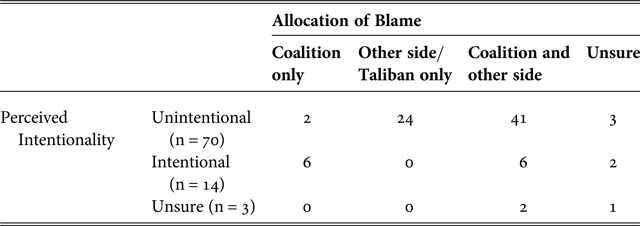
* This table reflects the results of three separate questions. All subjects were first asked, “Do you blame the attacker for the harm they did to you/your loved ones?” We then asked one of two follow-up questions based on a subject's response to this first question. Interviewees who answered yes to the first question were then asked, “Do you blame anyone besides the attacker for the harm they did to you/your loved ones?” Interviewees who answered no to the first question were then asked, “Do you blame anyone else for the harm they did to you or your loved ones?” For a list of relevant questions, see the online supplement, which outlines the form and content of the study.Footnote 58
The responses of those who did not place any blame on their attacker also exhibit an obvious association with intentionality. All twenty-four interviewees who thought they had been harmed unintentionally and who had initially said they did not blame the attacker solely blamed the Taliban or another anti-government party. Exemplifying this view, one interviewee stressed that “if [the Taliban] didn't fire, the Americans would not have sent the plane.”Footnote 60 In contrast, none of the interviewees who deemed themselves victims of intentional harm completely released the coalition from blame.Footnote 61
The association between perceived intentionality and the narratives that civilians told about their attack is on its own not conclusive of moral principles actually informing their attitudes, in the sense that civilians consciously draw on them. Blame, of course, is an expression of moral opprobrium, but I explicitly asked civilians whether and how they allocated blame for the harm done to them. It would be a stronger indication that moral principles actually inform civilians’ attitudes toward their own harming if the narratives that civilians related without guidance revealed that they draw on generalized propositions about right and wrong to make sense of what happened to them. Of course, not all interviews featured unprompted explicit moral reasoning, but several did.
Some interviewees explicitly tied the accounts of their own attacks to general propositions about the role of intentionality in making harm more wrongful. One interviewee stated that it was “much worse to kill an innocent person directly.” In contrast, killing someone in self-defense could be permitted: “Once the Taliban shoot at them, I would say [the U.S. troops] are allowed to shoot back.”Footnote 62 Another interviewee elaborated, “I thought maybe they deliberately targeted us, but they sent a delegation and it became clear they were not happy with what had happened. It would have been worse if they had no respect for our lives.” When I asked why it would have been worse if the harm had been directed at them, he said that “on the day of judgment it will matter.”Footnote 63 Both narratives associated with intentional harm often featured the assertion that American troops had no respect for Afghan civilians.Footnote 64 One argument of why intentional harming is morally worse than unintentional harming is indeed that it expresses a lack of respect for the victim's dignity.
Necessity
What about the moral principle of necessity? To recall, the principle of necessity considers unintentional but foreseeable civilian harm more morally wrongful if it could have been avoided. I therefore asked the seventy civilians who thought they were harmed unintentionally whether they thought the harm could have been avoided if the coalition had been more careful in the execution of the attack. Fifty-one out of seventy (73 percent) said the harm was unnecessary and could have been avoided; seventeen (24 percent) stated that the harm was probably or definitely unavoidable; and two were unsure. Many interviewees who thought their harming was unavoidable emphasized the chaotic circumstances of the attack, in terms of the pace and obscurity of who was firing at whom when insurgent fighters commingled with civilians: “It is not possible to be careful in this war. Taliban are inside our houses and the U.S. forces can't distinguish Talib from local people, especially during the night.”Footnote 65 In contrast, a common explanation for why civilians thought their harming could have been avoided highlighted the superior military capabilities of the United States. Several interviewees volunteered stories about the kind of objects that a U.S. pilot could allegedly distinguish from their vantage point. For instance: “We have been told that American technology is so advanced that they can see a needle from the air. Why then don't they distinguish civilians from Talib?”Footnote 66 And “Americans are able to recognize black and white chickens from the air, how come they can't recognize women and children?”Footnote 67
Almost all civilians who deemed themselves unintended and unavoidable victims of harm were in the group who subscribed to the self-defense narrative. The perceived necessity of harming was also associated with how interviewees allocated blame for their harming. As Table 2 shows, of those who maintained that the coalition could have avoided their “collateral” harming, fourteen out of fifty-one (27 percent) did not blame the attacker but instead blamed the other side. In contrast, ten out of seventeen (59 percent) who thought their harming was unavoidable did not at all blame the attacker but fully blamed the other side. The six civilians who deemed their harming both unintentional and necessary but who did not fully absolve their attacker of blame all partially blamed the other side. None of them solely blamed the coalition.
Table 2. Perceived necessity of harm (for those who viewed their harming as unintentional) and interviewees’ allocation of blame

The interviewees who believed they were harmed as an unintended but avoidable side effect of military operations exhibited remarkably nuanced attitudes. Many differentiated between the legitimacy of attacking the enemy in war for the purpose of defending troops under fire and the blame that they nonetheless levelled against the attacker because of the latter's failure to minimize harm to civilians. As one interviewee related, “[The Americans] were defending themselves. They didn't mean to kill us. The Taliban were fighting them in the village, but what I blame them for is the airstrike. They could have used a bomb with less fire.”Footnote 68
To summarize, there was a clear association between the perception of distinction and necessity on the one hand and the assigning of blame on the other. Those who perceived themselves as the victims of harm by the coalition as an unintentional and unavoidable side effect tended either to allocate partial blame to other parties or to completely absolve the attacker of blame. None of the civilians who perceived themselves as unintended and unavoidable victims of harm, in accordance with both principles of distinction and necessity, solely blamed the coalition. These findings add nuance to the prevailing theory that suggests that civilians uniformly punish the party to which they attribute civilian harm. Instead, the allocation of blame varied with the perceived circumstances of the attack.
Proportionality
Recall that according to the moral principle of proportionality, to be justified, civilian harm has to be not only unintended and necessary but also proportionate to the attack's contribution to the morally just aims that a war pursues. When asked about the legitimacy of the aims of the warring parties, none of the interviewed civilians could identify a coalition aim that they thought to be fully legitimate.Footnote 69 Rather, they identified aims such as uprooting terrorism and gaining control of the country.Footnote 70 This lack of variation in the perceived legitimacy of the coalition's overall war aims made it impossible to gauge whether the perceived legitimacy of such aims would have been associated with the consideration of an attack as relatively more legitimate or with a further mitigation of blame.
Given that I could not determine whether the moral principle of proportionality informed the interviewees’ attitudes toward their own harming, toward the end of the interviews I asked whether in general interviewees considered it legitimate to kill civilians in pursuit of a legitimate war aim. Sixty-nine of the seventy-seven interviewees who answered this question did so affirmatively.Footnote 71 Many emphatically stressed that a belligerent who brought peace, stability, or security would be permitted to cause civilian casualties and not incur blame. “People in Helmand are ready to sacrifice people. I would sacrifice my sons for peace, but their purpose is not peace.”Footnote 72 As one saw it, “If the Americans brought peace, everyone would praise and pray for them even in spite of what has happened.”Footnote 73 Another explained, “I accept that some ordinary people will die in war. If it ends in peace and removed the Taliban, I would accept this.”Footnote 74 One man was less sure: “If they bring security, they can stay as long as they want, but what if they kill people for nothing? That is wrong.”Footnote 75 Among the eight interviewees who denied the permissibility of killing civilians in pursuit of a legitimate war aim, some expressed doubts that continued hostilities could achieve such aims. “There are more [than] 50,000 people [who] were living in Sangin district. Nearly one-fourth were killed and even more are displaced, yet there is no peace.”Footnote 76 Others offered more principled rejections of the permissibility of killing civilians, such as: “It is not right at all. No one should be killed for the sake [of] peace and security.”Footnote 77
Of course, even the affirmative answers echo only one dimension of the principle of proportionality: the general permissibility of foreseeably killing innocent bystanders as a side effect of pursuing a morally just end. Strictly speaking, the principle of proportionality also demands a balance between the amount of civilian harm caused in a particular attack and the importance of the attack's contribution to the achievement of a legitimate overall war aim. Further research is required to establish whether this balancing requirement informs the attitudes of civilians affected by war. Moreover, it is important to stress that the interviewees were expressing their views in response to what-if questions. In other words, here the proportionality principle informed their attitudes toward civilian casualties in Afghanistan in general, not specifically toward their own harming.
Is the legal rule of proportionality reflected in the interviewees’ attitudes? To recall, the legal rule of proportionality, in opposition to the moral principle, does not require that civilian harm is proportionate to legitimate overall war aims; it is independent of whether a military campaign has a just aim. Instead, international law demands only a balance between the concrete military importance of the attack and the civilian harm it will cause. Whereas only a few interviewees were unsure about the intentionality and necessity of the harm caused to them, most were unsure or did not have clearly formed views about the attack's military importance. Beliefs about what aim an attack may have had, such as defending coalition troops or targeting Muslims, played prominent roles in civilians’ narratives and their perceptions of an attack as legitimate or not.Footnote 78 Yet interviewees had not thought about the importance or military value of achieving these aims in the specific context. When asked, many averred that they did not or could not know how important their attack was for the coalition's military success.Footnote 79
Implications for the Role of International Law
The discovered association between the perceived intentionality and necessity of harming, on the one hand, and civilians’ narratives and allocation of blame for their own harming, on the other, indicates that the substantive demands of the legal rules of distinction and necessity were reflected in the interviewed civilians’ attitudes. In contrast, the substantive proposition of the legal rule of proportionality—suggesting that an attack that harms civilians is more legitimate the greater the military advantage that it pursues—was not reflected in the interviewed civilians’ attitudes. In other words, whereas the legal rules of distinction and necessity resonated, the legal rule of proportionality did not. This is not to say that the interviewed civilians explicitly rejected or disagreed with the legal rule of proportionality. Rather, its substantive demand did not inform their reactions to being harmed.
Can we infer from this that an attack that conforms to the rules of distinction and necessity is more likely to be perceived as legitimate by the local population, in line with the assumption expressed in U.S. counterinsurgency doctrine? One objection here is that civilians’ judgments of legitimacy and their allocation of blame were based on how they perceived the circumstances of an attack, not on its actual circumstances. As a result, one might argue that this study does not give grounds to the argument that belligerents should comply with the rules of distinction and necessity, because a legally compliant attack may not always be perceived as such. While it is true that this study did not set out to investigate differences between the actual and the perceived conduct of an attacker, it is plausible that the two often correspond. Moreover, as I demonstrate below, the possibility that civilians wrongly perceive the circumstances of an attack increases rather than decreases the importance of complying with international law, if a belligerent party's goal is for civilian casualties to be relatively more legitimate in the eyes of the population.
The previous section reported that some civilians perceived harm caused by airstrikes called in by coalition troops on the ground as an unintentional side effect of self-defense. Other civilians, in contrast, perceived harm inflicted in the same way as intentional. Civilians’ prior beliefs about coalition forces may play a role in accounting for this divergence in interpretations of similar scenarios. Studies in political psychology have highlighted that we see the world through a prism of our prior beliefs, which act as a cognitive schema.Footnote 80 We have a need for consistency, and we therefore have a tendency to interpret events in a way that supports our prior beliefs.Footnote 81 If civilians’ prior beliefs about a party to war act as a schema through which they interpret the circumstances of an attack, then they are, prima facie, more likely to perceive legally compliant attacks correctly if they already have a positive view of the coalition. In this reading, civilians are more likely to misperceive legally compliant harm if they believe the coalition generally mistreats civilians. Prior beliefs about a party to war are, of course, informed by the party's prior conduct. Thus, the fact that intentional or avoidable civilian casualties influence the interpretation of future coalition conduct adds urgency to being consistently compliant with the legal rules of distinction and necessity.
At the same time, prior beliefs about a party to the war may also be systematically connected to an individual's political preferences or social environment.Footnote 82 This raises the question of whether an attacker's compliance with distinction and necessity ever makes a difference for how the circumstances of an attack are perceived when those circumstances defy the civilian's expectations of the attacker's conduct. Research in political psychology suggests that two factors make it more likely that individuals accept an interpretation of events that contradicts their prior beliefs. First, the more overwhelming the information is that they cannot assimilate to a prior schema—in other words, when the factual circumstances very obviously challenge their existing schema—the more likely they are to accept an interpretation of events that defies their expectations.Footnote 83 This suggests that the more obvious it is that civilian casualties are legally compliant, meaning unintended and unavoidable, the more likely they may be perceived as such—a civilian's divergent expectations of a warring party's conduct notwithstanding. The more open to interpretation are the circumstances of an attack, the more important may be a civilian's prior beliefs about an attacker's conduct for the interpretation of the attack. Accordingly, among the four types of attacks that displaced the interviewed civilians, air strikes were the most often subject to divergent interpretations regarding the intentionality of the harm caused because airpower affords no direct evidence of an attacker's state of mind. Any effort to avoid civilian harm is likely invisible to the civilian on the ground. A heavy reliance on airpower in a counterinsurgency campaign may thus be problematic, particularly for a belligerent who does not have a strong reputation for protecting civilians.
Second, individuals are also more likely to accept information that challenges their prior beliefs if it is emotionally shocking.Footnote 84 Affective reactions to events are a source of evidence for the beliefs we form about them.Footnote 85 As a result, in the face of a divergent schema, intentional and unnecessary harm may be more likely to be perceived correctly than unintentional and necessary harm. A civilian who believes that the coalition normally spares civilians will likely be shocked by an apparently intentional attack. Interestingly, interviewees who volunteered that the circumstances of an attack had contradicted their expectations of coalition troops’ conduct were all in the group that deemed themselves intentional targets of attack. “We were told that Americans usually make the distinction [between civilians and combatants]. Not in this case. And for this they will be judged,”Footnote 86 said one interviewee. Another posed the question: “I didn't think they killed civilians, but they shot three people outside the mosque. What else can that be? A mistake?”Footnote 87 Another interviewee saw it this way: “In general, their behavior isn't bad. But there are crazy soldiers among them. Being shot at made them crazy and so they targeted us.”Footnote 88
The importance of affective reactions in the formation of beliefs about an attack also suggests that an obviously intentional attack may be more likely to change a civilian's prior beliefs about an attacker for the worse. By comparison, an actually unintentional attack may be less likely to lead to an improvement in civilians’ views about a warring party, as it is more easily assimilated into their existing schema. Accordingly, interviewees who reported intentional harming sometimes highlighted that it had changed their previously favorable beliefs about the coalition. As one interviewee suggested, “The Americans showed good behavior in the beginning, but after they were challenged by the Taliban that changed. Now it seems like they are just shooting everywhere.”Footnote 89 Another asked: “They claim that they protect us, but how often can you make a mistake and it is still a mistake? I don't believe that anymore.”Footnote 90
This tentative exploration of the correspondence between an attacker's conduct and the perceived circumstances of an attack suggests that we cannot always be sure that compliance with the legal rules of distinction and necessity means civilian casualties are perceived as unintended and unavoidable. However, consistent compliance with these legal rules is certainly an attacker's best option for achieving this goal. Moreover, affective and cognitive constraints on civilians’ interpretation of an attacker's conduct also point toward the extraordinary strategic costs associated with obvious violations of international law: Violations may undermine civilians’ correct interpretation of future legally compliant attacks. An attacker's compliance with distinction and necessity may therefore be crucial, though not sufficient, for the affected civilians’ perception of harming as being relatively more legitimate and less blameworthy.
Conclusion
This article has shown that the moral principles of distinction and necessity informed the interviewed civilians’ reaction to their own harming in war. Amending the prevailing view in the literature, this study found that the interviewed civilians did not uniformly blame their attacker. Instead, their attitudes were sensitive to the perceived circumstances under which they were harmed. Those who saw their harm as unintentional and unavoidable fully or partially blamed parties to the war other than the coalition. The study further offers some preliminary evidence that the moral principle of proportionality informed participants’ abstract attitudes toward civilian casualties in Afghanistan. Further research might examine whether the perception of a belligerent's war aims as legitimate also informs civilians’ reaction to their own harming and what civilians perceive as an appropriate balance between civilian casualties and an attack's contribution to the achievement of a legitimate war aim. Investigating the extent to which the uncovered divergences in civilians’ attitudes translate into concrete differences in their behavior and, subsequently, into strategic outcomes is a further avenue for future research.
Moreover, this article has offered the first direct test of the assumption expressed in U.S. military doctrine that civilian casualties caused in compliance with international law stand a better chance of being perceived as legitimate by the local population. Although the findings presented here lend support to this assumption, they also point toward two caveats. First, the resonance of the international laws of war with civilians’ attitudes may depend on the laws’ convergence with underlying moral principles. The substantive demands of the legal rules of distinction and necessity, which accord with fundamental moral principles, were reflected in the civilians’ attitudes in this study. The proposition that the legitimacy of civilian casualties depends partly on the importance of the military advantage that an attack pursues—the legal rule of proportionality—did not resonate with the civilians, in that they had not thought about the military importance of their attack when making sense of what happened to them. Second, affective and cognitive constraints on civilians’ interpretations of an attacker's conduct may mean that an attack that complies with the rules of distinction and necessity will not always be perceived as unintentional and unavoidable. Thus, international law has an important, but ultimately limited, role to play in securing the perceived legitimacy of military force.
Supplementary material
The supplementary material for this article can be found at https://doi.org/10.1017/S0892679419000376



