





Introduction
Research shows that voters update their perceptions of parties’ positions based on a variety of information that might be more salient than or contradict a party’s policy statements, such as whether they are in government or opposition (Greene, Henceroth, and Jensen Reference Greene, Henceroth and Jensen2020); when party leadership changes (Fernandez-Vazquez and Somer-Topcu Reference Fernandez-Vazquez and Somer-Topcu2019); on which specific issues a party campaigns (de Vries and Hobolt Reference de Vries and Hobolt2012; Meyer and Wagner Reference Meyer and Wagner2014); and how credible voters judge party platform changes to be (Fernandez-Vazquez Reference Fernandez-Vazquez2018; Fernandez-Vazquez and Theodoridis Reference Fernandez-Vazquez and Theodoridis2020). Coalition decisions in particular provide voters a straightforward, formal, and institutionalized signal of where a party is positioned in relation to its competitors. Voters view parties that coalition together as more ideologically similar than their platforms suggest on multiple issue dimensions (Fortunato and Stevenson Reference Fortunato and Stevenson2013; Adams, Ezrow, and Wlezien Reference Adams, Ezrow and Wlezien2016). Therefore, coalition decisions help explain why voter perceptions of parties do not always match parties’ stated platforms (Spoon and Klüver Reference Spoon and Klüver2017).
In contrast to current arguments that limit their view to immediate coalition decisions as a short-term heuristic for voters, I argue that coalition history shapes voters’ expectations for current coalition decisions, therefore affecting how much voters update their perceptions after a coalition forms. Who was included in prior coalitions matters as much as who is included in current coalitions. Since these decisions shape voters’ expectations over time, coalition partnerships have the potential to become a part of parties’ brands.
Just as evidence shows that voters rely on prior expectations for parties built from past campaign information or polls (Fiorina Reference Fiorina1981; Stoetzer, Leemann, and Traunmueller Reference Stoetzer, Leemann and Traunmueller2022), I argue that voters rely on perceptions formed by prior coalition relationships to shape their expectations and perceptions of current coalitions. Voters update their perceptions of new coalition decisions based on whether the current coalitions conform to or counteract voters’ prior expectations for coalition decisions. If voters have ‘sticky’ perceptions of coalitions, the effect of any one coalition decision has a longer-lasting impact on parties’ reputations than it would if voters merely relied on coalition decisions as a short-term heuristic.
Using data from the Comparative Study of Electoral Systems (CSES) and ParlGov data from 27 countries between 1996 and 2021, I show that voters evaluate parties based on their coalition relationship histories. I find that voters view parties that have previously coalesced as more similar even when a given coalition ends. The more two parties coalesce, the closer voters view them when neither party is in government. On the other hand, voters react the most strongly to unprecedented coalitions, reducing the ideological distance between parties by the greatest amount. Because voters do not need to update their perceptions as much when coalition partnerships are expected, the impact of two parties rejoining a new coalition partnership diminishes as the partnership repeats. Furthermore, when one party excludes another from a coalition, this counteracts the compounding effect of previous coalitions on voter perceptions. Therefore, exclusion has a stronger distancing impact on voter perceptions as the number of times two parties have previously coalesced increases. Finally, exclusive past partnerships have a stronger converging impact on voter perceptions than non-exclusive past partnerships.
This paper shows that voters update their perceptions of parties using coalition information beyond the short run. These results demonstrate that coalition decisions have long-term effects on voter perceptions of party ideology. Voters evaluate parties in terms of their relationship histories, making coalition decisions integrated into parties’ individual brands. This also has implications for voters’ abilities to follow politics and remember political information over time, challenging the long-standing idea that voters are unresponsive and uninformed (Campbell, Converse, Miller et al. Reference Campbell, Converse, Miller and Stokes1960; Bartels Reference Bartels1996; Adams, Ezrow, and Somer-Topcu Reference Adams, Ezrow and Somer-Topcu2011). These findings indicate that voters are attentive and responsive to party decisions, even in coalition governments, but when and how they update their perceptions based on new information is not uniform for any given heuristic and depends on prior expectations and a wider range of information (see e.g., Lodge, Steenbergen, and Brau Reference Lodge, Steenbergen and Brau1995; Fernandez-Vazquez Reference Fernandez-Vazquez2014; Spoon and Klüver Reference Spoon and Klüver2017; Falcó-Gimeno and Fernandez-Vazquez Reference Falcó-Gimeno and Fernandez-Vazquez2020; Plescia Reference Plescia2022).
This paper has implications for party strategy. If voters evaluate parties on their prior coalition relationships, both when parties are in government and when neither party is in government, this indicates that coalition relationships can become integrated into parties’ individual brands. Coalition decisions impact a party’s ability to distinguish themselves from their competitors. Parties should carefully consider how each coalition decision fits with their long-term reputations, in addition to the short-run goals at stake during coalition negotiations. Choosing a partner poorly might harm a party’s reputation with voters for longer and to a greater extent than party leaders expect.
Existing work and theory
The Downsian idea that parties are first and foremost political rivals, attempting to maximize their vote share against all other competitors, has long pervaded the literature on party competition. In reality, parties often play the role of both competitors and collaborators, given that most parliamentary democracies require parties to form coalitions to govern. Theories for how parties behave have long attempted to balance this dynamic by contending that parties can behave in vote-seeking ways but also prioritize office-seeking or policy-seeking strategies, both of which account for collaborative behavior between parties (Strom Reference Strom1990). Though literature on party behavior has grappled with the seemingly contradictory reality that parties can have cooperative relationships as rivals, much of the literature on voter behavior assumes voters evaluate parties as competitors (see e.g., Downs Reference Downs1957; Cox Reference Cox1997).
Instead, coalition governments lower the clarity of responsibility for behavior within government, making it more difficult for voters to evaluate parties as individual units (Powell and Whitten Reference Powell and Whitten1993). When clarity of responsibility is blurred, this makes it more difficult for voters to assign responsibility to individual parties for policy outcomes, decreasing performance voting (Hobolt, Tilley, and Banducci Reference Hobolt, Tilley and Banducci2013; Williams and Whitten Reference Williams and Whitten2015). Voters start seeing the coalition parties as more ideologically similar (Fortunato and Stevenson Reference Fortunato and Stevenson2013), with voters viewing junior partners as more similar to the PM parties’ stated platforms (Fortunato and Adams Reference Fortunato and Adams2015). This important work exemplifies that voters’ perceptions of party platforms often do not align with actual stated policy positions by parties, instead responding to a wider environment of party behavior that results in a disconnect between how parties present their ideologies and how voters perceive party ideologies (see also Adams, Ezrow, and Wlezien Reference Adams, Ezrow and Wlezien2016). Fortunato (Reference Fortunato2021) argues that parties attempt to escape this ‘gravity’ of coalition governments by generating inter-party conflict while in government. Therefore, understanding the effects of coalitions on voter perceptions is essential to understanding how much control parties have over their reputations.
All this work focuses on the consequences of individual coalitions for voter perceptions without revealing their impact within a broader historical context. By drawing from Tversky and Kahneman’s (Reference Tversky and Kahneman1974) heuristic model, framing coalitions as an immediate informational shortcut only presents a microtheory for how voters update perceptions in the short run. From this perspective, the effects of coalition decisions on voter perceptions would be straightforward: a punctuated equilibrium, where each coalition constellation has a direct, independent effect on voter perceptions that reverts after the coalition ends and the heuristic is no longer directly applicable.Footnote 1 However, if the effects of coalitions are sticky, voter perceptions should not return to their original state, even after a coalition ends.
Even in the short run, coalitions do not have straightforward, consistent effects on voters. Instead, perceptions are conditioned by factors such as partner characteristics and party behavior. Falcó-Gimeno and Fernandez-Vazquez (Reference Falcó-Gimeno and Fernandez-Vazquez2020) argue that voters only update their perceptions of parties when they join ideologically unexpected coalitions. When parties behave in a conflictual manner while in a coalition, this can counteract the converging effect of coalescing (Adams, Weschle, and Wlezien Reference Adams, Weschle and Wlezien2021; Fortunato Reference Fortunato2021). Because voter perceptions vary depending on a coalition’s context, effects might also vary as different coalition constellations repeat or change over time.
In this paper, I argue that coalitions have long-term effects on voters. The existing literature does not sufficiently account for how the varying stability of coalition patterns over time affects party reputations. Coalition decisions do influence voter perceptions in the short run, but the current literature has not answered how this effect depends on the historical context of any given coalition. Because parties’ tenures in government are often punctuated with time in opposition, treating these two types of changes as equivalent obscures the true effects of joining a coalition that has persisted across punctuated periods in government versus joining a coalition that has not previously formed.
I argue that, in the long run, coalition partnerships can become a part of party labels. Put simply, a party’s relationship status with another party or parties becomes a part of its individual identity. Just as parties incorporate coalition decisions into their electoral strategies, voters incorporate a party’s history of partnerships (or lack thereof) into their conceptualizations of each party’s brand. When party labels signal not only individual information about policy positions but also information about relationships with other parties, voters are not evaluating parties as independent entities. Therefore, coalition decisions can have greater, longer-lasting, and more varied effects on voter evaluations of parties than would be expected if coalition decisions merely functioned as shortcuts that voters use to make momentary inferences about party ideology.
This theory draws from evidence that coalitions affect voter behavior in the long run. Debus and Müller (Reference Debus and Müller2014) show that voters’ coalition preferences are conditioned in favor of pairings that have occurred previously, rather than preferring unlikely partnerships. Horne, Adams, and Gidron (Reference Horne, Adams and Gidron2023) demonstrate that voters have warmer feelings towards their party’s coalition partners, even after the coalition ends. However, this research does not analyze how the effects of the broader historical context change each time a coalition persists or changes. Furthermore, these papers do not analyze how coalitions affect ideological perceptions of parties, which could be a fundamental mechanism to explain these effects.
Even if a party is not currently in government, voters are still evaluating that party based on its previous coalition relationships, keeping a continually updating ‘running tally’ of coalition relationships between parties. Fiorina (Reference Fiorina1981) argues that voters keep a running tally of available information and use retrospective evaluations to form conceptions of partisanship. I argue that voters use a similar process when evaluating parties through the lens of coalition governments. Therefore, impressions of coalition relationships are integrated into a party’s individual reputation. This does not require voters to consciously remember specific dates and detailed information from previous coalitions, merely that voters form general lasting impressions of parties based on prior coalition governments.
Voters form these historical impressions from a variety of sources. First, voters rely on previous experience. Because coalitions are such a useful and cheap informational heuristic in the short term (Fortunato and Stevenson Reference Fortunato and Stevenson2013), the information is easy to remember in the long term. Next, voters receive information about prior relationships from the media, particularly unprecedented coalitions. For example, in 2020, when Fianna Fáil and Fine Gael formed an unprecedented grand coalition that also included the Green Party, the media emphasized how this overcame the historic rivalry that dated back to the Irish Civil War. During fraught coalition negotiations in Spain in 2019, their failure leading to a snap election, news outlets theorized on whether Unidas Podemos would leave the opposition for the first time to govern with the Spanish Socialist Workers’ Party (PSOE).
Parties themselves emphasize prior coalition relationships. Potential junior coalition partners tailor their campaigns to position themselves as suitable coalition partners (van de Wardt, De Vries, and Hobolt Reference van de Wardt, De Vries and Hobolt2014; Schumacher, van de Wardt, Vis et al. Reference Schumacher, van de Wardt, Vis and Klitgaard2015; Bernardi and Adams Reference Bernardi and Adams2019). Parties also explicitly remind voters of prior coalition relationships. For example, the German Green Party’s website has an entire section about its 1998 coalition with the SPD and Alliance 90, mentions the national coalitions from which it has been excluded, and even mentions state-level coalition governments.Footnote 2
I primarily conceptualize a party’s coalition history as the amount it has coalesced with another partner or partners. While this conceptualization is limited in scope, it provides the most straightforward avenue for analysis. However, voters pay attention to more than just whether or not parties are in a coalition together, evaluating coalitions differently depending on coalition characteristics and perceptions of whether partners are able to deliver on policy promises (Spoon and Klüver Reference Spoon and Klüver2017; Hjermitslev Reference Hjermitslev2020; Klüver and Spoon Reference Klüver and Spoon2020).
Parties in coalitions even proactively strategize to combat the potential converging effect coalitions have on their brand when policymaking. For example, parties might use the legislative review process (Martin and Vanberg Reference Martin and Vanberg2005), strategic timing of legislation (König, Lin, Lu et al. Reference König, Lin, Lu, Silva, Yordanova and Zudenkova2022; König, Lu, and Silva Reference König, Lu and Silva2025; Lu Reference Lu2025), and calculated emphasis of policy issues (Martin and Vanberg Reference Martin and Vanberg2020) as a way to monitor their partners and publicly manage disagreements in parliament. Therefore, this suggests that how coalition partners governed together in the past might impact the way voters use past relationships to form impressions of parties. If parties previously co-governed together with little conflict and significant compromise, voters might view them as more similar than parties that previously co-governed with significant conflict and policy disagreements.
While party strategies during the policymaking process can condition voter perceptions of past coalitions, I focus primarily on how often two parties have co-governed. This requires less in-depth knowledge from voters. Only highly informed voters are likely to know both the frequency and the tenor of past coalition relationships between parties, barring the most recent or contentious coalitions. Furthermore, how voters interpret party behavior within a coalition is more subjective. Voters might either focus on different information or draw different conclusions from the same information depending on their own beliefs or partisanship (Spoon and Klüver Reference Spoon and Klüver2017).
How parties previously co-governed can intensify or diminish potential converging effects of past coalitions on voter perceptions. This might especially be true in systems where the policymaking process is more transparent, and voters are better able to accurately assign responsibility for parties’ choices, rather than systems where disagreements are more likely to occur behind closed doors. Because all coalitions require some sort of compromise, I theorize that, in general, voters will view parties who frequently coalesce as more similar. While disagreements in policymaking might moderate converging effects, measuring coalition history in terms of frequency of past partnerships can provide insight into the total effect of past relationships even if it does not tease out the specific mechanisms behind why some previous coalitions might have a greater impact on perceptions than others.
I argue that coalition decisions affect voter perceptions of parties based on how they conform to or thwart voters’ prior expectations because coalition decisions can either contribute to stability or novelty in party behavior. Falcó-Gimeno and Fernandez-Vazquez (Reference Falcó-Gimeno and Fernandez-Vazquez2020) find voters only update their perceptions of parties when they join ideologically unexpected coalitions. Drawing from this logic, I theorize that voters are less likely to alter their beliefs about parties after coalition decisions if the party’s decision is consistent with voters’ prior opinions about the party.
Introducing coalition histories as a mechanism for shaping voters’ priors presents a more dynamic view of voter expectations. Voters will come to expect longstanding partnerships to continue, so even when neither party is in government, their relationship history still affects voter evaluations. Just as voters expect green parties to champion environmental issues or liberal parties to support free market ideas, consistency in coalition partnerships becomes a part of a party’s brand stability. While unexpected coalition decisions will have a greater impact on voter perceptions, previous coalition decisions also condition which decisions voters view as expected or unexpected.
I predict that when a party joins an unexpected coalition in terms of that party’s relationship history, that decision will have the greatest converging effects on voter perceptions. Just as leadership changes allow parties the opportunity to change their reputations in the eyes of voters (Somer-Topcu Reference Somer-Topcu2017), if two parties form a coalition that has never previously occurred – which I call a novel coalition relationship – this signals to voters that a party is changing directions ideologically. When voters do not expect a coalition partnership between two partners because they lack a prior relationship, a new partnership will have a greater initial effect on perceptions than re-entering previously established coalitions. I hypothesize that:
H1: (novel coalition effect) Voters will view current coalition partners as more similar than parties that have not coalesced, especially when the two parties have never coalesced previously.
Voters update their opinions about parties the most after novel coalitions form because they are the least expected. After a novel coalition ends, I theorize voter perceptions will not revert to their original positions. Instead, voters will still view the former partners as more similar than if they had not coalesced at all. Voters update their opinions in response to each new coalition government, and then these updated opinions become integrated into their priors. After a partnership has occurred, voters now view that partnership as more likely to occur in the future, not only because those two parties now have a history, but also because voters will view those two parties as more similar ideologically as a baseline than if they had not previously coalesced, even when neither party is in government.
When a given partnership between one or more parties reiterates across multiple time periods, I refer to this as a reaffirming coalition between partners. A coalition does not have to reoccur during contiguous time periods to reaffirm the relationship, since parties alternate between opposition and government. I argue that each time two parties reaffirm a coalition relationship, the more similar voters will view the parties as a baseline, meaning the converging effect persists and compounds even when both parties are in opposition.
H2: (coalition history effect) The more parties have previously coalesced, the more similar voters will view these parties when neither party is in government.
While I expect perception convergence, I also expect the effects to diminish over time. A party re-entering its fourth consecutive coalition with another party will have less of an impact on voter perceptions than a party entering a coalition with a party with whom it has never previously coalesced because the former conforms with the voter’s prior expectations. The effect of joining a partnership that reaffirms previous coalition relationships should also have a diminishing impact on voter perceptions.
The first reason for this is mathematical. Voters can only view parties as so close together before there is zero perceived distance between them. Second, the more times a coalition partnership has persisted between two parties, the less voters need to update their perceptions based on a new ‘reaffirming’ coalition because the decision is unsurprising and consistent with their prior expectations. Even if voters might not have known which coalition would form prior to the election due to uncertainty with electoral success, the more times a coalition repeats, the more voters will assume those two parties will continue the partnership if they have the chance to form a government. Furthermore, novel coalitions introduce more uncertainty in how two parties might co-govern, which parties’ policies might be prioritized, and the extent to which parties are willing to compromise. If two parties have co-governed repeatedly and cooperated well in the past, voters can reasonably expect the parties to continue to cooperate in the future. Therefore, repeated coalitions provide less new information to voters. Converging effects of coalition histories might eventually stabilize because parties can take steps to differentiate themselves (Bernardi and Adams Reference Bernardi and Adams2019).
If voters view two parties in a current coalition who have also previously coalesced as more similar, part of this effect is explained directly by the current coalition, but part of it might also be explained by previous coalitions. Falcó-Gimeno and Fernandez-Vazquez (Reference Falcó-Gimeno and Fernandez-Vazquez2020) might not have found a converging effect for ideologically ‘expected’ coalitions because voters had already moved the two parties closer due to previous coalition histories, not because voters only respond to coalitions when the party chooses an unexpected partner. Because parties are most likely to choose the ideologically closest party as a coalition partner, these coalition constellations are more likely to repeat over time and reach a ceiling effect as the perceived distance between parties approaches zero. As voters expect reaffirming relationships to continue, they react less to new relationships. Therefore, the marginal effect of each new coalition decreases as the number of previous coalitions increases. This means that the overall converging effect of a given coalition might be relatively stable regardless of coalition history, but how much of this convergence is explained by prior expectations versus a new shift in opinion reacting directly to the new coalition depends on the number of previous relationships.
H2b: (diminishing history effect) The marginal converging impact of each new coalition diminishes as the number of times parties have previously coalesced increases.
Joining a new relationship is only one way parties can change their relationship status. Just as celebrity breakups make headline news, voters are likely to have strong reactions when two coalition partners get ‘divorced’. If parties abandon a long-term relationship, this signals that these parties are no longer as compatible ideologically as they once were. However, cabinet changes don’t always signal disagreement between two former partners. Two parties might not coalesce simply because they have lost too many seats in a recent election to form a viable parliamentary majority. In this case, when neither party is in government, shared opposition status does not counteract voter perceptions of prior cooperation.
Instead, I expect that voters only have strong reactions when one party excludes a previous long-standing partner from a new coalition relationship. When one party excludes another party from government, this counteracts the compounding effect of repeating coalitions. While voters won’t necessarily view coalition partners as more distant than if they hadn’t coalesced in the first place, exclusion will counteract the effect of previous coalitions on voter perceptions. Voters use exclusion as a signal that parties are deviating from prior relationships, so these previous relationships no longer hold the same weight for their evaluations of party ideology. I argue that excluding a long-term partner in favor of another undermines voter expectations, making voters view the two parties as more distant than if neither party had been in government.
H3: (exclusion against history effect) When one of the two parties excludes the other from government, the diverging impact of exclusion will be greater the longer a previous partnership has persisted over time.
Not all coalitions are partnerships between only two parties. Many coalitions include more than two partners. Furthermore, parties might have multiple past coalition partners. Therefore, voter reactions to individual partnerships between two parties might be conditioned by each party’s relationship with other parties outside of that pair. I theorize that the possibility for multiple partners conditions the effects of past coalitions on voter perceptions.
I argue that voters will have the strongest reactions to exclusive partnerships between parties. Parties have long been thought to benefit from minimizing the number of partners included in coalition governments (Riker Reference Riker1962). An exclusive relationship with a single partner sends voters a clear, predictable signal. By only partnering with one other party, voters can anticipate the types of compromises that will be made within a partnership because they know these compromises will occur based on the key differences between each party’s policy positions. On the other hand, as the number of partners a party cooperates with increases, the amount a party might have to compromise to balance competing interests also increases. Not only must parties manage these competing demands, voters must parse out how much a party has compromised and with which partner. When voters contend with multiple coalition partnerships for a given party, this complicates their evaluation process of any given relationship that party has. Therefore, I argue that voters will update their perceptions more for parties in exclusive partnerships than non-exclusive partnerships when evaluating that party’s coalition relationships.
The possibility for multiple past partners might condition the coalition history effect between any given pair. Even if a party has multiple past coalitions with a given partner, it might have a similar relationship history with another party or parties in the party system, either through coalescing together or alternating between partners. When parties have multiple past coalition partnerships, voters are less likely to rely on a single partnership when forming their perceptions, especially if a given partnership is not the most frequent partnership for that party. I argue that the more past partners a party has had, the less of a converging impact each individual pair’s coalition history will have on voter perceptions. In other words, when a party has joined a past partnership multiple times, voters will view that party as more similar to its partner when it has not had any other past partnerships than when it has had other past partnerships.
When a party has multiple past partners, some coalition partnerships might be more important than others. The relative importance of a given partnership for each party compared to that party’s total time in governing coalitions matters in how voters react to coalition histories. While the overall amount of times two parties govern together affects how similar voters will perceive parties, this relationship should have a stronger effect if it is the only long-term relationship a party has versus if a party has two long-term relationships. I theorize that the coalition history effect for each partnership is conditioned by the share of time this partnership represents for each party’s full coalition history with other partners. The higher the proportion of a party’s total coalition history a given partnership represents, the more of a converging impact this past coalition relationship will have on voter perceptions.
H4: (multiple histories effect) The marginal converging impact of the coalition history effect for a given partnership diminishes as the amount a party has coalesced with other partners increases.
Research design
To test these hypotheses, I need data on voter perceptions of parties, party coalition history, and details on party characteristics. I will be using data from several sources. For voter perceptions, I use the Comparative Study of Electoral Systems (2024) (CSES) data for 26 countries from 1996 to 2021. I use ParlGov data to model previous cabinets in each of these countries (Döring and Manow Reference Döring and Manow2024). I use data from the Manifesto Project to identify party ideology positions exogenous to voter perceptions and coalitions, ensuring changes in perceptions are not a result of explicit party platform changes (Lehmann, Franzmann, Al-Gaddooa et al. Reference Lehmann, Franzmann, Al-Gaddooa, Burst, Ivanusch, Regel, Riethmüller, Volkens, Weßels and Zehnter2024).
The data are stacked, where each respondent answers questions about each party, which are then nested within party dyads for each country and cabinet. In the CSES, voters score parties on a 0–10 left-right scale. The dependent variable is the absolute distance between how each respondent scores each party within a dyad, the perceived ideological distance. The smaller this distance becomes, the closer voters will view parties ideologically.
Because coalition histories are the main focus of my analysis, I create a measure of coalition history between each party dyad. To capture coalition history between parties, I form a (discounted) count variable that records the number of times any two parties were in any coalition together prior to the coalition at time
 t
. This is a new way of measuring coalition history that is independent from the current coalition relationship, and more recent past coalitions are weighted more heavily. The closest measure that accounts for coalition histories between parties is the ‘familiarity’ measure created in Martin and Stevenson (Reference Martin and Stevenson2010) and included in Fortunato and Stevenson (Reference Fortunato and Stevenson2013), which measures the proportion of months two parties have co-governed together. While this measure is more fine-grained than a count of previous coalitions, I use a count of previous coalitions because it is independent from the current coalition relationship and better for interpretation.Footnote
3
t
. This is a new way of measuring coalition history that is independent from the current coalition relationship, and more recent past coalitions are weighted more heavily. The closest measure that accounts for coalition histories between parties is the ‘familiarity’ measure created in Martin and Stevenson (Reference Martin and Stevenson2010) and included in Fortunato and Stevenson (Reference Fortunato and Stevenson2013), which measures the proportion of months two parties have co-governed together. While this measure is more fine-grained than a count of previous coalitions, I use a count of previous coalitions because it is independent from the current coalition relationship and better for interpretation.Footnote
3
My measure, previous coalition(s), counts the number of non-interim cabinets two parties joined, according to data from ParlGov. This count variable does not include the current cabinet, so its values are independent from the current coalition configuration. However, voters are likely to rely more on recent coalition decisions than more distant decisions (Fortunato and Stevenson Reference Fortunato and Stevenson2013), so more distant coalitions should not be weighted equally in calculating a party’s coalition history. Therefore, I up-weight more recent observations. Instead of each previous coalition counting equally, each count has a .95 decay factor based on the distance in years between the current observation year and the previous coalition.Footnote 4 If the previous coalition occurred one year prior to the current coalition, it only counts for .95 of the current relationship in the count rather than 1. If a prior coalition occurred ten years prior, it counts as .6 in the count rather than 1. Because I do not want the count variable to systematically increase as time goes on, I only count coalitions within a 60-year range of the current observation.
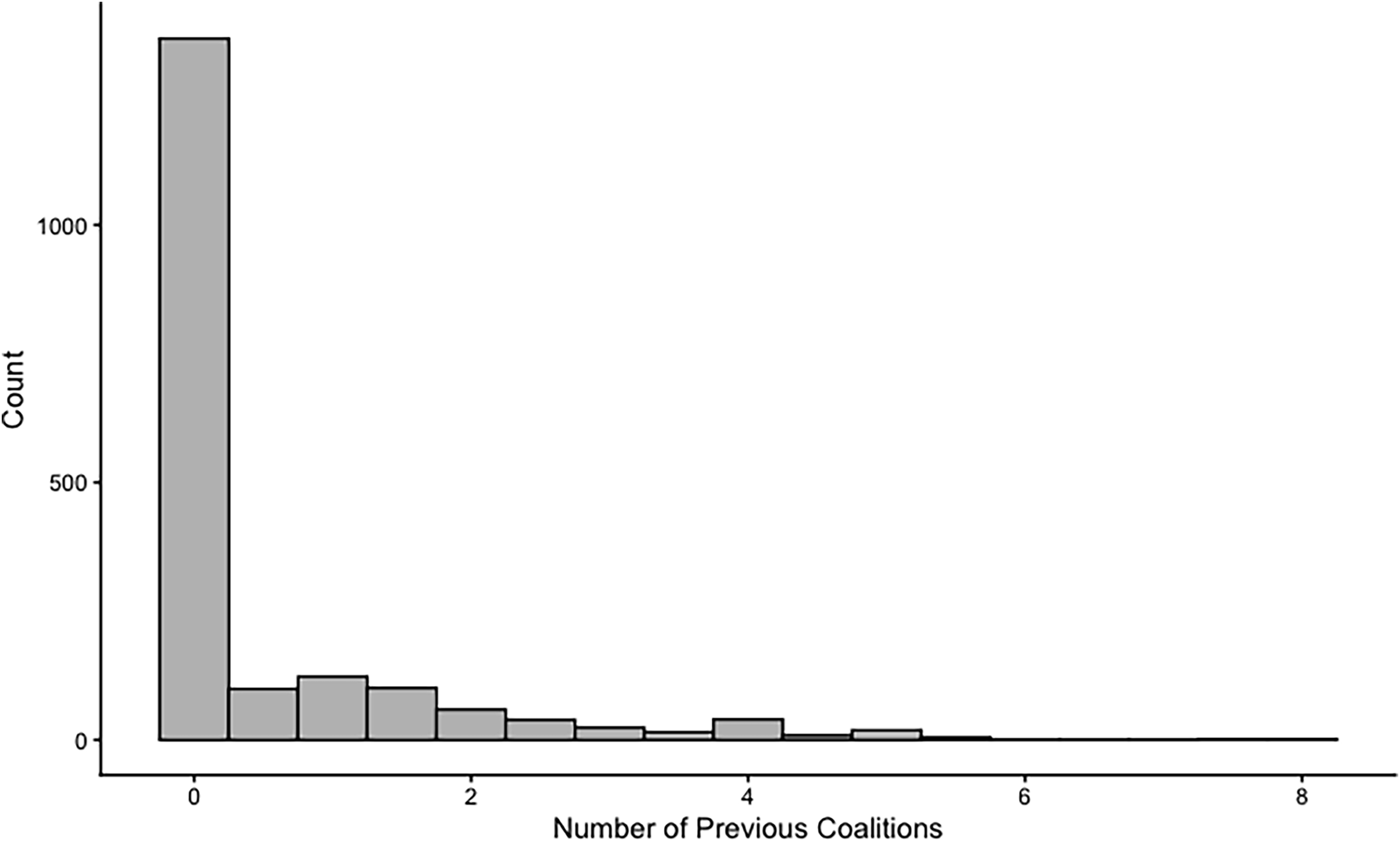
The distribution of this variable is shown in Figure 1. As shown, zero is the most common value since most parties have never coalesced. The values range up to 8, with the most common non-zero values lying below 2. The maximum value of 7.96 is for Finland’s Swedish People’s Party and Social Democratic Party in 2014. Since parties are often unable to be in government due to seat share or mathematical reasons, this measure accounts for coalition history while still allowing for gaps in parties’ experience in government.Footnote 5
Distribution of weighted previous coalitions.

Because I argue that this relationship is non-linear, with the converging effect of coalition history diminishing as the number of previous coalitions increases, I include a quadratic term for the measure of previous coalitions. The coefficient for the quadratic term should be the opposite from the coefficient for the linear term for coalition history. Not only does the effect of previous coalitions diminish as a given coalition becomes more distant in the past, the converging effect of the coalition diminishes each time a given coalition reaffirms. This will indicate that the marginal converging effect for coalition history diminishes as the number of previous coalitions increases. Because I argue that voters will have the strongest reaction to new coalitions, the rate of convergence should diminish as the number of times a coalition reaffirms increases. Empirically, this is necessary because the dependent variable has a lower bound of zero, so perceptions of parties cannot endlessly converge. The quadratic term corrects for this relationship.
My next independent variable of interest indicates whether both parties in each dyad governed in the current coalition together. A value of 1 indicates that each party dyad was in a coalition government together at time $t$
. This represents the immediate coalition arrangements that affect voter perceptions at the time of the survey. I use a count of previous coalitions for my measure of coalition history, rather than duration or proportion of time, in part because it is easiest to compare the substantive effects of current coalitions with previous coalitions. A change from zero to one means an increase of one coalition for the current coalition and approximately one previous coalition, although the count for previous coalitions would be discounted. Therefore, comparing the effect sizes of prior relationships relative to the current coalition is more straightforward using the count of the number of past relationships.
$t$
. This represents the immediate coalition arrangements that affect voter perceptions at the time of the survey. I use a count of previous coalitions for my measure of coalition history, rather than duration or proportion of time, in part because it is easiest to compare the substantive effects of current coalitions with previous coalitions. A change from zero to one means an increase of one coalition for the current coalition and approximately one previous coalition, although the count for previous coalitions would be discounted. Therefore, comparing the effect sizes of prior relationships relative to the current coalition is more straightforward using the count of the number of past relationships.
I create a binary variable, current exclusion, that measures whether one party in the dyad is included in the current government while the other party is not. This indicates whether there is a mismatch between governing statuses in each party dyad using the current coalition at the time of the survey.
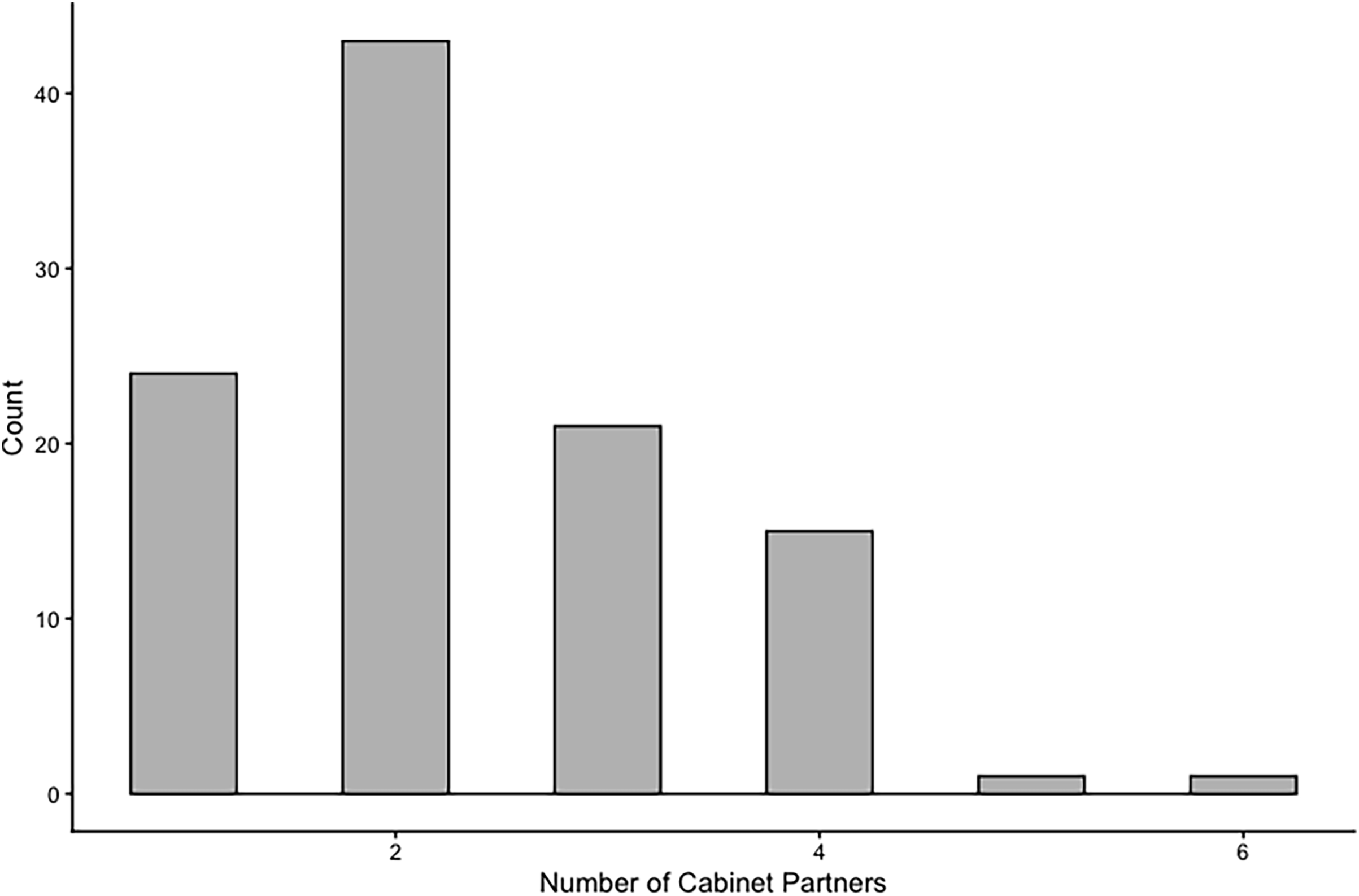
While these measures of coalition history focus on history between party pairs, coalitions can also include more than two partners. Figure 2 shows that two-party coalitions are by far the most common type of government in the dataset by a significant margin, even more so than single-party governments. Focusing primarily on the dyadic relationship between parties reflects the most common type of coalition relationships.Footnote 6 However, many coalition governments include more than two parties, with up to six-party coalitions appearing in the dataset. Furthermore, parties have multiple past partners as well, either through multiparty coalitions, alternating partners, or a combination of both. Therefore, it is important to understand how having multiple coalition histories affects voter perceptions.
Coalition size.

Next, I generate variables at the party level to test whether an individual party’s broader coalition history can moderate the effect of past relationships between that party and another party at the dyad level. To test the multiple histories effect, I create a variable representing a party’s total coalition history of other partners by summing the count of all a given party’s other coalition partnerships, excluding the count for previous coalition(s) between dyads being scored in the current observation. If a party has only coalesced with the other party in the dyad at hand, its value for total coalition history would be zero, since the party has not coalesced with any other partners. Importantly, this means that the measure for a party’s total coalition history is fully independent from the measure of previous coalition(s) for a given party dyad. This variable allows me to account for the fact that parties might have multiple past coalition partners, where some partnerships are more frequent than others.Footnote 7
To measure the actual ideological distance between parties, I use the absolute difference between the left-right score from the Manifesto Project dataset, the manifesto distance. This allows me to account for the difference in how parties present themselves ideologically during campaigns. To conceptualize whether there is a disconnect between a party’s actual ideology and voters’ perceptions of that party’s ideology, I control for the absolute difference between manifesto left-right scores for each given party dyad. Without controlling for the distance between parties’ stated platforms, voters might be responding to parties’ decisions to move their explicit policy platforms closer ideologically, rather than coalition decisions. Coalition partners might indeed be moving their platforms ideologically closer as they continue to coalesce, but I theorize voters will view former partners as more similar regardless of their stated platforms.
I include controls first for party-level variables. If the prime minister (PM) is from a given party, this is recorded as a 1; if not, 0. I include this variable because evidence shows voters are more likely to move junior partners towards prime minister parties (Fortunato and Adams Reference Fortunato and Adams2015), so differentiating whether one partner is the PM party or both are junior partners might affect voter perceptions. Next, I include a control for each party’s individual seat share as a 0–100 percentage using ParlGov data. One might expect voters to have more accurate perceptions of larger parties than smaller parties because they’re more well-known, and seat share also determines whether a party will be considered for a coalition, so it needs to be included as a control. Because I include party-level variables, this means that each dyad has two observations for each respondent, one for each party in the dyad.Footnote 8
Finally, I control for party age. Newer parties have fewer chances to participate in cabinets because they have not been in parliament as long. Therefore, dyads that include newer parties are likely to have lower counts of previous coalitions than dyads that include older parties. Furthermore, coalition counts might mean more for newer parties than older parties, even within dyads.
At the respondent level, I use CSES data to control for the gender, education, and age of the respondent. Age is particularly relevant because older voters will have longer-lived memories of coalition histories. Education is also relevant because more educated voters might have better memories of past coalition relationships. Descriptive statistics for these variables are in the online Appendix.
Because the data are stacked, I use multilevel models with party-dyad-cabinet random intercepts and country random intercepts in my models. I add country intercepts to the models to account for any unobserved country-specific effects. The party-dyad-cabinet intercepts account for the dyadic structure and clustering of the data. I include two interaction terms in all models. First, I interact with whether both parties are in a current coalition with the number of times parties previously coalesced. This shows how previous coalition history moderates the effect of joining a current coalition. Next, I interact with whether only one party is excluded for governance with the number of times parties have previously coalesced, revealing how previous coalition history moderates the effect of one party excluding the other from government.
I also run a separate model to test Hypothesis 4 with additional interaction terms. To test Hypothesis 4, I include the variable total coalition history and an interaction term between total coalition history and previous coalition(s). This allows me to see whether a party’s relative coalition history with other partners affects the marginal impact of previous coalitions between each dyad.
Based on Hypothesis 1, I expect a) that the predicted distance between parties that are in a current coalition will be lower (more similar) than for parties that are not in government and have never previously coalesced, and b) the individual coefficient for both in the current coalition to be negative and substantively the largest. This would indicate a novel coalition effect that when two parties are in government but have never previously coalesced, voters will view them as more similar, and this will have a greater impact than other types of coalitions.
For the coalition history effect in Hypothesis 2, I expect the coefficient for previous coalition(s) to be negative, which would demonstrate that voters view parties as more similar as the number of previous coalitions increases. According to Hypothesis 2b, I expect the interaction term between current coalition and previous coalition(s) to be positive and the marginal effect of joining a current coalition to increase as the number of previous coalitions increases due to a diminishing history effect. I also expect the coefficient for the squared measure of previous coalition(s) to be positive, indicating that as the number of previous coalitions increases, the rate at which perceptions converge should decrease, supporting a diminishing history effect. When comparing the exclusion against history effect in Hypothesis 3, I expect a positive coefficient for the interaction between current exclusion and previous coalition(s).
For the multiple histories effect in Hypothesis 4, I do not have specific predictions for the independent coefficient of the total coalition history because I don’t expect the total coalition history to have a specific effect for dyads with no past coalition relationship. For the interaction term between total coalition history for a party and previous coalition(s) between the given party dyad, I expect a positive coefficient because the marginal converging impact of past coalitions should decrease as a party’s total coalition history excluding the current dyad increases, since the relative weight of that dyad is decreasing.
Results
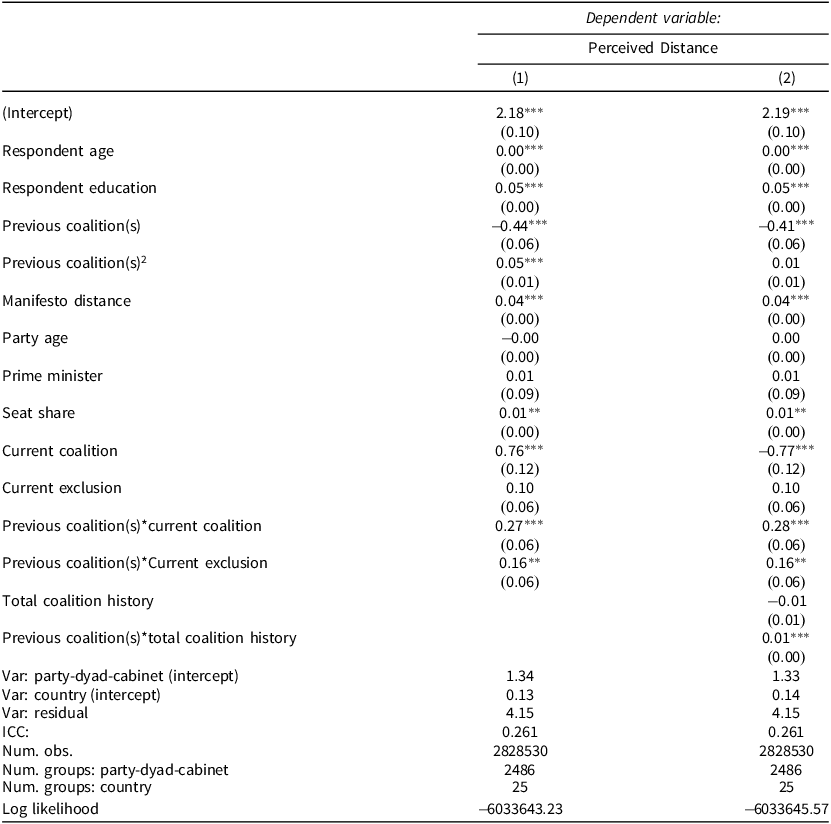
Table 1 shows results for all hypotheses. Model 1 shows the results for Hypotheses 1 to 3, focusing only on the dyadic relationship of the current observation, without including the variables that incorporate the possibility for multiple past and present partners, though these results are consistent in Models 2 and 3 as well. Overall, I find support for these hypotheses. First, these results support the coalition history effect. The coefficient for previous coalitions is negative and significant, showing that voters will view parties as more ideologically similar as the number of previous coalitions increases when neither party is in government. This is important because it shows coalition history has a distinct effect on voter perceptions that is not contingent on current government participation. Furthermore, this effect is compounding as the number of previous coalitions increases.
Effects of coalition history on perceived distance
 ${{^{***}P \lt 0}}.{\rm{001}}$
;
${{^{***}P \lt 0}}.{\rm{001}}$
; ${{^{**}P \lt 0}}.{\rm{01}}$
;
${{^{**}P \lt 0}}.{\rm{01}}$
; ${^{*}}P{\rm{ \lt }}0.05$
.
${^{*}}P{\rm{ \lt }}0.05$
.
Because the coefficient for the quadratic term of previous coalitions is positive and substantively small, while the linear coefficient for previous coalitions is negative and much larger in size, this indicates that the rate at which perceptions converge decreases as the number of previous coalitions increases. This indicates that there is a diminishing history effect, so coalitions have less marginal impact on perceptions the more times they repeat.
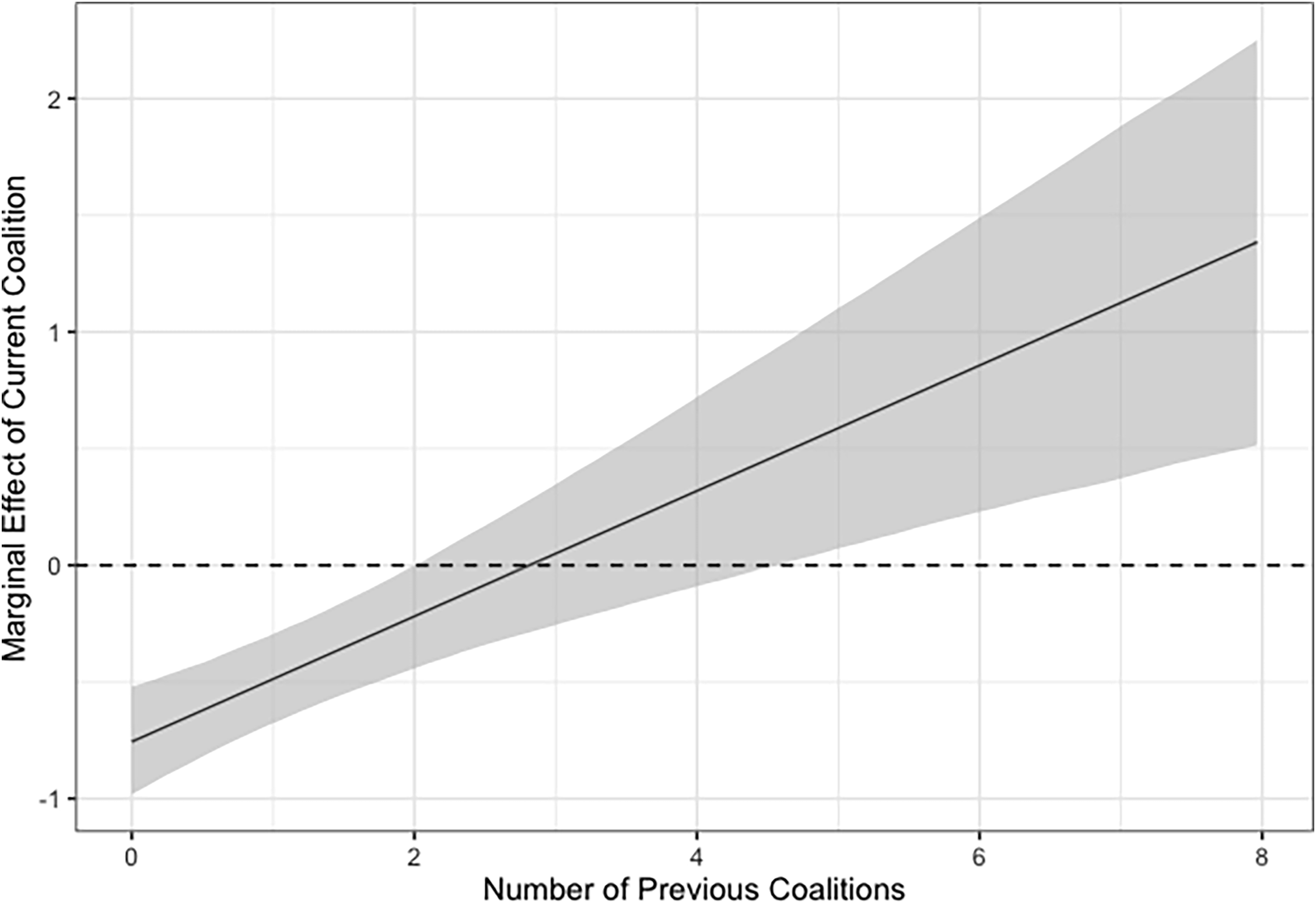
Next, I find clear support for the novel coalition effect. The coefficient for the current coalition is negative and substantially large. This coefficient indicates that when two parties join a coalition with no prior coalition history, voters will view them as .89 units more similar. To determine whether a novel coalition has the greatest converging impact on voter perceptions, I compare the marginal effect of joining a novel coalition with the effect of joining a coalition with two parties that have previously coalesced. Figure 3 shows the marginal effects of both parties joining a current coalition as the number of previous coalitions increases. Joining a coalition when the number of previous coalitions is zero has the strongest converging effect. This shows voters will update their perceptions the most when two parties join a novel coalition, exhibiting a novel coalition effect.
Marginal effects of current coalition on perceived distance.

Figure 3 also shows support for the diminishing history effect. The converging impact of each new coalition diminishes as the number of previous coalitions increases. On the one hand, the positive slope conforms with my theory that novel coalitions should have the strongest converging impact on voter perceptions. The marginal converging effect of both parties being in government is strongest when two parties have never coalesced before, and this marginal converging effect diminishes as the number of times two parties coalesce increases. On the other hand, this shows that after between two and three times coalescing, the effect of joining a new coalition becomes positive, meaning the marginal impact of two parties being in government becomes distancing as the number of previous coalitions reaches higher values. However, the marginal effects do not mean that voters view parties as more distant ideologically overall when in government as the number of times the parties have coalesced increases, because even though the marginal effect of new coalitions becomes positive, it is counteracted as the negative converging effect of previous coalition history compounds.
While the marginal effect of the current coalition becomes diverging as the number of previous coalitions increases above four, the overall combined effect of both previous and current coalitions is consistently converging as the number of previous coalitions increases. This is mathematically true because the independent coefficient for previous coalitions ( $\! - \!0.5$
) is negative and substantively larger than the positive coefficient of the interaction between previous coalitions and the current coalition (
$\! - \!0.5$
) is negative and substantively larger than the positive coefficient of the interaction between previous coalitions and the current coalition ( $0.32$
).
$0.32$
).
The marginal effect of the current coalition becomes positive between the values 3 and 4 when the value of the interaction term becomes greater than the independent coefficient for the current coalition ( $\! - \!0.89$
). This means that voters will always view parties currently in government as more similar as the number of coalitions increases; however, the rate at which perceptions converge based on previous coalitions is slower when both parties are in government as opposed to when neither party is in government. While a one-unit increase in previous coalitions predicts perceived distance between parties to decrease by
$\! - \!0.89$
). This means that voters will always view parties currently in government as more similar as the number of coalitions increases; however, the rate at which perceptions converge based on previous coalitions is slower when both parties are in government as opposed to when neither party is in government. While a one-unit increase in previous coalitions predicts perceived distance between parties to decrease by $0.5$
units when neither party is in government, a one-unit increase in previous coalitions predicts perceived distance between parties to decrease by only
$0.5$
units when neither party is in government, a one-unit increase in previous coalitions predicts perceived distance between parties to decrease by only $0.18$
units when both parties are in government.
$0.18$
units when both parties are in government.
As shown in Figure 1, very few observations, fewer than five percent, in the data have a previous coalition history with values above 4. Because these observations are so rare in the data, it is hard to interpret the marginal effects of previous coalition(s) on voter perceptions at the highest values with so few cases falling into this range. This is further supported by the increasingly wide confidence intervals as the number of previous coalitions increases. Therefore, even though the graph shows the marginal impact of currently being in a coalition becomes positive after the number of previous coalitions reaches 4, the slope of this effect is driven by the observations in the lower range of values.
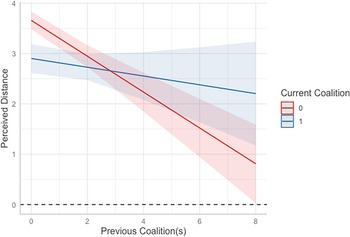
To assess the overall impact of being in government on voter perceptions, Figure 4 shows the predicted values of the interaction between previous coalitions and both parties in a current coalition. This compares the effects of neither party being in government to the effects of both parties in a dyad being in government, moderated by previous coalitions. The red line shows that as the number of previous coalitions increases, voters will view parties as more similar when neither party is in government due to the coalition history effect. The blue line indicates that as the number of previous coalitions increases, the predicted effect of being in government is relatively stable, with a slight downward slope. Importantly, the plot shows that voters view parties that either have previous coalition history or are in government as significantly more similar than parties that have no coalition history and are not in government. The difference between parties currently in government and dyads where neither party is in government is largest for dyads where the number of previous coalitions is zero, further affirming the novel coalition effect. This plot also shows that there is no significant difference between perceptions of party dyads in government or out of government as the number of previous coalitions increases to higher levels. As coalitions repeat, the impact of joining a new coalition is indistinguishable from the effect of prior coalitions on voter perceptions.
Predicted values of perceived distance.

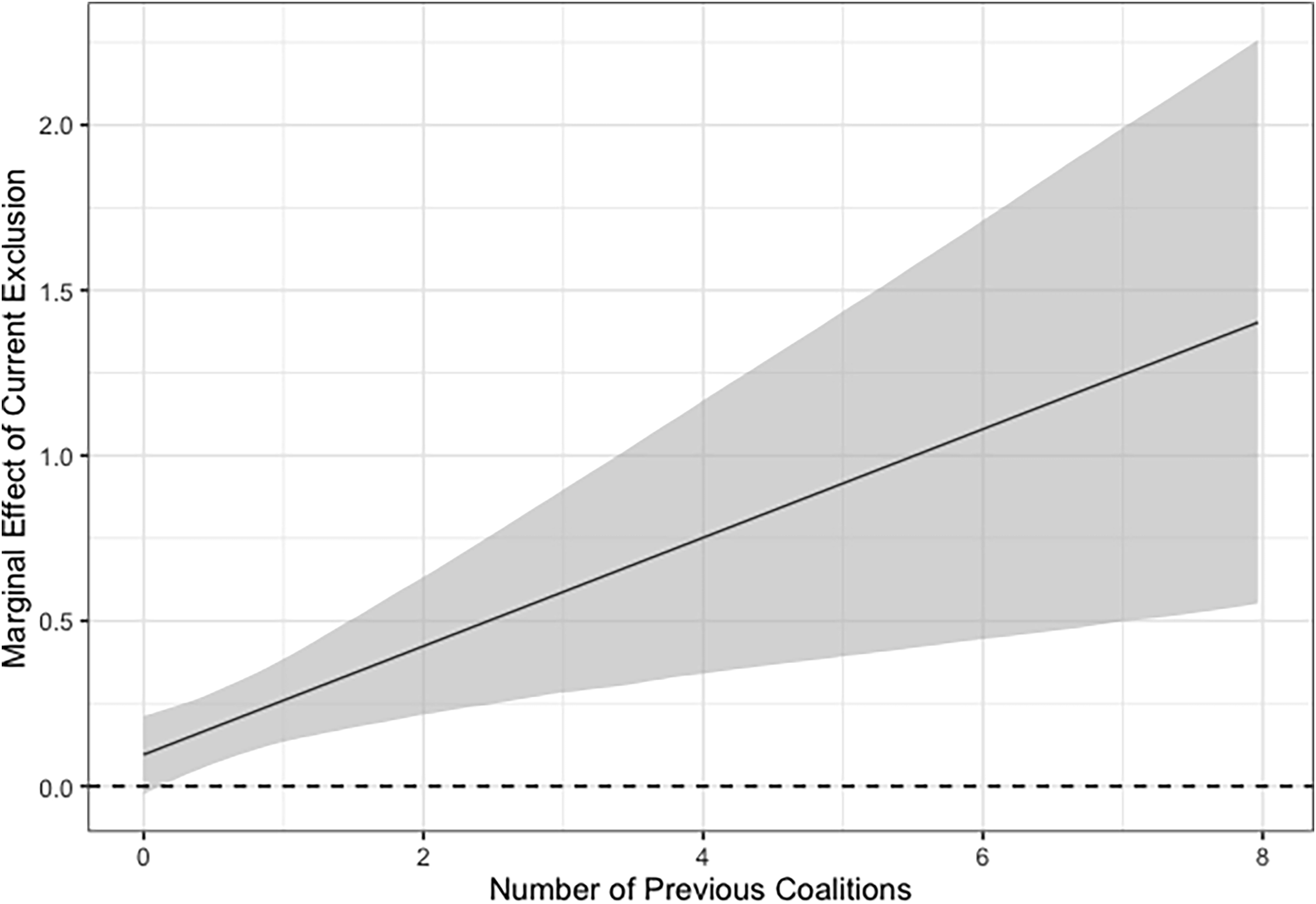
Moving on to the exclusion against history effect, the results show that as the number of previous coalitions increases, current exclusion from government has an increasingly diverging impact on voter perceptions. Figure 5 shows the marginal effects of the current exclusion of one party in the dyad on perceived distance as the number of previous coalitions increases. As the number of times two parties have previously coalesced increases, current exclusion from government has an increasingly distancing effect on voters, supporting my hypothesis that excluding a former partner has an increasingly diverging impact on voter perceptions as the number of previous coalitions increases.
Marginal effects of current exclusion on perceived distance.

Model 2 tests the multiple histories’ effect. This model includes an additional variable for the number of past partners a given party has and an interaction between a party’s total coalition history and the count of previous coalition(s) for a given party dyad. The findings for Hypotheses 1 to 3 in Model 1 are consistent with the results in Model 2. The individual coefficient for previous coalition(s) is significant and negative. When a party has formed no coalitions with other parties outside the observed dyad, meaning the value for total coalition history is zero, as the value for previous coalition(s) increases, voters will view the two parties within the dyad as increasingly more similar. The individual coefficient for total coalition history is not significant, as expected. Therefore, when a pair of parties has no coalition history together, an individual party’s coalition history with parties outside that dyad will have no effect on the perceived distance between that dyad. Voters are unlikely to change their perceptions of parties who never coalesced based on how often either of those parties coalesced with partners outside the dyad.
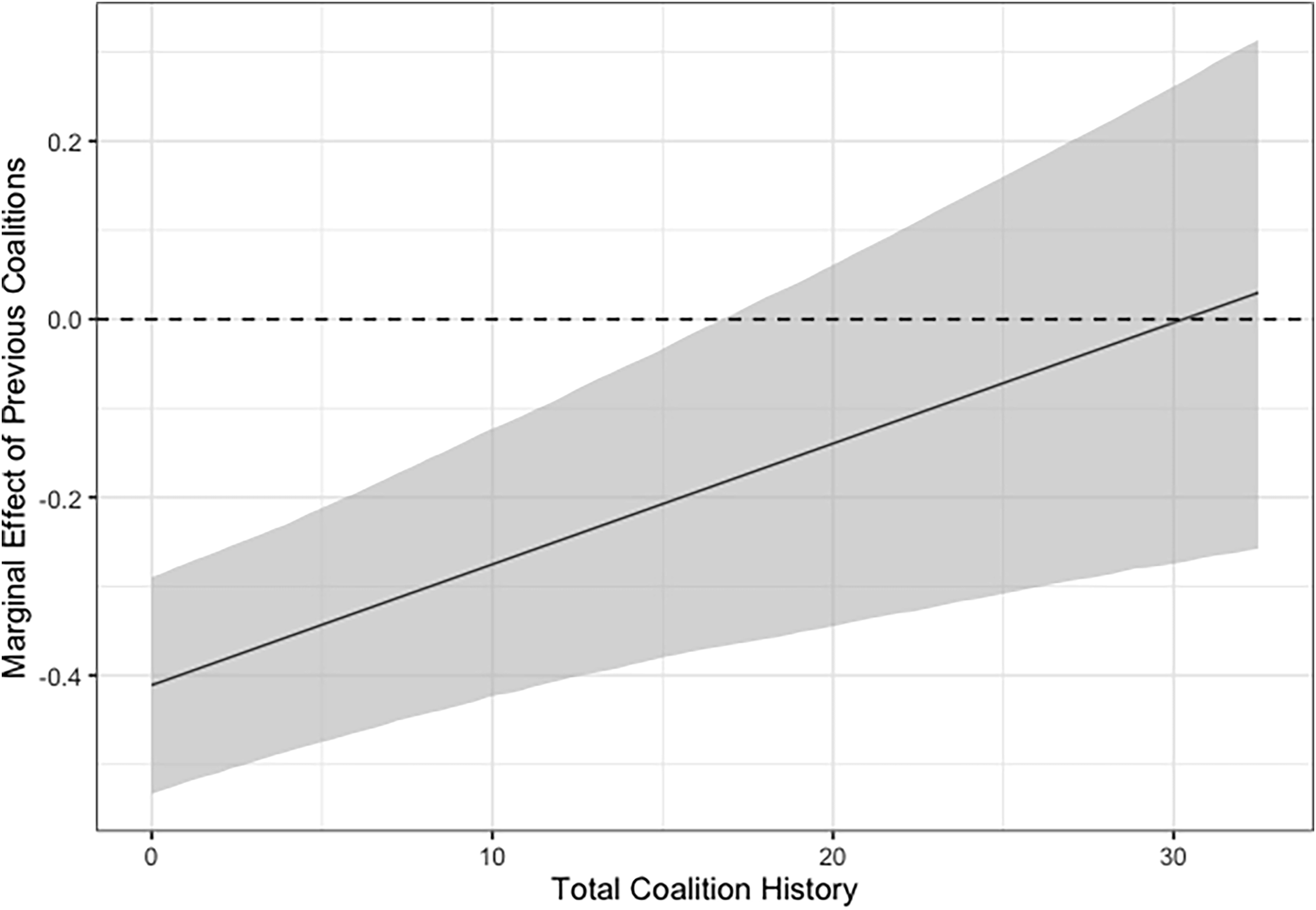
The results in Model 2 support the multiple histories effect, indicating that as the amount of coalitions with partners outside the observation dyad and the number of previous coalitions between the two parties in the dyad increase, there is a positive effect on voter perceptions. Figure 6 shows the marginal effect of previous coalitions between a party pair conditioned by the total coalition history between one of those parties and partners outside this pair.
Marginal effect of previous coalition(s).

Figure 6 shows that as a party’s coalition history with partners outside of the observed dyad increases, the marginal converging effect of previous coalitions within that dyad diminishes. When the observed party’s total coalition history is zero, indicating that the observed party in the dyad has not coalesced with any partners outside of the observed dyad, the converging effect of previous coalitions is the strongest. Voters will respond the most to a party pair’s previous coalition history when that is the exclusive partnership of the observed party. As the observed party’s total coalition history with partners outside the observed dyad increases, the marginal converging effect of the amount of previous coalitions within the dyad diminishes. For the highest values of total coalition history, where the party has the most extensive coalition history with a party or parties outside of the dyad being observed, the marginal converging effect of previous coalitions within the dyad is zero.
These results show clear support for the multiple histories effect. When parties have an exclusive partnership with one coalition partner, voters are more likely to view those two parties as more similar as coalition history increases. Without the noise of other past partners, the increasing number of previous coalitions with this partner is a clear signal of continued cooperation. On the other end of the spectrum, if voters have to contend with multiple past partnerships for a party, as the amount of past partnerships with other partner(s) increases, this provides competing information voters must incorporate into their perceptions of a single party. The higher relative importance a given coalition partnership has for a given party compared to its other potential past partners, the more of a converging impact this history will have on voter perceptions. Exclusive partnerships between two parties have the strongest effect on voter perceptions. This is because the fewer relationships voters must consider when evaluating a party, the clearer the effect these relationships will have.
The control variables in Models 1 and 2 show similar effects. At the respondent level, the coefficient for respondent age is positive and significant, showing that as age increases, respondents will view parties as more distant. The coefficient for respondent education is also positive and significant, indicating that as respondents become more educated, they will view parties as more ideologically distant. However, the substantive size of these effects is quite small. At the party level, the coefficient for whether the observed party holds the prime ministerial position is not significant. Furthermore, the coefficient for party age is not significant. The coefficient for seat share is positive and significant, indicating that as the seat share for the observed party increases, voters will view parties as more ideologically distinct. This indicates that larger parties might have more of an ability to differentiate themselves from smaller parties.
Results are robust when using alternate measures of coalition history, as shown in the Appendix. Some may argue that a count of previous coalitions might not be the best measure of previous coalition history because duration matters more, it is too complicated, or it doesn’t account for past interspersed exclusion from coalitions that might counteract the effects of cooperation.
Conclusion
In this paper I argue that voters update their perceptions of new coalitions based on prior expectations formed by coalition relationship histories. The results I find support my theory. I find strong support for the hypothesis that voters will move parties the most to be closer ideologically the first time two parties coalesce, indicating voters react the strongest to unexpected coalitions. Although I show that voters will view parties as more similar both when they are currently in government and when they have previously coalesced in comparison to parties that have never coalesced, I exhibit how coalition histories and current coalitions have distinct effects from each other.
I find that as the number of times two parties have previously coalesced increases, voters view parties as even more similar when neither party is in government. However, because a) the initial effect of joining a coalition with a party for the first time is so strong, b) voters react more strongly to less expected coalitions, and c) voters can only view parties as so close to zero ideologically, the marginal converging effect of repeating that same partnership diminishes as the number of times parties have previously coalesced increases. As coalitions reaffirm, voters integrate these decisions into their baseline perceptions of parties. Therefore, they react less strongly to new coalitions the more they have already updated their perceptions of parties based on previous coalitions.
This latter finding conforms with the theory that voters only update their perceptions when the new information does not conform with their priors. Perceptions of coalitions are sticky. As voters move their baseline perceptions of two parties to be closer and closer even when neither party is in government, they rely more on their previous perceptions and less on the new information provided by each new, reaffirming coalition. While the perceptions of two parties compound when neither party is in government, because the initial effect of the first time two parties coalesce is so strong, the marginal effect of current coalitions remains relatively consistent for reaffirming coalitions.
The results show that when one party excludes another from government, this counteracts the converging effect of previous coalitions on voter perceptions. This indicates that one way parties can differentiate themselves from their former partners and counteract converging perceptions is to form a new partnership, whereas simply alternating to opposition is not as effective. Previous coalitions and exclusion have a sort of tit-for-tat relationship, so the distancing impact of exclusion increases as the number of coalitions increases. While voters won’t view parties as more distant overall when one party excludes the other, the effect of previous coalitions has less of a converging impact when one party excludes another than when neither party is in government.
Finally, I find that past partnerships have a stronger converging impact on voter perceptions when they are exclusive than when they are non-exclusive. The marginal impact of previous coalitions between a party pair diminishes as a given party’s total coalition history with other parties increases. This shows that when voters must contend with multiple coalition histories for a party, they must incorporate the totality of a party’s coalition history into their perceptions of the party’s ideology. Just as exclusion can mitigate the effects of previous coalitions between two parties, additional partnerships can serve to diminish the converging effects of any specific partnership. While forming relationships with new partners might help distinguish a party from a specific partner, these results show that a party is judged based on its full roster of coalition relationships, not just its most frequent or most recent partnerships. Therefore, forming multiparty coalitions or alternating partners frequently can come with additional reputational consequences.
My results bolster Fortunato and Stevenson’s (Reference Fortunato and Stevenson2013) claim that voters use coalition decisions as a heuristic to infer party ideologies and move this literature forward by showing that the effects of these decisions persist after any one coalition ends. Voters accrue information about past relationships from their lived experiences, media coverage of campaigns and coalition histories, and parties themselves. It is logical for voters to rely on these decisions when determining their votes because voters can use them to infer which parties will coalesce after the election and what sort of policies they might pass based on prior governing experience. In addition, just as voters react most strongly to ideologically unexpected coalitions (Falcó-Gimeno and Fernandez-Vazquez Reference Falcó-Gimeno and Fernandez-Vazquez2020), voters also react the strongest to historically unexpected coalitions, where voters will view parties in novel coalitions as the most similar; one party excluding another from government has a stronger distancing impact as the number of times parties have previously coalesced increases.
Coalition decisions can therefore become integrated into parties’ individual reputations beyond the current coalition constellation. This changes the nature of party competition in elections, indicating a stronger influence of inter-party cooperation on election results. Parties should consider the ramifications of coalition decisions beyond the short term. While repeating the same coalitions can help voters form reliable expectations about how a party will govern and with whom, parties might struggle to differentiate themselves from these partners. Furthermore, simply spending time in opposition is not enough to refresh their brands as independent from former partners.
While excluding one partner in favor of another might decrease the converging effect of previous coalitions on voter perceptions, new coalition partners might still struggle to differentiate themselves from each other in the following election. Voters might dislike either the direction of the change or the unpredictability new coalition partnerships signal for the parties’ brands. Replacing consistent coalition partnerships with new partnerships is not a surefire way to refresh a party’s brand without consequences.
A party’s coalition participation only provides part of the story for how voters update their perceptions of co-governing parties. Future research should analyze how voters react to policymaking in coalition governments. Voters might evaluate co-governing parties differently depending on the legislative productivity of the coalition, which party they view as having more policymaking power in the relationship, and how well these parties cooperate. Like exclusion can counteract the converging effects of coalition histories, contentious coalition relationships, coalitions that pass unpopular legislation, or coalitions that terminate early will likely make voters view these parties as ill-suited partners. Not only will this affect evaluations of co-governing parties, but this will also affect the likelihood of a coalition forming in the future, as well as voter preferences on future coalitions. If voters continually update their perceptions of parties, then parties might be able to distinguish themselves from partners through legislative accomplishments.
This research shows that having multiple coalition histories can condition the effects of any given partnership, and further research could parse out exactly how voters compare various coalition configurations when forming an opinion of a party. Future studies could look at specific characteristics of coalitions, such as the number of participating parties, the characteristics of individual partners, and the relative strength of participating parties. While the data limited my analysis to the national level, future research could look at the effects of coalescing on the local level, as local coalitions might also affect voter perceptions. In federal systems, local-level governments might have different coalitions than the national government, which could have varying effects on voter perceptions.
Supplementary material
The supplementary material for this article can be found at https://doi.org/10.1017/S1475676526101145.
Data availability statement
The data and code necessary to replicate the analyses of the paper are available on Dataverse at https://doi.org/10.7910/DVN/TSRPWK.
Acknowledgements
I thank Zeynep Somer-Topcu, Chris Wlezien, Alison Craig, and Heike Klüver for helpful feedback. A previous version of this paper was submitted at the 2023 Midwest Political Science Association.
Financial support
The authors have no funding to declare.
Competing interests
The authors declare no potential conflicts of interest with respect to the research, authorship, and/or publication of this article.


 Open access

