

In 102 a Roman citizen named Lucius Equitius appeared before the censors and as part of his declaration made the surprising claim that he was actually the son of Tiberius Gracchus. The censor, Metellus Numidicus, the proud noble from whom Marius had snatched the war against Jugurtha, refused to continue with the registration. Tiberius had had three sons, insisted Metellus, and all were now dead; “unknowns of low origin” should not be thrust into the distinguished family. A furious crowd, supporting Equitius’ dubious assertion, soon tried to stone the censor. A tribune summoned Tiberius’ surviving sister, Sempronia, to a public meeting where the audience demanded that she kiss Equitius. Staring them all down, she refused.
Equitius almost certainly was not Tiberius’ son, and what his claim actually shows is how much the Gracchus brothers lived on in memory as a new generation of politicians questioned how the profits and prestige of empire were shared. Up and down the Rostra these politicians strode, grieving, mocking, attacking, gesturing dramatically. Chief among them was L. Appuleius Saturninus, a tribune who supported Equitius (and probably came up with the idea of the false Gracchus in the first place) and was determined to push through legislation, even by force, to help ordinary citizens. He used gangs to drive off other voters with stones and wooden clubs. When he sought a second term as tribune, some of his supporters ended up killing a rival candidate in a voting-place tussle. The following year, he ordered the assassination of a consular candidate.
“Every year some foul crime occurred in or around the Forum,” wrote the historian Appian. His Civil War is the only extant history for the period from Saturninus’ stormy entry into politics in 104 down through the far-worse crisis that erupted in 91. But he is all too brief on events of most of the 90s, a critical decade for the future of the Republic. Modern historians must piece together a narrative from small fragments of evidence, almost like forensic scientists. What emerges is growing dissatisfaction among key constituencies, including the Italian allies who had bled so often in Rome’s wars. While some senators realized that reforms were needed, mutual jealousies, combined with voters’ prejudices, proved an insurmountable obstacle – and so in 91 the Italians rebelled.
Roman citizens put aside their differences to meet the threat and ultimately gave the Italians citizenship. Yet specific plans to enfranchise the Italians divided leaders, and in 88 a new and deadlier cycle of violence began. Gangs armed with daggers were unleashed in the Forum; an attack was made on the two consuls; and, worst of all, one of them, Sulla, then marched on Rome with an army. That year marked a total breakdown of civic institutions. It was a bigger turning point than the more famous assassination of Julius Caesar in 44.
After Sulla’s march on Rome, power now lay in armed force. Armies helped legitimize leaders, and leaders in turn lavishly rewarded soldiers. Leaders also claimed that they had the unique support of the gods. Marius insisted that he should have a seventh consulship because of a prophecy he had received in childhood after catching a falling eagle’s nest with seven young ones in it. Sulla, whose blond hair and piercing blue eyes stood out in Rome, spoke even more awesomely. When he set out to fight the Italian allies, he said, a great chasm in the earth opened, out of which came much fire and one bright flame that reached the sky. According to his soothsayers it meant that a man of great qualities and striking appearance “would take the government in hand and free Rome from her present troubles.”
Sulla’s final victory seemed to bring civil war to an end, but his legacy proved an awful one. His lack of reconciliation inspired fresh outbreaks of violence in Italy after his death. The new constitution that he wrote for Rome failed to prevent new Sullas. Sulla, in the end, proved too wedded to using the old institutions of SPQR – especially the Senate – to bring stable government to the much-enlarged Roman state. A different framework would be needed to stop the killing.
The Din of Warfare and the Voice of Law
Like Tiberius Gracchus, Saturninus rose to power against a backdrop of imperial crisis. In 105, at Arausio, the Romans were disastrously defeated by the Cimbri. Not since the battle of Cannae in the Second Punic War had so many citizens died in one battle. Afterward, the proud patrician commander, Servilius Caepio, was stripped of his command by the People. Marius, elected to his second consulship for 104, was to take over.
Rome’s problems were not limited to the north. As he prepared to fight the Germans, Marius summoned aid from Roman allies, including King Nicomedes III of Bithynia. Nicomedes replied that he had nobody to send because the majority of his subjects had been seized and sold into slavery, by Roman tax-collecting companies no less. The companies had grown far more powerful than Gaius Gracchus had intended when he turned Asia over to them. At the same time, thanks to Rome’s weakening of Rhodes, pirates had infested the craggy coast of Cilicia and were enjoying a brisk sale in captives. Rome had done nothing to police the area (though it would finally, in 102, send a praetor there with naval forces). In 104, the Senate instructed provincial governors to free all those illegally enslaved. The praetor in Sicily began his investigation, and in the process stirred up a massive slave rebellion. Grain prices rose in Rome, and supplies began to run short.
Marius made his way from Rome to Gaul, and by a stroke of luck the Germans had left for Spain, allowing him to train his freshly recruited army intensively. He drove his soldiers so hard that they came to be called “Marius’ mules.” He also introduced a uniform battle standard for each legion, a silver eagle, the loss of which would bring disgrace. The reforms paid off. In 102, Marius destroyed many of the Germans at two battles near Aquae Sextiae (modern Aix-en-Provence in France). Coming to the aid of his fellow consul Catulus the next year, he defeated the Cimbri at the battle of Vercellae in northern Italy. Meanwhile, Marius racked up reelections to the consulship, winning his sixth for the year 100. He felt powerful enough to reward with Roman citizenship the Italians who had fought bravely under him. Called to account for this back in Rome, he replied that “the din of warfare had prevented him from hearing the voice of law.” However worthy those Italians were, comments like this undermined republican government.
By the end of 100, imperial stability was basically restored. The Germans had been defeated and the slaves in Sicily put down. The pirate war was more or less over too. Cilicia became a regularly assigned province, and assurances were made throughout the eastern world that Rome would guarantee freedom on the seas. Rome’s friends and allies were ordered to shut their ports to all pirates.
Back in Rome, tribunes had been apportioning blame for the losses to the Germans. By a tribunician law of 104, Caepio, the loser at Arausio, was expelled from the Senate, and as further embarrassment, an inquiry was held into the mysterious disappearance of the trove of gold he had carried off from the Gallic sanctuary at Tolosa. Junius Silanus, who had been defeated by the Cimbri back in 109, was also now put on trial before the People by the vigorous tribune Domitius Ahenobarbus. He was acquitted. Domitius did succeed in transferring to a special assembly made up of 17 voting tribes chosen by lot the election of members of the four great priestly colleges. Previously selection had lain with the priests themselves.
It was later in this year that Saturninus won election to his first tribunate. A strong speaker, he sought to champion popular interests at nearly any price. Probably in 103 he proposed a new grain law, apparently increasing the subsidy offered. This was a clear effort to win over city dwellers on edge from recent shortages. The son of the disgraced Caepio, serving as quaestor, protested that the treasury could not afford it, and the Senate passed a decree trying to block it. Saturninus persisted anyway and, despite vetoes by other tribunes, initiated voting. Caepio then disrupted the assembly, pulling down the gangways that voters crossed on and toppling the voting urns. It was the tribunate of Tiberius Gracchus all over again.
Saturninus ultimately got the bill passed, along with other controversial laws. One of them granted allotments of land in Africa to Marius’ veterans from the Jugurthine War. This was in the spirit of Gaius Gracchus’ colonization of Carthage and the colonization of Narbo Martius in Gaul in 118. Again, one of Saturninus’ fellow tribunes tried to interpose his veto but was driven off with stones by Saturninus’ supporters. Another law established a new court to try those accused of “diminishing the majesty of the Roman People” – an impressive-sounding crime that could embrace corruption or the disrupting of voting assemblies. Over time, this court replaced the assembly for the hearing of treason charges.
In 103, though, it was in the assembly that Saturninus continued hounding the elder Caepio. For his actions at Arausio, Caepio was charged with treason by a fellow tribune and ally of Saturninus named Norbanus. Two tribunes tried to interpose their vetoes, and they too were driven off in a hail of stones, one of which struck the princeps senatus, the formidable M. Aemilius Scaurus. Caepio was forced into exile, but Norbanus’ actions were not to be forgotten. The other loser of Arausio, the new man Mallius, was also prosecuted, this time by Saturninus himself, and he too went into exile.
Both Saturninus and his opponents clearly were willing to use violence to circumvent the political process. Like the tribunes during the Jugurthine War, he was putting on the mantle of the Gracchi. But he showed fiercer opposition to the Senate and its top leaders than the Gracchi themselves had. How much the memory of the Gracchi mattered in his and his supporters’ eyes is shown by his support of the false Gracchus in 102. Not only did the censor Metellus Numidicus refuse to register the imposter, but Numidicus also tried to remove Saturninus from the Senate, along with Servilius Glaucia, a key ally of Saturninus who won popular support with his jokes. Glaucia’s enemies dished it back by calling him “the Senate house shit.”
Numidicus only succeeded in strengthening the resolve of Saturninus and of Glaucia. Glaucia held a tribunate (probably in 101) and passed an extortion law that restored the panels of juries entirely to the Equestrians. This was another jab at the Senate. The elder Caepio, before his disgrace, had managed to pass a law stipulating that all courts were to have juries that included senators as well as Equestrians. By reversing it, Glaucia was putting senators on watch – while also gaining the support of the Equestrians who hated Caepio’s reform. Saturninus did not let up either. Later in 101, he stood for a second tribunate. Marius was back in Rome, eager to secure land in Gaul for his soldiers in the northern war, and lent his and his veterans’ support to Saturninus. Saturninus’ chances only increased when his supporters killed a rival candidate.
So with Marius’ help and by murder, Saturninus was reelected for 100. Then with the help of the veterans, who drove off the opposition with clubs, he passed the legislation on their behalf. Saturninus simultaneously settled his score with Numidicus, to the delight of Marius, who was not one to forget a grudge quickly. As a safeguard, Saturninus’ land bill required senators to swear to uphold it, and after Numidicus refused, he left Rome and a law was passed forbidding his return.
Marius benefitted too from a further provision of Saturninus’ agrarian legislation, which ultimately embraced more than Gaul. Settlements were to take place in Sicily, Greece, and Macedonia also; and in each of the new colonies, Marius was empowered to create new citizens, thereby rewarding the Italians who had served with him on campaign. Saturninus and Marius were thus winning the support of poor citizens in the countryside, as well as Italian allies.
Through his own actions, in addition to his alliances with Marius and Servilius Glaucia, Saturninus had a formidable power base – strong enough to take on the Senate majority on such matters as land distribution. Later in 100, Saturninus gained election to yet another tribunate, and the false Gracchus was elected with him. It was reasonable now to see him as subverting republican government, the heart of which was a smooth turnover of annually elected magistrates.
Even Marius began to have reservations. When Glaucia sought permission to stand for a consulship, Marius, as presider over the elections, refused. To delay the voting, Saturninus ordered the assassination of one of the recognized consular candidates. He then seized the Capitol, planning to pass a law there to allow Glaucia’s candidacy. Aemilius Scaurus shrewdly challenged Marius to defend the Romans’ liberty and take action against Saturninus, and Marius agreed. The Senate passed the same “ultimate” decree it had against Gaius Gracchus, an improvised force was raised, and after the water was cut to the Capitol, Saturninus and his forces capitulated on a promise of safety. But some of them were soon massacred by an angry crowd armed with shards of roof tiles, likely including supporters of Metellus Numidicus. Marius had failed to save his former allies.
Challenging the Senate on matters like the grain supply or the distribution of land, Saturninus above all relied on the plebeian assembly, as earlier tribunes had. Some of his techniques, though, were novel, including the use of veterans in assemblies and, even more disturbing, premeditated assassination. The Senate was forced to take up arms itself. In the aftermath, parts of Saturninus’ agrarian legislation were invalidated. A few lingering supporters of his were eliminated. No doubt deterred by Saturninus’ own fate, tribunes were less aggressive in the next few years. A kind of stability returned to the Republic, but the Senate took no immediate action to make debates over the profits of empire less acrimonious, and so it missed an opportunity to solidify its power. The forces Saturninus had roused – including soldiers fresh off campaigns – could be stirred to action again.
A Lost Decade
The 90s is among the most poorly documented periods in all of Roman history, but a key to understanding it may be found in a growing sense among some senators that it was not just rabble-rousing tribunes who were their problem. The Senate needed to consider at least some reform, if only to preserve itself. Even the formidable Aemilius Scaurus, whose nod was said practically to rule the world, saw this. But the violent quarrels of recent years had led to bad blood. Even when the surface was calm, strong currents of hostility lurked beneath and sucked in politicians.
First on the agenda for Senate champions was a concerted effort to restore the martyred Metellus Numidicus. Naturally, Marius opposed it, and he was supported by the tribune Furius, a one-time supporter of Saturninus who had turned on him. Furius refused to budge even in the face of conspicuous appeals by Metellus’ son, whose own persistence earned him the extra name Pius (the Latin adjective meaning “dutiful”). But eventually a bill on behalf of Numidicus was passed, probably in 99.
Criminal prosecutions were a tempting way to settle scores. After his tribunate ended, Furius was prosecuted by a relative of Saturninus, Decianus, who took the chance to go off topic at the trial and deplore the death of Saturninus. When Decianus failed to secure a conviction, a second trial was held, and Furius was lynched by an angry audience before the trial could finish. Clearly, Saturninus retained the love of his constituents. But the tide turned when Decianus was himself successfully prosecuted, as was the tribune Sex. Titius, who kept a bust of Saturninus in his house. For the next few years, there is no trace of aggressive tribunician activity.
Senatorial unity still proved elusive. A notable pair of trials probably took place in 95. Norbanus, Saturninus’ ally from 103 who had helped destroy the elder Caepio, was prosecuted in Saturninus’ own treason court for his use of violence. His skilled advocate saved him by dredging up memories of the horrific loss at Arausio and also Caepio’s judiciary law. For his part in breaking up Saturninus’ assembly, the younger Caepio also was now prosecuted. His defense was entrusted to Licinius Crassus, the superb orator by then well known for his stirring vindications of the Senate. While Caepio was acquitted, his prosecution was a reminder that Saturninus had not been the only one to use violence. At least indirectly, it was an attack on Senate champions, including Aemilius Scaurus, who had passed the ultimate decree. Possibly Marius had supported the prosecution.
No longer in command, discredited by his association with Saturninus and his intransigence to Numidicus, Marius was on the outs with many in the Senate. The Italian allies were a bone of contention. Marius had been generous with citizenship grants during and immediately after his various campaigns. Far more than in the 120s, citizenship must have seemed desirable, because it offered the prospect of land grants. At the same time, increasing benefits for Roman citizens must have made Italians – who had helped save Rome from the Germans – feel discriminated against. Questions arose about whether some Italians were illegally usurping Roman citizenship, apparently with the help of Marius and his remaining allies.
In 95, two consuls, the eloquent Licinius Crassus and the gifted lawyer Q. Mucius Scaevola, passed a law setting up a tribunal to investigate disputed claims. One of those put on trial was Matrinius, an Umbrian granted citizenship by Marius in 100 through Saturninus’ law. With a few words from Marius, he was acquitted. Still, the law alienated Italians even more.
Another growing tension in the 90s was relations between the Senate and the Equestrian order, members of which had the lucrative contract for tax collecting in Asia. Mounting unhappiness with the tax collectors there, coupled with concerns about security in the east (see discussion further on), led the Senate to action. After his consulship in 95, Quintus Scaevola was sent to overhaul the administration of Asia. This huge job was completed by his legate, Rutilius Rufus, an old military rival of Marius, whose study of law and Stoic philosophy disposed him to reform. Back in Rome, Rutilius was put on trial for extortion – the very problem he had tried to solve. He modeled his defense on Socrates, which did nothing to endear him to the Equestrian jurors, already furious at how their interests had been tampered with. Convicted, he chose as his place of exile Asia and was welcomed by the people he had allegedly wronged.
For many senators, Rutilius’ conviction was a travesty of justice. Gaius Gracchus had not brought the Equestrians into public life to undermine the Senate – just to watch over it and protect provincials. The outrage intensified the growing sense that reform was necessary and is the immediate explanation for developments of the momentous year 91. Rutilius’ nephew, the hard-driven Livius Drusus, was tribune. A son of the Drusus who challenged Gaius Gracchus and a protégé of Licinus Crassus, the new tribune was another champion of the Senate. His first aim was to restore membership of the juries to the Senate. The Senate would be doubled in size to ensure a sufficiency of jurors (and, presumably, to win over the 300 leading Equestrians who would be asked to join the Senate). To help win support, Drusus offered voters lower grain prices as well as land grants. To the Italians he promised citizenship.
The sources for Drusus’ legislative plans are thin and at times contradictory. There is, however, general agreement that he said he was acting on behalf of the Senate, and at critical moments he had the open support of no less than the princeps senatus, Aemilius Scaurus. It is also clear that he aroused opposition, including some from his fellow senators. Quite likely his plan to expand the Senate never got off the ground, and instead a law sharing juries between senators and Equestrians was passed. A certain type of die-hard senator would resist any new measures on grain or land. A proposal for citizenship would also be controversial – even if, as some modern scholars argue, many Italians had little interest in it and simply wanted greater recognition by Rome.
By the fall of 91, the consul Marcius Philippus had turned on Drusus. Also opposing him was the younger Caepio, who had once been a close friend. Philippus denounced not only Drusus but the Senate as a whole at a public meeting. An ailing Licinius Crassus appeared before the Senate to make what would be his final appearance, accusing Philippus of cutting the authority of the Senate to ribbons. He then passed a motion that “the Roman People be satisfied that the Senate had never failed in its advice and loyalty to the state.” But Crassus was soon dead, and Drusus’ own supporters were melting away. Some Italians were frightened that they would lose territory because of Drusus’ efforts to distribute land to citizens.
The ship of state had hit turbulent waters again and was splitting apart. Drusus threatened to execute Caepio, and he got into a violent fight with Philippus. Philippus, in turn, had all of Drusus’ laws invalidated. There was to be no accommodation for the Italians, whose impatience – which clearly added to Drusus’ own desperate situation – started to boil over. Poppaedius Silo, the chieftain of the Marsi, a mountain people of central Italy, even led an armed posse to Rome. Drusus, his friend, managed to turn him back and also warned the consul Philippus that his life was in danger. But it was Drusus who was stabbed to death, in his house, by an unknown assassin. Among those suspected was his old friend Caepio. The broken friendship symbolized a broken politics.
The Bull Gores the Wolf
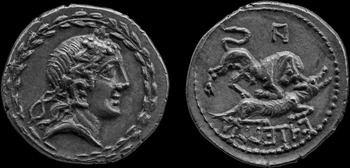
Learning of Drusus’ fate, the Italian peoples living in and around the central and southern Apennines, including the Marsi and the Samnites, now decided to break away from Rome entirely. For some time they had been engaged in secret negotiations involving an exchange of hostages as guarantees of good faith, and in the course of 91 the Senate had sent out magistrates to investigate. The threats one senator made at Asculum, a town set amid the mountains near the Adriatic, resulted in his assassination and a massacre of the other Romans there at the end of the year. The rebels now revealed their preparations. At a new capital city in Corfinium – renamed Italica – delegates would meet as a federal senate. The Italians appointed commanders, raised a massive army of perhaps 100,000, and even issued their own coins, on which the Italian bull replaced the Roman wolf.
The bloody war that followed – usually called the Social War (from the Latin word for “allies,” socii) – has been compared to the American Civil War. The Italian confederates had excellent generals, such as the wily Poppaedius Silo, and fierce fighters, and they achieved some impressive early victories. But they were, in the end, no match for a richer and better-organized opponent.
Two main theaters opened up. In the north, from their base in Corfinium, the confederates would try to head across the Via Valeria to Rome. In the south, they successfully captured the strategically located Latin colony of Aesernia, won over part of Campania (including Pompeii), and also began to penetrate Apulia and Lucania. The consul commanding the north was killed in battle, and command was reassigned to two of his officers, Drusus’ opponent Caepio and Marius. Caepio and his army were led into an ambush by Poppaedius Silo, leaving Marius to rally Rome’s forces, scoring a major victory over the Marsi. Still, as the rebellion threatened to spread, the Senate in Rome decided in late 90 that the consul Lucius Caesar should have a bill passed granting citizenship to those Italians who had stayed loyal. It was probably by further legislation that citizenship was granted also to those rebels who would surrender.

Figure 5.1 The Italian bull gores the Roman wolf on this silver coin issued by the Italian confederation. Beneath the mauling the name of ‘Italy’ is written right to left in the alphabet of Oscan, a southern Italian language.
Many of the rebels, with long memories of struggles against Rome centuries earlier, held out. In 89, Sulla, who was now the principal commander in the southern theater, regained most of Campania and drove back the Samnites. In the north, the consul Pompeius Strabo recaptured Asculum, where the war had begun, after a long siege. The confederates moved their senate to Aesernia and made Poppaedius supreme commander. But he went down in battle, putting an end to major fighting. All the Italians, with the temporary exception of some Samnites and Lucanians, would now be Roman citizens thanks to the recent legislation. They would serve in armies on the same terms as Romans, receive the same rewards, and enjoy the same individual freedoms. They might even vote.
In hindsight, the Social War seemed to have all the tragedy of a great civil war. Yet contemporaries could see that despite the casualties and destruction, which left some bitter memories, war had reversed Roman policy. Roman legions putting out the last embers of Italian resistance would soon be called upon to settle another dispute.
The Eastern Game of Thrones
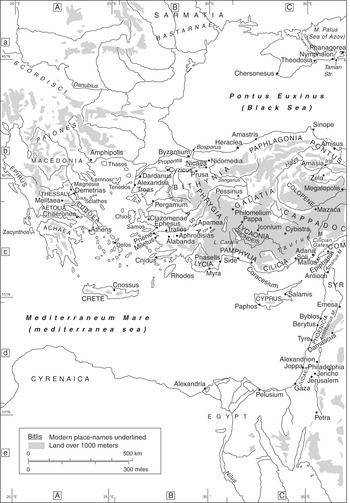
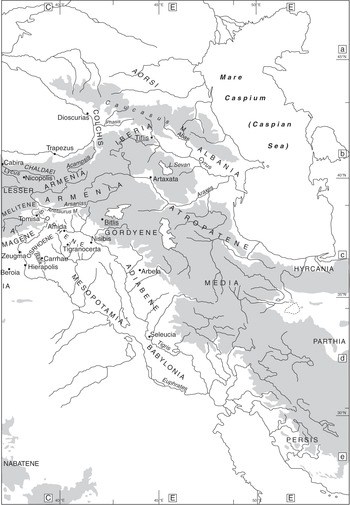
At just the same time as the Social War, and not by pure coincidence, Rome also faced a great challenge overseas. The establishment of a regular province in Asia in the 120s had destabilized the power dynamics of the wider region. Roman officials, along with tax collectors and moneylenders, were far less popular than the kings of Pergamum, and they provoked resentment. Neighboring kingdoms, especially Bithynia, grew increasingly worried about their own futures. Meanwhile, Cappadocia and Pontus, two kingdoms located farther away, although allied with Rome, increasingly pursued their own agenda.
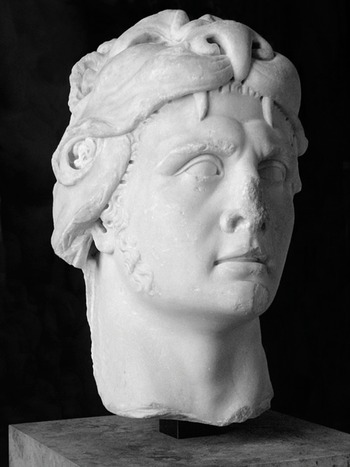
Especially ambitious was King Mithridates VI of Pontus, a gigantic man made even bigger in legend. He could run as fast as a deer, outdrink anyone at a party, and even was said to have made his body resistant to poisons through his experiments in pharmacology. Around the age of 20, he killed his brother and coruler, along with his mother, and began an expansion in the manner of a Hellenistic monarch. He strengthened control of the southern coast of the Black Sea, the traditional heartland of his kingdom. And he championed the Greek cities on the north shore against Scythian barbarians. When he and King Nicomedes III of Bithynia partitioned the kingdom of Paphlagonia (c. 108), Rome did nothing more than send an embassy to protest. And then – at the height of the German war – Mithridates schemed to take over Cappadocia and place his eight-year-old son on the throne. Once more, the Senate did little. Several years later, probably in 99, Marius travelled east, ostensibly to make sacrifices to Cybele, the great mother-goddess who had predicted a Roman victory during the German war. He also probably wanted to see what Mithridates was up to. The two did meet, and Marius is said, tactlessly, to have told the king either to be greater than the Romans or to obey them.

Figure 5.2 Rome’s most effective challenger in the first century BCE, Mithridates of Pontus. Artists depicted Mithridates as the reincarnation of Alexander the Great. Here, like the Macedonian conqueror, he wears the lion-skin cap of the hero Hercules. Louvre Museum, Paris, France.
More intrigue ensued over the Cappadocian throne, and this time the Senate acted more vigorously. It declared Cappadocia and also Paphlagonia free. When the Cappadocians then requested that the Senate name a king, they chose the Cappadocian noble Ariobarzanes, who was in Rome at the time. As governor of Cilicia, the new province set up to combat piracy, Sulla was to escort the king back and install him. He did so, and in the process of shoring up regional allies, Sulla agreed to meet on the Euphrates an envoy from the great Parthian empire. A shrewd astrologer in the Parthian entourage impressed Sulla with a prophecy of future greatness – and surprise that he had not yet taken first place among men. Sulla could play the game of thrones too.
The outbreak of the Social War in 91 gave Mithridates a new opening. He tossed Ariobarzanes back out of Cappadocia, acting in league with another up-and-coming ruler, Tigranes of Armenia, who had recently married Mithridates’ daughter. Mithridates also contrived to drive out Nicomedes IV, the new king of Bithynia – where Roman interests, including business, were stronger. The Senate sent a commission to restore the two deposed kings, headed by Manius Aquillius, son of the man who had organized the province of Asia in the 120s. With military help from the current governor of Asia and native allies, Aquillius fulfilled his assignment. Nicomedes then proceeded to invade Mithridates’ own territories, allegedly at the insistence of Aquillius and other Romans, to whom he owed money. Mithridates appeared to retreat. In fact, he was preparing for war. He sent his son to toss out Ariobarzanes yet again and prepared to retake Bithynia in 89.
Now came the disaster for Rome. Nicomedes’ army was roundly defeated in western Pontus, his infantry panicking at Mithridates’ scythed chariots. Mithridates pressed on into Bithynia and then overran much of western Asia Minor. He promised freedom to the Greeks, tax remission, and cancellation of debts. Aquillius was caught and made to parade around bound on an ass, before molten gold was poured down his throat – a grisly jest at Roman greed. The Roman Senate and People declared war, but as we shall see shortly, the army was delayed for the worst of reasons. A few cities, including Rhodes, heroically held out for the Romans. Mithridates, meanwhile, sent out secret instructions to murder all the Romans and Italians in the Asian cities at the same time. A reported figure of 80,000 undoubtedly is too high, but the massacre of 88 – which bound the cities to Mithridates in blood – showed that Roman rule in Asia Minor had collapsed.
88 BCE: The Republic Stops
Fighting in Italy was largely over in 88, but there was a new poison pill in Roman politics: the question of how to enroll the newly enfranchised Italians. A tribune, Publius Sulpicius, introduced legislation that the Italians should be distributed in all of the 35 tribes, rather than in a limited number of them as had been proposed. Sulpicius’ measure would ensure that the Italian vote was not diluted. He further proposed that freedmen should also be distributed across all 35 tribes rather than just the four urban ones.
Sulpicius, at least initially, was trying to finish the work of Drusus. Like Drusus, he had studied with Licinius Crassus, from whom he acquired an interest in reform and also an ability to speak exuberantly. He was a close friend of one of the consuls of 88, Pompeius Rufus, and apparently thought he would have the support of Rufus and the other consul, Sulla. But once again some senators were nervous about how Sulpicius’ reforms would affect elections; even stronger was the resistance of longstanding Roman citizens, fearful of their votes being swamped. Armed gangs formed, to prevent Sulpicius passing his law, and fighting broke out.
A new cycle of violence was underway. The consuls now voted to suspend public business, but Sulpicius pressed on, equipping his own supporters with daggers and bringing them into the Forum to protest the consuls’ suspension. In the fighting that broke out, Consul Pompeius Rufus’ son was killed, and the consuls soon left Rome, seemingly backing down. Marius, perhaps already cooperating with Sulpicius, now helped him pass the enfranchisement bill – at a price.

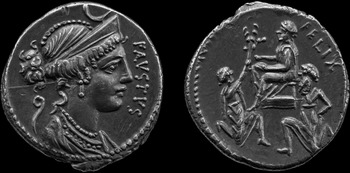
Figure 5.3 A silver coin issued by Sulla’s son Faustus in the 50s BCE. The reverse depicts Bocchus (on the left) surrendering Jugurtha (kneeling with hands tied, on the right) to a seated Sulla. Sulla had this glorious moment engraved on his signet ring.
Sulpicius had the plebeian assembly transfer command in the war against Mithridates from the Senate’s appointee, Sulla, to Marius. The quarrel over who had really ended the Jugurthine War had been reignited in 91, when the Senate allowed King Bocchus of Mauretania to dedicate on the Capitol a monument that included figures representing Jugurtha being surrendered by Bocchus to Sulla. “Marius,” Plutarch writes, “nearly lost it, he was so angry and jealous at the idea of Sulla stealing the glory of his achievements.” Now in 88, he could settle the score.
Sulla still had his army from the Social War in Campania, which he was preparing to take east. On hearing of Sulpicius’ measure, which also transferred this army to Marius, Sulla decided to challenge it. He would march on Rome with his troops. While virtually all of Sulla’s officers refused to take this unprecedented step, the ordinary soldiers, after hearing Sulla out, did so. They were anticipating a profitable eastern war, and Sulla insinuated that Marius would replace them. Why should armed gangs in Rome get to decide their fate?
Joined by his consular colleague Pompeius, Sulla proceeded to Rome and entered with force, brandishing a lighted torch and threatening to burn the houses of any who resisted. There was fighting, but Sulpicius’ gangs were no match for experienced legions, and Sulpicius and Marius fled. They and their other most prominent supporters were soon declared public enemies, and Sulpicius’ legislation was rescinded. While Marius escaped to Africa, Sulpicius was caught and killed.
So began what afterward would be called Rome’s first civil war (in Latin, bellum civile, meaning literally “citizens’ war”). Although the Social War, with its fielding of large armies in Italy, added fuel, the fire had been lit earlier. The sparks included the violence that politicians had relied on to settle disputes, going back to the tribunate of Tiberius Gracchus in 133; an associated loss of respect for the institutions of SPQR and the growth of bitter personal rivalries; the inability of SPQR to resolve disputes about the allocation of resources and status; and unresolved debates about the balance of power between the Senate and the People. Before he left Rome, Sulla and his colleague Pompeius attempted to address this last issue by introducing legislation that all future laws must be approved by the Senate and should be voted on in the centuriate assembly, controlled by consuls and praetors, not tribunes. But that did not address the real problem now: a state of civil war had replaced republican government.
Headhunting Comes to Rome
The historian Appian writes that after Sulla’s march on Rome, nothing – “neither law, nor political institutions, nor a sense of patriotism” – could deter men from violence. Another way to think about the situation is that with competing claims about who really represented Rome, armed force became a way of establishing power. Appeals to a leader’s individual achievements or his connection to the gods could be important too.
Having made it to Africa, Marius was joined by his son and made plans to take back Rome. He was ready to use force, exactly as Sulla had. His allies back in Italy helped prepare the way by reminding all the new citizens of Marius’ intention to distribute them across all the voting tribes. The new consul of 87, Cinna – whom Sulla had made swear an oath to uphold Sulla’s acts – took up the new citizens’ cause too. His colleague, Octavius, allied himself with the old citizens. An armed confrontation took place in the Forum, with many murdered. Cinna fled Rome and recruited troops in the towns of the newly enfranchised. He also won over a Roman army left by Sulla against Italian holdouts. Despite the Senate depriving Cinna of his consulship and the election of a replacement, this army declared that he was still consul, and he put his consular insignia back on. So an army was used to cobble together political legitimacy.
Marius sailed back to Etruria, boasting of his earlier victories over the Germans and insisting that he would see to the Italians’ rights. He joined Cinna, and together they blockaded Rome to try to undermine Octavius and his allies. The Samnites, in exchange for a very generous amnesty for themselves and all who had deserted to them in the Social War, agreed to serve under Marius. Octavius, meanwhile, had the dubious support of Pompeius Strabo, a commander of Roman forces in the northern theater of the Social War. Camped outside Rome, Strabo refused to offer full use of his army until he secured election to a second consulship. But then he and his army succumbed to plague, probably aggravated by the Marian blockade.


Map 5 The East
Fearful of the anarchy that a food shortage might unleash, the Senate accepted the return of Marius and Cinna. Supporters of Marius found Octavius, decapitated him, and hung his head on the Rostra in the Forum. Other heads joined his there – in keeping with the new strategy of legitimation by terror. Cinna, however, like many of his fellow senators, was eager to rein in the violence in Rome, and he curtailed Marius’ armed gangs. Sulla’s laws were annulled, and Sulla himself was declared a public enemy.
For the next year (86), Cinna and Marius were elected consuls – Marius for the seventh time – in accord with the prophecy of the eaglets he had clung to for so many years. He died within a month, leaving Cinna dominant in Rome. Assessing Cinna’s tenure in office is extremely difficult, so much did Sulla, after his final victory, come to control the historical record. Cicero, who lived in Rome at the time, would later recall that “for three years the city was free from fighting,” which is probably a fair verdict. Cinna was eager to restore order (which was not necessarily the same thing as republican government) and enjoyed some success in doing so. Because the censors elected in 89 had failed to complete the census, a new attempt was made in 86 – apparently successful, although the recorded number of citizens is problematic (Table 1). There were also measures to stabilize the economy, badly damaged by the recent violence.
As for Sulla, officially he remained an enemy; and Marius’ replacement as consul, Valerius Flaccus, was sent out to supersede Sulla, apparently through peaceful negotiation. Sulla made no move against Flaccus, and the two never met. Flaccus was assassinated in 85 by his own quaestor, Fimbria, who assumed command of the army. Many senators, meanwhile, were pressing for reconciliation, all the more so as it became clear that Sulla, having reached his own peace with Mithridates (also in 85) was planning to return to Italy. Those back in Rome had little taste left for fighting. Not so Cinna and his ally Carbo, who shared the consulship in 85. They felt they had no choice but to make military preparations, stoking fears among the recently enfranchised.
Sulla wrote to the Senate boasting of all of his military achievements, from the capture of Jugurtha – another jab at the now-dead Marius – to the defeat of Mithridates. Sulla also emphasized that he had taken in men driven from Rome and would soon be back to defend the interests of these men, and of Rome as a whole. Sulla was practically asserting that he was Rome.
The Senate continued to try to mediate, but in vain. Cinna and Carbo arranged for themselves to be consuls again, for 84, and they kept recruiting. After only part of their army crossed the Adriatic, other troops resisted, and Cinna was stabbed to death in a mutiny. Upon learning of it, Sulla immediately sailed to Italy with 40,000 troops. So the civil war would continue.
The Lion and the Fox
Sulla’s war in the east and the civil war that followed in Italy were crucially intertwined. By the end of 88, Mithridates was master of Asia, holding court at Pergamum. But his ambitions did not stop here. Mithridates had sent his admiral, Archelaus, with a fleet to take control of the Aegean. Athens was won over to Mithridates’ side, enticed by promises about the restoration of their democracy and debt relief. And a son of Mithridates swept through Thrace and harassed the Roman governor of Macedonia. Mithridates might soon control all of Macedonia and Greece.
Arriving in 87, Sulla put Athens and its harbor under an inexorable siege. Several Athenians came to Sulla in desperation and reminded him of their glorious past. “I was not sent to Athens by the Romans to study ancient history,” he replied coldly, and the city soon fell to him. Moving into the plains of Boeotia, Sulla scored a major victory over the Mithridatic army at Chaeronea. When a second army landed, Sulla camped nearby and defeated it too. Mithridates’ short-lived European empire was finished.
Ready to think about returning to Italy after these successes, Sulla began peace negotiations with Mithridates and made his way to Asia through Macedonia. Fimbria, with the army he had stolen from Flaccus, captured Pergamum in the meantime and narrowly failed to capture Mithridates. The king was ready to make a deal. At Dardanus, near Troy, he met Sulla and agreed to Sulla’s terms: restoration of Bithynia and Cappadocia to their former kings, surrender of Asia and the Aegean fleet, and an indemnity.
Fimbria’s army soon deserted to Sulla, leaving Sulla free to deal with Asia. Communities that had shown loyalty to Rome were generously rewarded, while the rebellious were punished. A massive indemnity was placed on the whole province, and Sulla’s soldiers enjoyed a luxurious winter at the locals’ expense. To some it seemed outrageous that despite the massacre of 88, Mithridates had sailed back home while Asia suffered. But as an opponent of his once said, Sulla was both a lion and a fox: he thought you won by force, but you had to be crafty in how you used it – he needed his troops to fight Romans.
In 83, Sulla’s army landed at Brundisium in Italy. Several key allies soon joined him. From Africa came Metellus Pius, the son of Marius’ great enemy Numidicus, and from Spain, Marcus Crassus, a refugee from Marius and Cinna. Pompeius Strabo’s son (later Pompey the Great), only in his early twenties, had taken the even-bolder step of raising a legion, scored some victories over the Marians, and then presented himself to a clearly impressed Sulla. Although Cinna’s ally Carbo had raised a massive army in Italy, Sulla encountered no resistance until reaching Campania, and it was fairly feeble at that. Sulla the fox won over one whole army by having his men fraternize with it. Carbo then rallied the Samnites – whom Sulla had crushed in the Social War – while his fellow consul for 82, Marius’ young son, chosen for the power of his name, recruited among his father’s veterans. Both sides were relying on personal allegiances.
Young Marius was driven into the hilltop citadel at Praeneste, and Sulla briefly came to Rome, where the great Temple of Jupiter on the Capitoline had (probably accidentally) burnt down, aptly symbolizing the breakdown of the Republic. Carbo and his forces were worn down, Carbo fled to Africa, and it was left to the Samnites to try to relieve Marius. Failing in this, they made a dash to Rome – the wolf might still gore the bull – but Sulla quickly caught up with them. After a ferocious battle outside the city’s Colline Gate (November 1, 82), the Samnite survivors were killed. The slain leaders’ heads were sent to Praeneste, precipitating surrender of the Marians there. The main opposition was now in the provinces.
Sulla reinforced his victory with more violence. Long lists were issued of citizens who were named outlaws. Anyone thus “proscribed” could be killed for a large reward and their property confiscated. Some managed to escape Italy. The heads of those caught were displayed in the Forum. The sons and grandsons of the proscribed were legally banned from ever holding office, and at least some of the property confiscated went to Sulla’s supporters, ensuring that the ban would not be lifted. Italian communities that had supported Carbo and Marius were also severely punished. Some, like Pompeii, were turned over for colonization by Sulla’s veterans, who were given confiscated land in inalienable grants.
Sulla’s final victory seemingly meant the end of civil war, at least in Italy (some high-profile opponents had escaped overseas). But even more than the events of 88, it also showed how the personal loyalty of a commander’s soldiers allowed him to outmaneuver and defeat the Senate and the People of Rome – and make a mockery of Roman ideas of justice. What was to stop that from happening again? Could law replace force?
Sulla’s New Constitution
For Sulla, the gods were all-important. He was constantly on watch for messages from them, whether in dreams, prophecies, or portents. His accumulated victories proved that he had their special blessing – what the Romans called felicitas. After the Battle of the Colline Gate, the Senate and the People gave Sulla the new name Felix (“Blessed”) to underscore his unique greatness. Sulla himself used it unhesitatingly after he celebrated a two-day triumph over Mithridates in January 81. A gilded statue of Sulla Felix was placed in front of the Rostra in the Forum. It clearly showed that civil war had fostered a more charismatic type of authority at Rome.
Part of Sulla’s divine calling was to reestablish Rome: it would be the final victory in the life of greatness he had been promised by the eastern astrologer. Plans were made to rebuild the burnt Capitol. And Sulla had himself appointed to a dictatorship – the extraordinary office meant to cope with military crises and last used in the Second Punic War. Sulla’s dictatorship was different. It had an unlimited term, and he was given a new, specific duty: “to write laws and put the state back in order.” This would allow him effectively to create for Rome a new constitution (something he had just done in Athens). And so he did, with a series of laws that aimed to reform the Senate and make its members dominant overall, yet also more regulated.
Echoing his reforms of 88, Sulla reduced the power of tribunes. They could not introduce legislation without Senate approval, their power of veto was limited, and once elected they were debarred from holding any other political office. Nobody with any ambition would want the job now, and the plebeian assembly would not be able to override the Senate legislatively.
Meanwhile, the Senate itself was remade. Through the addition of as many as 300 new members, many of them Equestrian, its size was increased to around 450 members and would gradually rise even higher. This was because membership now was to be given automatically to former quaestors – it would not be up to censors to choose. The number of quaestors was increased to 20, and praetors to eight. As before, both offices had to be held prior to the consulship, minimum age limits were set, and the consulship could only be repeated after 10 years. To prevent long military commands – clearly a threat to republican government – it was planned that praetors and consuls alike would serve their magistracy fully in Rome and then hold a province for a single year following that, through an extension of imperium. There were now 10 provinces (Sicily, Sardinia with Corsica, the two Spains, Africa, Transalpine Gaul, Cisalpine Gaul, Macedonia, Asia, and Cilicia) – exactly the number of praetors and consuls.
Sulla also enacted a major overhaul of the criminal courts, the source of so much dissension in the 90s. Jurors would be drawn exclusively from the enlarged Senate to serve in seven different courts, each presided over by a praetor. The criminal laws were all rewritten, including the treason law, which attempted to rein in governors in command of armies. Governors were forbidden to leave the boundaries of their provinces or start wars without senatorial permission.
With the new constitution in place, Sulla gradually diminished his formal power, holding a regular consulship in 80 with Metellus Pius. He then left Rome for good, taking up residence in Campania, where he could cavort with the dancers, musicians, and actors and actresses whose company he had always enjoyed. He also was working on his lengthy, now lost memoirs, which gave the “definitive” presentation of Sulla Felix, the favorite of the gods, enjoying victory after victory.
The End of Civil War?
It was in Sulla’s second consulship of 80 that an impressive speaker made his debut in the new criminal courts. Marcus Tullius Cicero was born in 106 in the small town of Arpinum, which happened also to be Marius’ birthplace. Cicero’s ambition was every bit as strong as the great general’s. His wealthy father sent him to Rome to be educated by the best orators of the time, above all Licinius Crassus, staunch defender of the Senate and senatorial power. Cicero’s education was interrupted by the Social War, in which he saw service under Pompeius Strabo, along with Strabo’s son. Cicero returned to Rome, picking up the study of civil law and also philosophy, thanks to the arrival in Rome of the head of Plato’s Academy in Athens, a refugee from Mithridates. Despite the troubles of 88 and 87 and then later in the decade, Cicero went on studying. He also made time for the theater, learning a trick or two from the actors’ delivery.
Cicero’s first jury trial saw him defending Sextus Roscius, accused of killing his father. Listeners would have been shocked when in his opening remarks Cicero mentioned an unpopular but powerful Greek freedman of Sulla’s named Chrysogonus. He claimed that after the death of the elder Roscius, Chrysogonus had added the dead man’s name to the list of the proscribed, in order to obtain valuable real estate in the Tiber valley. When Cicero’s client made a protest, Chrysogonus hoped to remove him by accusing him of his father’s murder. Chrysogonus must have assumed that his relationship with Sulla would protect him. What he did not count on was the young orator’s nerve. While studiously exonerating Sulla, Cicero lambastes the freedman, with his Palatine mansion crammed full of art stolen during the proscriptions.
Cicero won his case, and with it his reputation was made. His published speech For Roscius survives and is a fine introduction to the man whose writings more than any other light up the last years of the Roman Republic. We see in Cicero’s defense all the lawyer’s tricks, many still used today. There is also a sincere denunciation of all the atrocities of his era. “Remove this cruelty from our state,” Cicero urged the jurors. “Do not allow it to go on any longer … When every hour we are witnessing or hearing some terrible event … we lose all sense of humanity.” Defending his client, Cicero was also imploring his contemporaries to stop the spiral of violence.
But it was in vain. In 82 Strabo’s son Pompey had managed to regain Sicily from the Marians and put to death the former consul Carbo, who had gone there. Pompey then defeated the Marians in Africa under Domitius Ahenobarbus. Not yet a member of the Senate, Pompey refused in 80 to dismiss his army and demanded a triumph from Sulla. Another Marian, Sertorius, had been expelled from Spain in 81. The next year he returned and began building his own army, recruiting among the native Iberians. In time he even had his own senate, in Spain. The civil war was not over. Sulla’s new constitution may have muffled the plebs in Rome and removed the Equestrians from the courts, but it was unable to restrain charismatic men like Sertorius and Pompey and their soldiers.