

By the mid-140s BCE, Rome was in desperate need of more water. Only two aqueducts supplied the city, both were in bad repair, and individuals were believed to be diverting water from them. Rather than wait for a new pair of censors (the magistrates elected only every five years who typically awarded contracts for public works), in 144 the Senate took the unusual step of commissioning the praetor Q. Marcius Rex to repair existing water lines and bring in a new supply. He did so, probably reviving an earlier abandoned project to create his new aqueduct, and named it (after himself) the Aqua Marcia. It ran an impressive length of 56.5 miles and was the first to use arches on a grand scale, springing across the landscape. Not surprisingly, work was incomplete by the end of 144, and the Senate had to extend Marcius’ official authority.
In 143, he faced a new, unexpected challenge. A college of priests entrusted with the Sibylline Books, a collection of Greek oracles allegedly dating from the time of Rome’s pre-republican kings, insisted that it was improper to extend an aqueduct to Capitol Hill, with its ancient and important temple of Jupiter. They shared their finding with the Senate, which ordered Marcius to stop. It was a couple of years later, when the matter was reopened, that he was allowed to finish the line all the way to the Capitoline and so take full credit for it.
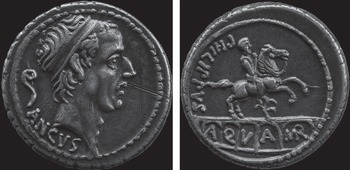
But was the aqueduct entirely his? Coins issued around the year 114 BCE by a mint official named Aemilius Lepidus appear to show an aqueduct, and arguably it is the one started by the censor of 179, also named Aemilius Lepidus, and then revived by Marcius in 144. Lepidus’ coin could be an attempt to restore to his family some credit for the project. A later member of Marcius’ family, in turn, issued coins in the 50s BCE with a similar design – and clearly labeled AQUA MAR (abbreviating “Aqua Marcia”). Intriguingly, on the opposite face of this same coin is Rome’s early king Ancus Marcius, from whom the family was proud to claim descent – even though Romans were supposed to hate kings! It was King Ancus Marcius, the family was now maintaining, who built the first (then lost) Aqua Marcia, leaving any claims for priority by the Aemilii in the dust.
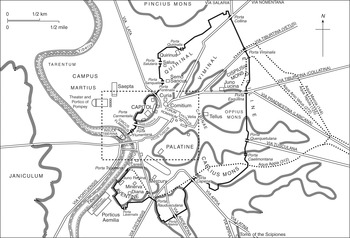
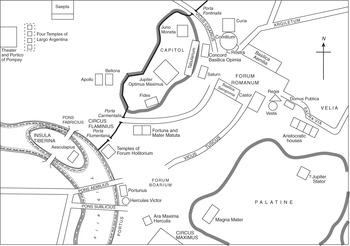
The City of Rome in the Second and First Centuries BCE
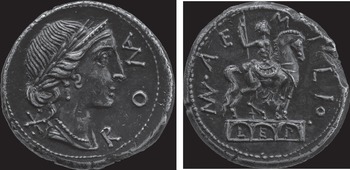
A silver coin of mint official Marcius Philippus, issued in the mid-50s BCE, showing the Aqua Marcia. On the obverse is Rome’s legendary king Ancus Marcius, his headband denoting royal authority.
The debate over the new aqueduct, its construction, and the coins cast much light on Rome in the 140s and beyond. Thanks especially to Rome’s burgeoning empire, as well as to expanding trade networks and the ability to manage resources, including water, the city was growing. Eventually it would become the largest in the Mediterranean, with a population perhaps of a million people by 50 BCE. This was an urban giant without parallel in European history until the nineteenth century. Those living in it had new, distinctive needs arising from the city’s risk-filled environment. Able to mass in the thousands, residents also found new ways to exert pressure on politics.
Despite Rome’s expansion overseas, politics remained entirely based in the city, with citizens required to assemble in large open spaces if they wished to vote. Other important rituals took place in Rome, such as the census held every five years and the routine games that honored the gods whose temples and shrines filled the city. Extraordinary spectacles such as triumphal parades and funeral processions also brought the people together and were a showcase for senatorial families. In spectacles as well as in buildings, illustrious families like the Aemilii and Marcii competed for power and prestige, with the empire bringing in the resources to make this possible.
Counting the People
The census was an institution at the heart of the Roman state in the second century. This was because it not only counted the Roman People, but it also categorized them, determining each man’s military role and voting rights. Every five years, adult male citizens were required to make a declaration to the censors in Rome or to local representatives. The first requirement was to state your full name. Each male citizen had a family name (usually ending in “ius” like Marcius) and a first name (such as Quintus) to distinguish himself. Since there were very few first names, these were frequently abbreviated (e.g., Q. = Quintus). Increasingly, male citizens also had an additional name, to distinguish branches of the family (Rex meant “king”). The end result was the distinctive threefold name (Q. Marcius Rex). Women, by contrast, customarily only had a single name, the feminine form of the father’s family name (so any daughter of Marcius was Marcia). In addition to giving his name, the declarant in the census would state his age, the name of his father (or, if he was a freed slave, the man who freed him), his place of residence, and the property he held.
The censors used the information to register the male citizen into two important divisions: the voting tribe and the century (centuria). The tribe was a division based on locality; altogether there were 35, with just four, the so-called urban tribes, representing the city of Rome. The other voting group, the century, was based essentially on the amount of property held. Early in Rome’s history, this was directly linked to one’s role in the army. The wealthiest men, for example, formed the 18 centuries of cavalry (the equites, or Equestrians). Note that each century could have well more than 100 men, the original number. Altogether there were 193 centuries, the vast majority of them assigned to one of five property classes. Those without significant property formed a single century, called the capite censi (“counted by head”). While the military purpose of the centuries was mostly obsolete in the mid-second century BCE (equites were not really the cavalry, for example), the landless capite censi were still normally excluded from army service.
In addition to conducting the census, the censors supervised the community’s morals, and this too had consequences for individuals’ status. Censors could examine men physically and morally; since it was the citizens who made up the state (the Roman People), bad men should have limited roles. The censors could remove a man from his voting tribe. They could banish a man from the Senate, and in fact it was they who formally admitted men to the Senate – usually younger magistrates, priests, or other members of distinguished families. Men could also be banished from the equites – if, for example, they were too fat to ride properly in the horseback parade that was now a ceremonial part of each census. After the whole census was over (about 18 months), the censors purified the city in a religious ceremony.
Censors went on moral crusades, and none was more famous for this than Cato. Serving in 184, he set out “to cut away the hydra-like luxury and effeminacy of the age.” He placed steep taxes on items he judged extravagances, such as jewelry. He cut the pipes by which Romans were illegally conveying public water to their houses and gardens. He ruthlessly expelled members of the Senate he deemed unworthy. Why, one of them had dared openly to kiss his wife, with their impressionable young daughter looking on! For his part, Cato said, he never kissed his wife unless there was loud thunder, which at Rome meant that public business could not go forward.
Literary sources report for many censuses the total number of adult male citizens counted (Table 1). These statistics might fail to include soldiers serving overseas and also fluctuated according to how assiduous the censors were. They also excluded women and children. As a very rough estimate, we could slightly triple the figure of male citizens to get the overall citizen population. Also excluded are non-Romans – notably the Italians allied with Rome and expected to contribute militarily. In 225 BCE, we happen to be told, they outnumbered the Romans roughly two to one. Excluded, too, were slaves, a rapidly expanding group in the second century.
A surprise in the surviving statistics is the declining number of male citizens after the census of 164/163. As we shall see (in Chapter 4), there may be reasons for this other than population loss, yet Roman politicians had real concerns about dwindling manpower – it could impact Rome’s ability to win wars. Censors urged men to marry, and even contemplated requiring it. “If we could exist without a wife, Citizens, we would all free ourselves of that annoyance,” one of them argued, perhaps not too persuasively, “but … we must give thought to our survival rather than transitory pleasure.”

Note: Most scholars have interpreted these tallies as referring to the total number of adult male citizens. For a full discussion, concluding that the tallies refer only to adult male citizens who were legally independent heads of their own families, see S. Hin, The Demography of Roman Italy (Cambridge, 2013), especially chap. 7. The figures in parentheses are proposed corrections to the immediately preceding figures transmitted in the manuscript tradition of the literary sources.
If the count of male citizens declined, what does this mean for the city of Rome itself? There are far fewer numbers here, and plotting population shifts even decade by decade is impossible. In the 50s BCE, when an entirely free grain dole was introduced in the city, 320,000 recipients (adult male citizens) are said to have received it. Adding women, children, and others who were excluded (e.g., foreigners and slaves), we could easily bring the overall total to one million. Subsidized grain began much earlier, in the 120s, and almost certainly was a magnet for immigrants. Still, an overall population for the city of Rome of 250,000 is entirely plausible for 150.
There were other magnets to draw men and women to Rome, including jobs – especially jobs in construction. A major project like the Aqua Marcia must have employed thousands, but there was steady work on smaller commissions such as houses or the temporary theaters built for annual games. Teachers, doctors, and artists came from the Greek world. Many came involuntarily, to work as slaves in the households of the well-off. In exchange for income they brought in, they could be freed and gain citizenship, being registered in one of the four urban tribes. Ex-slaves were an important component of the urban population (see Chapter 10).
The Layout of the City and the People’s Assemblies
A map of Rome in the late republic gives a useful orientation to the city’s topography, including its famous hills, the Tiber River, and the large floodplain at the Tiber’s bend, known as the Campus Martius (the Field of Mars). The Campus was where boys did physical training, an essential activity in Rome’s martial culture. Along the riverbanks were clustered port facilities, marketplaces, and warehouses, including an immense structure traditionally assigned to the same Aemilius Lepidus whose aqueduct was never finished. Altars and temples important to sailors stood near the river too.
Everywhere in Rome there were temples, none more important than Jupiter’s on the Capitol. The area around it was sacred (meaning it belonged to Jupiter) and was filled with statues that reminded the Romans of their history. There were representations of the early kings and also L. Junius Brutus, who drove out the last of these kings and helped found the Republic. On other hills, such as the Palatine, lived wealthy senators, enjoying the more salubrious air. Poorer Romans crowded together on the lower ground – for example, in the valley between the Quirinal and the Viminal, known as the Subura, a neighborhood with plenty of bars and brothels.
In another valley, between the Capitol, Palatine, and Velian Hills was the very heart of Rome, the Forum. It was lined on its long sides by two basilicas, large halls (named after similar structures in the Greek world) where business and legal proceedings were transacted. One of them was built by the busy censor of 179/178, Aemilius Lepidus. Networking was at its easiest in the Forum, and citizens could come to learn all the latest news. The Forum was a political center too. At its western end was the Curia (Senate house) and also one of the traditional meeting places for the voters, the Comitium. Statues scattered around here – including a representation of Rome’s founders, Romulus and Remus, suckling a she-wolf – also helped teach history. A clear sign of Rome’s growth was the decision in 145 to move voting out of the Comitium, which might only have had room for three thousand men, into the Forum itself.
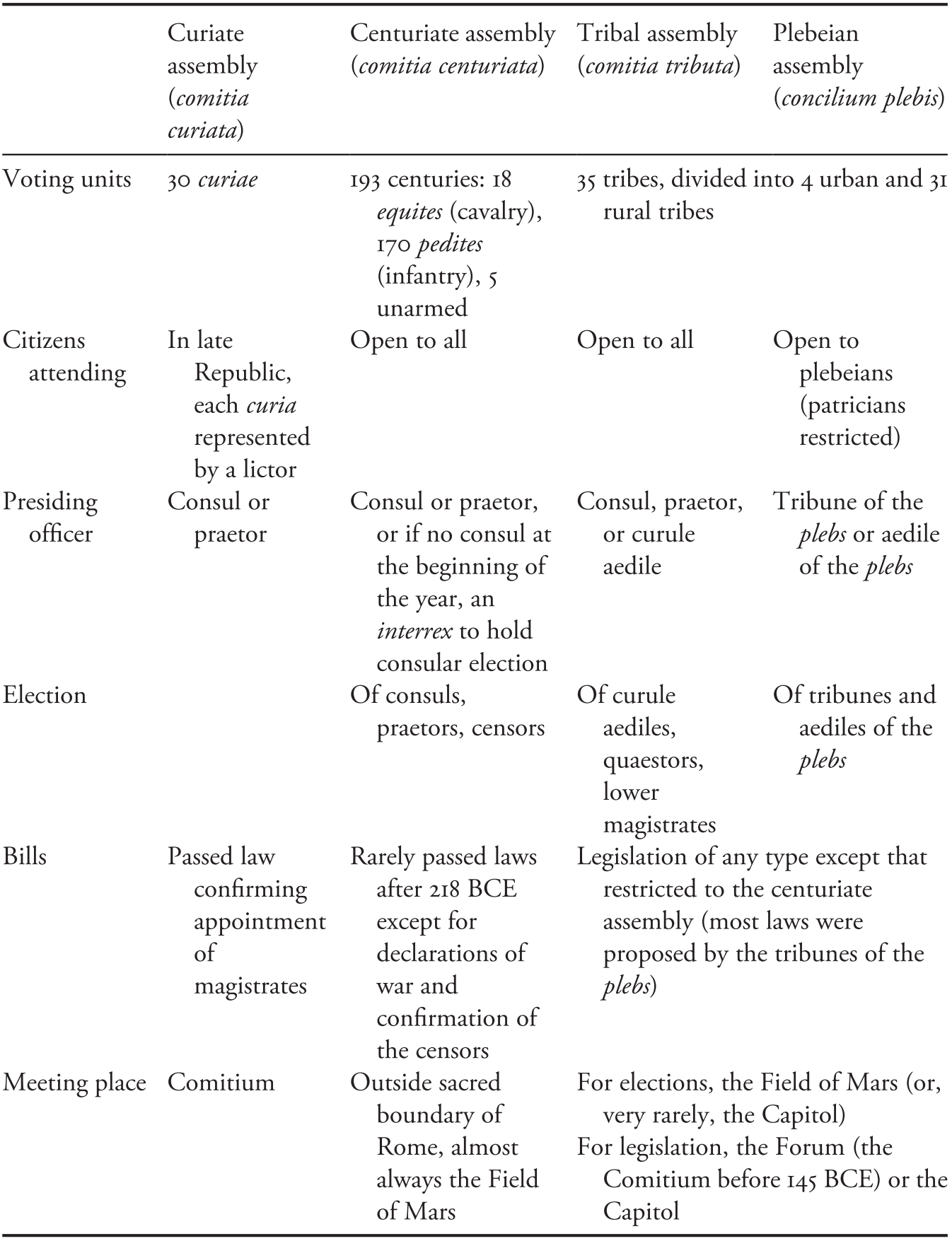
Voting assemblies were the core of the Roman political system. They elected all magistrates, and only they could pass laws. There were four distinct assemblies (Table 2), but all were similar in that the voter always voted only as part of a group. For example, in the curiate assembly, one voted in a curia, or neighborhood group. This was Rome’s oldest assembly and almost purely ceremonial in the late Republic, mainly serving to pass laws confirming certain magistrates elected by the other assemblies and also to witness adoptions.

The centuriate assembly, also quite old, was in origin an assembly of the army. Even in the late Republic it had to meet in Campus Martius, beyond the sacred boundary (pomerium) of the city that armies were forbidden to cross. This assembly could only be called by a senior magistrate to pass laws, to vote formally to go to war, and – most important – to elect the next year’s senior magistrates, consuls, praetors, and censors. The voting unit here was the century, described earlier.
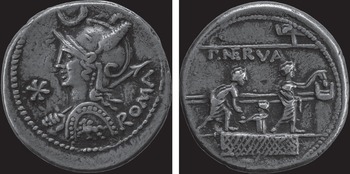
On election day, voters would gather by the huge rectangular structure known as the Sheepfold or Pens (Saepta), because it was divided into discrete alleys. The Equestrians and also the seventy centuries that made up the first property class voted first. Men would proceed up the individual alleys, several abreast, but then individually walk over wooden gangways called “bridges” to cast their vote. Voting was oral until 139, when a secret ballot was introduced in all electoral assemblies. Votes for each century were tallied. As soon as a candidate had a majority (97 centuries), he was declared a winner, and once a full slate of magistrates was elected, voting stopped altogether. This meant that the centuries in the lower class, including the single landless century that voted last, might not vote at all. In this assembly, the votes of wealthy citizens were valued much more highly than those of the nonwealthy.
Passing a law in the centuriate assembly proceeded along the same cumbersome lines, with the result that in the late Republic most legislation was enacted in one of the remaining two assemblies. The tribal assembly consisted of the 35 tribes described previously, with just four assigned to the city of Rome and the remaining 31 to communities of Roman citizens beyond. Seventeen of the 31 tribes had at least some territory within a day’s travel from Rome, but citizens living far away were seriously disadvantaged.
A toga-clad Roman citizen is shown on this silver coin voting. He has crossed the wooden gangway or ‘bridge’ and is dropping the tablet with his vote into a wicker basket on the right.
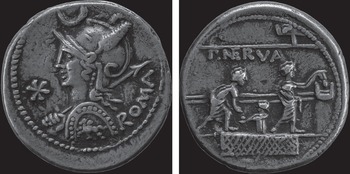
The plebeian assembly was a near twin of the tribal assembly and actually was born first, out of social struggle. In the early years of the Republic, a small number of established families (the patricians) were dominant. The mass of citizens (the plebeians) began meeting and passing their own resolutions; they also had their own officers – eventually 10 tribunes – who were to protect the plebeians. In 287, plebeian resolutions were made legally binding on the whole community, and plebeians had overall attained equality with the hereditary patricians (who dwindled in number but always had the cachet of their ancestry). The plebeian assembly used the same 35 tribes as the tribal assembly but simply excluded patricians from voting. It passed much legislation in the late Republic, and it also elected annually 10 tribunes as well as two aediles (junior magistrates in charge of the fabric of the city). The tribal assembly elected two more aediles, as well as the quaestors (junior magistrates with financial responsibilities).
Both electoral and legislative meetings of the tribal assemblies were typically held in the Comitium, until the year 145. Traditionally the Comitium was also where citizens – and perhaps others too – came together for the contio, a meeting called by a magistrate to discuss new legislative proposals or other matters of importance. As the people stood, he would address them from an elevated platform decorated with ships’ beaks (rostra) captured in a naval battle and therefore called the Rostra. Like other magisterial platforms, this was sacred space and thus offered the speaker some protection. While those attending could express their views through cheers, catcalls, or gestures, ordinary citizens could not ordinarily gain recognition to speak individually as they could in the more genuinely democratic assembly of Athens.
Topography was not just the backdrop for Roman political life but was intrinsic to it. Just as voting moved from the Comitium into the Forum, so did the contio, allowing an audience of perhaps 6,000 or even 10,000 rather than 3,000. To hold such a meeting effectively, the magistrate would need to turn around on the Rostra, and thus he would no longer be facing the Senate. An ancient biographer suggested that Gaius Gracchus, a tribune in the 120s, was the first to do so. By just slightly pivoting his body, Gracchus “stirred up a great question.” Were the magistrates, including the tribunes, too subservient to the desires of the Senate?
The Three Branches of Government: Magistrates, Senate, and People
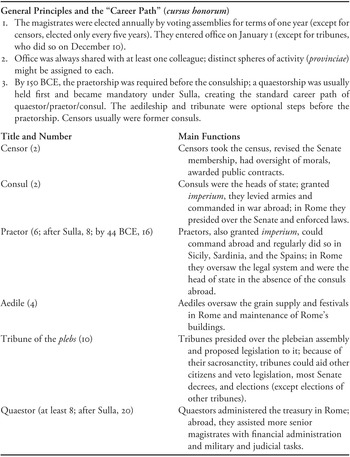
The Roman People passed laws in assemblies, but they needed an agent to execute their wishes, and this was the function of the annually elected magistrates (Table 3). Each of the magistrates had at least one colleague, to prevent a monopolization of power the Romans associated with kingship. The consuls – the top executive officers – could veto one another’s actions. Both consuls had imperium, the supreme power that allowed them to command in war and also (according to the standard view) to execute laws and inflict punishments in the city of Rome itself. Imperium was powerfully symbolized by the bundle of rods (fasces) carried by the magistrates’ attendants. The symbol was appropriated by the totalitarian politicians of 1920s Italy, giving rise to the word “fascism.” The six praetors had imperium also: in the mid-second century BCE, normally four were given overseas commands while two served as judicial officers in Rome. Aediles handled the city of Rome’s games, food supply, and buildings. Quaestors were junior financial officers. A still-more-junior board of three was elected to run the mint and influenced the design of coins. Laws set minimum age limits for some of the magistracies and also limited repetition of office, especially the consulship.

An utterly distinctive post was that of the tribune of the plebs. Ten were elected yearly, and in addition to presiding over the plebeian assembly, they were, at least by tradition, supposed to protect the lives and property of the people – especially from actions by other magistrates. Tribunes individually could veto legislation, end most official business, stop the other magistrates from carrying out punishments, and bring magistrates to trial. They had no special insignia like the fasces; they were supposed to be available day and night, at their houses with the doors open or sitting on special benches in the Comitium. Their power lay in their inviolability: anyone who laid a hand on a tribune was accursed, meaning that he had to be killed as a sacrifice to the gods.
The Senate’s role was to advise current magistrates, including tribunes, by issuing decrees understood as binding but not legal. In the mid-second century BCE, the Senate had perhaps 300 members, mostly ex-magistrates. We have already seen the Senate’s crucial role in shaping foreign policy and assigning commands. The Senate also concerned itself with the maintenance of order in Rome and Italy. Through its control of state funds, it could arrange for major new building projects, even if the censors themselves normally issued the contracts for these. Taking advice from the major colleges of priests, all of whom were senators, the Senate ruled on religious matters too – for example, when the dispute arose over the Aqua Marcia.
The Senate always met indoors, in the Senate house near the Comitium or in a temple. Meetings could be behind closed doors and decisions kept secret. Far more than in contiones, it was here that genuinely free debate might take place. The presiding magistrate, often a consul, would introduce a topic for discussion, and senators were called on to state their views. The first to speak was the princeps senatus, the senator chosen by the censors to head the list of members. The princeps was almost always a senior patrician. Open voting preceded the issuing of decrees. Fixed procedures like this helped resolve debates among its members (who were quite competitive) over allocations of command and resources.
From Polybius on, historians have been fascinated by the interactions among the three branches of Roman government: the People, their magistrates, and the Senate. Polybius argued that at least at the time of the Second Punic War (218–201 BCE), each was powerful but that if one became too powerful, it would be blocked by the others. This neat system of “checks and balances” was to be hugely influential 17 centuries later on the founders of the United States of America. Polybius himself was aware, though, that despite continuities, the balance was always subject to renegotiation. In his view, the influx of wealth was a destabilizing factor. We could add the growing size of the city of Rome, since it changed the dynamics of how magistrates and ordinary citizens interacted.
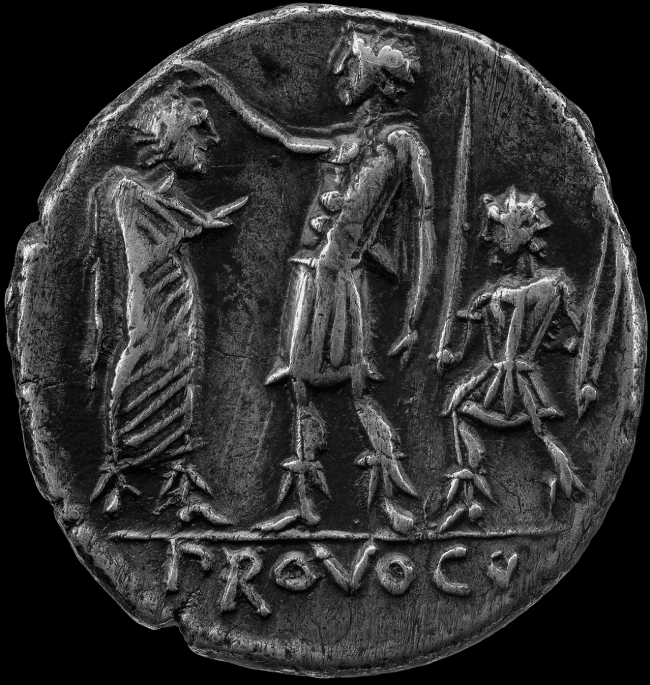
By the mid-second century there were some clear limits on the magistrates’ executive power. Not only could tribunes veto their actions, but a series of laws had been passed concerning “appeal” (provocatio, in Latin, meaning “crying out,” as in crying out for help). These laws stated that magistrates could neither put citizens to death without a trial before the assembled people nor flog them. The laws were guarantees of libertas – the freedom from arbitrary action by magistrates, or kings – that Roman citizens tended to take very seriously. The introduction of the secret ballot in 139 – an act with real significance for the balance of power in the Republic – was viewed as a further enhancement of popular liberty.
A particularly important question was how much the Senate (and senators) deferred to the citizens as a whole. In his analysis, Polybius claimed that “the Senate stands in awe of the masses and takes heed of the People’s will.” Yet prior to the Second Punic War, the Senate tried unsuccessfully to stop a tribune from passing legislation that distributed to Roman citizens plots of land conquered in northern Italy.
Conflict between the Senate and tribunes revived around the year 150. In 138, for example, two tribunes pressed the consuls to have the Senate authorize special purchases of grain for the city because of a price spike. Called to a contio, one of the consuls – Scipio Nasica, son of the man who blocked Rome’s stone theater – stopped the crowd shouting by saying, “Citizens, please, be quiet; I understand better than you what is in the public interest” (or so a later source records). Reports such as this one may be less objective testimony than salvoes in ongoing political controversy.
A silver coin from around 110 BCE that illustrates the precious right of appeal. A swaggering general threatens the toga-clad citizen on the left. The citizen cries out PROVOCO, “I appeal!”
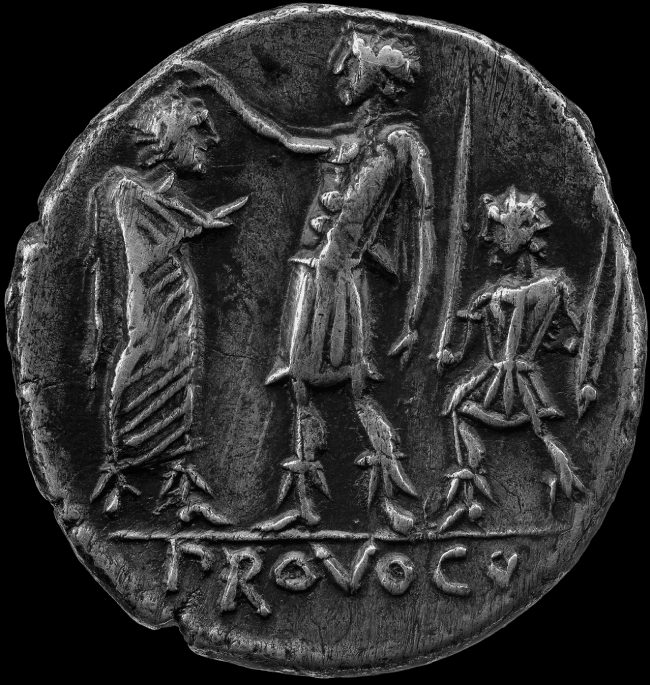
An essential part of the debate about the nature of the Roman Republic, then and now, is the electoral success enjoyed by a relatively small number of families, both patrician and plebeian, over multiple generations. Members of these families came to be identified as the nobiles (literally “the well known”). The historian Sallust claimed that in the second century “the nobility passed the consulship from hand to hand among themselves.”
Modern research at least to some extent agrees with Sallust. Examination of known officeholders clearly shows that it was extremely hard for newcomers to the Senate to achieve election to the consulship even though the Senate itself was constantly refreshed with members from new families. Some modern researchers have argued that the reason for the nobles’ success was their creation of relatively small factions of families who would secure prizes for one another – not just political offices but priesthoods and commands. A further part of this thesis is that the well-established families could mobilize electoral support directly through ties of patronage. A far better explanation, however, can be found by returning to the original meaning of nobiles.
Public Spectacles: The Real Basis of Aristocratic Success
Senatorial patronage was an important tradition. Each morning senators opened their houses to even the humblest Romans and would offer meals, gifts, legal advice, and more. In exchange, these “clients” might accompany the senator around Rome, to suggest his importance and support him with their votes. To facilitate visits by clients, senators lived near the Forum.
But personal patronage alone cannot explain why well-established families enjoyed so much success, down to the year 50 BCE. After all, newcomers to the Senate often had a great deal of wealth to share. Even more important, as Rome had grown, so had the number of voters. Senators’ houses were growing bigger as well, but they could not receive thousands. It was, therefore, at public spectacles that senators could impress large numbers of citizens.
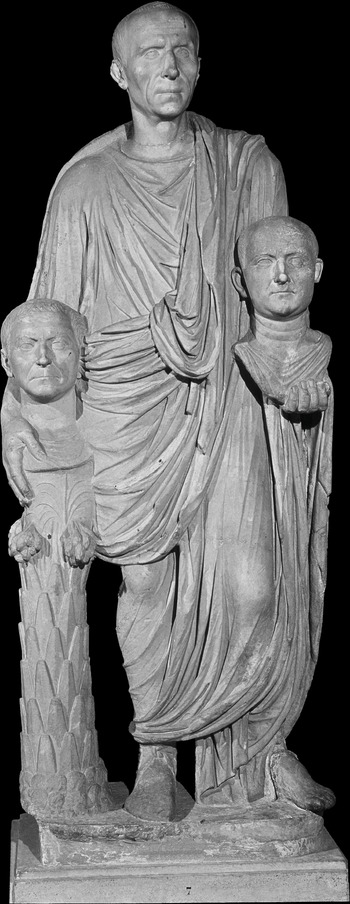
One of the most important of these was a funeral, which struck Polybius so much that he left a detailed account of it. After a man who had attained at least the rank of aedile died, his body would be carried in a procession to the Forum. There, from the Rostra, his son or another young family member would deliver a eulogy. Actors portraying the ancestors of the deceased who had also held political office joined the procession. They wore wax masks of the dead family members (normally stored in the main hall of the family house) as well as magisterial robes. These “ancestors” would listen as the eulogist recited not just the dead man’s accomplishments, but also those of earlier generations. Later there might be a public banquet and games, which often featured gladiatorial combat – sure to draw a large crowd.
For noble families, the funeral was a golden opportunity to remind the community, including its newest members, of their names. In the later second century, noble families even regularly began holding such public funerals for their women. Polybius writes of how moving these events could be, as the Roman People saw the heroes of their early days almost brought back to life. The funeral did not just help the political fortunes of the young eulogist. As Polybius saw, it was an institution that helped inculcate core aristocratic values, such as military valor. Funerals burnished the reputation of the nobility by demonstrating their commitment to public service.
Another hugely important spectacle was the triumph. This was an honor voted on by the Senate to pay tribute to a commander who had earned a notable military victory. Assembling on the Campus Martius with his army, the commander would parade through the streets of Rome. Spoils taken in war were carried on litters – weapons, precious metals, works of arts. Paintings showed highlights of the campaign. Captured enemies stumbled along in chains. The general, dressed in purple and silver, rode in a chariot to the Capitol, where he sacrificed white oxen to Jupiter. Again, a banquet and games followed.
Triumphs usually lasted only a day, but their glory was perpetuated in many ways. At a funeral, an “ancestor” who had won a triumph wore the special triumphal costume. The Senate and People often erected public statues for those who had celebrated triumphs. And the triumphant general used the plunder he had taken to enhance the city of Rome. After his victory in Macedon in 148 for which he earned a triumph, Caecilius Metellus used some of the spoils to fund a new temple for Jupiter, the first in Rome built entirely of marble. A twin for a temple of Juno, it was enclosed in a portico – essentially a covered walkway – within which Metellus put on display his most prized plunder, including a famous statue group of Alexander the Great and his companions.
Over the years, triumphing generals transformed Rome with buildings and displays like this one – and in doing so helped future generations of their families. Other types of buildings monumentalized families. Although censors used public funds, they gave their own names to the grand basilicas or infrastructure projects they constructed – structures that thousands would see and use. No wonder, then, if the Marcii and the Aemilii fought over “naming rights” for the great aqueduct of the 140s. Even a house could become a monument: victorious generals decorated their doorways with glittering arms and armor captured from the enemy. Cato once gave a speech reminding Romans that the spoils had to be captured – and not, for example, purchased.
A Roman holding portraits of two of his ancestors. The busts are not the wax masks worn by actors at the aristocratic funeral but their warts-and-all realism is typical of Republican portraiture and the style might have been influenced by the masks. Museo del Palazzo dei Conservatori, Rome, Italy.
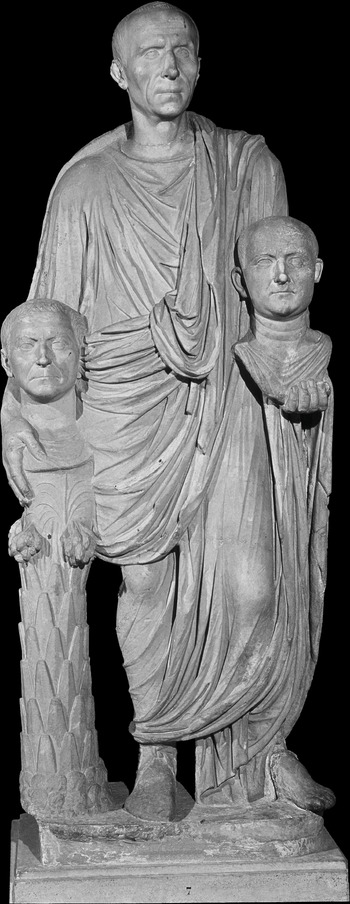
While nobles skillfully displayed their inherited glory, spectacles reinforced the power of even regular magistrates. The sight of them walking around Rome with their attendants – and, yes, their clients – was impressive. Moreover, they presided over regular games in honor of the gods who protected Rome, held each year according to a fixed schedule. Statues of the gods would be brought out of the temples and paraded on floats through Rome to the Circus Maximus, the vast racetrack that filled the valley between the Palatine and Aventine Hills. There, along with thousands of Romans – men and women, rich and poor – the gods would watch professional chariot racing. All sorts of dramatic performances were shown on temporarily erected stages. There were tragedies, comedies, and even a racy genre called mime in which women were allowed to perform, without masks, and perhaps without much clothing either. The magistrate in charge could win extra glory if he supplemented the regular entertainments with his own resources, bringing in exotic animals for a staged beast hunt, for example. The games that Rome is still so famous for in the popular imagination had their origin in religion, and in the politicians’ never-ending quest for publicity.
Civic Religion and Religious Pluralism
Polybius was stunned at how much religion permeated public and private life at Rome. Unlike the Greek world, here politicians were also priests, and it seemed to Polybius that they used religion almost consciously to bind society together. Certainly the gods were ubiquitous. Their temples filled the city, in addition to which there were many statues of them, and they were honored not just with grandiose games that did indeed bring citizens together but also by small gifts left at their altars. In part, the sheer number of deities worshipped was a reflection of Rome’s growth. As the Roman state fought foreign powers, it tried to win over those powers’ gods by offering them a new temple and cult at Rome.
Gods were, in a sense, the most powerful members of Roman society, and senators took their wishes seriously. Rome had four major priesthoods, each of which cultivated a distinctive expertise and had specific duties (Table 4). Particularly important was the pontifical college, which advised the Senate and individual citizens on matters of sacred law (example: How should you treat statues of gods seized as plunder in war?). This college included, in addition to the pontiffs, the Vestal Virgins – six women who, on pain of death, had to guard their celibacy and tend the flame that represented Rome’s continuity. The head of the college was called pontifex maximus, a title later borrowed and still used by the popes.

Relying on the advice of priests, the Senate was the ultimate decider in religious matters. Reports of unusual, even sinister, events known as prodigies – thought to be signs of divine anger – were sent to the Senate. An ancient book collects these reports for the years from 190 BCE onward and gives a sense of how such reports were resolved. For example, an entry in the year 142 explains that “since there was famine and an epidemic, offerings were made by the board of 10.” Priests advised in the face of military disaster too. It was very likely a Roman defeat in the Alps that prompted the board of 10 to consult the Sibylline Books, leading to trouble for Marcius Rex.
The role of priests extended well beyond the Senate, and at the same time the priests could be challenged. All public actions, including voting, the census, and even war making, were preceded by the taking of auspices. This required the magistrate to watch for signs from the gods, such as thunder and lightning. A bad sign meant that the contemplated action should be deferred to another day (luckily for Cato, this did not include kissing!). The college of augurs had special expertise in auspices. But the People in their assemblies also passed a series of laws concerning auspices. In 145, a tribune proposed that future vacancies in the priesthoods be filled by election (the practice was for each college to appoint its members). This bill failed to pass, but a similar measure would succeed 40 years later. The intertwining of religion and politics makes a certain type of skeptic, like Polybius, suspect that religion was manipulated for political purposes. A more compelling view of the evidence is that the Roman People and the Senate alike cared for the gods who had made Rome so powerful.
Roman religion never stood still – and it went beyond civic religion. Already by the early second century BCE there was a steep decline in the number of new gods officially recognized, while private religious associations proliferated, some with secret rites. If mighty gods like Capitoline Jupiter held sway over Rome’s imperial destiny, there were other deities, and other experts like astrologers, who could speak to the concerns of ordinary Romans – their health and material well-being. A sign of the times was a decree issued by the Senate in 139 that expelled astrologers from Rome, at once showing senatorial conservatism and proliferating religious activity. Despite such actions, which were justified on the grounds of public order, the Senate did not really concern itself with matters of individual belief. The polytheistic nature of Roman religion enabled a pluralism that usefully complemented shared rituals like the games and allowed individuals to find a place in smaller communities.
Getting By in the City
The city of Rome was full of risks. One of the worst was epidemics. Epitaphs recording the day or month of death have revealed a pattern of seasonal mortality, with a high concentration of deaths in August through October. The cause, in part, was mosquito-spread malaria, endemic to Rome but peaking at this time of year. Malaria itself could kill, or it could weaken people susceptible to other infectious diseases such as tuberculosis. Along with flows of human beings, animals, and goods, new pathogens regularly made their way into Rome. The high population density helped spread disease. Waters, including the Tiber, provided breeding grounds for malaria-infected mosquitoes. Overall, the death rate in the city was high, even for young adults and especially for immigrants with less resistance to malaria.
There were other sources of misery. Floods of the Tiber – which helped spread diseases, including malaria – were also devastating to property and life. Fires, too, were a constant threat. While ordinary Romans might live in shops or apartments attached to the houses of the wealthy, the less fortunate crammed into rickety buildings of many stories that were firetraps. Add to this recurring, if not chronic, grain shortages and price spikes, and life could be quite difficult.
Public services around the year 150 BCE were quite limited. There were no firefighters, no public health officials, and no police. Theft was only a civil offense, requiring victims to sue for the recovery of stolen property, or to take the law into their own hands. However, magistrates did take action in the face of acute food shortages. The Senate made investments in major infrastructure projects like the Aqua Marcia, which brought vital drinking water into Rome. There were the public games, increasingly outdoing any other city’s, and these could feature ever-popular free food.
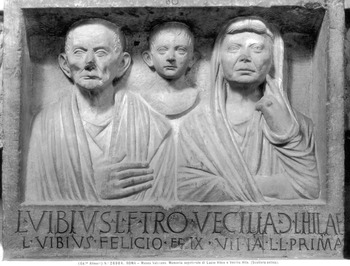
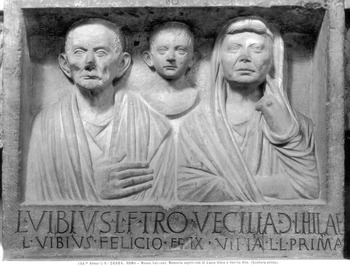
Inhabitants of the city found support in one another. Funerary monuments reveal that freed slaves – not necessarily related – formed such strong emotional bonds that they were buried together. There were formal groups as well that linked citizens, organized along sometimes-overlapping lines of profession, neighborhood, and religion. They would ensure burial for their members – welcome assurance in a world where death could strike so suddenly. Familial ties were often essential, such as those of husbands and wives, parents and children. Censors might have celebrated an old-fashioned ideal that the good wife was the obedient wife, but epitaphs show men far more often calling their wives “very dear” and “well deserving” – just as wives described their husbands. In addressing citizens, politicians would appeal to men’s desire to protect their families. When a tribune proposed a bill to investigate Sulpicius Galba for his treacherous attack on the Lusitanians in Spain (see Chapter 2), Galba brought his young sons into the Forum to arouse pity for himself – with great success. Obligations to kin were taken seriously.
As the metropolis grew, so did the threats posed by epidemics, fires, and food shortages. Still, the wealth of empire, as it poured in and paid for massive projects like the Aqua Marcia and lavish houses for senators, attracted migrants. Spectacles like the triumph and the games became more extravagant, entertaining thousands – while also confirming the power of the senatorial nobility. The city of Rome was the stage of politics, where citizens identified themselves as citizens, through the census, at voting assemblies, and to an extent in contiones. They asserted their freedom with pride. The increasing number of citizens below the Equestrian class who resided in the city, referred to as the plebs urbana, were emerging as a distinctively powerful force – a good example of Rome’s structural differentiation. Their interests did not necessarily correspond with those of citizens in the countryside, much less of Italians who lacked the vote altogether. This was to be one of the greatest issues facing Romans in the late Republic.
An early Augustan funerary monument of a Roman, Lucius Vibius, who married an ex-slave, Vecilia. With her veiled head and serious expression, Vecilia is the height of respectability. In between the couple floats a young boy, almost certainly their son; he has the same jug ears as his father. Vatican Museums, Rome, Italy.