


1. Introduction
In an era of increasing urbanization and escalating environmental problems, motivating sustainable consumption has become crucial, particularly in cities where the demands of mobility and food systems leave a major ecological impact. According to the European Environment Agency, transport remains the only sector in which greenhouse gas emissions have increased over the past three decades, accounting for approximately a quarter of the EU’s total CO₂ emissions, of which 60.2% originates from cars and 1.3% from motorcycles (European Parliament, 2019). Similarly, food production, processing, and logistics are significant contributors to environmental impact, as they require substantial energy and emit greenhouse gases (Reference Notarnicola, Tassielli, Renzulli, Castellani and SalaNotarnicola et al., 2017); for instance, food production accounts for 26% of global greenhouse gas emissions (Reference Poore and NemecekPoore & Nemecek, 2018). Food’s environmental impact extends beyond greenhouse gases and energy consumption to include food waste (UNEP, 2024).
Amidst these challenges, a new wave of digital platforms is emerging, offering innovative solutions to promote responsible consumption practices within mobility and food. These platforms, often driven by collaborative consumption models (Reference Botsman and RogersBotsman & Rogers, 2010), aim to transform how we move and eat, potentially paving the way for a more sustainable future. They offer a range of benefits, including reduced carbon emissions (Reference Yin, Liu, Coulombel and ViguiéYin et al., 2018), reduced traffic (Reference Alisoltani, Leclercq and ZargayounaAlisoltani et al., 2021), decreased food waste (Reference SheldonSheldon, 2024), and promote local economies through various mechanisms, such as facilitating carpooling and bike-sharing, connecting consumers with local food producers, and redistributing surplus food that would otherwise go to waste. Known as Digital Provisioning Platforms (DPPs), these platforms connect multiple user groups (typically consumers and service providers) to enable the provision of fundamental necessities through a digital infrastructure (Reference Southerton and FuentesSoutherton & Fuentes, 2022).
DPPs have expanded globally, driven by the promise of enhanced convenience, efficiency and sustainability benefits. This expansion typically follows two models: the direct export of a successful platform to new markets, such as Uber’s launch in Paris shortly after its San Francisco debut (UBER, 2025), or the adaptation of a model to a local context, like Gojek digitizing Indonesia’s existing ojek motorcycle taxis (GOJEK, 2025). Research on e-scooter adoption in Ghana reveals that social acceptance, influenced by specific community norms, is a more significant factor in success than the technology itself (Reference Adjei, Mensah, Pflug, Bauer and SeverengizAdjei et al., 2023). Similarly, according to a study of ride-hailing in China, a platform’s long-term viability is intrinsically linked to its ability to navigate local policy and governance structures (Reference Lee, Kim, Kim and HwangLee et al., 2020). These studies show that DPPs’ successful adaption is not guaranteed by technological feasibility alone; they are deeply contingent upon their alignment with local socio-cultural and institutional landscapes, making understanding the local context crucial for facilitating DPP adoption.
However, the existing research on DPP adoption remains geographically concentrated in established markets like the USA (e.g., (Reference Komanduri, Wafa, Proussaloglou and JacobsKomanduri et al., 2018)), Europe (e.g., (Reference Gomez, Aguilera-García, Dias, Bhat and VassalloGomez et al., 2021; Reference Mohamed, Rye and FonzoneMohamed et al., 2020), and China (e.g., (Reference Liu and Wayne XuLiu & Wayne Xu, 2019)). This creates a significant gap in our understanding of how these platforms function in major emerging economies with unique characteristics. This paper addresses this gap by focusing on Turkey, a country bridging Europe and Asia, with a highly urbanized and digitally native population grappling with unique economic pressures and mobility challenges. Mapping food and mobility DPPs in Turkey and presenting a deeper analysis of eight DPPs first the first time in the literature, the paper contributes to the literature with implications for designing future DPPs in food and mobility domains. While shedding light on an under-researched user base, these implications can help transfer the learnings from the Turkish context to global DPP design practices.
2. Related work
2.1. Digital provisioning platforms in food and mobility
DPPs have emerged with the potential to mitigate the impact of food and mobility practices by reshaping how we access, consume, and share essential resources (Reference Martínez-Peláez, Ochoa-Brust, Rivera, Félix, Ostos, Brito, Félix and MenaMartínez-Peláez et al., 2023). They are technology-enabled exchange systems that facilitate interactions between producers and consumers. By fostering cooperation, they connect users with resources and services in ways that can minimize waste and optimize efficiency (Reference Michelini, Principato and IasevoliMichelini et al., 2018).
In the food sector, platforms like Too Good to Go (TOO GOOD TO GO, 2025) minimize waste by redistributing surplus food, while others like Good Eggs (Good Eggs, 2025) encourage local consumption. Web-based platforms such as OLIO, Karma, and FoodCloud have been recognized for their effectiveness in addressing food waste (Reference Harvey, Smith, Goulding and Branco IllodoHarvey et al., 2020; Reference Schanes and StaglSchanes & Stagl, 2019). Beyond environmental benefits, these platforms can also foster new social relationships and promote economic justice (Reference Harvey, Smith, Goulding and Branco IllodoHarvey et al., 2020). However, research indicates that (Reference Hong, Jaegler and GergaudHong et al., 2024) they face significant hurdles, including technological glitches, financial instability, and a lack of clear, measurable impact on waste reduction, leading to calls for more empirical research on scalability (Reference Apostolidis, Brown, Wijetunga and KathriarachchiApostolidis et al., 2021).
In the mobility sector, ride-sharing apps like BlaBlaCar (BlablaCar, 2025) and micromobility systems like Lime (Lime, 2025) aim to reduce personal car dependency. They improve first and last-mile connectivity, with advanced systems using real-time data to optimize routes (Reference Mitropoulos, Kortsari and AyfantopoulouMitropoulos et al., 2021). Their adoption is influenced by socio-demographics and perceived risks, with concerns about safety and privacy often acting as barriers (Reference Si, Shi, Hua, Cheng, De Vos and LiSi et al., 2023). Furthermore, mobility DPPs face various challenges, such as the difficulty of integrating diverse transport modes and ensuring financial sustainability while remaining affordable (Reference Turno and YatskivTurno & Yatskiv, 2023).
2.2. Food and mobility DPPs in Turkey
Contextual and cultural factors are paramount in shaping DPP adoption (Reference Vo-Thanh, Zaman, Hasan, Rather, Lombardi and SecundoVo-Thanh et al., 2021). As (Reference Si, Shi, Hua, Cheng, De Vos and LiSi et al., 2023) argues, there is a pressing need for research that moves beyond established Western markets to understand diverse cultural contexts. As a country representing a non-western context, Turkey faces significant environmental challenges in both food and mobility. Its agricultural sector has the largest carbon footprint (Reference Aktürk and GültekinAktürk & Gültekin, 2024), and household food waste is estimated at 8.7 million tons per year (UNEP, 2024). In Istanbul, Turkey’s largest city, the transportation sector is the second-largest contributor to the city’s 50.6 million tons of CO2 emissions (İstanbul Planlama Ajansı, 2023).
In recent years, various DPPs have emerged to address these issues, from mobility super-apps like Martı to surplus-food platforms like Fazla. On the surface, Turkey’s digital landscape presents a fertile ground for these platforms. With 95% smartphone ownership (MOBİSAD, 2023) and a booming e-commerce market where nearly half of online shoppers order food deliveries (TÜİK, 2024), the population is clearly comfortable with digital consumption. Yet this digital readiness exists in tension with deep-seated cultural preferences and structural realities. Wider adoption of DPPs remains slow, revealing a critical gap between technological potential and on-the-ground practice. For instance, despite the rise of online grocery shopping, 80% of consumers still prefer to select fresh produce in person (Reference Güney and SangünGüney & Sangün, 2021; Metro Türkiye, 2022). Consumer priorities also diverge; surveys show that purchasing local and domestic food is a much higher concern for Turkish consumers (51% and 25%, respectively) than food’s environmental impact (14%) (Metro Türkiye, 2022). In mobility, a strong cultural preference for personal cars persists, driven by an overburdened public transport system and unique geographical challenges (Reference CanitezCanitez, 2024; Reference Canitez, Alpkokin and KiremitciCanitez et al., 2020).
This interplay of digital infrastructure, persistent traditional consumer habits, and unique urban challenges makes Turkey an intriguing case for studying DPPs. A close examination of the DPP landscape is vital to understand not only whether DPPs can succeed, but also how they must be adapted to align with local values and context-specific problems to realize their full sustainability potential.
3. Methodology
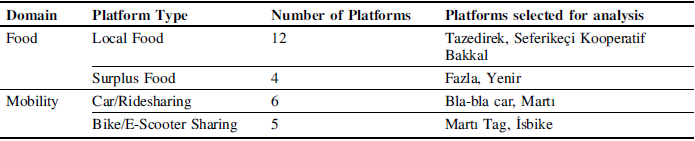
A mapping exercise was conducted to identify all relevant food and mobility DPPs in Turkey, within the scope of an international research project conducted across the USA, Sweden, Norway, Japan, and Turkey. A total of 16 food DPPs and 11 mobility DPPs were identified and mapped using the standardized consortium mapping guide (Table 1). Data was collected through publicly available sources, including search engine results, official DPP websites, mission and vision statements, annual reports, press releases, and social media accounts etc. This information was descriptive, including general platform characteristics, market orientations, participation models, pricing and delivery mechanisms, the scope of available services and products, environmental and social commitments, userbase sizes (where available), and public presence across various social media platforms.
From the mapping pool, 8 DPPs were selected for further analysis (Table 1), based on two main priorities. First was the representation of all platform subtypes identified during phase one, including variation in market orientation, pricing logic, and delivery organization. Second was the potential for unique and meaningful insights into the Turkish context. Prevalence and user visibility observed during the mapping phase served as indicators of contextual relevance. Within platforms of comparable size and reach, preference was given to cases that stood out during the mapping for offering contextual insight. Platforms that lacked sufficient available documentation to support analysis were not considered for selection. The analysis followed a standardized guide and consisted of document analysis of selected platforms’ organizational structure, infrastructure, participation types and demands, value proposition, and value capture, as well as public discourse, including research and press coverage. In this second phase, the circumstances of the platforms’ creation were also examined in greater depth, including whether they emerged in response to specific community needs or evolved over time, as well as the challenges the platforms faced and their operational models, including how they manage orders, payments, and shipping, as well as their target audiences and media presence.
To enrich this analysis with users’ perspectives, we further examined user reviews since 2024. For platforms with a dedicated mobile application, reviews were gathered from the Google Play Store. For platforms that do not exist as standalone applications but are embedded within larger applications (e.g., Tazedirekt operating as a sub-service within the Migros app), user complaints and feedback were collected from www.Şikayetvar.com, a widely used platform in Turkey for reporting user issues and service-related problems. For platforms without an app store presence, such as SeferiKeçi, reviews were collected from Google Reviews.To ensure relevance and comparability, reviews were first sorted by newest, and all reviews from the most recent six months were included. When the number of reviews within this period was high, the analysis was limited at the first 300 reviews. In addition, reviews sorted by most relevant were examined, and the first 10 reviews in this category were included for each platform. To further strengthen the dataset, an additional round of data collection was conducted in 2025, incorporating all reviews posted in that year. As a result, the number of reviews analyzed varied across platforms depending on their popularity and user activity. For example, highly used platforms such as BlaBlaCar yielded up to 347 reviews, while less frequently reviewed platforms, such as Yenir, included 49 reviews. All reviews were analyzed using thematic analysis (Reference Terry, Hayfield, Clarke and BraunTerry et al., 2017). Although user reviews can be limited as they are often perceived as representations of frustrated users, they still provide useful insights for improving digital user experiences (e.g., (Reference Yang, Liu, Liang and TangYang et al., 2019)). In line with this, the purpose was not to draw a broader picture representing the experience of the entire user pool of DPPs in Turkey, rather, to identify issues users have, and thus, in turn, design opportunities and implications.
4. Results
4.1. Mapping food and mobility DPPs in Turkey
The global trends in DPPs are also evident in Turkey, where platforms employ various approaches to promote sustainability, including redistributing surplus food, providing local and fresh produce, facilitating ridesharing, and offering eco-friendly transportation options such as bicycles (Table 1).
Digital food and mobility provisioning platforms in Turkey

4.1.1. Local food platforms
12 local food provisioning platforms were identified, the majority acting as intermediaries between producers and consumers, purchasing from producers, setting prices, and managing sales and delivery.
There are three types of local food platforms. TazeDirekt (www.tazedirekt.com), an example of the first type, is a for-profit online retail storefront that now operates within one of the major retail chains in Turkey, after initially shutting down in 2016 due to operational difficulties. The platform is an intermediary for producers and consumers and has the widest selection of producers out of all identified platforms. It offers year-round availability with scheduled delivery, and functions much like other online grocers, with a focus on fresh, natural products and source transparency.
A second type is non-profit cooperatives like SeferiKeçi Kooperatif Bakkal. Initially only a magazine and a podcast focused on local-producer issues, it now runs a neighborhood shop, accepts online orders via its website, and serves as a small community and culture hub where seasonal, small-producer goods are sold or picked up (www.seferikecibakkal.com).
In the third type, there are no intermediaries and producers handling stock, orders and shipment directly. Currently, the only platform who falls into this category is Pazardan, a platform that reflects Turkey’s open-air neighborhood markets (www.pazardan.app). Every producer on the platform is a stall vendor. Users choose a producer and stall to buy from, pick the products, and the vendor packs the order for local delivery or pickup. Pazardan is not an intermediary, producers publish their own inventory, determine prices and manage orders end-to-end. It functions as a practical halfway point between visiting the market in person and ordering online.
4.1.2. Surplus food platforms
Four surplus-food services were identified, with two currently operating. The first is Fazla (www.fazla.com) which is a B Corp allowing businesses such as bakeries, cafés, restaurants, to sell with leftover food in discounted surprise boxes. Each listing shows the shop name, price, and a pickup time window but not a list of the exact contents of the surprise boxes. Users pay for the boxes through the app and pick the items up directly from the seller. Pick up times and other logistics are handled by the businesses. The second available surplus food platform, Yenir (www.yenir.com), sells packaged products that are near or just past their best-before dates but not past their expiry dates, and items with minor packaging flaws, at large discounts. Users can shop through the app or at Yenir’s physical store.
4.1.3. Car/Ridesharing platforms
Six car/ridesharing platforms were identified. One example is Martı TAG (www.marti.tech/tag/), which provides ride-sharing and allows private drivers to register their cars in the app and accept ride requests. Pricing is agreed in-app. Drivers pay Martı a subscription to receive requests, but the fare for the ride is settled directly between passenger and driver (no per-ride commission and no in-app payment). The driver’s account details can be found in the app to facilitate cash or bank transfer. The other ridesharing type available is carpooling, i.e., BlaBlaCar (www.blablacar.com.tr), an intercity service that matches drivers already planning a route with passengers going to the same location. As Uber only operates as a dispatcher of licensed yellow taxis, not private cars, and it does meet the inclusion criteria.
4.1.4. Bike/E-Scooter sharing platforms
Five DPPs and two platform types were identified in this category. First is public bikes that require an account and docking at designated stations run by city municipalities. In Istanbul this service is İsbike (www.bisikletokulu.isbike.istanbul) (operated by the Istanbul Metropolitan Municipality via its company İSPARK), which has been paused since 2023 for upgrades, so availability has not been consistent. The second type is privately operated e-scooters (e.g., Martı) that are unlocked in the app and ridden point-to-point within marked operating zones (www.marti.tech). The app has parking guidelines and enforces speed/parking rules. Martı launched scooters in 2019 and later expanded into a mobility super app, adding Martı TAG (ride-sharing) and Martı Taksi (taxi dispatch service).
4.2. Challenges and opportunities for food DPPs in Turkey
The food-focused DPPs examined in this study show various ways to achieve sustainable consumption in food, i.e., buying, preparing, eating, storing or discarding food in a way the minimises the environmental impact of these activities. While Yenir purchases surplus products and manages orders directly, Fazla functions as a marketplace where producers list surplus items for consumers to purchase and pick up directly. Both platforms cater to businesses and consumers, offering cost-effective solutions for surplus food while contributing to sustainability. Tazedirekt uses a for-profit model to deliver fresh, organic products to consumers while mostly collaborating with larger producers. In contrast, Seferi Keçi Kooperatif Bakkal operates as a cooperative, prioritizing sustainability and community empowerment by focusing on small-scale, local producers. These platforms employ various approaches to connecting producers with consumers, while addressing food accessibility, sustainability, and waste reduction.
Despite the benefits, some issues may hinder the widespread adoption of these platforms, as indicated by user reviews. While some of these issues are generic and can be found in other digital applications as well, others are specific to food DPPs. The generic issues include technical problems like bugs, system crashes, low internet connection, poor customer support, and usability problems. On the other hand, platform-specific issues are more diverse, ranging from usefulness (i.e., limited availability of the restaurants and lack of integration with other apps like maps or payment systems in Fazla), delivery problems (wrong delivery, missing delivery or poor packaging in Yenir and Tazedirekt), expectation mismatch (i.e., obtaining spoiled food while expecting to have local and fresh produce in Tazedirekt), poor quality produce, lack of competitive pricing (i.e., the increased price range for organic and local food in Tazedirekt) and additional costs such as delivery costs in Yenir.
On top of these issues, the analysis revealed that the way surplus food platforms are utilized in practice can significantly damage the users’ trust in the system and food providers. Food DPPs bring together two different stakeholders: consumers and providers (e.g., restaurants or grocery stores). In the case of Fazla, these companies prepare surprise boxes filled with surplus and unsold goods, with the freedom to set the price for these boxes. From the consumers’ side, this creates multiple problems. On the one hand, while opening a surprise box is found to be an attractive and enjoyable experience, it occasionally creates a feeling of unexpectedness, i.e., consumers do not know what they are paying for, and sometimes they purchase things they would not buy. Furthermore, when they compare the price of a surprise box as opposed to its contents, some consumers believe that the price is higher than the regular price. A similar problem was reported by consumers using Yenir, which promises to sell products nearing their expiry date. Although the platform does not sell expired foods, the lack of awareness of the distinction between best before date and expiry date, some consumers believe that they pay the regular price for expired food, and that consuming such food is unhealthy. As a result of these perceptions, consumers often feel deceived and think that companies exploit the system for their own benefit by selling products that will be discarded. The analysis of reviews showed that this situation reduces their trust in the platform, in turn preventing them from using the platform again.
4.3. Challenges and opportunities for mobility DPPs in Turkey
The mobility-focused DPPs in this study offer different ways to encourage sustainable transportation. Martı and Isbike provide eco-friendly alternatives to cars. While the latter focuses on public welfare, offering affordable bike-sharing services in Istanbul, the former operates e-scooters in urban areas, emphasizing speed, convenience, and reduced carbon emissions for users looking to avoid traffic. BlaBlaCar connects drivers already traveling to a specific destination with riders heading in the same direction, allowing them to share travel costs and reduce carbon emissions. On the other hand, Martı TAG enables drivers to offer their cars to take riders to their preferred destinations, providing an affordable and flexible ride-hailing option in urban areas. These platforms showcase diverse approaches to enhancing urban mobility and promoting more sustainable travel.
Despite the benefits of DPP in promoting sustainable mobility practices, some issues have been identified that could hinder their widespread adoption, as indicated by customer reviews. Like food DPP, the generic issues consumers face includes technical problems (crashes, slow performance, and bugs), usability issues, lack of integration with other platforms, and poor customer support. These issues are particularly problematic during urgent situations, such as when users need the platform to function quickly. For international users, the onboarding process on some platforms, such as Martı TAG, can be especially alienating. Customer reviews include declined credit cards, inflexible mobile number requirements (e.g., assumptions about 10-digit formats), failed ID verifications, and inconsistent English-language support. These breakdowns leave many tourists feeling excluded from a service they were otherwise eager to use. Additional frustrations stem from the integration of payment services, where users are forced to add a card even if they prefer not to, and SMS verification failures. These issues are compounded by poor customer support, where users often encounter automated responses, delayed resolutions, and difficulty reaching customer support during critical moments.
More specifically, mobility DPP issues include pricing, system agency, platform misuse, poor equipment maintenance, system exploitation by one party (drivers), and trust concerns. For ridesharing DPPs, users often complained about unrealistic pricing and perceived price manipulation. Prices are automatically set by the platform with upper limits for drivers, but these limits are frequently insufficient to cover their costs and expectations, particularly given high inflation rates in Turkey. As a result, they often negotiate their own rates during chats with passengers (e.g., asking for 500 through Martı TAG sets a cap of 250 Turkish Lira). This creates a negative experience for passengers, as it is perceived as price manipulation and deception by drivers. Passengers also frequently compare ridesharing DPP pricing to taxis, often viewing it as excessively high. Coupled with the lack of transparency in pricing (i.e., two passengers with identical routes being charged differently) and hidden costs (i.e., cancellation fees), passengers often feel confused and treated unfairly. BlaBlaCar users also report misleading trip listings that appear available even when already full or expired, frequent last-minute cancellations, and uneven enforcement of profile verification, such as strict ID or photo requirements applied to some users and not others. Both drivers and passengers request clearer verification badges, visible trip histories, and larger profile photos to help rebuild trust.
In mobility DPP, system-determined settings also create problems in route customization. In the case of BlaBlaCar, while the system auto-generates stops, drivers feel these should be adjustable to meet individual needs better, as current suggestions sometimes lead to unrealistic expectations or misunderstandings (e.g., adding stops where drivers refuse to pick up passengers). On the other hand, both drivers and passengers desire stronger system involvement in managing problematic behaviors. They suggest that the system should impose penalties on both passengers and drivers who frequently cancel trips or display biased behavior, such as drivers prioritizing specific passenger groups (e.g., only accepting female passengers). Some passengers have also raised concerns about drivers misusing the platform as a dating app by selectively accepting female passengers. Additionally, driver reliability is a common concern due to frequent cancellations, delays, and inappropriate behavior, such as invasive personal questions or accusations. Passengers also complained about unprofessional behavior due to unsuitable attire and drivers bringing family and friends along during the rides.
For bike-sharing DPPs, many of the issues revolve around poor equipment maintenance and infrastructural problems. Users frequently report that scooters or bikes are often broken, unsafe to ride (e.g., low tire pressure and broken buttons), or poorly maintained (e.g., İsbike). Many stations are out-of-service, and sometimes bikes cannot be returned. Other issues include displaying inaccurate information on the app, such as incorrect parking zones or bike availability. Martı scooter users are especially critical of the removal of pre-ride battery previews, as scanning a scooter’s QR code now immediately starts billing, even if the battery is too low to use. This, combined with recurring bugs in ending rides, delayed fines, lack of a functional feedback system, poor interface visibility, and hidden fees for unclear parking violations, contributes to a strong sense of unfairness.
5. Discussion
This paper presented an analysis of eight DPPs operating in food and mobility domains within Turkey and reflecting on how they operate and are utilized. The analysis showed that the number and variety of food and mobility DPP in Turkey have been increasing, with 16 food provisioning and 11 mobility platforms. While these DPPs, with diverse business models and value propositions, offer opportunities for implementing DPPs in Turkey, multiple friction points were identified that are summarized below.
5.1. Align sustainability goals with everyday motivations
In Turkey, sustainability awareness is high but rarely translates into consistent action. Surveys indicate that around 70% of people are familiar with the concept, yet only 30% truly understands its meaning (PwC Türkiye, 2024). Additionally, while 98% report moderate to strong intention toward sustainable living, 65% are unsure about how to live more sustainably (IPSOS, 2023). This creates a clear intention–action gap, suggesting that people support the idea of sustainability but struggle to embody it in practice. Most individuals engage in low-cost, low-effort behaviors, such as reducing food and water waste (Reference Engin and SevimEngin & Sevim, 2022; IPSOS, 2023), but are hesitant when action requires extra money, time, or knowledge. Economic pressures amplify this hesitation: 90% state that it is becoming increasingly difficult to live sustainably due to financial constraints (IPSOS, 2023). Responsibility for sustainability is also externalized; half of consumers believe sustainability is mainly the duty of public institutions, while only 9% takes responsibility (PwC Türkiye, 2024).
Moreover, sustainability is not a primary driver of consumer choices; for Turkish users, pragmatic concerns are more dominant. In both food and mobility platforms, users primarily evaluate services based on price, convenience, quality, and reliability, rather than environmental impact. Brand trust remains low, with only 39% believing that companies genuinely care about consumers’ well-being, and 90% thinking that firms do not do enough for the environment, despite their claims (IPSOS, 2023). As the analysis of customer reviews indicated, when sustainability is promoted but the core service fails (e.g., overpriced rides, spoiled surplus food), users feel deceived rather than engaged. This suggests that, in the Turkish context, sustainability should be embedded within services that already meet users’ practical needs, by aligning environmental goals with everyday motivations such as saving money.
5.2. Design for verifiable trust
The analysis showed that trust remains a critical barrier to the adoption of DPP across both the food and mobility sectors. Trust can be based on multiple factors, ranging from price to process transparency. Due to the nature of monetary exchange in DPP, users need a sense of security and trust. While third parties generally handle the transaction and payment part of the process, the value-cost ratio and trust toward fees and rates are prominent challenges. In mobility, users frequently report issues with pricing transparency, as seen in ridesharing platforms where discrepancies between platform-generated fares and negotiated rates create confusion. Passengers often feel deceived when they are charged more than advertised, which erodes trust in the platform. Consumers face similar issues in food DPPs. Especially in the case of surplus food platforms, such as Yenir and Fazla, the viability and value of the platforms for consumers are based on the price point, i.e., taking advantage of the opportunity to pay less for food. Still, as seen in the case of Fazla, consumers may feel uncertain about the value of surprise boxes. The lack of clarity on what consumers will receive in these boxes creates feelings of unpredictability, and when the perceived value of the surprise box exceeds its actual contents, users feel exploited. A similar situation can be observed in Yenir, where the confusion about expiration dates and best-before dates led some consumers to believe they were paying full price for expired goods, further deepening distrust.
Platform reputation, governmental support, and structural assurance (protective legal and technological structures for safe online transactions) positively influence consumers’ trust in ridesharing apps (Reference Gao, Jing and GuoGao et al., 2017; Reference Shao, Guo, Li and BarnesShao et al., 2020). Considering these issues surrounding trust, DPPs operating in the food and mobility domains should establish fairness and transparency regarding pricing, product quality, and service expectations, ensuring that consumers feel confident in their transactions.
The analysis in this study revealed that the multiple-stakeholder structure of the DPPs can pose challenges in balancing and regulating the intentions and practices of stakeholders. Misuse of the platform by one party, whether by providers or consumers, is directly reflected in how DPPs are used. In mobility, this manifests through drivers exploiting fare systems by negotiating higher prices with passengers or using the platform for personal purposes, i.e, selectively accepting passengers or engaging in inappropriate behavior during rides. While platforms cannot enforce the use of in-platform services, which can be regulated, for interactions, the potential financial benefits can cause such problems. Besides, for ridesharing apps, the interaction between the driver and the passengers is of critical importance (Reference Chaube, Kavanaugh and Pérez-QuiñonesChaube et al., 2010); a bad experience can result in abandoning the service, as evidenced by the analysis of customer reviews. For example, previous research showed that driver’s name, whether they are real or nicknames, significantly influences users’ willingness to use ridesharing apps, favoring real driver names (Reference Fu, He, Hong and HuFu et al., 2023). Thus, DPPs should facilitate effective communication among stakeholders to establish trust among them and prevent tensions that can lead to platform abandonment.
All in all, this study revealed that trust in DPP is not a feature but a foundation, and it can be easily harmed due to a poor user experience. Here, the design challenge is to make trust tangible. Designers can create verifiable by design systems instead of just claiming transparency. For a surplus food app, this could mean visualizing food’s journey from the partner restaurant to the consumer, complete with timestamps and quality checks. For mobility, it could involve a reputation system that rewards drivers for consistent, platform-compliant pricing, making this information visible to future passengers.
5.3. Design for a hybrid model in provisioning
The results showed that while some platforms adopted the business model of existing applications (e.g., Fazla resonating with the business model of Too-Good-To-Go), others introduced new models to the DPP space (e.g., integrating digital provisioning with the cooperative culture in Sefer Keçi Kooperatif Bakkal). The former approach suggests that DPPs active in other countries can offer various benefits in terms of sustainability when applied to other contexts (Reference ÇavuşÇavuş, 2021). However, this work showed that adopting an existing business model successfully implemented in one country is a complex task influenced by challenges and opportunities unique to the local context.
DPP in mobility and food often aim to challenge and disrupt existing consumption habits, for instance, by encouraging consumers to share their rides or to order food online instead of going to a local bazaar. This, in a way, changes how users are getting value. In the case of purchasing food, despite the proliferation of food delivery apps, a high majority of Turkish consumers still prefer in-person shopping from local grocery stores, for fresh fruits, vegetables, and meat and dairy products (Reference Güney and SangünGüney & Sangün, 2021). Platforms like Tazedirekt may sound attractive to Turkish consumers who lack time to go to the grocery stores and willingness to pay a bit extra for fresh produce. However, as indicated in the customer reviews, when there is a gap between the perceived value of the food and its actual price, and when the quality of food deteriorates due to problems in packaging in delivery, consumers feel frustrated, preventing the platform’s widespread adoption. Another DPP identified in the mapping exercise, Pazardan, addresses this problem by considering the socio-cultural context in Turkey. This platform was inspired by the consumers’ tendency to buy food from local bazaars, which are temporary stands that are used to travel to different neighborhoods. Consumers need to visit these places on dedicated days of the week. The platform brings together vendors from local bazaars and consumers who lack time. Consumers can virtually select products from specific vendors through a mobile app and a website. Instead of using the distribution channels of a big retail chain (as in Tazedirekt), Pazardan benefits from people who already sell their goods at local bazaars and make them deliver the goods to consumers in their neighborhood. While such a solution preserves the value offered by purchasing food from local bazaars, it utilizes community aspects to maintain trust between stakeholders.
The persistent preference for in-person shopping at local bazaars is not a barrier to be overcome, but a design opportunity to be embraced. The most promising DPPs will be those that augment, not replace, existing social and economic structures, as argued by (Reference Southerton and FuentesSoutherton & Fuentes, 2022). For example, designers of future DPPs can take inspiration from Pazardan, which aims to digitize the bazaar experience. This example suggests a design pattern for hybrid platforms that combine the efficiency of a digital interface with the trusted, tangible experience of a physical marketplace. Such solutions could not only facilitate online ordering but also reinforce community ties rather than eroding them.
6. Conclusion
Digital platforms that support the provision of food and mobility services offer substantial benefits in terms of sustainability and consumer convenience. While numerous platforms exist globally, their adoption in various contexts remains limited. This paper contributes to the current discussions on DPPs for sustainable consumption through an analysis of eight DPPs operating in Turkey. The analysis highlights various platform configurations in the mobility and food domains, along with the problems and issues consumers encounter when using these platforms, which could serve as barriers to their widespread adoption, including trust issues, platform misuse, power imbalances, and limited-service availability. The paper presents recommendations on how Turkish users could be better motivated to use DPPs, how trust issues and relationship dynamics among consumers and providers/producers could be managed, and illustrates how DPPs can be inspired by existing consumption habits.

 Open access

