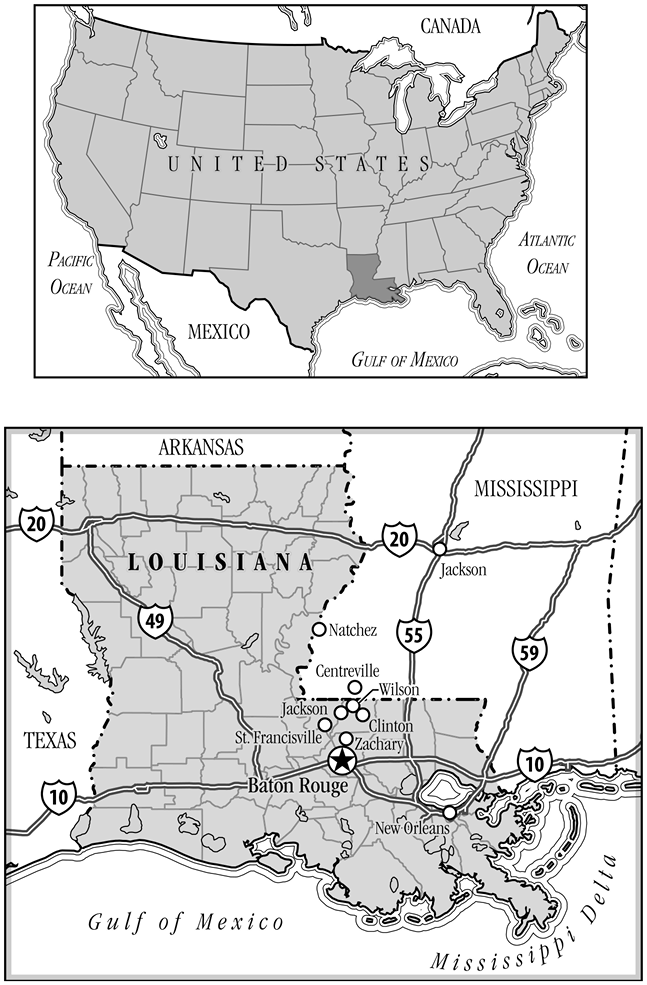
“The country” is not as far from New Orleans as it once seemed. As a young child it seemed the two-hour drive through Baton Rouge to Wilson would never end. I can still picture a wall of trees in front of my grandmother’s dilapidated childhood home, her older brother Andrew Drake, Jr.’s collard greens planted in neat rows out front. According to the national mythos, honest, hardworking Americans live in the heartland while coastal cities like my hometown teem with vice. No wonder the journey north seemed to bring me to an earlier, simpler time. If not entirely factual, such perceptions are powerful. But times and places change. In the decades since that childhood trip, coastal Louisianans pushed north by climate change along with domestic and international migration to the US South have extended the Baton Rouge metropolitan area north to Zachary (Map 1). Its banks, chain stores, and budget hotels of suburban everywhere augur the development to come.1
Louisiana today.
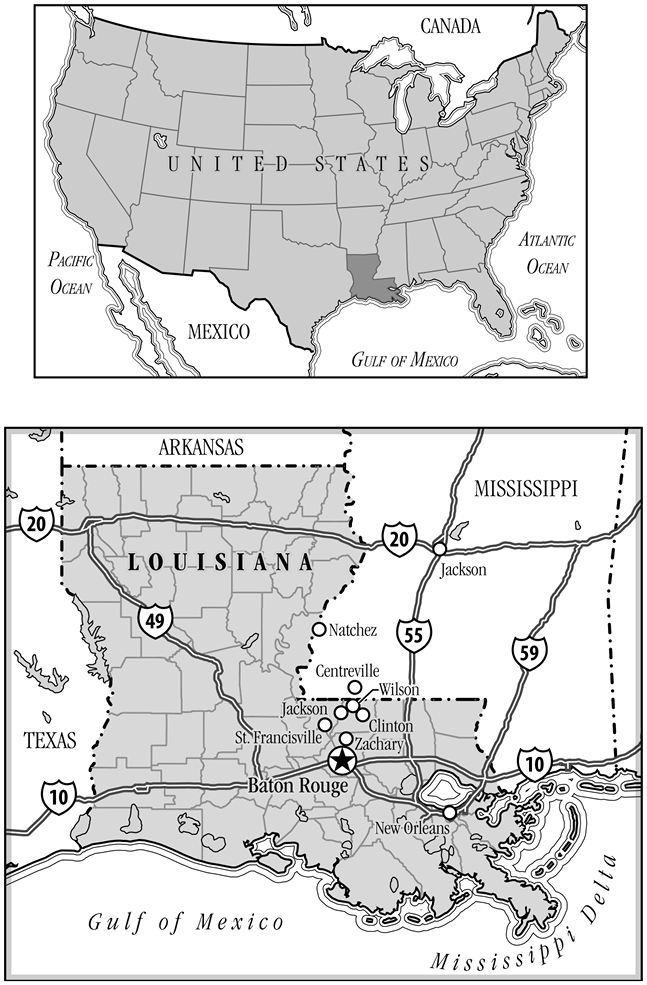
The roads north from Zachary diverge in more than one way. One route wends toward St. Francisville in West Feliciana, a picturesque tourist destination. Thousands visit each year to enjoy the quaint charm of an antebellum town. Zachary’s Main Street leads to Church Street to Mt. Pleasant Boulevard and a new, patriotically named subdivision (“from mid-$300s”). Five miles and a right turn leads to thirteen or so tree-lined miles north along Highway 61, the Blues Highway, that connects Memphis to New Orleans. That road hugs the Port Hudson battlefield and cemetery, where Black troops first fought for the Union in the Civil War. A few more miles north are the reasons they fought: the Rosedown Plantation with its bucolic oak alley and the Myrtles Plantation that the enslaved girl Chloe allegedly haunts even today. Twenty of so more miles north lead to Woodville, Mississippi, while a turn onto Tunica Trace and thirty or so more miles end at Angola, the Louisiana State Penitentiary.
The drive from Zachary toward East Feliciana carves a different route. Five miles north along LA-19 is Slaughter, an exurb where the McMansions have enough land for a few horses. But the “cash for land” signs denote future population density. Another five miles north at Ethel the landscape again subtly shifts. McMansions give way to rows and rows of tall pines, oddly uniform as if planted at the same time. This future lumber is the pride of the Feliciana Forestry Association, whose plaques honor century-old tree farms. A few more miles, at LA-10 junction, a left heads toward Jackson and the Dixon Correctional Institute, a right to Clinton and its noted courthouse. A dozen or so more miles north is “The Village of Wilson,” population just under seven hundred and my grandmother’s birthplace.2 Technically the state line cuts through this region, but practically Wilson is closer to Centreville, Mississippi (ten or so miles to its north) than it is to New Orleans, and the region’s history runs as much through the Mississippi Delta as the port of New Orleans. Though only my second visit as far as I can recall, I arrive, in some sense, home.
Toni Morrison’s Beloved lays bare the dilemmas of Black placemaking in a world warped by slavery. Sethe and Paul D meet while enslaved at the Sweet Home plantation, where they endure trials and build relationships that haunt them and their descendants. Heroic flights away from the plantation define so much African American lore, so understandably Sethe’s daughter Denver struggles to understand why Sethe and Paul D’s conversations so regularly return to a place neither sweet nor home in any usual sense. Sethe replies with a simple if profound truth: “But it’s where we were.”3
Like my own, the strange roots of many African American family trees burrow deep into this region’s soil, sometimes literally. Over a century after emancipation Elnora Robinson Colbert, the great-granddaughter of a woman enslaved in Louisiana, reflected that perhaps she returned from California to live near the Landry Plantation because that was where her ancestors had buried her “navel string,” or umbilical cord, under a step, which meant the children would return.4 As one scholar observes, “the placenta is highly revered in most African societies because of its biological and spiritual connection to the child’s life cycle.” Across Africa and its diasporas, the burial of the umbilical cord signifies passage from the ancestral realm to the physical world, ensures the mother’s fertility, and protects the child.5 Family and ritual made a claim to place far more profound than narrow conceptions of private property.
Yet we tell the story of the modern African diaspora largely through the lives of people “run off” from one place to another. From Indian Ocean slave trades to the Middle Passage across the Atlantic, intercolonial and interstate trades, the Underground Railroad to the Great Migration, circulation defines the Black American experience. But flight is only half the story. The other half is Black placemaking, or the ways people of African descent “create sites of endurance, belonging, and resistance through social interaction.”6 What do diverse experiences of placemaking, or “the creative, celebratory, playful, pleasurable, and poetic experience of being black and being around other black people,” teach us about life in the shadow of death? What can we learn from the diverse peoples who found warmth under the same old sun?7
Freedman Edmond Harrison proclaimed over a century ago that the US South is a global place that reveals much about the African diaspora and the world. In December 1867, just over two years after the Civil War ended, someone murdered an eleven-year-old white boy in West Feliciana. In a confession, undoubtedly coerced, an alleged accomplice blamed “Uncle Edmond Harrison,” who after trial and conviction received a death sentence.8 At the appointed hour, on Friday, May 1, 1868, Harrison officiated his own burial ritual. He sang a hymn as he filed past Union soldiers toward the St. Francisville prison yard. There, standing between the sheriff and a Black preacher, the embodiments of state and divine authority, he delivered a homily: “Dear friend, one and all – I am here to die.” He proclaimed his innocence and denied hatred of any person, white or Black. He exhorted children to make good choices and to be obedient Christians. And just before the sheriff carried out the final act, Harrison declared: “I am before you, a looking glass for the world; I beg and pray that your fate may never be this.”9
Harrison did not need European philosophers to tell him that many defining events of his life – slavery, war, emancipation, conviction, execution – arose in part from slaveholders’ need to prove their own power by witnessing its effects on others. But Harrison opted out of this drama. Neither heroic rebel nor powerless victim, Harrison claimed for himself “the revelation of the abject.” Rather than accede to the degradation offered him, he acted in accordance with his own values. As he stared down certain death, this emancipated man prayed for real freedom. He knew he would not live to see it, but he envisioned it for the region’s children and the futures they embodied.10
My ancestors were among those children, and his life and times indeed offer “a looking glass for the world.” A close look at the Felicianas shows that experiences of time and space are not universal or objective; they are dynamic sites over which a global assemblage contested the meanings of family, race, colonialism, slavery, and freedom. As in Toni Morrison’s Beloved, specters come “from a place out of time to haunt and disturb the historical present.” Slavery and its afterlives defy linear and progressive notions of time and instead require “acknowledging that past and present are not necessarily successive but, instead, are simultaneously produced.”11 “The” past and our relationship to it have never been singular, nor are those plural pasts behind us.
In any single historical event, then, we must account for the different experiences of time and conceptions of place that each actor brought to it. “One significant characteristic of historical events,” historian William Sewell writes, “is that they always combine social processes with very different temporalities … which are brought together in specific ways, at specific places and times, in a particular sequence.”12 Power shapes those combinations and clashes. “More than a fixed standard of measure by which the progress of other processes can be measured,” Walter Johnson writes, “time figures in these works as, in the words of Johannes Fabian, a culturally constructed ‘dimension of power.’”13 The Felicianas offer a microcosm of the competing temporalities that have animated conflicts from the colonial era to the present.
To add another layer of complexity, those multiple and competing experiences of the present then became competing versions of the past. How do we as historians consider the cumulative effects of multiple temporalities? “The social world is accumulated history,” theorist Pierre Bourdieu writes, “and if it is not to be reduced to a discontinuous series of instantaneous mechanical equilibria between agents who are treated as interchangeable particles, one must reintroduce into it the notion of capital and with it, accumulation and all its effects.”14 Unlike theorists and social scientists, who use case studies to create models that can be applied in different contexts, professional historians usually value context and specificity. But people outside our discipline understandably lose patience when we seem to measure grams and forget the masses. Especially in Louisiana history, with its rich archives, it is tempting to prize empirical details in ways that, however unintentionally, obscure broad patterns in ways that avoid reckoning with the full weight of history. In this case, that weight is what seems like five centuries of unrelenting antiblackness. As Michel-Rolph Trouillot writes, the fundamental truth of it all “dies in the cumulative irrelevance of a heap of details.”15 By focusing on a relatively small space over a relatively long time, this book uses granular details to create a pointillist account of the making and unmaking of power and privilege over generations.
Sweet Home Feliciana: Family, Slavery, and the Hauntings of History tells three stories that together illuminate histories of contested placemaking from the late eighteenth century to the earliest days of the twentieth. It blends scales of history that range from the personal to the regional, and from the regional to the global and back, to develop a narrative that can do justice to the deeply interwoven strands of these intimate histories. From one perspective, it follows the land’s transitions from Indigenous homeland to borderland claimed by successive European empires to a state in the early republic, from antebellum center of sugar and King Cotton, Civil War battlefield, home of Angola Penitentiary, and cradle of the blues. But in another sense the book uses those events to question the way we define the successiveness of those historical transitions. The land remained an Indigenous homeland as it became a planter’s fantasyland where enslaved people were left to find sanctuary in a hellscape. Words like “development,” “modernization,” “transformation,” and “progress” fail to capture the ways simultaneous and competing experiences became layered onto the land itself.16
The first story is of family, especially the ways ideas about who counted as family and the rights afforded or denied them reshaped this region. In a classic article, Ann Laura Stoler called for attention to the ways “intimate domains – sex, sentiment, domestic arrangement, and child rearing – figure in the making of racial categories and in the management of imperial rule.”17 Similar to practices implemented across the colonial Americas, competing European empires used land grants to translate the number of settlers in a family, which here included enslaved persons, into acres of granted land. This is how Hezekiah Harrell, who moved from South Carolina to the Felicianas when they were part of Spanish West Florida, secured acres of land that remained in his family one century and one empire later. As Bourdieu argues, a respected family name, education, and social connections played an outsized role in social reproduction. These provided elites with the “‘credential’ which entitles them to credit,” which in turn allowed them to accumulate generational wealth.18 A handful of families amassed unprecedented wealth and power through settler colonialism and slavery, and they created a society that enriched, educated, and entertained them in the ways of white supremacy. And, despite the tendency to cleave Louisiana’s colonial history from the history of the early republic, the wealth and power amassed in the earlier period brought rewards long after US statehood.
The creation of planter families required the manipulation and exploitation of enslaved ones. Perhaps my own ancestors migrated with the Harrells from the early republic to the Felicianas, their bodies translated into acres, and who, in their productive and reproductive labor, produced new capital. But many enslaved people still created deep if complex familial and social ties that formed the bedrock of communities of faith and resistance.19 After emancipation, legal marriage was for some a marker of freedom. My great-great-great-grandfather Virgil took for himself the last name of his slaveholder (and likely biological kin) the Harrells, married, and started a family. His successive marriages to Rachel Robbins and then Martha Greene Tapp during Reconstruction and its aftermath offered companionship and sanctuary, which they needed to survive the spectacular and intimate violations of this era. Those included Martha Harrell’s experience of sexual assault that undoubtedly haunted her and created a vexed inheritance for me and her other descendants. Yet, as a caveat, white and Black Harrells appear throughout, and this book includes reflections from my own family members. But this book is not a conventional family history. My ancestors are not the protagonists, nor are their stories the book’s throughline.20 It is a community study that includes my family and others. We have never limited our conception of family or belonging to biology, so consistent with our family values this book does not privilege a single lineage but instead takes a broader view.
The second intersecting story is about a region and the ways it unsettles dominant ideas about Louisiana and its relationship to the United States. An important political history of this region focuses entirely on the white yeomen “plain folks” and their struggles against the planter elite over principles of honor and belonging. It gives no attention to the experiences of white women or persons of color, leaving unexamined an entire world of political, social, and economic contests. Such studies effectively erase Indigenous peoples and the Black majority forced to live there.21
This book is not comprehensive, but it does attempt a more expansive and inclusive story. Unlike other parts of Louisiana, French residents did not dominate this region. By 1800 West Florida was a New Spain borderland inhabited by the Choctaw, Tunica, Houmas, and other Native nations; French, Spanish, and Anglo settlers; and largely enslaved African-born survivors of the Middle Passage and circum-Caribbean migrations. After the Louisiana Purchase in 1803 the region remained under Spain until in 1810 a small group of white settlers revolted against Spanish colonial officials and grandees to form the Republic of West Florida, the first “Lone Star Republic.” The next year just downriver up to 500 people held as slaves and their allies carried out a world-making rebellion against slavery, colonialism, and capitalism. A brutal state response followed, and in 1812 Louisiana became a US state. Anglo-Americans flocked to the region, and they compelled their enslaved laborers to transform piney woods into a hub of industrial raw sugar and cotton production. Some of the most important chroniclers of early America – ornithologist John James Audubon, landscape architect Frederick Law Olmsted – traveled through those lands to produce and disseminate scientific and social knowledge. Each plantation moved this borderland deeper into the emergent US Deep South.
But planter politics was not the only politics; in that region’s contested spaces people of African descent drew on their own experience and imagination to exist, survive, and sometimes resist. As historian Sterling Stuckey writes of similar sentiments, “There is no question of the self-generative nature of their impulse toward freedom.”22 But the plantation South was not the only South, and that shaped not only that region but also the nation to which it came to belong. First, the labor necessary to produce enough staples to meet global demand for sugar and cotton made this region home to a Black majority. To be sure, they labored under unconscionable conditions. Still, like their Tunica, Choctaw, and other Indigenous neighbors and sometime associates who lived there before and after the Trail of Tears, they claimed spaces of assembly, dance, ritual, care, mourning, and conflict. In “slave culture,” they nurtured alternative ways of seeing themselves outside those assigned them. Their radical politics motivated the everyday acts of resistance that presaged spectacular ones. During the Civil War, Black troops first fought for the Union at Port Hudson, and after emancipation freedpersons claimed the rights of citizenship in a liberal republic when they married, voted, and built institutions. As former Confederates dismantled democracy and reestablished “home rule,” Black residents again drew on community resources to survive and to live. In families and churches, political meetings and elections, crafts and athletics, blues and jook joints, they expressed themselves and built complex communities on sites blood-soaked by generations of dispossession. Famous blues musician Huddie “Lead Belly” Ledbetter turned even the wretched circumstances of Angola Prison into a pained source of brilliance and beauty. And African Americans born in the cradle of cotton and culture migrated to New Orleans, Memphis, St. Louis, and Chicago; they became a transformative political and cultural force.23
The final story concerns the world to which this region belonged. At one point it would have been provocative to call this region an “American” place at all. Louisiana’s colonial and early American history seem to differ from the usual sites of national self-definition, such as Philadelphia, Boston, and Virginia. British West Florida’s colonists did not join the American Revolution, a fact Spain exploited by claiming the region for itself. We now appreciate the ways worlds well beyond the Thirteen Colonies, including the Lower Mississippi Valley, were not as peripheral to the nation-making process as earlier scholarship might suggest.24 Following Lisa Lowe’s conception of “the “intimacies of four continents,” we must examine “the political, sexual, and intellectual connections and relations among slaves, peoples of indigenous descent, and colonized laborers,” whether on slaving ships or the plantations of the Atlantic and Pacific worlds.25 This region offers a rich site to investigate how hemispheric and global peoples and networks could make one space into a simultaneous Indigenous homeland and the Jim Crow South.
Sweet Home Feliciana extends my own interest in unlikely circulation and assemblage, not in a port city on the make but in a rural area that today most would struggle to locate on a map. But for centuries rural areas like the Felicianas were not peripheral to the world; they were the world. Ancient mounds from the Archaic period (8500–3000 bce) attest to the long history of Indigenous life in the region. Houmas, Pascagoulas, Tunica, Choctaw, and other Native peoples built their own complex societies and expanded their power as, beginning in the seventeenth century, a succession of settlers and the empires they represented – France, Britain, Spain, and later the United States – competed with Native peoples and one another for dominance. Drawing on wealth created through land extraction and labor exploitation, settlers amassed fortunes, sent their children to private academies, patronized the theater, read, built infrastructure, and even set aside money for the paupers. For much of the nineteenth century Indigenous and enslaved persons lived alongside Anglo settlers and Irish, Jewish, and Italian immigrants. Rather than simply shift the cosmopolitanism pendulum from port cities to rural plantations, this book shows how people from across the world assembled in rural plantation societies that were themselves critical nodes in regional, national, and global webs of circulation and communication. It brings water and land, city and hinterland into a global whole. In weaving these three components – family, region, world – together, this project insists on the bristling and complicated relationships of people to place to the activities of a teeming planet. This history aims to create a portrait of the world in a family, a family in a region, a region in the world, to frame a fresh vision of this period of American history and of what, even, it might mean to be American.26
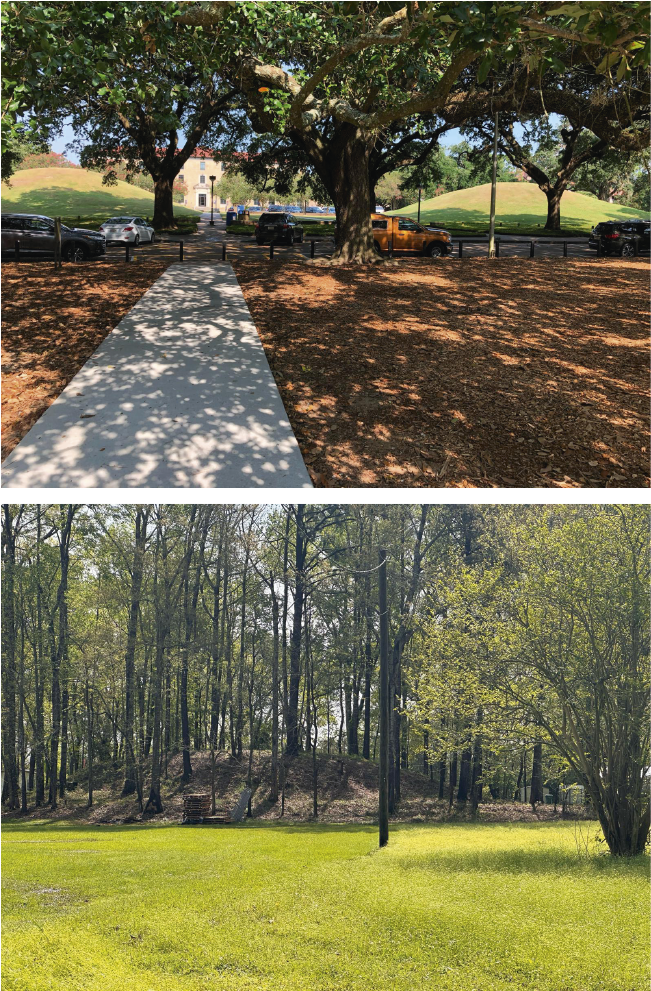
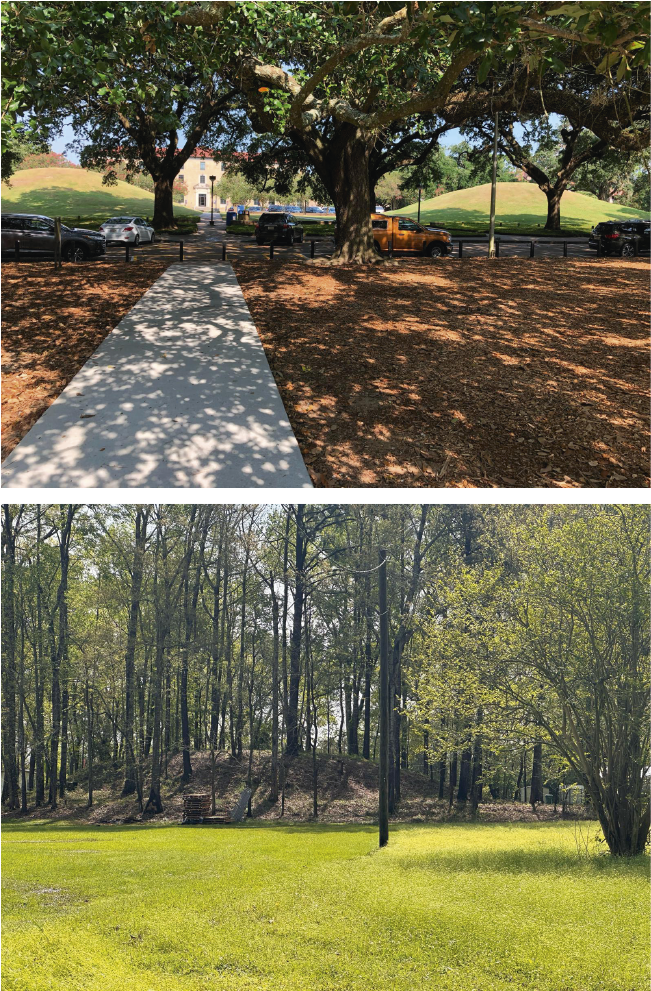
But how do we write these histories? Those who would do archival research at Louisiana State University’s Special Collections in Hill Memorial Library must walk around ancient mounds. Thought to date to the Archaic period, they provide physical evidence of Indigenous life, politics, and ritual in this region. As seen in Plate 3, the campus, which dates to the 1920s, curves around the ancient formations. Also visible in the image are several of the campus’s thirteen hundred live oak trees. As one scholar observes of such trees, “images and other remainders of these landscapes came to stand in for the complexities of the place itself.”27 Planted in the Jim Crow era, these southern trees evoke for me the “strange fruit” for whom blues legend Billie Holiday sang her mournful elegy. The image scrambles time and place: ancient mounds and the primary Indigenous claim to land; archives that overflow with the records of its theft; and southern trees that suggest shade from the blistering Louisiana sun and the horror of lynchings. Together they raise a simple but profound question: Where do we look for history?
Top: Indigenous mounds from the North American Archaic period, Louisiana State University campus, Baton Rouge; bottom: Indian Mound Round, St. Francisville, La.
Right now, many scholars, including Black women historians, are dissecting archival violence and the ways it shapes the stories we write. This has led to important innovations, new ways to read “along the archival grain” and “against the bias grain,” to use “critical fabulation” and other speculative techniques to name and explore ways to ensure our accounts do not limit historical figures to the terms by which those in power chose to represent them in the documents now enshrined in archives. Yet to recognize the limits of archival research methods does not require us to reject them altogether, which is not necessarily what these scholars suggest.28 As bad-faith critics object to the most basic facts of Black history, archives can be useful in our efforts to tell fuller histories of our past and the ways they shape our present. Each generation confronts detractors who use laws and intimidation to limit and outright ban Black history. A century ago, W. E. B. Du Bois used archival methods to challenge similar attempts to blame African Americans for what were deemed the many failures of Reconstruction and thereby justify its end and the subsequent rise of revanchist rule in the South. As he asked in his magisterial Black Reconstruction, “Nations reel and stagger on their way; they make hideous mistakes; they commit frightful wrongs; they do great and beautiful things. And shall we not best guide humanity by telling the truth about all this, so far as the truth is ascertainable?”29
Black history is all around us if we know where and how to look for it. Now more than ever, it is important to use the broadest range of sources and interpretive techniques to offer fresh perspectives that do not simply recover and describe archival findings in the name of detached empiricism. We do not have to choose between rigorous archival methods and a critical stance. In fact, innovative readings of traditional sources along with broadened definitions of what counts as a source both allow us to tell fresh and powerful stories.30 Here I draw on thousands of periodicals, police jury records, probate and marriage records, personal correspondence, family papers, and similar documents from multiple archives. Most sources offer limited access to the interior lives of the dispossessed, so I read against the grain for ways they shed light on the experiences of those in whom I am most interested. Unfortunately, like the histories they helped to produce, the archives of settler colonialism, slavery, war, and Jim Crow are simply brutal. I cannot claim to have achieved a violence-free narrative of genocidal processes, if such a thing is practicable or even desirable, but I do my best to exercise restraint and to avoid gratuitous and pornographic “scenes of subjection.”31
Inspired by the improvisation fundamental to regional and African diasporic culture, I also draw on everything from popular culture and performances, cemeteries, material culture, and oral histories to glean as best I can the counternarratives that people of African descent nurtured in their hearts and minds through it all. I use published oral histories from the Jim Crow era as well as the late twentieth century as well as the ones I conducted with my late grandmother Ruth. Here the lack of objectivity, to whatever extent it exists, is a feature, not a limitation. As Darlene Clark Hine argues in her classic article, Black women are not only silenced; many choose silence. My relationship with my grandmother afforded me insights that otherwise would have remained hidden from public view. Together, these sources allow me to create what I hope is an empirically rigorous and deeply critical account of Black death and life in this region.
What this approach contributes, first, is an opportunity to reflect on power, namely the deeply contingent yet unrelenting ways actual people in particular places hoarded and bequeathed it over generations, and the ways the dispossessed lived, died, resisted, and refused. In moving from the everyday and intimate realms to the macrolevel, it complements works on slavery and its afterlives by showing how specific families and societies operated through the exploitation of other specific people and families, how people of African descent challenged them at every turn, and how those battles remain ongoing.
Second, Sweet Home Feliciana investigates regional “roots” at a time when the word has become verboten, and for good reason. As geographer Doreen Massey points out, nationalists, fascists, and their ilk adopt words like “place,” “heritage,” and “rootedness” to signal their distinctiveness from (and superiority to) others and their preference for bygone eras. In the US South, this often means Confederate flags and nostalgic songs like Lynyrd Skynyrd’s 1974 hit “Sweet Home Alabama” (itself a nod to blues legend Robert Johnson’s earlier ode to the Great Migration, “Sweet Home Chicago”). Instead, Massey imagines a “progressive sense of place, one which would fit in with the current global–local times and the feelings and relations they give rise to, and which would be useful in what are, after all, political struggles often inevitably based on place” (emphasis original).32 In recent memoirs some of our most talented writers have done exactly that, peering past neo-Confederate nostalgia to contemplate the Black South and its universal dimensions.33 While not a memoir, this book stems from a similar impulse to train my dual gaze as a professional historian and a Black woman raised in the South to confront this infinitely complex region.34
Finally, people interested in the African diaspora have long contended with questions of “roots” versus “routes,” a debate that becomes even more complex when transected with settler-colonial studies. Some insist that efforts by non-Native peoples, including enslaved and freedpeople of African descent, to create senses of belonging on Native lands perpetuates settler-colonialism by erasing and excluding Indigenous people and their primary claims to the land.35 For people of African descent forcibly transported from their own homelands, the forging of a new sense of home, family, community, and history has long represented an important act of survival. Whatever one’s conception of diaspora, people of African descent produced places for themselves in the lands on which planters forced them to settle. While people of Afro-Native descent sit at the intersection of these inheritances, we all must attend to the ways these complex histories riven with tension and beauty shape our own. And in tracing their contours in this one place, we observe the outlines of many more.36