




Introduction
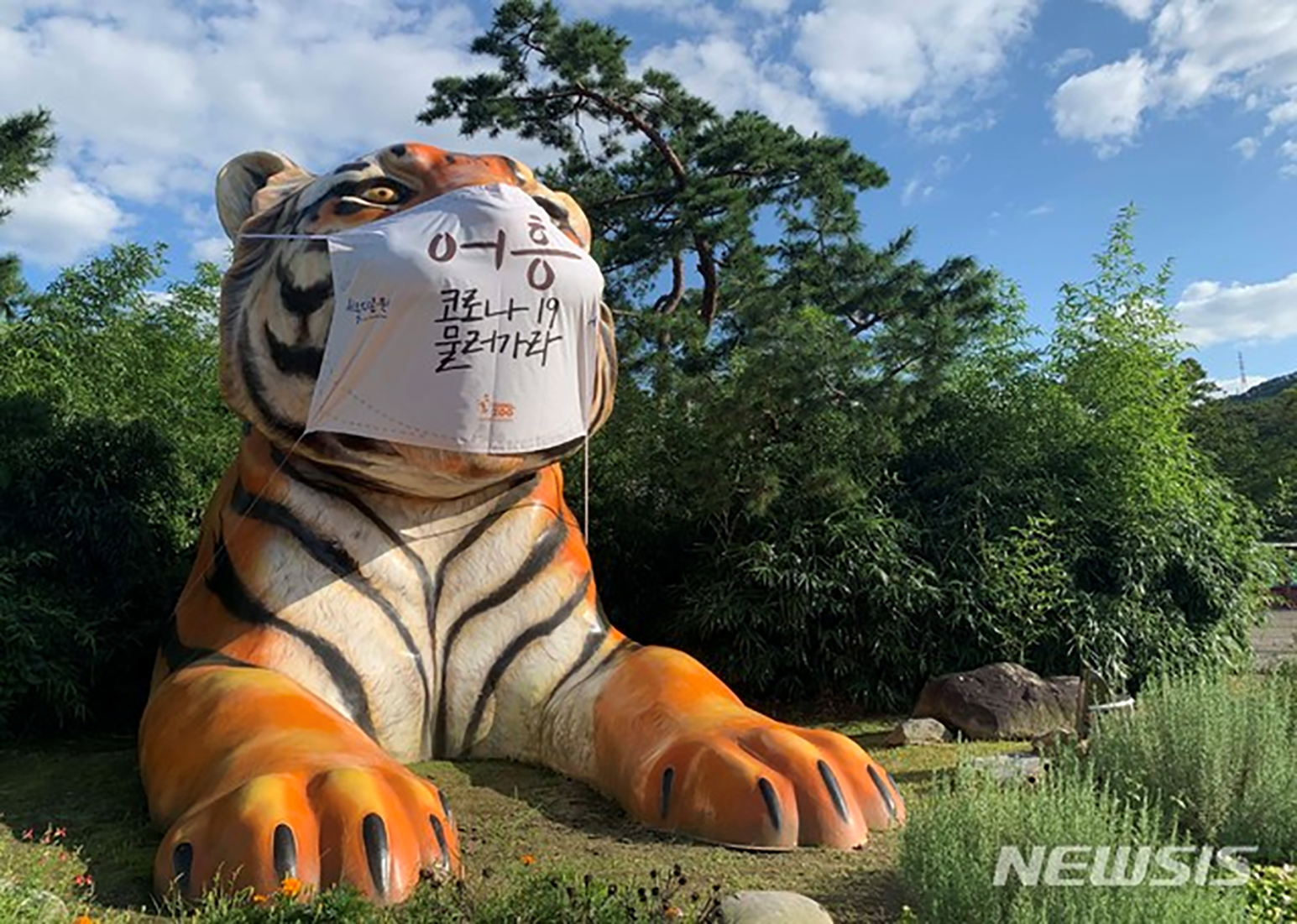
On the 23rd of September of 2020, during the global coronavirus (COVID-19) pandemic, officials at Seoul Grand Park Zoo affixed a giant facemask, bearing the words “Ŏhŭng k'orona 19 mullŏgara” 어흥 코로나 19 물러가라 (“Roar! Go away corona!”), to a tiger statue that stands at the entrance of the zoo (Fig. 1). The imagery at work in this act of public spirit and the large fibreglass tiger statue itself have complex historical roots. Today, tigers are a popular symbol of Korea and of the Korean people, epitomized by the choice of tiger mascots for the epoch-making Seoul Summer Olympics in 1988 and again at the P'yeongChang Winter Olympics in 2018. Popular discourse accepts the tiger as a symbol of Korea that stretches back into premodern history (e.g. Pak Reference Pak2020), while, among scholars, it is generally understood that the writings of early twentieth century Korean intellectuals from the independence movement, notably Ch'oe Namsŏn (1890–1957), were instrumental in the creation of this connection (Chŏng Reference Chŏng, Ko, Kim and Min2013; Mok Reference Mok2014; Seeley and Skabelund Reference Seeley and Skabelund2015, p. 489). However, the process by which the association between tigers and the modern Korean nation state came about has not been examined in detail. Drawing upon visual materials, early independence activists' writings and the commercial press, in this paper we follow Foucault's genealogical method in order to examine the hidden conflicts and contexts that lie behind the invented tradition of tigers as a national symbol of Korea (Foucault Reference Foucault1977; Hobsbawm and Ranger Reference Hobsbawm and Ranger1983). We show how Ch'oe's image of Korea as tiger was, in fact, largely overlooked until the 1980s when the successful Seoul Olympic bid and the Chŏn dictatorship's cultural policy converged to facilitate the “rediscovery” of Ch'oe's tiger metaphor, via post-colonial sites of cultural inscription, such as national newspapers, zoos and museums, but in a sanitized form that omitted Ch'oe and his troubling legacy. We also note that the use of a tiger to symbolize Korea had Japanese origins, and that resistance to colonial rule imbued the tiger with new, nationalistic meanings on the peninsula during the twentieth century. The mask-wearing fibreglass tiger at the entrance to Seoul Grand Park Zoo is a product of these historical processes. We will show how it was originally conceived as a flagship tourist boat for Seoul's Han River following the successful Olympic bid, but proved a failure with the public and was later repurposed for the entrance of the Seoul Grand Park Zoo. There, it heralded the celebration of “native” Korean Amur tigers and the anti-Japanese sentiments that underpinned the zoo's tiger breeding programmes.
Tiger statue with facemask at the entrance of Seoul Grand Park Zoo (Newsis 2020).
Japanese colonialism and Ch'oe Namsŏn's tiger map of 1908
The early-twentieth-century intellectual, poet, historian and leading member of the Korean independence movement, Ch'oe Namsŏn, is often credited with making the first modern connection between tigers and the Korean nation state (Chŏng Reference Chŏng, Ko, Kim and Min2013; Mok Reference Mok2014; Seeley and Skabelund Reference Seeley and Skabelund2015, p. 489). In his life's work and in his use of the tiger symbol, we see a continuing dialogue with Japan the colonizer. Ch'oe was educated in Seoul, and went to Japan as a scholarship student between 1904 and 1905, before returning the next year to study geography for 2 years at Waseda University in Tokyo. Active as an intellectual during the time when Korea became a Japanese protectorate (1905) and then a colony (1910), Ch'oe's relationship with Japan was ambiguous. During the protectorate period, he resisted the colonial portrayal of Korea; but he was imprisoned in 1919 for his role in the Korean independence movement, and a few years after his release Ch'oe began to cooperate with the Japanese administration in an attempt to influence colonial knowledge production. This later led to him being denounced as a traitor (Allen Reference Allen1990; Scholl Reference Scholl2019).Footnote 1
Ch'oe's earliest writings about Korean tigers, and the piece for which he is credited with starting the modern association between the Korean nation and the tiger, was published more than a decade before his imprisonment and subsequent “collaboration,” but already it shows not only resistance to but also use of Japanese systems of knowledge. The article in question, “Ponggiri chiri kongbu” 鳳吉伊地理工夫 (Ponggiri's Geography Study) (Ch'oe Reference Ch'oe1908), appeared in his magazine, Sonyŏn 소년 (Youth), the organ of the Youth Student Association (Ch’ŏngnyŏn haguhoe 청년 학우회) containing translations of Western literature, articles on Western thought and Korean history, suffused with patriotic overtones (Robinson Reference Robinson2014, p. 65). In “Ponggiri chiri kongbu,” Ch'oe discusses the maps of various countries, including Korea, using the European convention of comparing them to the shapes of objects. This strategy had also been adopted by Japanese geographers, and in his article Ch'oe criticized an assertion that had been made by then Tokyo University professor of geography Kotō Bunjirō (1856–1935) that the map of Korea resembled the shape of a rabbit (Kotō Reference Kotô1903, p. 3) (Fig. 2).Footnote 2
Ch'oe Namsŏn's interpretation of Kotō Bunjirō's rabbit analogy (Ch'oe Reference Ch'oe1908, p. 67).

Instead of a rabbit, Ch'oe suggested an idea “of Ch'oe Namsŏn's own making” (Ch'oe Namsŏn ŭi anch'ul 崔南善의 案出): that Korea resembled a tiger “with its paw raised, clawing as it runs towards the Asian continent – an energetic, leaping form” (Ch'oe Reference Ch'oe1908, pp. 66–67) (Fig. 3).Footnote 3 The reasons Ch'oe gave for proposing an alternative to Kotō's rabbit analogy were twofold: unlike the rabbit, he argued, the tiger shape required no taking of liberties with Korean national boundary lines; additionally, the tiger conveyed the “assertive and rapidly growing, young Korean peninsula” (Ch'oe Reference Ch'oe1908, p. 67).Footnote 4 In his choice of the tiger analogy, we observe Ch'oe resisting the image of Korea as seen through the gaze of a Japanese scholar. This colonial gaze both weakened Korea by comparing it to a rabbit and did violence to the boundary lines of the Korean nation state.
Ch'oe Namsŏn's tiger map (Ch'oe Reference Ch'oe1908, p. 67).

Ch'oe's choice of the map of Korea as a site of resistance to Japanese discourse reflects the importance of maps in modern nationalism. As the visual manifestation of what Thongchai Winichakul called “the geo-body” of the nation, during the modern period maps have been frequently used to arouse nationalism and to assert national identity (Winichakul Reference Winichakul1994, p. 137). However, unlike the Thai case discussed by Winichakul, by the time Western powers arrived in Asia, a sense of defined geographical territory was already well-developed within the Chosŏn state, which had administered a relatively stable realm for over four centuries (Schmid Reference Schmid2002, p. 18). As we will show, there was no habit of symbolizing the boundaries of this Korean state or people by means of a tiger in premodern Korea. There was, however, a strong association between tigers and the Korean state in Japan. What is particularly interesting about Ch'oe's map analogy, therefore, is the choice of the tiger shape, since this not only resists Japanese knowledge about Korea but also cleverly uses a symbol with Japanese resonance.
Japan and tiger symbolism in premodern Korea
Seeley and Skabelund note in their environmental history of tigers in Korea that throughout the peninsula's history tigers have been valued more as symbols than as actual living beings. The Amur (or Siberian) tiger, Panthera tigris altaica, is native to the Korean peninsula but was hunted to extinction there by the early-twentieth century. Prior to this, violent encounters between humans and tigers gave rise to a variety of images of tigers in the popular imagination (Seeley and Skabelund Reference Seeley and Skabelund2015, p. 476). Heo Weongi's examination of tiger stories contained in the largest edited collection of Korean folk tales (the eighty-two volume Han'guk Kubi Munhak Taegye 한국구비문학대계), together with North Korean folk tales contained in the Han'guk Kujŏn Sŏlhwa 한국구전설화, for example, revealed over 600 stories about tigers, more than for any other animal. The themes of these stories include tigers as divine messengers, foolish tigers, compassionate tigers, tigers repaying a debt, tigers who turn into humans and violent tigers (Heo Reference Heo2003, pp. 89–92).
For our purposes here, it is significant to note that – despite the contemporary notion that tigers have been associated with some timeless form of the Korean nation throughout Korean history – in none of the folk tales mentioned above were tigers cast as symbols of any of the premodern kingdoms of the Korean peninsula nor of some kind of premodern national identity, in so far as such an identity may be said to have existed (Haboush and Kim Reference Haboush and Haboush2016). This is the case even for the Tan'gun myth, which has been foundational in modern Korean nationalism, and was often cited in twentieth-century nationalist discourse as evidence of the tiger's long history of ethnic symbolism in Korea (Kim Reference Kim2014; Pai Reference Pai2000, pp. 57–76). A tiger does appear in the Tan'gun story, however it is not the tiger but rather a bear who becomes the national progenitor, when Tan'gun, the god king and legendary founder of the first Korean kingdom, Kojosŏn, is born as the offspring of a bear and a heavenly prince. The oldest surviving written account of this oral tradition is contained in the thirteenth-century Samguk yusa 三國遺事 (Memorabilia of the Three Kingdoms), a collection of folk tales and historical accounts compiled by the monk Iryŏn (1206–1289) (Iryŏn 2020). According to this account of Tan'gun's parentage, a tiger and a bear compete for the privilege of becoming human by sequestering themselves in a cave, living only on garlic and wormwood. The tiger abandons the attempt to become human and leaves the cave, fated to forever remain an animal. The bear is victorious, becomes a female human and later conceives Tan'gun after a union with the son of the lord of heaven. The scholarly consensus today is that this foundational myth represents the results of a struggle between agrarian and hunting peoples in ancient Korea: the agrarian people who took the bear as their totem eventually emerging victorious over the hunters who were represented by the tiger (Yi Reference Yi1988, pp. 14–15). What is significant for our purposes here is that this earliest surviving attempt to codify the origins of the Korean people in writing eschews the tiger in favour of the bear as symbol.
In addition to its multiple meanings in folk law, for Korean elites the tiger was also associated with political power and military strength. Yi Sŏng-gye (1335–1408), who founded the Chosŏn Dynasty, was said to have single-handedly killed a tiger during his youth in an act that demonstrated his bravery and future fitness as a ruler (T'aejo sillok 太祖實錄 1.31 in CWS).Footnote 5 Together with leopard skins, tiger skins were given by Korean kings as rewards to their ministers, and portraiture from the Chosŏn period often depicts kings and high-ranking officials seated on a rug made of leopard or tiger fur as a symbol of authority and power (Park Reference Park2015, pp. 299–300).
Among the Korean elites who engaged in diplomacy during the premodern period, tigers came to play an important symbolic role in relations with Japan, a construction that mirrors later developments in tiger symbolism among early-twentieth-century Korean intellectuals who were engaging with Japanese colonial hegemony. Since tigers were not found in the Japanese archipelago, they were known there only via skins, furs, illustrations and the occasional captured specimen. These hailed from the continent and were associated with China, or more commonly with the Korean kingdoms. The oldest extant mention of tigers in a Japanese source is to karakuni no tora からくにの虎 (the tiger from karakuni) and is contained in a poem in the Man'yōshū 万葉集 anthology (Collection of Ten Thousand Leaves, late-seventh century–eighth century) (Kojima, Kinoshita, and Tōno Reference Kojima1996, p. 138).Footnote 6 In another early reference, the eighth-century Japanese chronicle, the Nihon shoki 日本書紀 (Chronicles of Japan, 720), records that in 545 Kashiwade no Hasubi (dates unknown) was sent as an envoy to the Korean kingdom of Paekche, where his young son was eaten by a tiger. The chronicle reports that Kashiwade killed the offending tiger, skinned it and came back to Japan with the hide (Kojima et al. Reference Kojima1994, p. 404). This is the first extant story in a long line of accounts in which a Japanese protagonist travels to Korea where he encounters a tiger and kills it in a display of manly courage before returning to Japan (Yamaguchi Reference Yamaguchi2012). Thus, in Japan, tigers were strongly associated with the Korean peninsula and with displays of courage and virility. The meat was also valued as an ingredient in traditional Chinese medicine to enhance male virility, a fact that led the Japanese hegemon Toyotomi Hideyoshi (1537–1598) to order his generals to send him tiger meat during the Japanese invasions of Korea of 1592–1598 (the Imjin War) (Yamaguchi Reference Yamaguchi2016).
The Japanese interest in tigers accounts for the animal's role in diplomatic exchanges between Korean and Japanese states. Korean tiger furs, meat, bones and other body parts were prestige goods considered vital to the smooth functioning of such embassies. Tiger skins were included in the diplomatic gifts from the Korean kingdoms of Silla in 686 and Parhae (Ch. Bohai) in 739, and we find evidence of the practice continuing up until at least the nineteenth century (Aoki et al. Reference Aoki1990, pp. 356–58; Kojima et al. Reference Kojima1994, p. 459; Kojong sillok 1877.11.11 in CWS). The Chosŏn wangjo sillok朝鮮王朝實錄 (The Annals of the Chosŏn Dynasty, 1413–1865) records 139 occasions on which tiger skins were sent as diplomatic gifts to Japan, far greater than the recorded six occasions on which tiger skins were sent to the Ming Dynasty, since tigers were endemic in China and therefore of lower value (CWS).
Korean records reveal that tigers were consciously used to display the wealth of Korea and to assert Korean power and strength in diplomatic exchanges with Japan. An example from the early-seventeenth century serves to illustrate this point. In the wake of Toyotomi Hideyoshi's devastating invasions at the end of the sixteenth century, Tachibana Tomomasa (dates unknown) was sent to Korea in 1601 and again in 1602 in order to petition for the resumption of trade. Yi Tŏk-hyŏng (1561–1613), who had served as Second State Councillor (Chwaŭijŏng 左議政) and Supreme Commander of Four Provinces (Sado chech'alsa 四道 提察使) during the war, advised that Tomomasa should be humoured and sent back with diplomatic gifts chosen for their symbolic meaning. These gifts included tiger skins. In 1601 he advised:
They came with an offering of weapons, showing that they look down upon us. We should send them back with the same number of good quality arrows. In addition, we should of course send tiger skins and the like. Since the Japanese do not understand [classical Chinese] grammar well, when writing a reply do not concern yourself with composition; it is imperative that the word order is easy to understand (Sŏnjo sillok 1601. 11.27 in CWS).
Here, tiger skins were part of a show of military strength (evidenced by sending a gift of “good quality arrows”) and superior civilization (evidenced by a display of classical Chinese literacy). Thus, the Korean elites who participated in diplomatic encounters with Japan were highly conscious of tigers as coveted gifts and symbols of power useful when dealing with their neighbour state. In so far, as this image of the tiger in Korea was constructed vis-à-vis Japan, it foreshadows the structure of modern tiger symbolism in Korea, which was constructed in dialogue with Japan.
The Japanese association between Korea and tigers had spread beyond diplomatic circles by the middle of the nineteenth century, and illustrations for the Japanese commercial print industry were depicting the map of Korea in the shape of a tiger. These illustrations, such as Satō Kiyomasa toragari no zu 佐藤正清虎狩之図 (Satō Kiyomasa hunting a tiger, 1860) by Utagawa Kunitsuna (Fig. 4), were based on a tradition of depicting the Japanese general Katō Kiyomasa (1562–1611) hunting Korean tigers for Toyotomi Hideyoshi during the Imjin War (Seeley and Skabelund Reference Seeley and Skabelund2015, pp. 487–89).Footnote 7 Originally, such illustrations showed Kiyomasa fighting a live tiger, but several later versions from the nineteenth century onwards instead show a tiger contorted into the shape of the Korean peninsula reaching out towards Japan with one paw, while Kiyomasa spears or stabs the aggressive Korean menace. This brings us full circle to Ch'oe Namson, who had been educated in Japan and was surely aware of such illustrations of his home country. Ch'oe turned this image metaphorically and literally on its head by drawing the tiger map of Korea facing away from Japan and running towards the Asian continent. Instead of attacking Japan, Korea was racing away from Japan to join China and the rest of Asia; the uniqueness of tigers to Korea emphasized Korean independence from Japan.
Satō Kiyomasa toragari no zu, 1860 by Utagawa Kunitsuna. Courtesy of Tokyo Keizai University.

Thus, the shape Ch'oe chose to represent Korea was one that not only overturned what he perceived as the weak image of a rabbit proposed by a Japanese scholar but did so by using an image with strong resonance in the colonizing culture: coveted symbols of power, strength and national wealth; an animal Korea possessed and Japan lacked. Having studied geography and history in Tokyo he would have been aware of Japanese depictions of the map of Korea as a tiger. Tobias Scholl has noted the negotiation of Japanese knowledge that was present in Ch'oe's later work, “Treatise on Purham Culture, 1925” (Purham munhwaron 不咸文化論, J.: Fukan bunkaron), as he “use[d] the language of the colonizers …to participate in their discourses in order to maintain a Korean identity within the colonial setting” (Scholl Reference Scholl2019, p. 156). By participating in the academic discourse of the colonizer, Ch'oe was attempting to resist the colonial view of a weak and dependent Korea. We see something similar at work in his earlier attempt to reframe a Japanese image of Korea in a new light during the protectorate period by means of the tiger map analogy.
The limited reach of early-twentieth-century cultural nationalism
However, despite the fact that Ch'oe's map is often credited with starting the association between modern Korea and the tiger, the role of Ch'oe's 1908 article in shaping Korean identification with the Amur tiger was limited in his day as well as in the decades that followed. Colonial censorship and low literacy rates among the Korean population meant that the pioneering attempts by literati like Ch'oe failed to garner mass support for cultural nationalism (Robinson Reference Robinson2014, pp. 145–63). Moreover, in 1931 Kotō's article with its rabbit analogy was introduced by official publications of the Education Department of the Japanese Colonial Administration (Itō Reference Itō1931), and thereafter influenced depictions of the shape of the peninsula in Korea (Mok Reference Mok2014, p. 24).
Thus, during the colonial period Ch'oe's tiger analogy did not spread to the general populace, who still experienced tigers as a dangerous menace and enthusiastically supported extermination efforts by the colonial government and Japanese big game hunters (Seeley and Skabelund Reference Seeley and Skabelund2015, pp. 491–92). Yet, even among the writings of Korean intellectuals at the time, there are only a few known references to Ch'oe's tiger analogy. When Ch'oe himself wrote a series of seven articles about tigers in 1926, the year of the tiger in the Chinese zodiac used throughout East Asia, he began by mentioning that “Since the founding of our nation the tiger has long been the symbol of Korea” (Kŏn'guk ch'odu irae kuwŏn chosŏn ŭi p'yosang 建國初頭以來久遠朝鮮의 表象). However after this initial passing mention, Ch'oe merely discussed the tiger's history and habitat in Korea, avoiding his map analogy and eschewing nationalist overtones, perhaps because of his own delicate position vis-à-vis the Japanese authorities following his release from prison a few years earlier in 1921 (Ch'oe Reference Ch'oe1926a, Reference Ch'oe1926b, Reference Ch'oe1926c, Reference Ch'oe1926d, Reference Ch'oe1926e, Reference Ch'oe1926f, Reference Ch'oe1926g).
Seeley and Skabelund, in their pioneering study of tigers in Korean history, note two further cases where tigers feature in nationalist literati publications, which may be attributable to Ch'oe's influence (Seeley and Skabelund Reference Seeley and Skabelund2015, pp. 489–91). The first, which appeared in an editorial in the Hwangsŏng sinmun 皇城新聞 (Capital Gazette) a few weeks after Ch'oe's original article, clearly referred to Ch'oe's piece and expressed the hope that images of the peninsula as a tiger, the “fiercest and strongest of all creatures,”Footnote 8 could help cultivate the “will and spirit (chigi 志氣)” of young Koreans (Hwangsŏng sinmun 1908, p. 2). The second possible reference to Ch'oe's map is a pair of articles published in 1926, the year of the tiger, in the journal Kaebyŏk 개벽 (Creation) (Kaebyŏk 1926a, 1926b). These articles are written from the viewpoint of two Korean tigers, who call for resistance to Japanese rule. Written two decades after Ch'oe's original article, and without any reference to it, it is difficult to tell whether the Kaebyŏk articles were inspired by Ch'oe's tiger map, or whether, like Ch'oe's own articles from 1925, they were simply using the symbol of the zodiac that year.
Indeed, the most frequent use of the tiger image in the decades immediately following Ch'oe's article appears on the covers of independence movement magazines founded during the year of the tiger, or the year before. The years 1914 and 1926 were tiger years in the Chinese zodiac and images of the animals appeared on the cover of the first edition of Pulgŭn chŏgori 붉은 저고리 (The red jacket) in 1913, Ch’ŏngch'un 청춘 (Youth) in 1914, Saebŏt 새벗 (New friend) in 1925 and Pyŏlgŏn'gon 별건곤 (Other world) in 1926 (Chŏng Reference Chŏng, Ko, Kim and Min2013, pp. 339–356). These magazines' association with the Korean independence movement suggests that the choice of the tiger image for the front covers of their foundational issues may indeed have been related to Ch'oe's nationalist message, albeit a message that needed to be conveniently cloaked in conventions of the zodiac year. These images aside, there was not an overt discourse about tigers and nationalism even among the literati in the colonial period.
In the popular press that emerged during the post-colonial period, the same scarcity of references to Ch'oe's tiger map may be observed. A search of Naver News Library, the digital archive of South Korea's five major twentieth-century newspapers – Kyŏnghyang sinmun, Tonga Ilbo, Maeil Kyŏngje, Chosŏn Ilbo and Han'gyŏre – reveals six articles in which the map of Korea is described as having the shape of a rabbit, occurring between 1958 and 1982 (Chosŏn Ilbo 1976; Kyŏnghyang sinmun 1958, 1966, 1972; Tonga Ilbo 1980). These references to the rabbit shape of the Korean map are uncritical, passing mentions that merely provide context for the article in which they appear, indicating the ubiquity of Kotō's rabbit analogy at the time: e.g. “in general we think of the map of our nation as having the shape of a crouching rabbit” (Tonga Ilbo 1980, p. 5). This impression is confirmed by the memories of scholars educated in the 1970s, who recall being taught the rabbit shape of the national map (e.g. Chŏng Reference Chŏng, Ko, Kim and Min2013, p. 340). For the same period as the ubiquitous rabbit maps, there are only two newspaper articles in which the map is described as having a tiger shape. The first, from 1974, the year of the tiger, mentions that some say the map of Korea looks like a tiger, in the context of a New Year's article about tigers in Korean folklore (Kyŏnghyang sinmun 1974, p. 7). The second, from 1977, mentions both the rabbit and tiger analogies, but again does so only in passing (Chosŏn Ilbo 1977, p. 3). Neither of these articles mentions Ch'oe, but, like the use of tiger maps in calendars, they do indicate that his idea had not been completely lost. This scarcity of references to the tiger map in the print media remained the case until a watershed editorial, discussed below, was published in 1983.
Ch'oe's cooperation with the Japanese authorities is a likely factor in the limited use of his tiger map during the post-colonial period. After independence, writers who had used the Japanese language or worked closely with the Japanese authorities were put on trial and their existence was repressed in national discourses (Kwon Reference Kwon2015). In 1928, Ch'oe had become a member of the Chōsenshi Henshūkai 朝鮮史編修會 (Korean history compilation committee), created by the Japanese Governor-General, and thereafter joined the faculty of Jianguo University in 1939, which had been established by Japanese authorities in the puppet state of Manchukuo. Between the outbreak of the Sino–Japanese war in 1937 and the liberation of Korea in 1945, Ch'oe continued to publish pro-Japanese articles and speeches. In 1949 he was arrested as a collaborator under the Panminjok haengwi ch’ŏbŏlpŏp 반민족행위 처벌법 (the law to punish those who carried out anti-national activities), which had been enacted by the government of Yi Sŭng-man (1875–1965) (Allen Reference Allen1990, p. 788). Although scholars point out that Ch'oe's work following his imprisonment by the Japanese authorities may be understood as a continued resistance to the Japanese description of Korea through engaging with colonial discourse, even today his right to be considered a nationalist historian is questioned by many (Lee Reference Lee2018; Ryu Reference Ryu2007; Scholl Reference Scholl2019). As we will see below, when his tiger map was “rediscovered” in 1983, Ch'oe was erased from the story of its conception in favour of a narrative linking tiger maps to a continuous Korean national tradition, stretching back into history.
Nationalist historiography and the rediscovery of tiger symbolism in the 1980s
On the 4th of May 1983, an article was published in the Kyŏnghyang sinmun (Urbi et orbi daily news), describing the discovery of an “old illustration” depicting the map of Korea as a tiger:
An old illustration has been found, which shows that the map of our nation more closely resembles an aggressive tiger than it does a weak rabbit. This fact is demonstrated by a picture called “Kŭnyŏk kangsan maengho kisangdo, 槿域江山猛虎氣象圖”Footnote 9 which was recently shown at an exhibition held by the Korea University Museum, commemorating its 78th anniversary…According to the President of Korea University, the picture is known to have been drawn at the end of the Chŏson period, and old documents also show that the Korean peninsula was originally drawn in the shape of a tiger. The Japanese empire, having annexed Korea, learned of this fact and emphasized the weakening of our nation by drawing the map of the Korean peninsula in the shape of a rabbit in Japanese and Korean textbooks. Even after Korean independence, in elementary school, middle school, and high school we have been taught that the shape of our national territory resembles a rabbit (Kyŏnghyang sinmun 1983b, p. 11).
This piece was picked up in turn by other papers (e.g. Chosŏn ilbo 1983, p. 11) and 3 days after the first article in the Kyŏnghyang sinmun, an editorial appeared in the same paper:
If you ask people today what shape the Korean peninsula resembles most, eight or nine out of ten will reply that it looks like a rabbit. This is especially true of people under 40…However, this idea …that has spread among our people is actually false information made up by the Japanese empire in order to claim that Korea is a weak nation and that the people living there are backward. According to specialists, scholars have long considered that the shape of the Korean peninsula resembles a tiger, and as a result there are many folk paintings that depict the peninsula in the shape of a tiger. One such example is the image called Kŭnyŏk kangsan maengho kisangdo 槿域江山猛虎氣象圖, which was reported in this paper on the 4th of the month…(Kyŏnghyang sinmun 1983c, p. 2).
The meaning of the picture's title “Kŭnyŏk kangsan maengho kisangdo” 槿域江山猛虎氣像圖 is “A map with the ferocious energy of the tiger from the land where the Korean rose blooms.” Although nothing is known about the author of this image (Kim T'ae-hŭi), as the shape indicates it was influenced by Ch'oe's 1908 rendering of the map of Korea as a tiger (Fig. 5) (Mok Reference Mok2014, p. 15). Likewise, the rhetoric of these articles about the map's “discovery” also reflects Ch'oe's arguments about the need to rebut the supposedly Japanese idea of Korea as a weak rabbit (Chŏng Reference Chŏng, Ko, Kim and Min2013, p. 349). However, as previously noted, Ch'oe came up with the tiger map himself in reaction to Kotō Bunjirō's rabbit analogy; his map was not based on older Korean illustrative traditions that were eradicated by the Japanese colonial administration. And, as we have seen, the only old documents that depict Korea in the shape of a tiger are, in fact, nineteenth-century Japanese illustrations. In the version of the story that appears in the Kyŏnghyang sinmun, however, the ideologically dubious Ch'oe has been erased, and the nationalistic tiger map is implied to have a long historical pedigree in Korea.
Kŭnyŏk kangsan maengho kisangdo, early twentieth century, by Kim Tae-hŭi (Kyŏnghyang sinmun 1983b, p. 11).

The Kyŏnghyang sinmun articles and the Korea University Museum exhibition bear the hallmarks of growing nationalistic rhetoric in South Korean public discourse at the time, in which historians, archaeologists and museum curators played a part. The late-1970s to early-1980s was a period of political oppression as the regime of Pak Chǒng-hŭi (1917–1979) fell and Chŏn Tu-hwan (1931–) consolidated his power. Newspaper headlines, published articles and printed photographs were regulated by strict censorship laws, which also covered cultural events including art exhibitions. Publicly consumed information, ranging from elementary textbooks to news broadcasts, had to conform to the state ideology of national struggle against imperial and communist enemies. Leading academics in the fields of Korean literature, history, arts and the media played a key role in censorship via a coalition of government historical and educational steering committees. These scholars were usually chosen for their support of government policies. Historians sought to provide South Korea with a continuous history that resisted Japanese imperialistic historical frameworks, and museums encoded “symbolic national meanings of the past in museum objects” (Pai Reference Pai2000, pp. 3, 13). These factors can be seen in the meaning given to the copy of Ch'oe's tiger map by the Korea University Museum exhibition, in the long historical pedigree it is implied to have – stretching “Korean” identity back into history – and in the anti-colonial discourse with which it was introduced.
Moreover, the Kyŏnghyang sinmun article and editorial introducing the image appeared less than a year after the first “textbook controversy.” In June and July of 1982, protests in Japan brought to the attention of the Chinese and Korean media accusations that the Japanese Ministry of Education was attempting to soften the reality of Japan's colonial actions in China by requesting that textbook authors replace the term shinryaku 侵略 (invasion) by shinshutsu 進出 (advancement), unleashing a storm of protests within Asia (Lee Reference Lee1983). Echoes of this debate appear in the Kyŏnghyang sinmun editorial, which emphasizes the ideological role of textbooks and criticizes Japanese colonial knowledge:
The Japanese Empire incorporated the idea of the Korean peninsula as a rabbit into their textbooks …and so put this idea into the minds of Japanese and Korean children. Even after independence, our nation's educational institutions did not see through this frivolous idea and continued to teach the rabbit shape of the Korean peninsula….Our national educational institutions ought to correct the convention of depicting the peninsula as a rabbit and instead teach that the shape is a tiger (Kyŏnghyang sinmun 1983c, p. 2).
This outrage at the contents of Japanese textbooks suggests that the textbook controversy a few months previously was in part responsible for the tone of the editorial.
The 1988 Seoul Olympic tiger mascots
Although it is tempting to see the origin of modern Korean tiger symbolism in the resurrection of Ch'oe's map, Korean society at the time when the Kyŏnghyang sinmun pieces were published was already engulfed by an unprecedented wave of interest in tigers. In 1981 Seoul was announced as the host of the 1988 Summer Olympics, and in 1982 the organizing committee chose the tiger as the animal that was to be used for the mascot from among various possibilities including a Jindo-dog, a magpie, a horse and a dragon. The reasons publicly given for this choice were the closeness that the Korean people had historically felt with the tiger, the fact that the tiger was appropriate as the symbol of a brave, strong, forward-moving people, the tiger's humorous expression, which was described as characteristic of the Korean people and the high levels of international interest in native Korean tigers (Maeil Kyŏngje 1983a, p. 11). Although the idea of the tiger as a symbol of a brave, forward-moving people has echoes of Ch'oe's article and although his article brought the beginnings of the tiger metaphor into the public sphere, there is no evidence that Ch'oe's writings were directly responsible for inspiring the tiger choice on this occasion. This is unsurprising, given his status as a perceived imperial collaborator. Timed at a moment when the economy was expanding, national confidence was increasing and the mass media becoming even more influential, a movement that was centred around nation-building and the Olympics turned the tiger into a mainstream image of the nation. Explicit reference to the writings of a known collaborator was not ideologically possible, nor was admitting that the practice of using a tiger to symbolize Korea in fact had Japanese roots.
As Sandra Collins has noted, when participating in the Western hegemony of the Olympics, Tokyo, Seoul and Beijing distinguished themselves by showcasing not only their modernity, but also their hybridity of ancient cultural traditions within a modern setting, in order to demonstrate that modernization and development does not equal westernization (Collins Reference Collins, Price and Dayan2008). We see this here in the search for a mascot with ancient “Korean” roots, and the promotion of the tiger as having been a historic symbol of the Korean people. Where Ch'oe's efforts to arouse Korean nationalism through the tiger image failed, it was the Olympic mascots that brought the idea of the tiger as the national symbol into the homes of South Koreans though newspapers, television programmes, commercial goods and comics. In 1983, Hodori 호돌이 and his lesser-known female counterpart, Hosuni 호순이, were chosen as the official designs (Fig. 6), a decision that was published just 3 months before the Kyŏnghyang sinmun articles about the rediscovered tiger map (Tonga Ilbo 1983, p. 9). The two smiling Amur tigers were the first highly successful commercial character products developed in Korea, and as such heralded the start of what is now a major industry. On the world stage, Hodori likewise functioned as a cute and friendly symbol of Korea's open-door economic policy, representing the nation (Seo Reference Seo2018). One hundred and forty corporations purchased the right to use the mascots as official supporters or sponsors, and the mascots were used to sell everything from soft toys to Chinese traditional medicine (Chosŏn Ilbo 1988, p. 11). One newspaper reporter remarked that “The international celebrity…Hodori is the most famous individual in the history of our nation” (Chosŏn Ilbo 1988, p. 11).
Hodori, official mascot of the Seoul 1988 Summer Olympic Games (https://www.olympic.org/seoul-1988-mascot).

Hodori promoted national cohesion and identity, something the troubled Chŏn dictatorship was keen to encourage. The children's animated television programme Run Hodori (Tallyŏra Hodori 달려라 호돌이) aired on the KBS network between May and June of 1987. It showed Hodori travelling around the countries of the world solving problems (Fig. 7). This served to advertise the forthcoming Olympics, as well as to promote a sense of national pride and internationalism; a cartoon version was also published in print (Kyŏnghyang sinmun 1988b, p. 16). As a result, some observers satirized Hodori as a dictator's pet, clearly aware of the deliberate use of the mascot to promote national unity and the aims of the Chŏn regime (Seo Reference Seo2018).
Advertisement for Tallyŏra Hodori (Run Hodori!) (Kyŏnghyang sinmun 1988b, p. 16).

Tigers and the creation of urban leisure cultures
Following the 1982 announcement of the tiger mascot for the 1988 Summer Olympics, there was a groundswell of interest in the tiger in the public sphere, of which the Kyŏnghyang shinmun article and editorial on the tiger map are but two examples. Exhibitions were held showcasing historical depictions of the tiger as fearsome predator, and divine protector, as well as the animal's use in Korean folk art throughout the centuries (Han’gyŏre sinmun 1988, p. 6; Kyŏnghyang sinmun 1985a, p. 7). Year 1986 was the year of the tiger in the Chinese zodiac, and interest in the animal is particularly evident in newspaper articles from 1 January that year. By this time, the tiger was clearly used as a symbol of the nation: Korea's main daily business newspaper, the Maeil Business Newspaper, published a photograph of three tigers with the caption “Look at the fierce eyes of these three tigers, do they not reflect our hopes and dreams? 1986 will surely be the year when the spirit of our people arises and spreads its wings” (Maeil Kyŏngje 1983b, p. 11). As a new year's special, the MBC television network aired a documentary on the historical links between tigers and the Korean people (Kyŏnghyang sinmun 1985b, p. 12).
This growing interest in tigers was reflected in their changing conservation status in Korea, especially since the extinction of tigers in the peninsula allowed people to adopt a more sympathetic attitude towards the animal their ancestors had feared (Seeley and Skabelund Reference Seeley and Skabelund2015, p. 493). Once again, the fact that tigers were native to Korea became a point of pride. But, the disappearance of the tiger from the peninsula also posed a problem, causing some resistance to the use of the animal as the Olympic mascot (Kyŏnghyang sinmun 1983a, p. 1). In a reversal of the historical pattern of Japanese representatives seeking tigers from Korea, in 1984 the Siberian Tiger Park, a private zoo in Hokkaido, offered to send ten of their Amur tigers to zoos in Korea so that the peninsula would have P. tigris altaica once again (Chosŏn ilbo 1984, p. 11; Kyŏnghyang sinmun 1984, p. 7; Tonga Ilbo. 1984, p. 11). The Siberian Tiger Park proposed that as a gesture of goodwill and cooperation between the two nations: Japanese children would name five of the tigers and Korean children would name the other five. However, the idea that Korea should have to import its national icon from Japan of all places caused outrage in the Korean press, and opinion pieces were published calling for money to be raised and tigers bought from elsewhere (Pak Reference Pak1984, p. 12).
Thus, the Hokkaido Siberian Tiger Park's offer never came to fruition; instead, in June of 1986, a pair of Amur tigers was brought from the USA and moved to the Seoul Grand Park Zoo (Tonga Ilbo 1986a, p. 11); they were followed by a male and two females in September of the same year (Chosŏn Ilbo 1986c, p. 11). There was widespread newspaper coverage of this importation of P. tigris altaica, and the animals were feted as “returning Korean tigers” (toraon Han'guk horangi 돌아온 한국 호랑이) (Chosŏn Ilbo 1986c, p. 11; Kyŏnghyang sinmun 1986b, p. 7; Tonga Ilbo 1986b, p. 7). With the arrival of these Amur tigers, the zoo's eight Bengal tigers (Panthera tigris tigris) were no longer exhibited to the public. They were kept out of sight in a storeroom and regional zoos refused to take them for their breeding programmes, citing the need to produce purebred “Korean” tigers (Kyŏnghyang sinmun 1986a, p. 19). Of no use in promoting nationalism, the eventual fate of the zoo's Bengal tigers is unknown.Footnote 10
The 1988 Olympics had been part of a larger package of cultural policy decisions made by the Chŏn dictatorship in the early years of its power, and this in part explains the way in which the tiger symbol was cemented in the popular consciousness at this time. It also brings us full circle to the tiger statue with an anti-COVID-19 facemask at the entrance to Seoul Grand Park Zoo. The Chŏn regime's cultural policies promoted homegrown leisure industries and adapted entertainment and leisure activities that had previously been regarded as foreign, such as Western sports and soft porn (Davis Reference Davis, Tsutsui and Baskett2011). As the cityscape of Seoul was reshaped for a new class of urbanites with leisure time on their hands, tigers with their nationalistic overtones became a focal point. After the colonial period and the wars of the twentieth century, zoos in Seoul and Taipei had been rebuilt by officials and reconceived as “playgrounds and exhibition spaces for a new, postcolonial nationalism” (Seeley and Skabelund Reference Seeley and Skabelund2020, p. 448). As the importation and display of Amur tigers at the expense of the Bengal tiger show above, Seoul Grand Park Zoo was no exception. The zoo had moved from the site of the Japanese colonial-era Ch'anggyŏngwŏn 昌慶苑 (Jp. Shōkeien) zoo at Ch'anggyŏng Palace to its current location in 1984 and formed part of a leisure complex that also included a museum, an amusement park and hiking trails. The newly imported “Korean tigers” were displayed for national enjoyment in this context.
The tiger boom that accompanied the Seoul Olympics was also felt in plans for the city's leisure-related infrastructure. In an attempt to construct an iconic tourist attraction for Seoul, the city government planned giant pleasure boats in the shape of tigers, lions, peacocks and horses for the Han River, which flows through the centre of the city. Following public opposition to the plan on the grounds that they would not suit the river scenery and that the animal shapes would obstruct passengers' view of the city, the plans were shelved (Chosŏn Ilbo 1986a, p. 11). In actual fact, the city had already started manufacturing the boats 3 months before announcing the designs, beginning with the tiger, such was their confidence that the tiger would prove a drawcard with the public (Chosŏn Ilbo 1986b, p. 11) (Fig. 8). After the boat project was abandoned, the partially completed tiger boat was given to the city of Seoul by the company that had made it. The city government attempted to set the 13 m × 5 m × 4 m moulded fibreglass tiger body as a display in Seoul Grand Park, but this proved too difficult due to its large size and unwieldy shape (Kyŏnghyang sinmun 1988a, p. 11). The hapless tiger boat was the subject of much public discussion; it was eventually moved to the entrance of the Seoul Grand Park Zoo (Fig. 9), where it stands today, and where it became a rallying point during the COVID-19 crisis.
Model of the intended shape of the tiger boat (Yonhap News 1986).

Unwanted tiger boat is removed from the Han River (Kyŏnghyang sinmun 1988c, p. 11).

Conclusion
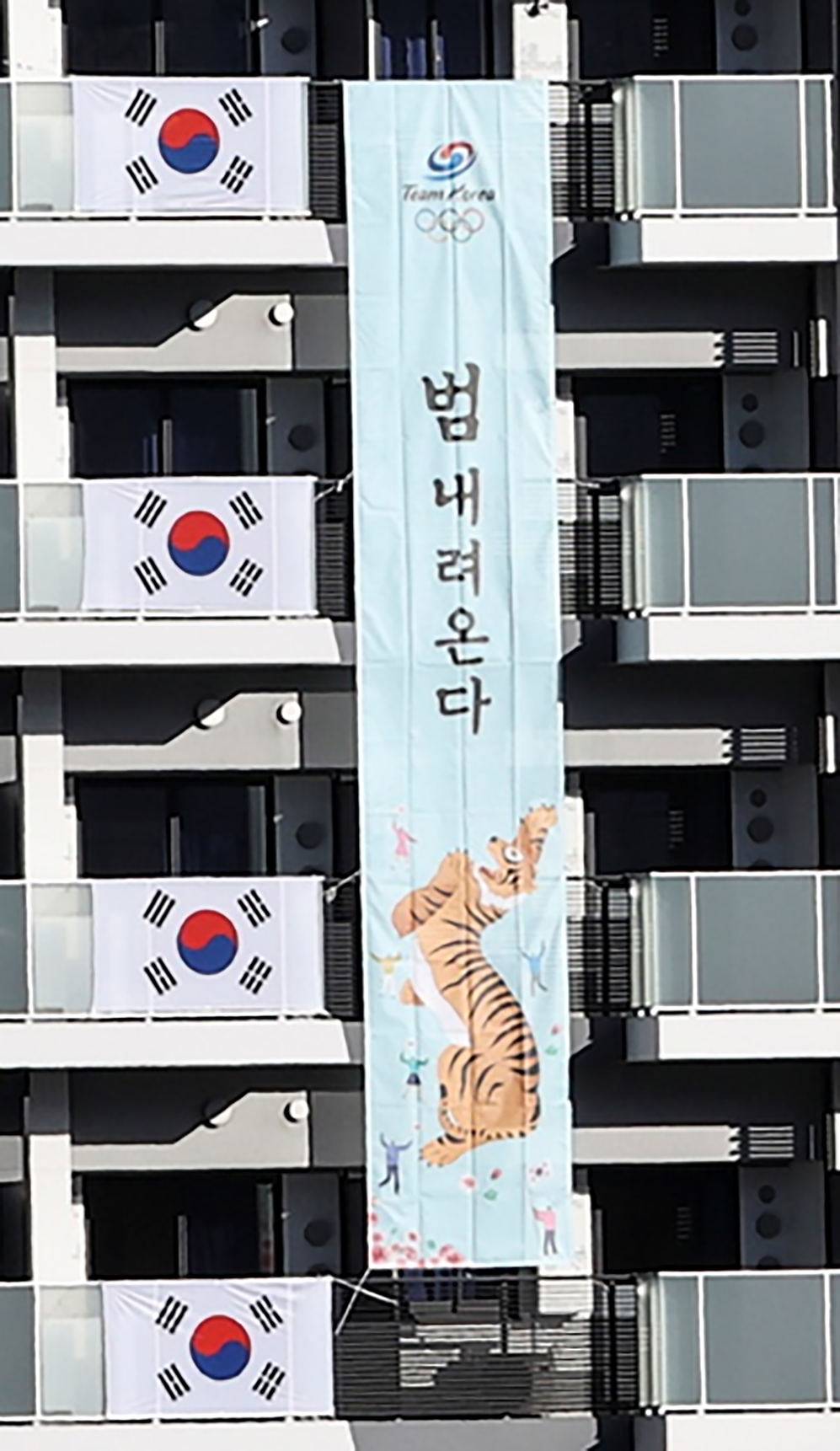
Thus, it was the 1988 Seoul Olympics with its tiger mascot that was a turning point in the genealogy of the tiger as a popular symbol of modern South Korea. Ch'oe Namsŏn's tiger map was rediscovered at this time, but in a more palatable form with Ch'oe's colonial collaboration and the map's Japanese associations discretely erased in favour of an artificially constructed Korean historical past in which tiger maps of the peninsula were commonplace. This narrative was created and diffused by museums, television and the popular press. The idea of Japan was still subtly present in the process of recasting tigers as a symbol of the young and vigorous Korean nation, as observed in the post-colonial reorganization of the Seoul Grand Park Zoo and the refusal to accept the donation of Amur tigers of Japanese origin. As the publicity surrounding the Grand Park Zoo's tiger statue with its anti-corona facemask in 2020 demonstrates, the tiger remains a rallying point for Koreans today. Indeed, a banner displaying an image derived from Ch'oe's tiger map and the words “Pŏmnaeryŏonda” 범내려온다 (“The tiger descends”) has been recently unfurled outside the accommodation for the South Korean team at the Athlete's Village in Tokyo (Fig. 10), indicating that in the summer of 2021 the image still has powerful resonance at the intersection of Korean nationalism, anti-Japanese sentiment and the Olympics (Yonhap News 2021).
Banner displaying an image derived from Ch'oe Namsŏn's tiger map, unfurled at the South Korean accommodation in the Tokyo Olympic Village (Yonhap News 2021).
Acknowledgements
The authors would like to thank Dr. James Lewis for his comments on an earlier draft of this paper and the anonymous reviewers for their advice.
Conflict of interest
The authors declare none.


 Open access

