Book contents
- Frontmatter
- Contents
- List of tables
- Acknowledgments
- Introduction: White-collar crime and the criminal “upperworld”
- 1 The new economy: transformation of finance and opportunities for crime
- 2 The Railway Mania
- 3 Banking and credit fraud
- 4 Stock fraud
- 5 Company fraud: promotion
- 6 Company fraud: management
- 7 Company law and the courts
- 8 Business ethics and professionalization
- Conclusion: Final considerations
- Notes
- Bibliography
- Index
5 - Company fraud: promotion
Published online by Cambridge University Press: 08 December 2009

Book contents
- Frontmatter
- Contents
- List of tables
- Acknowledgments
- Introduction: White-collar crime and the criminal “upperworld”
- 1 The new economy: transformation of finance and opportunities for crime
- 2 The Railway Mania
- 3 Banking and credit fraud
- 4 Stock fraud
- 5 Company fraud: promotion
- 6 Company fraud: management
- 7 Company law and the courts
- 8 Business ethics and professionalization
- Conclusion: Final considerations
- Notes
- Bibliography
- Index
Summary
The greatest opportunities for white-collar crime probably occurred during the promotion of new companies. British company law was the most permissive in all of Europe and gave promoters great latitude in their operations. The ease with which a limited, joint-stock company could be created was remarkable. Seven persons had only to take up one share each in a concern to achieve incorporation. They might have no real stake in the company, but they could sell its shares to the public, have themselves or their friends appointed directors, and trade on the firm's capital in the most reckless manner with no personal liability beyond their own small shareholding. In 1867, only ten years after the liberalization of company law, Parliamentary hearings were held to inquire into the alarming incidence of company fraud. Many witnesses complained that promoters were taking advantage of the law's leniency. The company promoter David Chadwick admitted “there are radical defects in the Act [Companies Act, 1862], and that too great facility is afforded to the promoters of companies who wish to palm off something unsound on the public.” The Master of the Rolls, Lord Romilly, was more blunt:
In a great many cases which have come before me, I am satisfied that the company was formed for the purpose of being wound up, and that the original promoters had no other object than just to put a company on foot which they were satisfied could never be carried into any profitable execution, for the mere purpose of afterwards winding it up in the Court of Chancery.[...]
Information
- Type
- Chapter
- Information
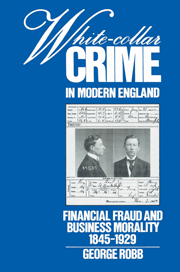
- White-Collar Crime in Modern EnglandFinancial Fraud and Business Morality, 1845–1929, pp. 94 - 124Publisher: Cambridge University PressPrint publication year: 1992
Accessibility standard: Unknown
Why this information is here
This section outlines the accessibility features of this content - including support for screen readers, full keyboard navigation and high-contrast display options. This may not be relevant for you.Accessibility Information
Accessibility compliance for the PDF of this chapter is currently unknown
and may be updated in the future.