Preface
Published online by Cambridge University Press: 31 May 2019

Summary
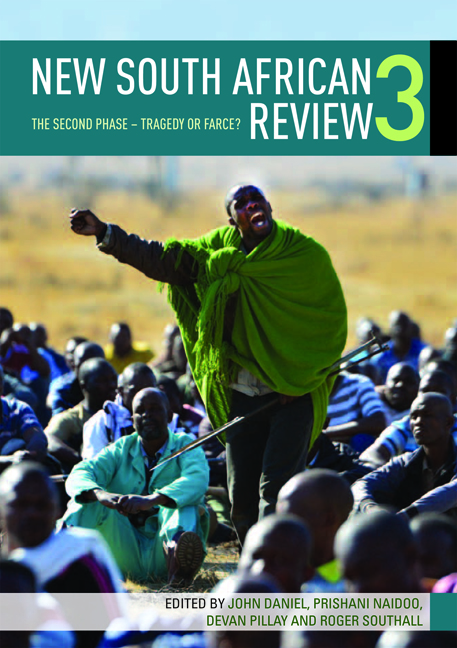
This third edition of the New South African Review indicates that our series of volumes featuring original chapters on issues of concern and interest to South Africa is coming of age, and is an established feature of the annual calendar (although for publishing reasons a new schedule will see it appearing in the first quarter of the year rather than the last). As ever, our chapters seek to present critical and progressive, yet varying, perspectives on current affairs, to encourage debate and diversity rather than conformity. Inevitably, for reasons of economy and practicality, there are numerous topics that we ignore or omit, and it may appear to some that our choice of issues is somewhat random, for although we as editors aim to discern common concerns raised by our contributors, we do not impose a theme upon them. We welcome suggestions of important issues, national or local, for inclusion in later volumes.
The New South African Review continues to be located in the Department of Sociology at the University of the Witwatersrand, Johannesburg, with John Daniel of the School of International Training in Durban having served as an additional editor of this and the two preceding volumes. We should like to thank the University for its financial support for the project under its SPARC Programme, and Professor Tawana Kupe, who served his final year as Dean of Humanities during 2012, for his constant support. Our colleagues in the Department of Sociology provide constant backing, while Ingrid Chunilall and Laura Bloem, our administrators, willingly undertake the numerous backroom tasks necessitated by production of the volume. Once again, we have received the enthusiastic support of Veronica Klipp and all her staff at Wits University Press, while Monica Seeber has exhibited her usual proficiency, combined with her kindly ability to harry recalcitrant contributors to stick to schedule. Finally, alongside our referees who unfailingly provide valuable and constructive comments, we thank all those who have reviewed our previous volumes and who have given us the encouragement to continue with this project on an annual basis.
Information
- Type
- Chapter
- Information
- New South African Review 3The second phase - Tragedy or Farce?, pp. viii - ixPublisher: Wits University PressPrint publication year: 2013
Accessibility standard: Unknown
Why this information is here
This section outlines the accessibility features of this content - including support for screen readers, full keyboard navigation and high-contrast display options. This may not be relevant for you.Accessibility Information
Accessibility compliance for the PDF of this chapter is currently unknown
and may be updated in the future.