

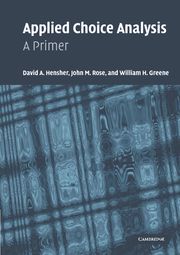
Applied Choice Analysis
A Primer
- Authors:
- David A. Hensher, University of Sydney
- John M. Rose, Institute of Transport Studies, Sydney
- William H. Greene, New York University
- Date Published: June 2005
- availability: Replaced by 9781107465923
- format: Paperback
- isbn: 9780521605779
$
94.99
Paperback
Other available formats:
eBook
Looking for an inspection copy?
This title is not currently available for inspection. However, if you are interested in the title for your course we can consider offering an inspection copy. To register your interest please contact asiamktg@cambridge.org providing details of the course you are teaching.
-
Almost without exception, everything human beings undertake involves a choice. In recent years there has been a growing interest in the development and application of quantitative statistical methods to study choices made by individuals with the purpose of gaining a better understanding both of how choices are made and of forecasting future choice responses. In this primer the authors provide an unintimidating introduction to the main techniques of choice analysis and include detail on themes such as data collection and preparation, model estimation and interpretation and the design of choice experiments. A companion website to the book provides practice data sets and software to estimate the main discrete choice models such as multinomial logit, nested logit and mixed logit. This primer will be an invaluable resource to students as well as of immense value to consultants and professionals, researchers and anyone else interested in choice analysis and modelling.
Read more- Was the first book to help individuals new to the theory and practice of choice analysis
- Data and statistical software available to apply all the modeling and data skills presented in the book
- The book and software is ready made for undergraduate and post graduate courses as well as short courses and is portable throughout the world
Reviews & endorsements
'I cannot imagine a better introduction to choice modeling. The authors manage to bring a vivid, storytelling voice to this complex topic, with language that has personality and rhythm. The various interrelated concepts and procedures that constitute choice modeling come across as simple and straightforward. An amazing feat. The ins-and-outs of a computer code are also taught along with the statistical methods. This integration of computer language within the text is unusual and highly valuable, giving readers all the steps that are needed to implement the methods on their own data.' Kenneth Train, Adjunct Professor, University of California, Berkeley
See more reviews'With all knowledge, the fundamental concepts constitute the most important part of learning. Hensher et al. have taken this to heart and done a superb job here in explaining the trickiest of discrete choice survey and analysis concepts in a simple, elegant, and intuitive fashion. This book, written by leading authorities in the discrete choice field, is required reading not only for beginners, but also for those experienced researchers who would like to clarify basic concepts. It is a much-needed and welcome addition to a field that is seeing a literal revolution in the analyst's ability to incorporate and estimate realistic behavioral structures. The book holds the hands of readers and walks them through the new developments in the field. Let it not be said any more that the recent advances in discrete choice analysis are beyond the reach of all but the nerdiest of researchers!' Chandra Bhat, University of Texas, Austin
Customer reviews
Not yet reviewed
Be the first to review
Review was not posted due to profanity
×Product details
- Date Published: June 2005
- format: Paperback
- isbn: 9780521605779
- length: 744 pages
- dimensions: 244 x 170 x 54 mm
- weight: 1.432kg
- contains: 108 tables
- availability: Replaced by 9781107465923
Table of Contents
Preface
1. In the beginning
2. Basic notations of statistics
3. Choosing
4. Paradigms of choice data
5. Processes in setting up stated choice experiments
6. Choices in data collection
7. Nlogit for applied choice analysis: a primer
8. Handling choice data
9. Case study: model choice data
10. Getting started modelling: the workhorse - MNL
11. Getting more from your model
12. Practical issues in the application of choice models
13. Allowing for similarity of alternatives
14. Nested logit estimation
15. The mixed logit model
16. Mixed logit estimation
Nlogit terms and commands
References
Index.-
Resources for
Applied Choice Analysis
David A. Hensher, John M. Rose, William H. Greene
General Resources
Find resources associated with this title
Type Name Unlocked * Format Size Showing of
This title is supported by one or more locked resources. Access to locked resources is granted exclusively by Cambridge University Press to lecturers whose faculty status has been verified. To gain access to locked resources, lecturers should sign in to or register for a Cambridge user account.
Please use locked resources responsibly and exercise your professional discretion when choosing how you share these materials with your students. Other lecturers may wish to use locked resources for assessment purposes and their usefulness is undermined when the source files (for example, solution manuals or test banks) are shared online or via social networks.
Supplementary resources are subject to copyright. Lecturers are permitted to view, print or download these resources for use in their teaching, but may not change them or use them for commercial gain.
If you are having problems accessing these resources please contact lecturers@cambridge.org.
Related Books
related journals
also by this author


Sorry, this resource is locked
Please register or sign in to request access. If you are having problems accessing these resources please email lecturers@cambridge.org
Register Sign in» Proceed
You are now leaving the Cambridge University Press website. Your eBook purchase and download will be completed by our partner www.ebooks.com. Please see the permission section of the www.ebooks.com catalogue page for details of the print & copy limits on our eBooks.
Continue ×Are you sure you want to delete your account?
This cannot be undone.
Thank you for your feedback which will help us improve our service.
If you requested a response, we will make sure to get back to you shortly.
×