

The Practice of Liberal Pluralism

The Practice of Liberal Pluralism
Author:
William A. Galston, University of Maryland, College Park
Published:
December 2004
Availability:
Available
Format:
Paperback
ISBN:
9780521549639
Looking for an examination copy?
If you are interested in the title for your course we can consider offering an examination copy. To register your interest please contact collegesales@cambridge.org providing details of the course you are teaching.
William Galston defends a theory, liberal pluralism, based on three core concepts--value pluralism, political pluralism, and expressive liberty--and explores the implications of this theory for politics. Liberal pluralism helps clarify some of the complexities of real-world political action and points toward a distinctive conception of public philosophy and public policy.
- Galston is a well-respected political philosopher, with experience both in the political and academic worlds
- Written in a straightforward, non-technical language
Reviews & endorsements
"A worthy successor to the authors highly regarded Liberal Pluralism. Highly recommended." Choice
Product details
- Published: December 2004
- Format: Paperback
- ISBN: 9780521549639
- Length: 216 pages
- Dimensions: 228 × 153 × 17 mm
- Weight: 0.303kg
- Availability: Available




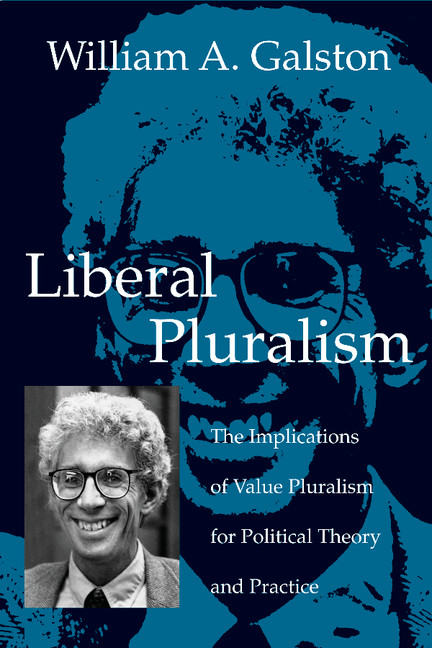

Table of Contents
- 1. Introduction
- Part I. Philosophical Dimensions of Liberal Pluralism:
- 2. Value pluralism and its critics
- 3. Political pluralism and limits on state power
- 4. Expressive liberty and constitutional democracy: the case of freedom of conscience
- Part II. Liberal Pluralism and Public Action:
- 5. Value pluralism and political means: toughness as a political virtue
- 6. Value pluralism and motivational complexity: the case of cosmopolitan altruism
- Part III. Politics, Markets, and Civic Life in Liberal Pluralist Societies:
- 7. The public and its problems
- 8. The effects of modern markets on civic life
- 9. The politics of reciprocity: the theory and practice of mutualism
- Part IV. Defending Liberal Pluralism:
- 10. Liberal pluralism and liberal egalitarianism
- 11. Liberal pluralism between monism and diversity
- 12. Conclusion: liberal pluralism at home and abroad.
- Show more



