

Railways and the Formation of the Italian State in the Nineteenth Century
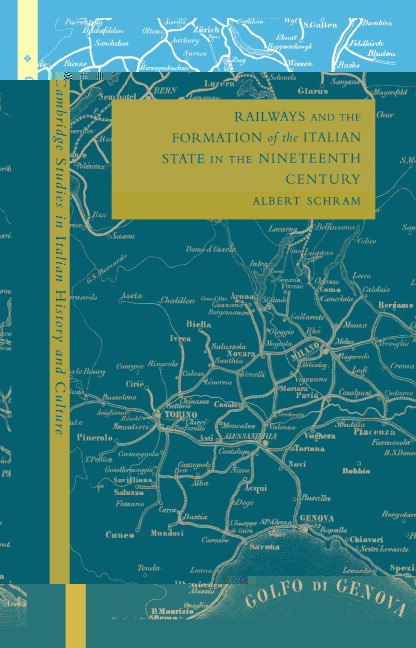
Railways and the Formation of the Italian State in the Nineteenth Century
Looking for an examination copy?
If you are interested in the title for your course we can consider offering an examination copy. To register your interest please contact collegesales@cambridge.org providing details of the course you are teaching.
This book relates the history of Italian railways and their relation with the Italian state from the 1840s, when the first lines were constructed, until nationalization in 1905. The effects of railway legislation are assessed, and various socio-economic indicators for the Italian regions are analyzed. It is shown that railways contributed little to the economic unification of Italy, and that any positive effects were felt mostly in the twentieth century. During the nineteenth century and the process of unification, it is argued that railways had a pernicious and divisive influence on Italian political life.
- An assessment of the role of railways in Italy's century of unification
- Casts doubt on the previous assumption of the crucial socio-economic role of the railways in this period
- Provides information and analysis for business and economic historians, as well as for political historians
Reviews & endorsements
"This very succinct and persuasive account of railway development in the second half of the 19th century validates an older view that the economic impact of the railroads was substantially less than had been predicted." Choice
"This welcome addition to the growing English-language literature on nineteenth-century Italy brings together a great deal of material on the interrelations of the State, the railways, and the economy." Stefano Fenoaltea, Jrnl of Eco Hist
"...this volume is an excellent survey about the transport history of the nineteenth century." Stefano Maggi, American Historical Review
Product details
- Published: November 1997
- Format: Hardback
- ISBN: 9780521571593
- Length: 200 pages
- Dimensions: 236 × 161 × 20 mm
- Weight: 0.46kg
- Contains: 3 b/w illus. 3 maps 32 tables
- Availability: Available








Table of Contents
- List of illustrations
- List of tables
- Acknowledgements
- List of abbreviations
- 1. The history of railways
- 2. Railways and the Italian state in the nineteenth century
- 3. Railway building in Italy
- 4. Railway traffic
- 5. Conclusions
- Bibliography
- Index.
- Show more



