

The Lithium Handbook
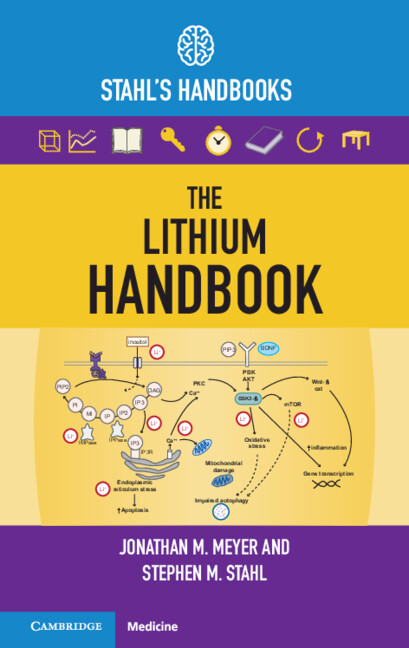
The Lithium Handbook
Looking for an examination copy?
If you are interested in the title for your course we can consider offering an examination copy. To register your interest please contact collegesales@cambridge.org providing details of the course you are teaching.
Worldwide efforts to promote greater lithium use for mood disorders have increased the need for evidence-based guidance addressing key questions related to initiation, monitoring and adverse effect management. This practical handbook provides clinicians with a detailed explanation of lithium's renal journey, how this informs our understanding of polyuria pathogenesis and how medications or hyponatremia can alter lithium clearance. Covering efficacy, pharmacokinetics, toxicity, discontinuation, and use in special patient groups including pregnant and breastfeeding women, older or younger patients, each section also provides a detailed background for its suggested logical approach to managing lithium's renal and other adverse effects. Using the latest data, the book outlines rationales for specific management decisions, and prioritizes options to provide clinical guidance on the best course of action. Colour-coded lists and tables, bulleted text, and diagrams illustrate important points throughout, helping to make information accessible and easy-to-digest. An essential resource for mental health professionals worldwide.
- Offers a reasoned approach to management of non-renal adverse effects, how to interpret and manage changes in TSH and serum calcium, and how to address patient complaints of cognitive dysfunction, polyuria, tremor and other common clinical situations
- Provides detailed coverage of previously overlooked topics such as lithium use during lactation or in patients with Brugada syndrome, and a discussion of the pathogenesis for adverse effects such as hyperparathyroidism, hypothyroidism and renal dysfunction
- Provides an up-to-date review of the latest data from 2020 onwards on the use of lithium during pregnancy and breastfeeding and in child/adolescent bipolar disorder, the rationale for management of lithium related nephrogenic diabetes insipidus with amiloride and acetazolamide, alongside guidance on the use of the 2021 revised CKD-EPI eGFR formula
Reviews & endorsements
‘This is the most authoritative and comprehensive exposition of lithium to date. Lithium is the only medication in psychiatric practice that could be reasonably considered as disease-modifying, and so is worthy of a dedicated exposition of its chemistry, physiological impact, clinical efficacy and safety. Drs Meyer and Stahl deftly explain putative mechanisms of lithium action with both accessibility and nuance. This is a must have for any practitioner prescribing in the mental health space.' Manpreet Kaur Singh, M.D., M.S., Associate Professor of Psychiatry and Behavioral Sciences, Stanford University, Stanford
‘Meyer and Stahl's Lithium Handbook accomplishes a rare feat – a book for clinicians that is comprehensive, scientifically sophisticated, data-based and clinically wise – all at once! It can be read as an overall review or used as a reference book to explore specific questions. The sections reviewing the renal effects of lithium are particularly detailed and thoughtful. The book covers the use of lithium in all clinical areas imaginable, from bipolar disorder to depression to dementia; provides concrete recommendations in pediatric populations, geriatric populations and pregnant women. Overall, a tour de force!' Michael Gitlin, M.D., Distinguished Professor of Clinical Psychiatry, Director, Adult Division of Psychiatry, Director, Mood Disorders Clinic, Geffen School of Medicine at UCLA
‘Dr Meyer has provided a masterpiece for the field by synthesizing and translating the literature as it relates to Lithium for psychiatric and medical disorders that integrates basic and translational research with accessible clinical application; a must-have for clinicians, academics, researchers and all persons interested in the best of care of persons living with bipolar disorder.’ Roger S. McIntyre, M. D., FRCPC, Professor of Psychiatry and Pharmacology, University of Toronto, Canada
‘What a timely appearance of this excellent publication! This year, we observe the 60th anniversary of Geoffrey Hartigan’s article, which first discovered the prophylactic activity of lithium in mood disorders. In the following years, lithium became a gold standard for preventing affective episodes in bipolar illness. Furthermore, many beneficial psychiatric properties of lithium have been established, such as the augmentation of antidepressant drugs and the great benefits of long-term treatment, including antisuicidal, neuroprotective, and antiviral effects. Yet in recent years, the art of lithium treatment has deteriorated, and the use of this valuable drug decreased, probably due to the introduction of other mood-stabilizing medications and a reluctance to employ lithium by psychiatrists, simply uninformed in this respect. And here comes Stahl’s book, with its rectifying and educational message for psychiatrists. The book is bringing hope that, after its careful reading, more patients will become the beneficiaries of lithium therapy.’ Janusz Rybakowski, Professor Emeritus and previous Head, Department of Adult Psychiatry, Poznan University of Medical Sciences; Corresponding member of the Polish Academy of Sciences
Product details
- Published: November 2023
- Format: Paperback
- ISBN: 9781009225052
- Length: 470 pages
- Dimensions: 191 × 122 × 21 mm
- Weight: 0.51kg
- Availability: Available



Table of Contents
- Introduction
- 1. The efficacy story
- 2. Renal handling of lithium
- 3. Clinical pharmacokinetics
- 4. Lithium initiation and monitoring
- 5. Management of routine lithium related adverse effects
- 6. Lithium toxicity
- 7. Special populations and circumstances
- 8. Lithium discontinuation
- Index.
- Show more



