

Local Peace, International Builders
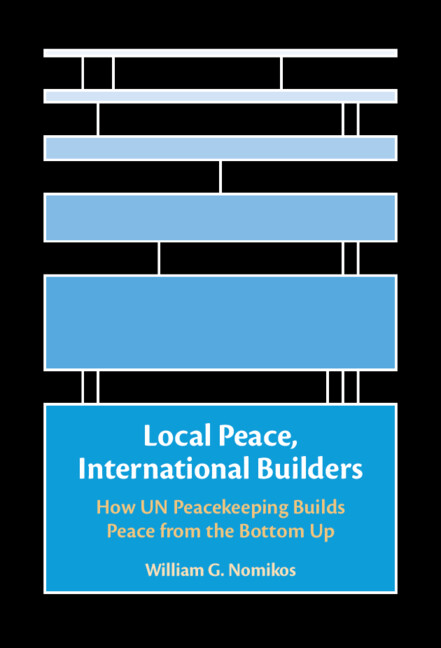
Local Peace, International Builders
Looking for an examination copy?
If you are interested in the title for your course we can consider offering an examination copy. To register your interest please contact collegesales@cambridge.org providing details of the course you are teaching.
Communal disputes over local issues such as land use, cattle herding, and access to scarce resources are a leading cause of conflict across the world. In the coming decades, climate change, forced migration, and violent extremism will exacerbate such disputes in places that are ill equipped to handle them. Local Peace, International Builders examines the conditions under which international interventions mitigate communal violence. The book argues that civilian perceptions of impartiality, driven primarily by the legacies of colonialism, shape interveners' ability to manage local disputes. Drawing on georeferenced data on the deployment of over 100,000 UN peacekeepers to fragile settings in the 21st century as well as a multimethod study of intervention in Mali – where widespread violence is managed by the international community – this book highlights a critical pathway through which interventions can maintain order in the international system. This title is also available as Open Access on Cambridge Core.
- Systematically investigates the effect of UN peacekeeping on local-level violence and the conditions under which these operations promote peaceful interactions between civilian communities in fragile settings
- Analyzes data from both conflict and post-conflict settings using different methodological approaches from multi-disciplinary perspectives, showing how these can interact to provide robust support of a theory
- Highlights ways that the international community can prevent violence driven by climate change and violent extremists, demonstrating how local politics can affect the international system and how international relations can shape local outcomes
- This title is also available as Open Access on Cambridge Core
Reviews & endorsements
‘Through this book, readers will gain a novel perspective on the role of peacekeeping in building local peace. With careful fieldwork, lab-in-the-field experiments, cross-national analyses, and in-depth case studies, Nomikos provides compelling evidence that UN peacekeepers are uniquely capable of reducing communal violence. This is essential reading for practitioners, scholars and students of peacemaking and peacebuilding.’ Kyle Beardsley, Professor of Political Science, Duke University and co-author of Equal Opportunity Peacekeeping
‘Local Peace, International Builders offers an important contribution to a new generation of research on peacekeeping. Through an artful combination of research methods, Nomikos underscores the critical importance of peacekeeper impartiality. Citizen perceptions of peacekeepers on the ground in their day to day lives, we learn, make an enormous difference in the effectiveness of post-conflict recovery. Both scientific and optimistic, this book is a model for the next generation of peacekeeping research.’ Susan D. Hyde, Robson Professor of Political Science, University of California, Berkeley
‘How do UN peacekeepers keep the peace? William Nomikos offers a micro-level theory of peacekeeping, based on years of research in and on Mali, including interviews with local leaders and peacekeepers, behavioral games, surveys, and georeferenced data on troop deployments. He finds that when peacekeepers are viewed as impartial arbiters of communal disputes, they are able to de-escalate local conflicts that would otherwise escalate to broader violence. This is a must-read for anyone interested in peacekeeping and the de-escalation of violence.’ Lise Morjé Howard, Professor of Government and Foreign Service, Georgetown University
‘Although UN peacekeeping is often viewed skeptically, Will Nomikos demonstrates that it can have strongly positive effects in mitigating local conflicts when peacekeepers are perceived to be impartial. A thoroughly researched, multi-method study that explains when, how, and why peacekeeping matters with important lessons for the conduct of future peacekeeping missions.’ David A. Lake, Gerri-Ann and Gary E. Jacobs Professor of Social Science and Distinguished Professor of Political Science, University of California San Diego
‘This work is one of the few that empirically tests the effects of unbiased actions and underlines their importance. The book’s findings and conclusion contain clear policy implications, even though it has been almost a decade since the UN authorized a new peacekeeping operation. … Highly recommended.’ P. F. Diehl, Choice
Product details
- Published: January 2025
- Format: Hardback
- ISBN: 9781009432146
- Length: 218 pages
- Dimensions: 229 × 152 × 14 mm
- Weight: 0.469kg
- Availability: Available





Table of Contents
- Part I. Localized Peace Enforcement Theory:
- 1. Introduction: understanding interventions to stop local-level violence
- 2. The evolution of local-level UN peacekeeping
- 3. A micro-level theory of UN peacekeeping
- 4. Research design: developing empirical tests of the theory
- Part II. Applying the Theory to a Case Study-Mali:
- 5. Introduction to ethnic conflict and international intervention in Mali
- 6. Individual peace: experimental tests on beliefs about cooperation
- 7. Communal peace: sub-national tests of escalation dynamics
- Part III. Implications for Academics and Policy-Makers:
- 8. International peace: cross-national tests of impartiality
- 9. Conclusion: local-level conflict and the future of international intervention.
- Show more



