

The Rise of Early Modern Science

The Rise of Early Modern Science
Looking for an examination copy?
If you are interested in the title for your course we can consider offering an examination copy. To register your interest please contact collegesales@cambridge.org providing details of the course you are teaching.
Now in its third edition, The Rise of Early Modern Science argues that to understand why modern science arose in the West it is essential to study not only the technical aspects of scientific thought but also the religious, legal and institutional arrangements that either opened the doors for enquiry, or restricted scientific investigations. Toby E. Huff explores how the newly invented universities of the twelfth and thirteenth centuries, and the European legal revolution, created a neutral space that gave birth to the scientific revolution. Including expanded comparative analysis of the European, Islamic and Chinese legal systems, Huff now responds to the debates of the last decade to explain why the Western world was set apart from other civilisations.
- Places Western, Islamic and Chinese philosophies of nature in the context of cultural and institutional structures
- Highlights the importance of legal history in the rise of modern science
- This revised and updated third edition further investigates the religious history of Islam and Islamic attitudes towards Greek natural philosophy
Reviews & endorsements
'A remarkable and eminently readable blend of rich historical details and analysis of the rise of modern science. An exemplar of how comparative historical sociology of science ought to be done.' Zaheer Baber, author of The Science of Empire: Scientific Knowledge, Civilization and Colonial Rule in India
'Why did the scientific revolution take place in Europe and not in China or in the Islamic world? Toby E. Huff gives this controversial question an extraordinarily wide-ranging and deep examination. Surprisingly, the answer may lie largely in the nature of Western educational institutions and in the structure of Western law.' Owen gingerich, Professor Emeritus of Astronomy and History of Science, Harvard Smithsonian Center of Astrophysics
Product details
- Published: July 2017
- Format: Hardback
- ISBN: 9781107130210
- Length: 396 pages
- Dimensions: 234 × 158 × 22 mm
- Weight: 0.75kg
- Contains: 24 b/w illus.
- Availability: Available






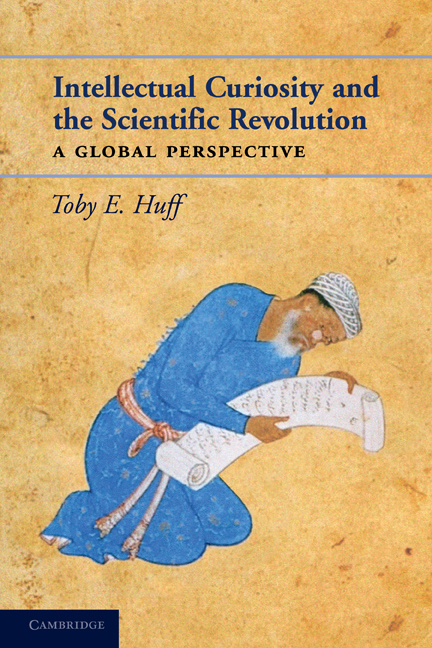


Table of Contents
- Introduction
- Part I:
- 1. The comparative study of science
- 2. Arabic science and the Islamic world
- 3. Philosophy, science, and civilizational configurations
- 4. The European legal revolution
- 5. Madrasas and the transmitted sciences
- 6. Universities and the institutionalization of science
- Part II:
- 7. Science and civilization in China
- 8. Education, examinations, and Neo-Confucianism
- 9. Poverties and triumphs of Chinese science
- Part III:
- 10. The rise of modern science
- Epilogue: science, history and development.
- Show more
