

Aristotle's Ethics and Medieval Philosophy
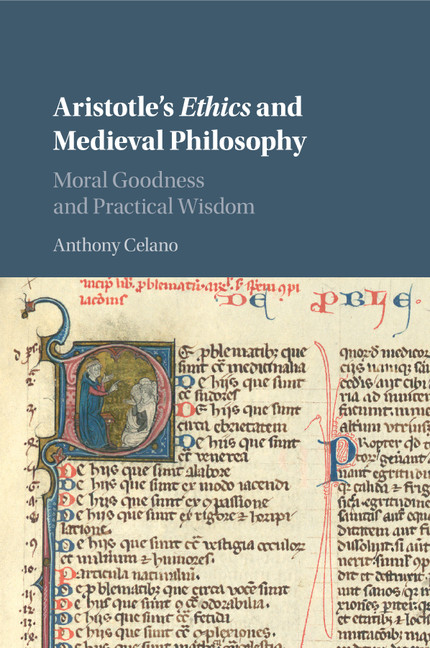
Aristotle's Ethics and Medieval Philosophy
Looking for an examination copy?
If you are interested in the title for your course we can consider offering an examination copy. To register your interest please contact collegesales@cambridge.org providing details of the course you are teaching.
Aristotle's Nicomachean Ethics had a profound influence on generations of later philosophers, not only in the ancient era but also in the medieval period and beyond. In this book, Anthony Celano explores how medieval authors recast Aristotle's Ethics according to their own moral ideals. He argues that the moral standard for the Ethics is a human one, which is based upon the ethical tradition and the best practices of a given society. In the Middle Ages, this human standard was replaced by one that is universally applicable, since its foundation is eternal immutable divine law. Celano resolves the conflicting accounts of happiness in Aristotle's Nicomachean Ethics, demonstrates the importance of the virtue of phronesis (practical wisdom), and shows how the medieval view of moral reasoning alters Aristotle's concept of moral wisdom.
- Reconciles two concepts of happiness in Aristotle's Ethics to present a new perspective
- Provides accessible translations, interpretations and explanations of primary texts in ancient Greek and medieval Latin philosophy
- Examines the secondary literature in English, French, German and Italian
Reviews & endorsements
'Celano’s textual analyses are laborious, and some features of his story may be considered stimulating insights. His construal of phronesis as primary to Aristotle’s moral conception (viii), his emphasis on Albert’s contribution to medieval moral thought …, and his inclusion of the largely uncharted anonymous Erfurt commentary … represent important contributions.' Katja Krause, Journal of the History of Philosophy
Product details
- Published: March 2018
- Format: Paperback
- ISBN: 9781316500934
- Length: 273 pages
- Dimensions: 230 × 153 × 15 mm
- Weight: 0.4kg
- Availability: Available


Table of Contents
- Preface
- 1. Preliminary considerations
- 2. Practical wisdom in the moral theory of Aristotle
- 3. The moral theories of William of Auxerre and Philip the Chancellor
- 4. The earliest Medieval Latin commentaries on the Nicomachean Ethics
- 5. The early moral works of Albert the Great
- 6. Happiness, prudence and moral reasoning in the later works of Albert the Great
- 7. Thomas Aquinas and Bonaventure on the understanding of moral goodness
- 8. Two commentaries on the Nicomachean Ethics in the late thirteenth century
- 9. Conclusion.
- Show more



