
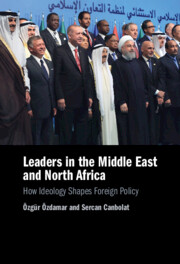
The study of politics in the MENA region has traditionally been dominated by historical and case study approaches. In this innovative book, Özgür Özdamar and Sercan Canbolat instead adopt a social science-based methodology to reconsider the dynamics of power and leadership in Africa and the Middle East. By analysing the psychological profiles of fourteen leaders across eight countries and three non-state organizations, they develop a nuanced portrait of modern leadership. Using this approach, the authors are able to draw connections between apparently disparate political ideologies, from Sunni Islamism to Shia revolutionism, from secular nationalism and armed non-state groups. Demonstrating the previously unacknowledged commonalities and divergences in these leaders' approaches, Özdamar and Canbolat illuminate their tactics and strategies and offer novel insights into how best to negotiate with them.
Co-winner, 2023 ISA Foreign Policy Analysis Section Outstanding Book Award, International Studies Association
‘This book bears all the hallmarks of an instant classic. To what extent are the foreign policies of MENA nations influenced by the personalities and personal beliefs of their leaders? The authors answer that question with a wide-ranging operational code analysis of historical and contemporary MENA leaders. This volume will be of immense interest to scholars and foreign policymakers alike.'
Valerie Hudson - Texas A&M University
‘This is a breakthrough in the study of leadership in the Middle East and North Africa. Operational code analysis is applied to gain insights into how political Islam and other factors shape foreign policy. The book is essential reading for scholars of MENA and international relations in general.'
Patrick James - University of Southern California
‘This book is an excellent example of how combining foreign policy analysis with regional expertise sharpens the analysis of international relations. Özdamar and Canbolat put leaders front and centre to make significant contributions to our understanding of the dynamics in the region and to multiple areas of scholarship.'
Julie Kaarbo - University of Edinburgh
‘The authors of this pathbreaking volume show how key operational code beliefs regarding the exercise of power vary across MENA leaders with the same ideology and between groups with different ideologies to account for their distinct foreign policy decisions and approaches to important regional and global issues in world politics.'
Stephen G. Walker - Arizona State University
Loading metrics...
* Views captured on Cambridge Core between #date#. This data will be updated every 24 hours.
Usage data cannot currently be displayed.
This section outlines the accessibility features of this content - including support for screen readers, full keyboard navigation and high-contrast display options. This may not be relevant for you.
Accessibility compliance for the PDF of this book is currently unknown and may be updated in the future.

