

Since its publication in 2006, Kalyvas’s (Reference Kalyvas2006) landmark classic The Logic of Violence in Civil War has occupied a central place in the study of civil war and conflict processes. The control–collaboration model of violence, outlined in Kalyvas’ book, has been the subject of numerous empirical tests, extensions, and refinements (Balcells Reference Balcells2017; Bhavnani, Miodownik, and Choi Reference Bhavnani, Miodownik and Choi2011; Kalyvas and Kocher Reference Kalyvas and Adam Kocher2009; Steele Reference Steele2017; Vargas Reference Vargas2009) and has sparked a far-reaching research agenda on the micro-level dynamics of civil war (Kalyvas Reference Kalyvas2012). The book also has increasingly appeared on political science syllabi, partly as a result of its accessible and gripping style—ideal for undergraduate audiences—as well as the proliferation of peace and conflict resolution majors and MA degrees. These developments respond to a pressing need in policy circles for sophisticated analysis of conflicts in an increasingly conflict-ridden world.
Yet, despite its importance to conflict scholarship, Kalyvas’s control–collaboration model has not been previously simulated so that it may be taught in an intuitive manner to advanced students. This is unfortunate because simulations have proven to be valuable pedagogical tools for teaching abstract models of political behavior (Asal Reference Asal2005; Brynen Reference Brynen2010; Haynes Reference Haynes2015; Kollars and Rosen Reference Kollars and Rosen2017; Levin-Banchik Reference Levin-Banchik2018; Shellman and Turan Reference Shellman and Turan2006). Moreover, whereas The Logic of Violence in Civil War builds its theoretical scaffolding with exceptional clarity, the core of the control–collaboration model and its empirical implications may be less clear to undergraduates. This is because Kalyvas (2006, 197–207) presented the theory’s key insight in a formal model that may prove difficult for some students to translate into concrete terms. Furthermore, the book makes demands on its readers’ ability to empathize with the choices made by individuals caught up in wartime situations.
This article describes a classroom simulation based on the logic of Kalyvas’s control–collaboration model, which presents students with strategic choices available to both armed actors and noncombatants in a contested village. The simulation is adapted from the game “Mafia,” in which a group of innocents attempts to identify an unknown killer before all are killed (Davidoff Reference Davidoff1999). In my adaptation, the killers are known (i.e., soldiers belonging to two armies, Red and Black), whereas the civilian loyalties necessary to select their targets are private information partially known by the other students (i.e., the villagers, divided into four clans: Clubs, Diamonds, Hearts, and Spades). The soldiers attempt to arrest their opponents’ loyalists and the villagers attempt to manipulate the soldiers into arresting local rivals. The simulation captures three core elements of Kalyvas’s control–collaboration model: the joint production of violence by combatants and noncombatants, the concentration of selective violence in zones of partial control, and the disjuncture between a conflict’s master and local cleavages.
The simulation captures three core elements of Kalyvas’s control–collaboration model: the joint production of violence by combatants and noncombatants, the concentration of selective violence in zones of partial control, and the disjuncture between a conflict’s master and local cleavages.
DESCRIBING KALYVAS’S CONTROL–COLLABORATION MODEL
Kalyvas argued that both indiscriminate and selective violence are ultimately functions of the level of local control exercised by competing armed actors. The model assumes that armed actors engaged in irregular warfare prefer to use selective violence in territories under their control. Specifically, government and rebel forces seek to arrest or kill their opponents’ supporters scattered among the civilian population, but they lack information on individual civilian loyalties that—after all—are easily falsified. Armed actors can overcome this “identification problem” by relying on denunciations from civilian informants (Kalyvas Reference Kalyvas2006, 89–91). This is because civilians possess the local knowledge necessary to identify defectors that armed groups lack. Yet, civilians’ goals do not necessarily align with those of occupying armies. Whereas denouncers may proffer accurate information, they also may falsely denounce their rivals in local familial, economic, and romantic disputes. That is, denunciations often are driven by “local” dynamics rather than the conflict’s “master cleavage” (Kalyvas Reference Kalyvas2003).
Selective violence therefore results from a “joint process” in which civilians provide (often inaccurate or malicious) information and armed actors’ provide violence. However, civilians are likely to proffer the necessary denunciations only when an armed actor controls a territory strongly enough to credibly protect the civilians from its opponent’s retaliation. Thus, levels of selective violence can be predicted by the local balance of military control between the competing armies.
Figure 1 shows the complicated relationship between the level of control by each armed group in any given region and the amount of selective violence predicted by the theory. Kalyvas divided control into five zones. Zones 1 and 5 are completely controlled by Actors A and B, respectively, and thus should see “no defection, no denunciation, and no [selective] violence” (Kalyvas Reference Kalyvas2006, 203).Footnote 1 In Zone 3, Actors A and B have equal levels of control (e.g., one side controls a village during the day and the other at night). In this zone, although the actors have a strong incentive to punish civilian defectors to gain control of the zone, they can offer no credible protection to potential informers. Thus, civilians have no incentive to inform and, again, little violence takes place. In Zones 2 and 4, however, the incentives of armed actors and civilians align. In these zones, one armed actor possesses dominant but incomplete control. This actor possesses a strong incentive to identify and punish defectors and can provide credible protection to informers. Thus, the model predicts high levels of selective violence in Zones 2 and 4.

Figure 1 Predicted Pattern of Selective Violence, Defection, and Denunciation
Source: Kalyvas Reference Kalyvas2006, 204
DESCRIBING THE SIMULATION: SETTING AND ROLES
The simulation is set in a village contested by two occupying armies in a civil war, with students taking on the role of either soldier or villager. These roles are randomly assigned using a standard 52-card deck that is carefully prepared before the simulation. Students who are dealt number cards are villagers whereas those who receive Jacks (and, in larger classrooms, Queens) are soldiers, with the ratio of villagers to soldiers roughly 4:1. Instructors should remove all extraneous cards; for example, in a minimal class of 10 students, the deck should contain 10 cards: the 2 and 3 of clubs, the 2 and 3 of diamonds, the 2 and 3 of hearts, the 2 and 3 of spades, a red Jack, and a black Jack. For 20 students, instructors should add the 4 and 5 of each suit and a second red and black Jack. “Red” and “Black” represent different sides of the civil war (i.e., opposing sides of the master cleavage) and the different suits (i.e., clubs, diamonds, hearts, and spades) represent different village clans (i.e., villagers’ identities with respect to local cleavages). The students should keep their cards hidden as they are being dealt.
Discovery Round
After instructors deal the cards, they should ask the soldiers to hold up their cards and publicly identify themselves. The soldiers then must close their eyes and put their head down as the villagers hold up their cards. Villagers thereby learn all of the identities within their village: who belongs to their own clan and who belongs to opposing clans, as well as who supports Red and who supports Black. However, soldiers are not privy to any of this “private” information. At this point, the simulation begins.
Battle Round
The soldiers now must battle for control of the village, determining where it falls within Kalyvas’s typology of zones of control: Zone 1 (total incumbent control), Zone 2 (partial incumbent control), Zone 3 (fragmented control), Zone 4 (partial insurgent control), and Zone 5 (total insurgent control). A rock-paper-scissors match determines the outcome of the battle and therefore the zone of control.
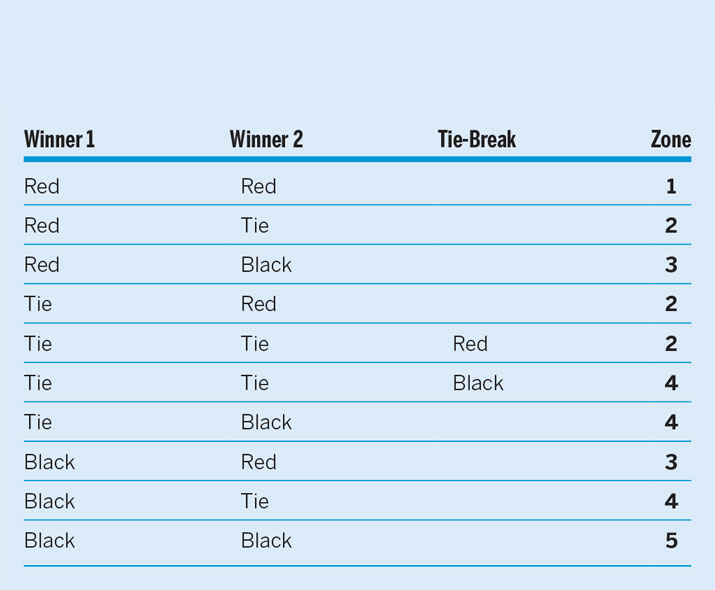
One soldier from each army (chosen on a rotating basis) plays rock-paper-scissors. They should “shoot” two matches, unless this results in two ties, in which case a tie-break match determines “partial” control.Footnote 2 Table 1 shows the different rock-paper-scissors outcomes and the resulting zone of control.
Table 1 Rock-Paper-Scissors Decision Rule
If the village is under “full” or “partial” control at the conclusion of the Battle Round, the losing army’s soldiers must leave the room and are not allowed to observe the subsequent Denunciation Round. If the village is under “fragmented” control, all soldiers remain in the room during the Denunciation Round.
Denunciation Round
During the Denunciation Round, the soldiers who remain in the classroom have three minutes to ask the villagers questions. (Instructors should consider setting an alarm to ensure that the round does not drag on if villagers do not share information.) The soldiers’ goal is to ascertain the identities of the opposing army’s supporters in the village so that they then can arrest them (i.e., Kalyvas’s identification problem). The villagers’ goals are to (1) avoid individual arrest, and (2) direct soldiers to arrest members of opposing clans. Villagers may publicly accuse others or privately write names on a sheet of paper (labeled an “informant sheet”) to give to the soldiers.
At the end of the Denunciation Round, each army in the classroom can arrest one villager of its choice. Therefore, in Zones 1 and 2, where the Black Army has been sent out of the classroom, Red Army soldiers will confer briefly at the end of the Denunciation Round and agree on which villager to arrest. In Zones 4 and 5, only Black Army soldiers will confer and make an arrest. In Zone 3, or fragmented control, both armies can make an arrest. The armies also may choose to forgo arresting a villager if they think they lack enough information to select a target.
Upon arrest, villagers reveal their card and all players observe the outcome of the round.Footnote 3 If an army has been sent out of the room, instructors will recall them to inform them of the outcome. Instructors calculate any team points won or lost. At this point, the next round of the simulation begins, starting with a new Battle Round.
The Denunciation Round produces villager strategies that often closely align with the expectations of Kalyvas’s theory.
Villager Strategies in the Denunciation Round
The Denunciation Round produces villager strategies that often closely align with the expectations of Kalyvas’s theory. In zones of full or partial control, where only one army is present in the room, denunciations should abound. In zones of fragmented control, with both armies present, theory predicts few denunciations; villagers should not be willing to risk publicly identifying their loyalties in front of the opposing army. However, students often behave less rationally than we would expect of real-life security-maximizing villagers, and some tend to talk freely under fragmented control. These students are likely to find themselves rapidly arrested, reflecting a Colombian campesino’s pithy statement, “Aquí el que habla, no dura” (“Those who talk don’t last long here”) (Kalyvas Reference Kalyvas2006, 227).
Other behaviors predicted by Kalyvas can be commonly observed in this classroom simulation. These include “preference falsification” (Kalyvas Reference Kalyvas2006, 93–101): in zones of full or partial control, villagers who are loyal to the absent army should feign loyalty to the occupying army. The students also likely will observe “counter-denunciations” (Kalyvas Reference Kalyvas2006, 195) and even mutually destructive cycles of revenge between clans (Kalyvas Reference Kalyvas2006, 58–61).
It is important to note that soldiers’ and villagers’ goals only partially align. Whereas soldiers seek to identify which villagers support Red or Black (i.e., the master cleavage), villagers are concerned only with promoting their clan (i.e., Clubs, Diamonds, Hearts, or Spades—the local cleavage). As Kalyvas predicted, denunciations in the simulation may reflect this disjuncture between the master cleavage and local-level loyalties. Thus, members of the Hearts clan may denounce a member of the Diamonds clan in pursuit of their local victory, despite the fact that both clans are Red in the context of the master cleavage. Similarly, astute players in the Spades clan might use the strategy of denouncing Clubs when under Red Army control; this simultaneously strikes at a local rival while also bolstering the credibility of the Spades’ feigned loyalty to Red.
Scoring System
Soldiers and villagers score points for meeting different goals. The soldiers seek to win the conflict, whereas villagers seek to survive and promote their local clan. At the instructor’s discretion, the simulation may end after a designated number of rounds or when one army scores five points.
The scoring system serves two goals: it is simple enough for students to quickly understand and strategize around, and it parallels actors’ incentives in Kalyvas’s control–collaboration model. Instructors may easily modify the scoring system to fulfill different pedagogical goals. Points may count for extra credit at the instructor’s discretion to further incentivize rational decision making.
The army with the most points at the end of the simulation wins.Footnote 4 Armies can gain or lose points based on the outcome of each Denunciation Round. Specifically, an army gains one point (+1) for every round in which it achieves full control of the village. It can do this by (1) winning full control in the Battle Round, or (2) arresting one of its enemy’s supporters under fragmented or partial control. However, an army loses a point (-1) if it arrests its own supporter. If this happens after having won full control, it also loses the point gained in the Battle Round (i.e., -2 in total). This deters armies from making arrests under full control—as Kalyvas (2006, 203) argued, violence under such circumstances is often counterproductive.Footnote 5
Villagers, by contrast, gain a point (+1) for every round they survive. They also gain five points (+5) if their clan has the most members left at the end of the simulation. Therefore, villagers first should seek their own survival and, second, seek to promote the interests of their clan by denouncing members of other clans. Villagers do not gain any points from victories by the Red or Black Army, which exemplifies the disjuncture between local and macro-cleavages.
TEACHING THE MODEL
Simulating Violence
Any simulation of civil war violence requires sensitivity on the part of both the instructors and the students. Instructors should consider the classroom context before running this simulation. It would not be appropriate for an introductory comparative politics course; rather, it should be run in advanced courses that treat political violence as a central topic. Due to the fraught subject matter and the emotional challenge of strategies that depend on prevarication, some students may find this simulation stressful. However, although I give my students the option to skip individual classes that may be triggering, none have exercised that option for this simulation and none have expressed regret about participation.
Before the simulation, instructors should prepare students by reminding them to be respectful of one another and of victims of civil war violence. Instructors may also take several steps to lower stakes, such as eschewing the violent language of killings and assassinations in favor of “arrests.” Furthermore, the simulation can be set in a fictional country or a fantastical pop-culture setting (e.g., with students taking the roles of rebels, imperial storm troopers, or moisture farmers).
Finally, instructors can move from strategies to the emotions that players felt during the simulation, which can range from frustration to worry, excitement, and desire for revenge. How might these emotions translate into the violent dynamics of actual civil wars?
Pedagogy
Instructors can take several steps to help students understand the logic of the simulation and Kalyvas’s model. First, they should draw on the board a column for each of the five zones of control and record in which zone each arrest occurs. If the students play relatively strategically, it should become clear that arrests cluster in Zones 2 and 4, approximating the pattern predicted in figure 1.Footnote 6
Second, instructors should follow the simulation with a discussion of the players’ strategies. They may ask soldiers to explain how they sought to determine the accuracy of the information they were receiving as well as which signals they took as credible and which they deemed unlikely to be true. An example from the game, in which two villagers denounced and counter-denounced one another, could be examined. How did the soldiers determine which villager to believe?
Third, instructors should ask soldiers to delineate the social structure of the village, if they are able. Which villagers belonged to which clan? Fourth, instructors should ask villagers to outline their strategies for survival and for clan victory. These strategies are likely to be varied, as discussed previously.
Finally, instructors can move from strategies to the emotions that players felt during the simulation, which can range from frustration to worry, excitement, and desire for revenge. How might these emotions translate into the violent dynamics of actual civil wars?
ASSESSING STUDENT LEARNING
To evaluate the simulation’s effectiveness as a teaching technique, I tested students’ learning and knowledge retention with an anonymous extra-credit pop quiz six weeks after the simulation (Levin-Banchik Reference Levin-Banchik2018). I gave quizzes to two matched classes: one that participated in the simulation and a debriefing and one that learned Kalyvas’s model through active learning and a subsequent classroom discussion applying the model to three cases studied earlier in the course (i.e., Syria, Yemen, and Libya). Both classes were assigned pages 87–104, 111–124, 138–153, and 173–209 from Kalyvas (Reference Kalyvas2006), and two full class periods were devoted to the control–collaboration model. Because class sizes (and therefore sample sizes) were small, I increased the comparison’s power by biasing the experimental design against the simulation—that is, I selected a higher-level course focused on political violence as the control group.
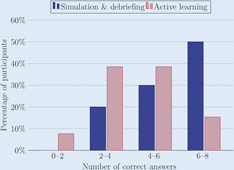
The pop quiz contained eight questions that focused on the control–collaboration model’s three main themes identified previously. Table 2 presents results of the assessment, which indicate that the simulation achieved its educational goals: six weeks after the lessons, students who took part in the simulation and debriefing demonstrated more learning and knowledge retention than students who were taught with typical active-learning techniques. As figure 2 shows, 50% of all students participating in the simulation correctly answered six to eight questions on the quiz, whereas only 15.4% did so in the control group.
Table 2 Class Pop Quiz Performance
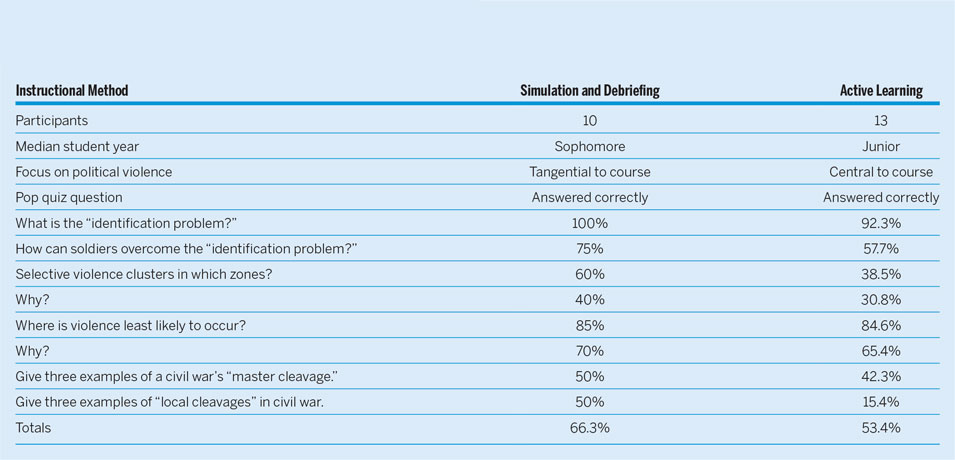

Figure 2 Individual Student Performance on Pop Quiz
SIMULATION VARIANTS
Three variants of the simulation are presented in the online supplemental appendix. The variants introduce role playing; pair the simulation with case studies; and add themes of forced displacement, local peace building, and endogenous identity formation.
CONCLUSION
This article describes a classroom simulation of Kalyvas’s control–collaboration model of the logic of violence in civil war. Given growing enrollments in conflict resolution programs—and the growing incidence of real-world conflict—this simulation fills an important pedagogical need. Students should leave the simulation with an intuitive sense for Kalyvas’s theory. Indeed, the previous assessment shows that the simulation is especially likely to aid students with more difficult aspects of Kalyvas’s model—that is, the distribution of selective violence and the distinction between master and local cleavages—which are built into the simulation’s design. Moreover, after spending a class period making the difficult life-and-death decisions that confront noncombatants caught up in civil war, students should develop a greater empathy for the victims of conflict.
SUPPLEMENTARY MATERIAL
To view supplementary material for this article, please visit https://doi.org/10.1017/S1049096519000222