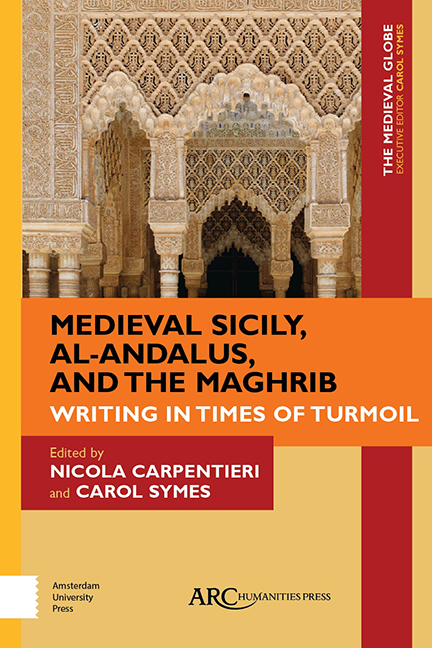
Book contents
- Frontmatter
- Contents
- Acknowledgements
- Introduction
- The Indiculus luminosus and the Creation of a Ninth-Century Prophetic Conflict between Christianity and Islam
- Empire and Caliphate in the Life of John of Gorze
- The Writing of Munāẓarāt in Times of Turmoil: Disputations inFatimid Ifrīqiya
- Messaging and Memory: Notes from Medieval Ifrīqiya and Sicily
- “And God Dispersed Their Unity”: Historiographical Patterns in Recounting the End of Muslim Rule in Sicily and al-Andalus
- A Wondrous Past, a Dangerous Present: The Egyptian Temple of Akhmīm and the Martorana Church in Palermo, as Seen through Ibn Jubayr’s Travelogue
- How Does a Moorish Prince Become a Roman Caesar? Fictions and Forgeries, Emperors and Others from the Spanish “Flores” Romances to the Lead Books of Granada
- Index
The Indiculus luminosus and the Creation of a Ninth-Century Prophetic Conflict between Christianity and Islam
Published online by Cambridge University Press: 20 November 2020
Book contents
- Frontmatter
- Contents
- Acknowledgements
- Introduction
- The Indiculus luminosus and the Creation of a Ninth-Century Prophetic Conflict between Christianity and Islam
- Empire and Caliphate in the Life of John of Gorze
- The Writing of Munāẓarāt in Times of Turmoil: Disputations inFatimid Ifrīqiya
- Messaging and Memory: Notes from Medieval Ifrīqiya and Sicily
- “And God Dispersed Their Unity”: Historiographical Patterns in Recounting the End of Muslim Rule in Sicily and al-Andalus
- A Wondrous Past, a Dangerous Present: The Egyptian Temple of Akhmīm and the Martorana Church in Palermo, as Seen through Ibn Jubayr’s Travelogue
- How Does a Moorish Prince Become a Roman Caesar? Fictions and Forgeries, Emperors and Others from the Spanish “Flores” Romances to the Lead Books of Granada
- Index
Summary
“LORD, DECLARE YOUR words through my mouth; feed me the crumbs from your table as your hound, baying for you against the rabid wolf.” This prayer was written in 854 in Umayyad Córdoba by Paulus Alvarus (ca. 800– 861), a Christian layman whose Indiculus luminosus (Enlightened Little List) survives as the earliest Latin treatise to deal extensively with the Prophet Muḥammad. While it enjoyed little success in subsequent generations, surviving in a single, damaged manuscript, scholars have studied the Indiculus as a glimpse into the so-called Córdoban martyrs’ movement of the 850s, or more abstractly as evidence of early medieval Muslim– Christian interaction. Between 850 and 857, forty-eight individuals “intentionally sought their executions in Córdoba,” with some travelling a great distance to do so, “by publicly insulting the prophet Muḥammad and denying the truth of Islam, or refusing to return to Islam after apostatizing.” Against this backdrop, Alvarus wrote a text that may have begun as a speech to the Christian elites of Córdoba, wherein he cast himself as a prophet to galvanize his Christian compatriots to assert their Christianity publicly and so oppose Islam and, by extension, the ruling regime. Through his Indiculus luminosus, Alvarus thus asserted his own prophetic authority in order to discredit that of Muḥammad, whom Alvarus imagined in this text as his opponent.
Modern scholarship has often interpreted the Indiculus as a defence of the recent martyrs, as a call to martyrdom or violent rebellion, or even as an early formulation of holy war ideology.4 Further, these scholars tend to focus their analysis of the Indiculus on Alvarus's depiction of Muḥammad's sexuality or Alvarus’ apocalypticism. None of these studies have, however, noted Alvarus’ own prophetic claims and his adaptation of a mode of authoritative discourse, increasingly common in the politics of the Latin West, based upon claims of divine inspiration or revelation. This omission stems in part from the fact that, although Alvarus undoubtedly crafted much of his Indiculus to attack Muḥammad, he never used the Prophet's name: a point I will address below. Instead, weaving his own prophetic authority into the Indiculus, Alvarus worked to convince his Christian contemporaries that God supported his ideal of Christian behaviour and sought to undermine Muslim arguments for Muḥammad's prophethood.
Information
- Type
- Chapter
- Information
- Medieval Sicily, al-Andalus, and the MaghribWriting in Times of Turmoil, pp. 17 - 38Publisher: Arc Humanities PressPrint publication year: 2020
Accessibility standard: Unknown
Why this information is here
This section outlines the accessibility features of this content - including support for screen readers, full keyboard navigation and high-contrast display options. This may not be relevant for you.Accessibility Information
Accessibility compliance for the PDF of this chapter is currently unknown
and may be updated in the future.