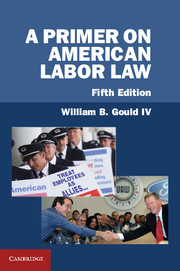
Book contents
- Frontmatter
- Contents
- Preface to the Fifth Edition
- Preface to the Fourth Edition
- Preface to the Third Edition
- Preface to the Second Edition
- Preface to the First Edition
- 1 An Overview
- 2 Industrial Relations and Labor Law before Modern Legislation
- 3 The National Labor Relations Act and Related Labor Law
- 4 Unfair Labor Practices
- 5 Establishing the Collective Bargaining Relationship: Organization and Recognition
- 6 Economic Pressure and Bargaining Tactics in the Established Relationship
- 7 Remedies, the Labor Reform Bill of 1978, and the Employee Free Choice Bill of 2009
- 8 Dispute Resolution in the Established Relationship
- 9 The Duty of Fair Representation
- 10 The Public Sector
- 11 Public-Interest Labor Law
- 12 Conclusion
- Index
- References
1 - An Overview
Published online by Cambridge University Press: 05 June 2013

Book contents
- Frontmatter
- Contents
- Preface to the Fifth Edition
- Preface to the Fourth Edition
- Preface to the Third Edition
- Preface to the Second Edition
- Preface to the First Edition
- 1 An Overview
- 2 Industrial Relations and Labor Law before Modern Legislation
- 3 The National Labor Relations Act and Related Labor Law
- 4 Unfair Labor Practices
- 5 Establishing the Collective Bargaining Relationship: Organization and Recognition
- 6 Economic Pressure and Bargaining Tactics in the Established Relationship
- 7 Remedies, the Labor Reform Bill of 1978, and the Employee Free Choice Bill of 2009
- 8 Dispute Resolution in the Established Relationship
- 9 The Duty of Fair Representation
- 10 The Public Sector
- 11 Public-Interest Labor Law
- 12 Conclusion
- Index
- References

HTML view is not available for this content. However, as you have access to this content, a full PDF is available via the 'Save PDF' action button.
Summary
American labor law and the American industrial relations system have a symbiotic relationship, and neither can be understood without reference to the other. This should come as no surprise; after all law, lawyers, and litigation play a major role in our society. Our collective bargaining system has been devised predominantly by labor and management, however, not by the government and the courts. In fact we often forget – and foreign observers fail to grasp – that our most important tool in the resolution of labor disputes is our private arbitration system, which operates outside the formal legal system of courts and administrative agencies. Before examining the history and substance of American labor law, then, let us begin with their impetus in the American industrial relations system: organized labor.
As a result of the evolution of the industrial relations system in the United States, the unions have a remarkably different attitude toward law than, for instance, those in Britain. This is not to say that American trade unions do not have a healthy and often well-founded distrust of lawyers; one can see this attitude manifested in countless ways. But the unions are not against the law here. And this is because the American unions – especially the industrial unions that emerged during the Great Depression of the 1930s – obtained political power before industrial power. American unions were willing and eager to look to the law as a useful adjunct to their growth and the achievement of recognition and bargaining relationships with employers.
Information
- Type
- Chapter
- Information
- A Primer on American Labor Law , pp. 1 - 8Publisher: Cambridge University PressPrint publication year: 2013
References
American Can Co., 13 NLRB 1252 (1939)
, Collective Bargaining in Sweden (1962)
and , The Local Union (1953)
, “Divided We Stand,” New Labor Forum (Spring 2006), at 38
, A Theory of Labor Movement (1928)
“Protecting At Will Employees against Wrongful Discharge: The Duty to Terminate Only in Good Faith” (comment), 98 Harv. L. Rev. 1816 (1980)
“Implied Contract Rights to Job Security” (note), 26 Stan. L. Rev. 335 (1974)
, “Individual Protection against Unjust Dismissal: Time for a Statute,” 62 Va. L. Rev. 481 (1976)Google Scholar
, Japan’s Reshaping of American Labor Law, at 94–116 (1984)
Accessibility standard: Unknown
Why this information is here
This section outlines the accessibility features of this content - including support for screen readers, full keyboard navigation and high-contrast display options. This may not be relevant for you.Accessibility Information
Accessibility compliance for the PDF of this chapter is currently unknown
and may be updated in the future.
 You have
Access
You have
Access