To save content items to your account,
please confirm that you agree to abide by our usage policies.
If this is the first time you use this feature, you will be asked to authorise Cambridge Core to connect with your account.
Find out more about saving content to .
To save content items to your Kindle, first ensure no-reply@cambridge.org
is added to your Approved Personal Document E-mail List under your Personal Document Settings
on the Manage Your Content and Devices page of your Amazon account. Then enter the ‘name’ part
of your Kindle email address below.
Find out more about saving to your Kindle.
Note you can select to save to either the @free.kindle.com or @kindle.com variations.
‘@free.kindle.com’ emails are free but can only be saved to your device when it is connected to wi-fi.
‘@kindle.com’ emails can be delivered even when you are not connected to wi-fi, but note that service fees apply.
Throughout his television career, screenwriter and producer Russell T Davies has explored potential relationships between the spectacular intensity of epic storytelling and the intricate patterns of everyday life. This investment results in a synthesis of contrasting scales and dramatic tones as the extraordinary and grandiose become fused with the modest and familiar. Years and Years (2019) encapsulates Davies’ approach, as the cataclysmic events of an alternative near-future are given shape and meaning within the domestic context of a family’s commonplace existence. Emphasis is frequently placed upon slight, nuanced aesthetic features which come to express and encapsulate global tensions and traumas. This chapter explores the ways in which Davies builds up layers of meaning and significance through his evocation of the everyday in the epic, and the epic in the everyday. The discussion moves through earlier examples of Davies’ television work, tracing complementary and contrasting patterns across earlier programmes The Second Coming (2003) and his rebooted Doctor Who (2005– ). Attending to moments from the span of Davies’ career in this way reveals thematic coherence in his writing and, consequently, gestures towards a wider sense of his status as a television author. More specifically, however, Davies’ ability to consistently find dramatic potential in the balance between the epic and the everyday might also reveal his especially acute understanding of television itself, which is always small and domestic but also vast and unbound. In this way, Davies’ stories reveal and reinforce aspects of the medium, shaping narrative fiction to the television experience.
The Depression Genetics in Africa (DepGenAfrica) study seeks to address the underrepresentation of African populations in psychiatric genomics by investigating the genetic basis of major depressive disorder in three African countries: Ethiopia, Malawi and Nigeria. This Editorial reflects on lessons from project set-up and offers recommendations, highlighting trust, communication, ethical oversight, data tools, workforce training and resource governance.
This chapter explores themes of complexity and simplicity in relation to the animated television series Rick and Morty (Warner Bros Television, 2013–). The programme is considered as an example of the kind of narrative sophistication and intricacy that is the hallmark of a number of contemporary television animations, and which connects them to broader notions of complexity that have influenced key debates in television studies. The discussion moves on to reflect upon the particular ways in which fan audiences have responded imaginatively to Rick and Morty’s narrative complexity by using brief moments from the show to formulate their own extra-textual connections and meanings. The chapter concludes by returning to a moment from Rick and Morty to look again at features that, against a backdrop of elaborate plot speculation, may be considered simplistic but can equally be understood as complex expressions of creative choice, in turn providing rich opportunities for critical engagement.
Some psychotic experiences in the general population show associations with higher schizophrenia and other mental health-related polygenic risk scores (PRSs), but studies have not usually included interviewer-rated positive, negative and disorganised dimensions, which show distinct associations in clinical samples.
Aims
To investigate associations of these psychotic experience dimensions primarily with schizophrenia PRS and, secondarily, with other relevant PRSs.
Method
Avon Longitudinal Study of Parents and Children (ALSPAC) birth cohort participants were assessed for positive, negative and disorganised psychotic experience dimensions from interviews, and for self-rated negative symptoms, at 24 years of age. Regression models were used to investigate associations between psychotic experience dimensions and schizophrenia and other PRSs (2500+ participants for each analysis).
Results
Against expectation, none of the positive, negative or disorganised dimensions was associated with schizophrenia PRS. In secondary analysis, self-rated negative symptoms were associated with higher depression (β = 0.10 [95% CI 0.06–0.15]), anxiety (β = 0.09 [95% CI 0.04–0.13]), neuroticism (β = 0.11 [95% CI 0.06–0.15]) and autism (β = 0.09 [95% CI 0.05–0.13]) PRSs (all P < 0.001); and first-rank delusions were nominally associated with higher schizophrenia PRS (odds ratio 7.35 [95% CI 2.10–25.77], P = 0.002), although these experiences/symptoms were rare.
Conclusions
Positive, negative and disorganised psychotic experiences are probably not strongly associated with polygenic liability to schizophrenia in this general population cohort of young adults. Self-rated negative symptoms may indicate social withdrawal/low motivation due to higher polygenic liability to affective disorders or autism, and first-rank delusions may indicate higher polygenic liability to schizophrenia, but these findings require independent confirmation.
Genetic research on nicotine dependence has utilized multiple assessments that are in weak agreement.
Methods
We conducted a genome-wide association study (GWAS) of nicotine dependence defined using the Diagnostic and Statistical Manual of Mental Disorders (DSM-NicDep) in 61,861 individuals (47,884 of European ancestry [EUR], 10,231 of African ancestry, and 3,746 of East Asian ancestry) and compared the results to other nicotine-related phenotypes.
Results
We replicated the well-known association at the CHRNA5 locus (lead single-nucleotide polymorphism [SNP]: rs147144681, p = 1.27E−11 in EUR; lead SNP = rs2036527, p = 6.49e−13 in cross-ancestry analysis). DSM-NicDep showed strong positive genetic correlations with cannabis use disorder, opioid use disorder, problematic alcohol use, lung cancer, material deprivation, and several psychiatric disorders, and negative correlations with respiratory function and educational attainment. A polygenic score of DSM-NicDep predicted DSM-5 tobacco use disorder criterion count and all 11 individual diagnostic criteria in the independent National Epidemiologic Survey on Alcohol and Related Conditions-III sample. In genomic structural equation models, DSM-NicDep loaded more strongly on a previously identified factor of general addiction liability than a “problematic tobacco use” factor (a combination of cigarettes per day and nicotine dependence defined by the Fagerström Test for Nicotine Dependence). Finally, DSM-NicDep showed a strong genetic correlation with a GWAS of tobacco use disorder as defined in electronic health records (EHRs).
Conclusions
Our results suggest that combining the wide availability of diagnostic EHR data with nuanced criterion-level analyses of DSM tobacco use disorder may produce new insights into the genetics of this disorder.
Functional impairment in daily activities, such as work and socializing, is part of the diagnostic criteria for major depressive disorder and most anxiety disorders. Despite evidence that symptom severity and functional impairment are partially distinct, functional impairment is often overlooked. To assess whether functional impairment captures diagnostically relevant genetic liability beyond that of symptoms, we aimed to estimate the heritability of, and genetic correlations between, key measures of current depression symptoms, anxiety symptoms, and functional impairment.
Methods
In 17,130 individuals with lifetime depression or anxiety from the Genetic Links to Anxiety and Depression (GLAD) Study, we analyzed total scores from the Patient Health Questionnaire-9 (depression symptoms), Generalized Anxiety Disorder-7 (anxiety symptoms), and Work and Social Adjustment Scale (functional impairment). Genome-wide association analyses were performed with REGENIE. Heritability was estimated using GCTA-GREML and genetic correlations with bivariate-GREML.
Results
The phenotypic correlations were moderate across the three measures (Pearson’s r = 0.50–0.69). All three scales were found to be under low but significant genetic influence (single-nucleotide polymorphism-based heritability [h2SNP] = 0.11–0.19) with high genetic correlations between them (rg = 0.79–0.87).
Conclusions
Among individuals with lifetime depression or anxiety from the GLAD Study, the genetic variants that underlie symptom severity largely overlap with those influencing functional impairment. This suggests that self-reported functional impairment, while clinically relevant for diagnosis and treatment outcomes, does not reflect substantial additional genetic liability beyond that captured by symptom-based measures of depression or anxiety.
Mood and anxiety disorders co-occur and share symptoms, treatments and genetic risk, but it is unclear whether combining them into a single phenotype would better capture genetic variation. The contribution of common genetic variation to these disorders has been investigated using a range of measures; however, the differences in their ability to capture variation remain unclear, while the impact of rare variation is mostly unexplored.
Aims
We aimed to explore the contributions of common genetic variation and copy number variations associated with risk of psychiatric morbidity (P-CNVs) to different measures of internalising disorders.
Method
We investigated eight definitions of mood and anxiety disorder, and a combined internalising disorder, derived from self-report questionnaires, diagnostic assessments and electronic healthcare records (EHRs). Association of these definitions with polygenic risk scores (PRSs) of major depressive disorder and anxiety disorder, as well as presence of a P-CNV, was assessed.
Results
The effect sizes of both PRSs and P-CNVs were similar for mood and anxiety disorder. Compared to mood and anxiety disorder, internalising disorder resulted in higher prediction accuracy for PRSs, and increased significance of associations with P-CNVs for most definitions. Comparison across the eight definitions showed that PRSs had higher prediction accuracy and effect sizes for stricter definitions, whereas P-CNVs were more strongly associated with EHR- and self-report-based definitions.
Conclusions
Future studies may benefit from using a combined internalising disorder phenotype, and may need to consider that different phenotype definitions may be more informative depending on whether common or rare variation is studied.
Outlining the economic significance of the role of global supply chains (GSCs) in the organisation of the global economy, this paper initially presents some indications of health and safety outcomes in low- and middle-income counties (LMICs) where GSCs source much of the production destined for use in advanced economies. It goes on to discuss the operational dynamics of these chains and the corporate priorities that they reflect, which, it argues, do little to improve the poor work health and safety (WHS) outcomes in LMICs. It then examines evidence for the effectiveness of various private and public regulatory strategies that are claimed to bring about improved health and safety practices and outcomes among GSC suppliers in these countries. The paper critically evaluates this evidence and argues that, while there may be some examples of effective strategies and regulatory practices in particular contexts, their overall influence remains limited. It identifies and discusses the principal reasons for these limitations and concludes that the global regulation of conditions of labour – including WHS – at the end of GSCs falls well short of universal best practice and is, more generally, insufficient to counter the economic forces working against the maintenance of adequate standards of worker protection.
Positive, negative and disorganised psychotic symptom dimensions are associated with clinical and developmental variables, but differing definitions complicate interpretation. Additionally, some variables have had little investigation.
Aims
To investigate associations of psychotic symptom dimensions with clinical and developmental variables, and familial aggregation of symptom dimensions, in multiple samples employing the same definitions.
Method
We investigated associations between lifetime symptom dimensions and clinical and developmental variables in two twin and two general psychosis samples. Dimension symptom scores and most other variables were from the Operational Criteria Checklist. We used logistic regression in generalised linear mixed models for combined sample analysis (n = 875 probands). We also investigated correlations of dimensions within monozygotic (MZ) twin pairs concordant for psychosis (n = 96 pairs).
Results
Higher symptom scores on all three dimensions were associated with poor premorbid social adjustment, never marrying/cohabiting and earlier age at onset, and with a chronic course, most strongly for the negative dimension. The positive dimension was also associated with Black and minority ethnicity and lifetime cannabis use; the negative dimension with male gender; and the disorganised dimension with gradual onset, lower premorbid IQ and substantial within twin-pair correlation. In secondary analysis, disorganised symptoms in MZ twin probands were associated with lower premorbid IQ in their co-twins.
Conclusions
These results confirm associations that dimensions share in common and strengthen the evidence for distinct associations of co-occurring positive symptoms with ethnic minority status, negative symptoms with male gender and disorganised symptoms with substantial familial influences, which may overlap with influences on premorbid IQ.
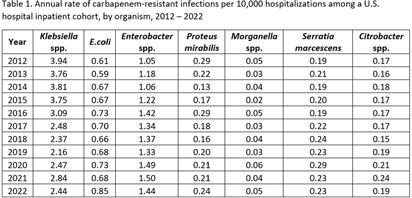
Background: Carbapenem-resistant Enterobacterales (CRE) infections are an urgent public health threat. An estimated 12,700 CRE (including E. coli, Klebsiella spp., and Enterobacter spp.) infections occurred in the United States in 2020. While the estimated incidence of CRE infections has been relatively stable between 2012 and 2020, organism-specific trends, including those for organisms not typically included in CRE surveillance definitions, have not been described. We estimated the annual rate of carbapenem-resistant Enterobacterales infections, disaggregated by organism, from 2012 to 2022. Methods: Data on inpatient hospitalizations from a dynamic cohort of short-term acute care hospitals reporting microbiology data between 2012 and 2022 were obtained from the PINC AI Database and the BD Insights Research Database. We included patients with clinical isolates of E. coli, Enterobacter spp., Klebsiella spp., Citrobacter spp., Serratia marcescens, Proteus mirabilis, and Morganella spp. and sufficient susceptibility results to identify carbapenem resistance. We limited our analysis to incident isolates, defined as a patient’s first isolate of a given organism and carbapenem resistance phenotype in a 14-day period. We calculated the annual rate of carbapenem-resistant infections per 10,000 hospitalizations for each organism. Results: There were 3,018,792 incident isolates from 55.8 million hospitalizations included in the analysis. Overall, 31,226 incident carbapenem-resistant isolates were identified. The rate of carbapenem-resistant infections varied by organism and over time (Table 1). The rate of carbapenem-resistant Klebsiella spp. infections appeared to decline from 3.94 in 2012 to 2.44 infections per 10,000 hospitalizations in 2022. The rate of carbapenem-resistant Enterobacter spp. infections appeared to increase from 1.05 in 2012 to 1.44 infections per 10,000 hospitalizations in 2022. The rate of carbapenem-resistant E. coli infections also appeared to increase, from 0.61 in 2012 to 0.85 infections per 10,000 hospitalizations in 2022. Rates of carbapenem-resistant Proteus mirabilis, Morganella spp., Citrobacter spp., or Serratia marcescens infections were similar in 2022 compared to 2012. Conclusions: Disaggregating data by organism revealed heterogeneous trends, with apparent increases in rates of carbapenem-resistant Enterobacter spp. and E. coli infections and apparent decreases in rates of carbapenem-resistant Klebsiella spp. infections. Organism-specific CRE analyses may provide additional insight into CRE epidemiology.
The 16-8-, 8-5-, 5-2-, 2-1-, 1-0.5-, 0.5-0.3-, 0.3-0.1-, and <0.1-μm size fractions were centrifuged from a Georgia (U.S.A.) sedimentary kaolin and a hydrothermal kaolin from the Sasso mine (Italy) and analyzed by scanning electron microscopy (SEM), X-ray powder diffraction (XRD), infrared spectroscopy (IR), differential thermal analysis (DTA) and thermogravimetry (TGA) together with the corresponding whole rocks. All size fractions of the Georgia sample consisted dominantly of well-crystallized, fine-grained kaolinite, associated with minor quantities of smectite. Some halloysite-like elongate particles were noted by SEM in the intermediate size fractions, minor amounts of quartz were identified in the coarsest size fractions, and < 1% noncrystalline material and traces of organic material were suspected in the finest size fraction. The crystallinity of the kaolinite as measured by XRD and IR varied moderately with size. IR suggested that nacrite-like stacking disorder increased with decreasing size for particles < 5 μm in size.
In the Sasso sample kaolinite dominated all size fractions and was accompanied by dickite in the coarse and by halloysite in the fine size fractions. Regular mixed-layer illite/smectite (I/S) was present in all size fractions and dominated in the finest. Abundant quartz and traces of alunite were identified in the whole rock and coarsest size fractions. The kaolinite in this sample showed marked variation in stacking order and crystallinity, as shown by changes in XRD, IR, and DTA patterns.
The observed compositional and structural variations in the size fractions of the Georgia sedimentary kaolin are small, as expected from formational environment, which was characterized by low temperatures and relative stable genetic conditions. The much more marked differences in composition within the size fractions of the Sasso hydrothermal kaolin are likely a result of the broad range of temperatures and fluid chemistry of its formational environment. The sequence dickite-well-crystallized kaolinite-kaolinite-halloysite is probably temperature-dependent.
The adsorption mechanisms of divalent cations in zeolite nanopore channels can vary as a function of their pore dimensions. The nanopore inner-sphere enhancement (NISE) theory predicts that ions may dehydrate inside small nanopore channels in order to adsorb more closely to the mineral surface if the nanopore channel is sufficiently small. The results of an electron paramagnetic resonance (EPR) spectroscopy study of Mn and Cu adsorption on the zeolite minerals zeolite Y (large nanopores), ZSM-5 (intermediate nanopores), and mordenite (small nanopores) are presented. The Cu and Mn cations both adsorbed via an outer-sphere mechanism on zeolite Y based on the similarity between the adsorbed spectra and the aqueous spectra. Conversely, Mn and Cu adsorbed via an inner-sphere mechanism on mordenite based on spectrum asymmetry and peak broadening of the adsorbed spectra. However, Mn adsorbed via an outer-sphere mechanism on ZSM-5, whereas Cu adsorbed on ZSM-5 shows a high degree of surface interaction that indicates that it is adsorbed closer to the mineral surface. Evidence of dehydration and immobility was more readily evident in the spectrum of mordenite than in that of ZSM-5, indicating that Cu was not as close to the surface on ZSM-5 as it was when adsorbed on mordenite. Divalent Mn cations are strongly hydrated and are held strongly only in zeolites with small nanopore channels. Divalent Cu cations are also strongly hydrated, but can dehydrate more easily, presumably due to the Jahn-Teller effect, and are held strongly in zeolites with medium-sized nanopore channels or smaller.
Epigenetics is the umbrella term for processes by which gene expression can be altered without changes in DNA sequence, and represents a way in which genetics and environment can interact. The main epigenetic processes implicated in psychiatric disorders are DNA methylation and histone modification/chromatin structure.
UK, NHS medical genetics services are specialist tertiary services located in regional centres with clinical genetics and laboratory genetics services.
Advances in the systematic mapping of human genetic variation and high throughput genotyping facilitated the development of genome-wide association studies (GWAS), which typically assess common genetic variants (those present at >1% frequency in the population). Genotyping can be performed either by sequencing to determine each individual’s DNA sequence (see Subsection 7.3.2), or, much more cheaply and rapidly, using array-based technologies (DNA microarrays) to test genetic variation at specific predetermined locations across the genome. In GWAS, hundreds of thousands of single DNA base-pair changes (single-nucleotide polymorphisms (SNPs)) are genotyped throughout the genome using array-based technologies.
In addition to the contribution from common variation, predisposition to many psychiatric disorders can also be increased by rare variants. A rare variant is one that occurs in the population at a rate of < 1% and rare variants identified to date have much larger effect sizes than individual common SNPs.
Sequencing of the human genome and the demonstration of a substantial heritability for many psychiatric conditions has enabled a new era of molecular psychiatric genetics research. Progress has been made towards goals of identifying ‘risk genes’ and associated biological pathways to establish new drug targets for psychiatric disorders, particularly in the last decade. In addition, genetic advances offer the prospect of informing more personalised treatments and improving diagnosis, classification and prediction. With the prospect of emerging genetic discoveries having real clinical impact comes the responsibility of establishing how best to communicate genetic findings to patients and their families. In the sections in this chapter, we provide an overview of basic genetics and review psychiatric genomic research advances over the last decade and beyond.
Three years after the beginning of the COVID-19 pandemic, better knowledge on the transmission of respiratory viral infections (RVI) including the contribution of asymptomatic infections encouraged most healthcare centers to implement universal masking. The evolution of the SARS-CoV-2 epidemiology and improved immunization of the population call for the infection and prevention control community to revisit the masking strategy in healthcare. In this narrative review, we consider factors for de-escalating universal masking in healthcare centers, addressing compliance with the mask policy, local epidemiology, the level of protection provided by medical face masks, the consequences of absenteeism and presenteeism, as well as logistics, costs, and ecological impact. Most current national and international guidelines for mask use are based on the level of community transmission of SARS-CoV-2. Actions are now required to refine future recommendations, such as establishing a list of the most relevant RVI to consider, implement reliable local RVI surveillance, and define thresholds for activating masking strategies. Considering the epidemiological context (measured via sentinel networks or wastewater analysis), and, if not available, considering a time period (winter season) may guide to three gradual levels of masking: (i) standard and transmission-based precautions and respiratory etiquette, (ii) systematic face mask wearing when in direct contact with patients, and (iii) universal masking. Cost-effectiveness analysis of the different strategies is warranted in the coming years. Masking is just one element to be considered along with other preventive measures such as staff and patient immunization, and efficient ventilation.
