

The Theft of History
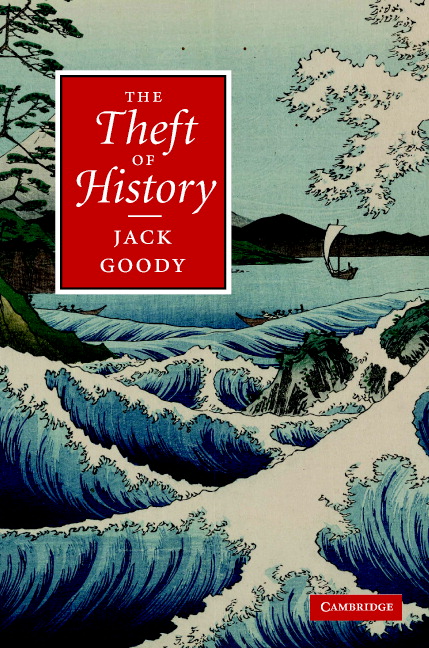
The Theft of History
Looking for an examination copy?
If you are interested in the title for your course we can consider offering an examination copy. To register your interest please contact collegesales@cambridge.org providing details of the course you are teaching.
Professor Jack Goody builds on his own previous work to extend further his highly influential critique of what he sees as the pervasive eurocentric or occidentalist biases of so much western historical writing. Goody also examines the consequent 'theft' by the West of the achievements of other cultures in the invention of (notably) democracy, capitalism, individualism, and love. The Theft of History discusses a number of theorists in detail, including Marx, Weber and Norbert Elias, and engages with critical admiration western historians like Fernand Braudel, Moses Finlay and Perry Anderson. Major questions of method are raised, and Goody proposes a new comparative methodology for cross-cultural analysis, one that gives a much more sophisticated basis for assessing divergent historical outcomes, and replaces outmoded simple differences between East and West. The Theft of History will be read by an unusually wide audience of historians, anthropologists and social theorists.
- A major new statement from one of the world's leading social scientists
- Engages with some of the great thinkers of our time
- Highly accessible essay from a distinguished and provocative author
Reviews & endorsements
"The author is famous; the analysis is cogent and stimulating."
--Robert L. Tignor, Princeton University, Journal of Interdisciplinary History
"The book will be welcomed to graduate seminars or to advanced classes in the historiography of world history." -Jared Poley, World History Bulletin
"The problem of Eurocentrism in the social science is real and Goody's critique, bases upon impressive research, is both lucid and warranted." -Richard Reitan, Journal of World History
"In his broad and sweeping new book...the prolific Jack Goody once again endorses revisionist arguments and takes issue with Eurocentric historical narratives on two important registers." -Ajay Skaria, Journal of Modern History
Product details
- Published: January 2007
- Format: Adobe eBook Reader
- ISBN: 9780511258428
- Length: 0 pages
- Weight: 0kg
- Contains: 1 table
- Availability: This ISBN is for an eBook version which is distributed on our behalf by a third party.






Table of Contents
- Introduction
- Part I:
- 1. Who stole what? Time and space
- 2. Antiquity: no markets, but did they invent politics, freedom and the alphabet?
- 3. Feudalism: transition to capitalism or the collapse of Europe and the domination of Asia
- 4. Asiatic despots, in Turkey and elsewhere?
- Part II:
- 5. Science and civilization in Renaissance Europe
- 6. The theft of 'civilization': Elias and Absolutist Europe
- 7. The theft of 'capitalism': Braudel and global comparison
- Part III:
- 8. The theft of institutions, towns, and universities
- 9. The appropriation of values: humanism, democracy and individualism
- 10. Stolen love: European claims to the emotions
- 11. Last words
- Bibliography.
- Show more



