

The Mamluk City in the Middle East
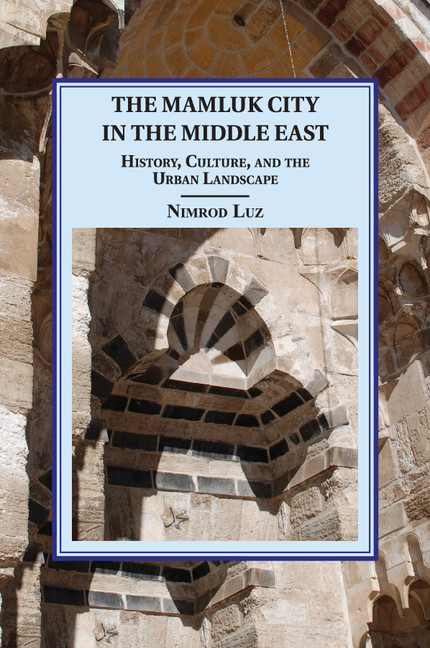
The Mamluk City in the Middle East
Looking for an examination copy?
If you are interested in the title for your course we can consider offering an examination copy. To register your interest please contact collegesales@cambridge.org providing details of the course you are teaching.
The Mamluk City in the Middle East offers an interdisciplinary study of urban history, urban experience, and the nature of urbanism in the region under the rule of the Mamluk Sultanate (1250–1517). The book focuses on three less-explored but politically significant cities in the Syrian region – Jerusalem, Safad (now in Israel), and Tripoli (now in Lebanon) – and presents a new approach and methodology for understanding historical cities. Drawing on diverse textual sources and intensive field surveys, Nimrod Luz adroitly reveals the character of the Mamluk city as well as various aspects of urbanism in the region, establishing the pre-modern city of the Middle East as a valid and useful lens through which to study various themes such as architecture, art history, history, and politics of the built environment. As part of this approach, Luz considers the processes by which Mamluk discourses of urbanism were conceptualized and then inscribed in the urban environment as concrete expressions of architectural design, spatial planning, and public memorialization.
- Offers an interdisciplinary approach and new methodologies for the study of historical cities in the Middle East
- Broadens the field of urban history to include approaches, theories, and understandings from the social sciences
- Extensive survey of the cities' landscape and the construction of an innovative methodology to study historical built environment
Reviews & endorsements
'Luz’s observations are interesting and astute. His work is thus a distinct and interesting contribution to scholarship.' Anne Broadbridge, Jerusalem Studies in Arabic and Islam
Product details
- Published: April 2016
- Format: Paperback
- ISBN: 9781107626713
- Length: 286 pages
- Dimensions: 229 × 152 × 15 mm
- Weight: 0.39kg
- Contains: 15 b/w illus. 4 maps 2 tables
- Availability: Available





Table of Contents
- Part I. Introduction:
- 1. Urban regional history before the Mamluks: presenting Tripoli, Safad, and Jerusalem
- Part II. The Tangible City:
- 2. Reading the built environment: a field survey of Mamluk Jerusalem
- 3. Houses and residential solutions in the cities of al-Sham
- 4. The neighborhood: social and spatial expressions
- Part III. The Socially Constructed City:
- 5. Awqāf and urban infrastructures
- 6. Icons of power and expressions of religious piety: the politics of Mamluk patronage
- Part IV. The Conceptualized City:
- 7. Cities scripted, envisioned, and perceived
- 8. The public sphere - urban autonomy and its limitations.
- Show more



