

Governing Gender and Sexuality in Colonial India
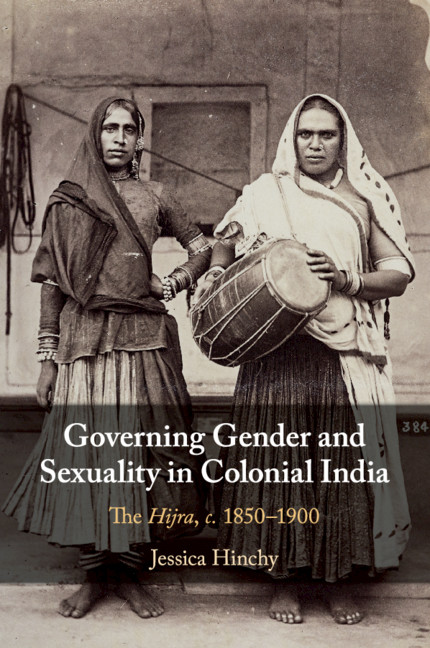
Governing Gender and Sexuality in Colonial India
Looking for an examination copy?
If you are interested in the title for your course we can consider offering an examination copy. To register your interest please contact collegesales@cambridge.org providing details of the course you are teaching.
In 1865, the British rulers of north India resolved to bring about the gradual 'extinction' of transgender Hijras. This book, the first in-depth history of the Hijra community, illuminates the colonial and postcolonial governance of gender and sexuality and the production of colonial knowledge. From the 1850s, colonial officials and middle class Indians increasingly expressed moral outrage at Hijras' feminine gender expression, sexuality, bodies and public performances. To the British, Hijras were an ungovernable population that posed a danger to colonial rule. In 1871, the colonial government passed a law that criminalised Hijras, with the explicit aim of causing Hijras' 'extermination'. But Hijras evaded police, kept on the move, broke the law and kept their cultural traditions alive. Based on extensive archival work in India and the UK, Jessica Hinchy argues that Hijras were criminalised not simply because of imported British norms, but due to a complex set of local factors, including elite Indian attitudes.
- Examines the history and social practices of the nineteenth-century transgender Hijra community
- Analyses colonial archival practices and the formation of colonial knowledge
- Based on extensive archival research in India and the UK, including previously unexamined documents
Reviews & endorsements
‘This brilliantly researched and highly original book reveals how the colonial state equated gender disorder with political disorder. Highly relevant to contemporary Indian debates on gender, sexuality and law, this is a masterful account of the relationship between colonial governance and gender expression, sexual behaviour, domestic arrangements and intimate relationships.' Clare Anderson, University of Leicester
‘Deftly reading the colonial archive against the grain, Hinchy has provided a rich and novel analysis of the Hijra community against the backdrop of moral panic in British India.' Kim A. Wagner, Queen Mary University of London
Product details
- Published: May 2019
- Format: Hardback
- ISBN: 9781108492553
- Length: 322 pages
- Dimensions: 235 × 157 × 18 mm
- Weight: 0.67kg
- Availability: Available




Table of Contents
- Introduction
- Part I. Solving the 'Eunuch Problem':
- 1. The Hijra panic
- 2. An ungovernable population
- 3. Hijras and Indian middle class morality
- 4. The 'gradual extirpation' of the Hijra
- Part II. Multiple Narratives of Hijra-Hood:
- 5. The Hijra archive
- 6. Hijra life histories
- Part III. Surviving Criminalisation and Elimination:
- 7. Classifying illegible bodies, contesting colonial categories
- 8. Policing, evading, surviving
- 9. Saving children to eliminate Hijras
- 10. Conclusion
- 11. Postscript: Hijras and the state in postcolonial South Asia.
- Show more



